 Add to Chrome
 Add to Firefox
 Add to Edge
Do Sequential Recommendation Benchmarks Really Require Higher-Order Sequence Modelling?
Aug 20, 2026
Sequential recommenders increasingly use language-model architectures designed to capture complex, context-dependent interactions. Yet it remains unclear whether widely used benchmarks actually require this modelling capacity. We investigate this question using two simple, recency-weighted pairwise probes that do not learn higher-order sequence representations: Sequential Rules (SeqRules) and our Probabilistic Collaborative Transition Model (PCTM). Using the evaluation protocol of eSASRec, at least one probe exceeds our eSASRec reproduction by 15-38% on three Amazon datasets and by 4.4% on MovieLens-1M, but trails it by 27.3% on MovieLens-20M. On the four remaining datasets, at least one probe also outperforms our sampled-softmax SASRec reproduction by 9-28%, suggesting that these widely used benchmarks are poorly suited to measuring gains from higher-order sequence modelling. More broadly, comparing Transformer-based models against strong recency-weighted pairwise probes provides a concrete test of whether a benchmark can meaningfully measure gains from higher-order sequence modelling.

A Unified Language Model for Large Scale Search, Recommendation, and Reasoning
Mar 18, 2026LLMs are increasingly applied to recommendation, retrieval, and reasoning, yet deploying a single end-to-end model that can jointly support these behaviors over large, heterogeneous catalogs remains challenging. Such systems must generate unambiguous references to real items, handle multiple entity types, and operate under strict latency and reliability constraints requirements that are difficult to satisfy with text-only generation. While tool-augmented recommender systems address parts of this problem, they introduce orchestration complexity and limit end-to-end optimization. We view this setting as an instance of a broader research problem: how to adapt LLMs to reason jointly over multiple-domain entities, users, and language in a fully self-contained manner. To this end, we introduce NEO, a framework that adapts a pre-trained decoder-only LLM into a tool-free, catalog-grounded generator. NEO represents items as SIDs and trains a single model to interleave natural language and typed item identifiers within a shared sequence. Text prompts control the task, target entity type, and output format (IDs, text, or mixed), while constrained decoding guarantees catalog-valid item generation without restricting free-form text. We refer to this instruction-conditioned controllability as language-steerability. We treat SIDs as a distinct modality and study design choices for integrating discrete entity representations into LLMs via staged alignment and instruction tuning. We evaluate NEO at scale on a real-world catalog of over 10M items across multiple media types and discovery tasks, including recommendation, search, and user understanding. In offline experiments, NEO consistently outperforms strong task-specific baselines and exhibits cross-task transfer, demonstrating a practical path toward consolidating large-scale discovery capabilities into a single language-steerable generative model.
Deploying Semantic ID-based Generative Retrieval for Large-Scale Podcast Discovery at Spotify
Mar 18, 2026Podcast listening is often grounded in a set of favorite shows, while listener intent can evolve over time. This combination of stable preferences and changing intent motivates recommendation approaches that support both familiarity and exploration. Traditional recommender systems typically emphasize long-term interaction patterns, and are less explicitly designed to incorporate rich contextual signals or flexible, intent-aware discovery objectives. In this setting, models that can jointly reason over semantics, context, and user state offer a promising direction. Large Language Models (LLMs) provide strong semantic reasoning and contextual conditioning for discovery-oriented recommendation, but deploying them in production introduces challenges in catalog grounding, user-level personalization, and latency-critical serving. We address these challenges with GLIDE, a production-scale generative recommender for podcast discovery at Spotify. GLIDE formulates recommendation as an instruction-following task over a discretized catalog using Semantic IDs, enabling grounded generation over a large inventory. The model conditions on recent listening history and lightweight user context, while injecting long-term user embeddings as soft prompts to capture stable preferences under strict inference constraints. We evaluate GLIDE using offline retrieval metrics, human judgments, and LLM-based evaluation, and validate its impact through large-scale online A/B testing. Across experiments involving millions of users, GLIDE increases non-habitual podcast streaming on Spotify home surface by up to 5.4% and new-show discovery by up to 14.3%, while meeting production cost and latency constraints.
Model Selection for Production System via Automated Online Experiments
May 27, 2021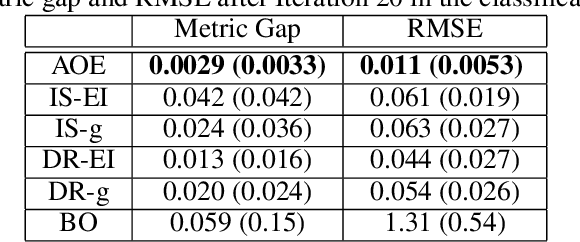
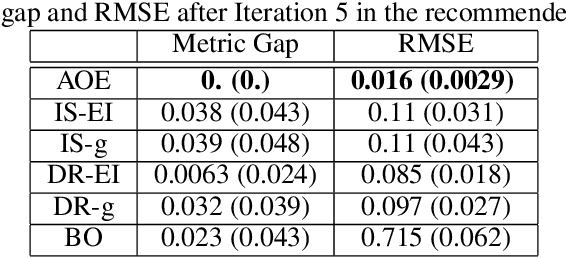
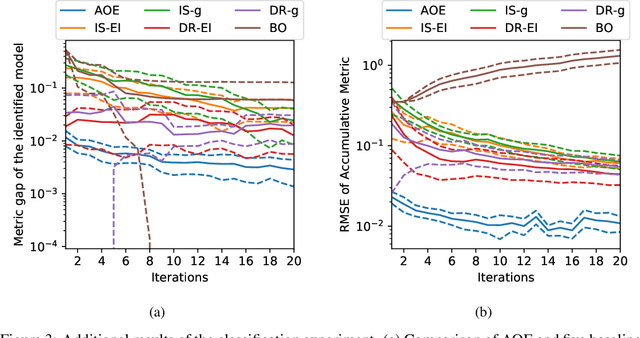
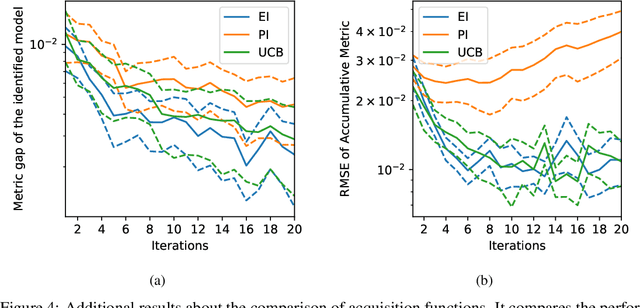
A challenge that machine learning practitioners in the industry face is the task of selecting the best model to deploy in production. As a model is often an intermediate component of a production system, online controlled experiments such as A/B tests yield the most reliable estimation of the effectiveness of the whole system, but can only compare two or a few models due to budget constraints. We propose an automated online experimentation mechanism that can efficiently perform model selection from a large pool of models with a small number of online experiments. We derive the probability distribution of the metric of interest that contains the model uncertainty from our Bayesian surrogate model trained using historical logs. Our method efficiently identifies the best model by sequentially selecting and deploying a list of models from the candidate set that balance exploration-exploitation. Using simulations based on real data, we demonstrate the effectiveness of our method on two different tasks.
Counterfactual Evaluation of Slate Recommendations with Sequential Reward Interactions
Aug 24, 2020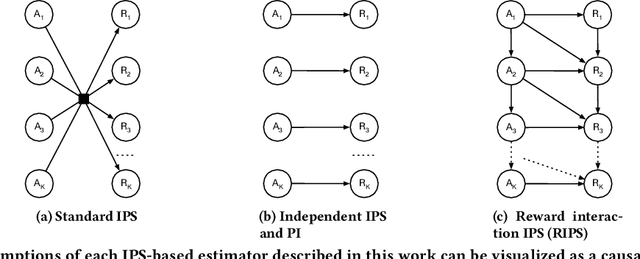
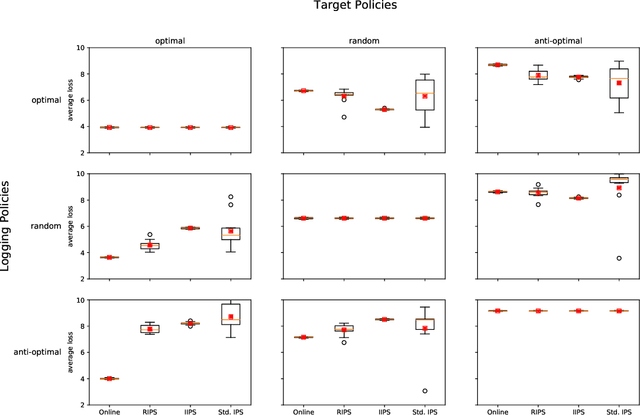
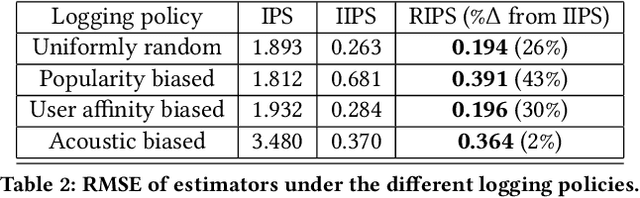
Users of music streaming, video streaming, news recommendation, and e-commerce services often engage with content in a sequential manner. Providing and evaluating good sequences of recommendations is therefore a central problem for these services. Prior reweighting-based counterfactual evaluation methods either suffer from high variance or make strong independence assumptions about rewards. We propose a new counterfactual estimator that allows for sequential interactions in the rewards with lower variance in an asymptotically unbiased manner. Our method uses graphical assumptions about the causal relationships of the slate to reweight the rewards in the logging policy in a way that approximates the expected sum of rewards under the target policy. Extensive experiments in simulation and on a live recommender system show that our approach outperforms existing methods in terms of bias and data efficiency for the sequential track recommendations problem.
Methods for Individual Treatment Assignment: An Application and Comparison for Playlist Generation
May 09, 2020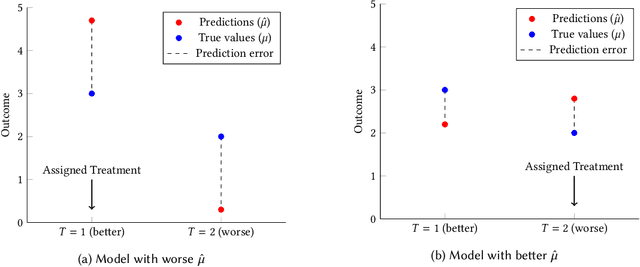
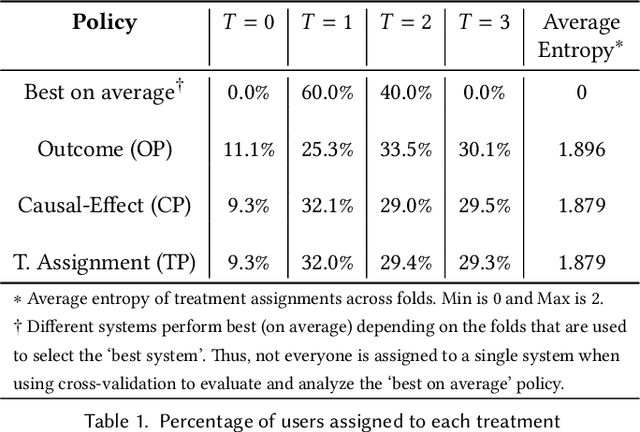
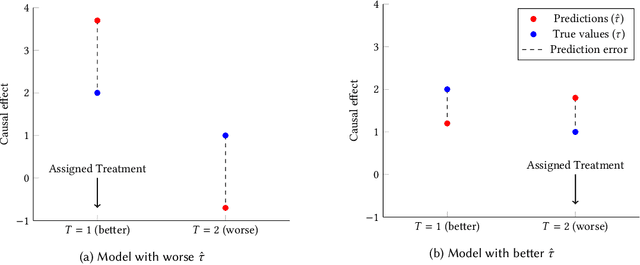
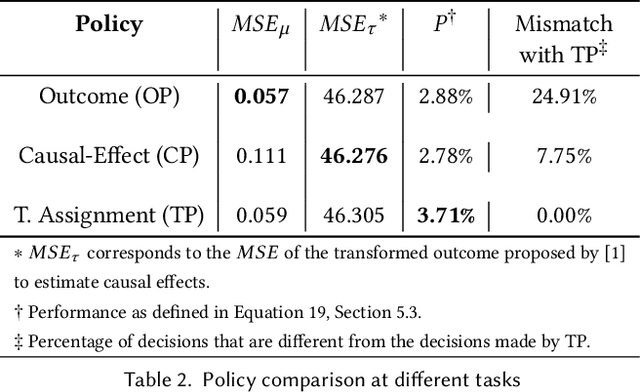
We present a systematic analysis of causal treatment assignment decision making, a general problem that arises in many applications and has received significant attention from economists, computer scientists, and social scientists. We focus on choosing, for each user, the best algorithm for playlist generation in order to optimize engagement. We characterize the various methods proposed in the literature into three general approaches: learning models to predict outcomes, learning models to predict causal effects, and learning models to predict optimal treatment assignments. We show analytically that optimizing for outcome or causal-effect prediction is not the same as optimizing for treatment assignments, and thus we should prefer learning models that optimize for treatment assignments. For our playlist generation application, we compare and contrast the three approaches empirically. This is the first comparison of the different treatment assignment approaches on a real-world application at scale (based on more than half a billion individual treatment assignments). Our results show (i) that applying different algorithms to different users can improve streams substantially compared to deploying the same algorithm for everyone, (ii) that personalized assignments improve substantially with larger data sets, and (iii) that learning models by optimizing treatment assignments rather than outcome or causal-effect predictions can improve treatment assignment performance by more than 28%.
The Engagement-Diversity Connection: Evidence from a Field Experiment on Spotify
Mar 17, 2020
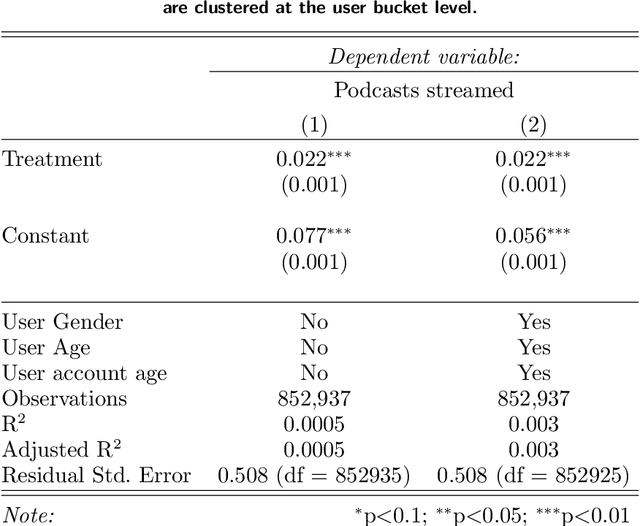
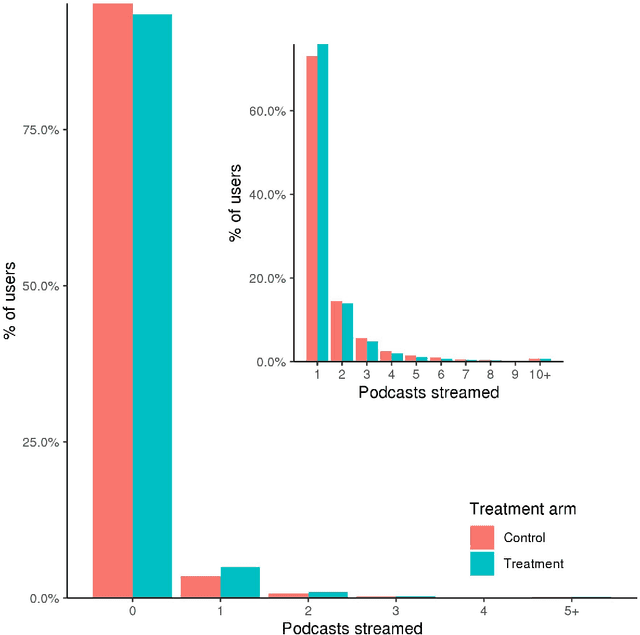
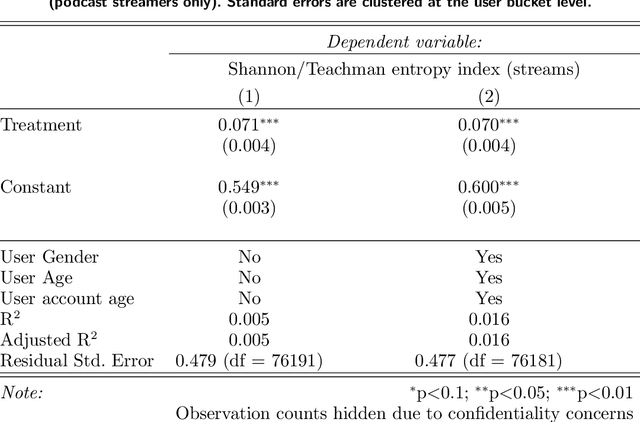
It remains unknown whether personalized recommendations increase or decrease the diversity of content people consume. We present results from a randomized field experiment on Spotify testing the effect of personalized recommendations on consumption diversity. In the experiment, both control and treatment users were given podcast recommendations, with the sole aim of increasing podcast consumption. Treatment users' recommendations were personalized based on their music listening history, whereas control users were recommended popular podcasts among users in their demographic group. We find that, on average, the treatment increased podcast streams by 28.90%. However, the treatment also decreased the average individual-level diversity of podcast streams by 11.51%, and increased the aggregate diversity of podcast streams by 5.96%, indicating that personalized recommendations have the potential to create patterns of consumption that are homogenous within and diverse across users, a pattern reflecting Balkanization. Our results provide evidence of an "engagement-diversity trade-off" when recommendations are optimized solely to drive consumption: while personalized recommendations increase user engagement, they also affect the diversity of consumed content. This shift in consumption diversity can affect user retention and lifetime value, and impact the optimal strategy for content producers. We also observe evidence that our treatment affected streams from sections of Spotify's app not directly affected by the experiment, suggesting that exposure to personalized recommendations can affect the content that users consume organically. We believe these findings highlight the need for academics and practitioners to continue investing in personalization methods that explicitly take into account the diversity of content recommended.