 Add to Chrome
 Add to Firefox
 Add to Edge
What Makes a Maze Look Like a Maze?
Sep 12, 2024
A unique aspect of human visual understanding is the ability to flexibly interpret abstract concepts: acquiring lifted rules explaining what they symbolize, grounding them across familiar and unfamiliar contexts, and making predictions or reasoning about them. While off-the-shelf vision-language models excel at making literal interpretations of images (e.g., recognizing object categories such as tree branches), they still struggle to make sense of such visual abstractions (e.g., how an arrangement of tree branches may form the walls of a maze). To address this challenge, we introduce Deep Schema Grounding (DSG), a framework that leverages explicit structured representations of visual abstractions for grounding and reasoning. At the core of DSG are schemas--dependency graph descriptions of abstract concepts that decompose them into more primitive-level symbols. DSG uses large language models to extract schemas, then hierarchically grounds concrete to abstract components of the schema onto images with vision-language models. The grounded schema is used to augment visual abstraction understanding. We systematically evaluate DSG and different methods in reasoning on our new Visual Abstractions Dataset, which consists of diverse, real-world images of abstract concepts and corresponding question-answer pairs labeled by humans. We show that DSG significantly improves the abstract visual reasoning performance of vision-language models, and is a step toward human-aligned understanding of visual abstractions.

Is Child-Directed Speech Effective Training Data for Language Models?
Aug 07, 2024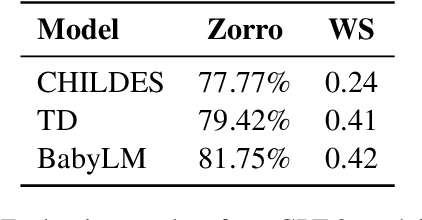
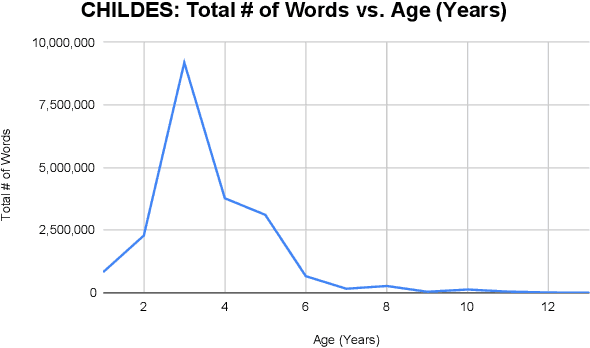
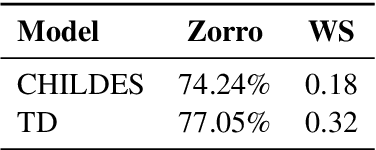
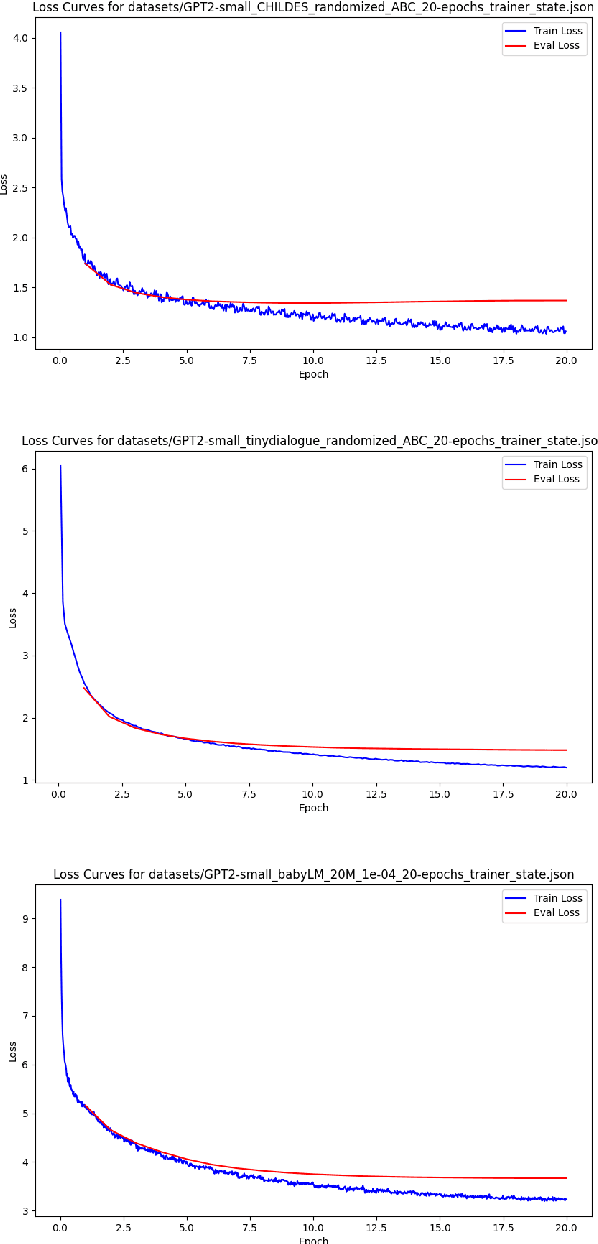
While high-performing language models are typically trained on hundreds of billions of words, human children become fluent language users with a much smaller amount of data. What are the features of the data they receive, and how do these features support language modeling objectives? To investigate this question, we train GPT-2 models on 29M words of English-language child-directed speech and a new matched, synthetic dataset (TinyDialogues), comparing to a heterogeneous blend of datasets from the BabyLM challenge. We evaluate both the syntactic and semantic knowledge of these models using developmentally-inspired evaluations. Through pretraining experiments, we test whether the global developmental ordering or the local discourse ordering of children's training data support high performance relative to other datasets. The local properties of the data affect model results, but somewhat surprisingly, global properties do not. Further, child language input is not uniquely valuable for training language models. These findings support the hypothesis that, rather than proceeding from better data, children's learning is instead substantially more efficient than current language modeling techniques.
Psychometric Alignment: Capturing Human Knowledge Distributions via Language Models
Jul 22, 2024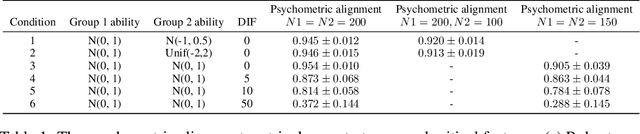
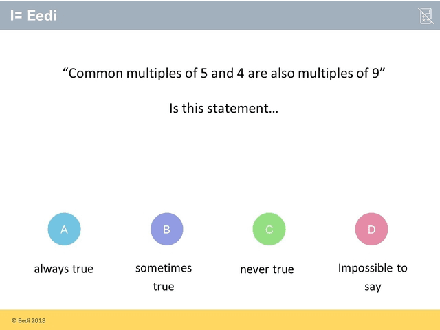
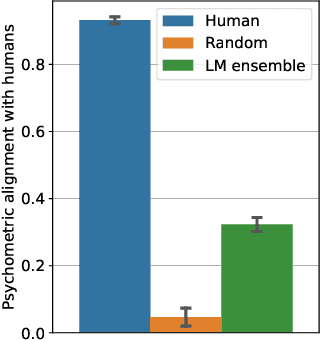
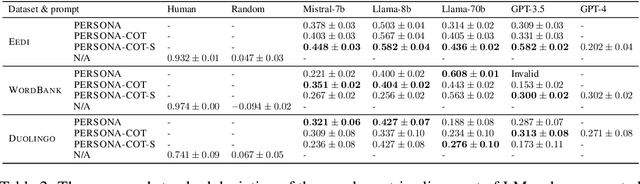
Language models (LMs) are increasingly used to simulate human-like responses in scenarios where accurately mimicking a population's behavior can guide decision-making, such as in developing educational materials and designing public policies. The objective of these simulations is for LMs to capture the variations in human responses, rather than merely providing the expected correct answers. Prior work has shown that LMs often generate unrealistically accurate responses, but there are no established metrics to quantify how closely the knowledge distribution of LMs aligns with that of humans. To address this, we introduce "psychometric alignment," a metric that measures the extent to which LMs reflect human knowledge distribution. Assessing this alignment involves collecting responses from both LMs and humans to the same set of test items and using Item Response Theory to analyze the differences in item functioning between the groups. We demonstrate that our metric can capture important variations in populations that traditional metrics, like differences in accuracy, fail to capture. We apply this metric to assess existing LMs for their alignment with human knowledge distributions across three real-world domains. We find significant misalignment between LMs and human populations, though using persona-based prompts can improve alignment. Interestingly, smaller LMs tend to achieve greater psychometric alignment than larger LMs. Further, training LMs on human response data from the target distribution enhances their psychometric alignment on unseen test items, but the effectiveness of such training varies across domains.
On scalable oversight with weak LLMs judging strong LLMs
Jul 05, 2024


Scalable oversight protocols aim to enable humans to accurately supervise superhuman AI. In this paper we study debate, where two AI's compete to convince a judge; consultancy, where a single AI tries to convince a judge that asks questions; and compare to a baseline of direct question-answering, where the judge just answers outright without the AI. We use large language models (LLMs) as both AI agents and as stand-ins for human judges, taking the judge models to be weaker than agent models. We benchmark on a diverse range of asymmetries between judges and agents, extending previous work on a single extractive QA task with information asymmetry, to also include mathematics, coding, logic and multimodal reasoning asymmetries. We find that debate outperforms consultancy across all tasks when the consultant is randomly assigned to argue for the correct/incorrect answer. Comparing debate to direct question answering, the results depend on the type of task: in extractive QA tasks with information asymmetry debate outperforms direct question answering, but in other tasks without information asymmetry the results are mixed. Previous work assigned debaters/consultants an answer to argue for. When we allow them to instead choose which answer to argue for, we find judges are less frequently convinced by the wrong answer in debate than in consultancy. Further, we find that stronger debater models increase judge accuracy, though more modestly than in previous studies.
MathCAMPS: Fine-grained Synthesis of Mathematical Problems From Human Curricula
Jul 01, 2024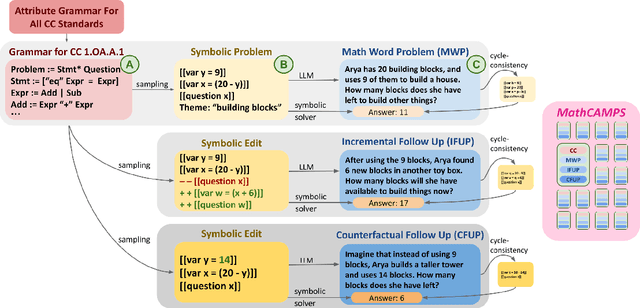
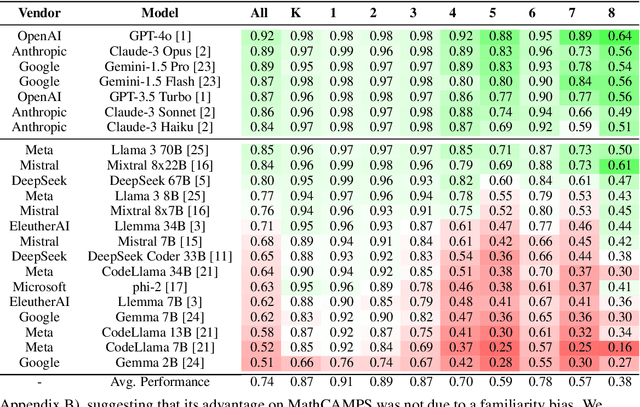
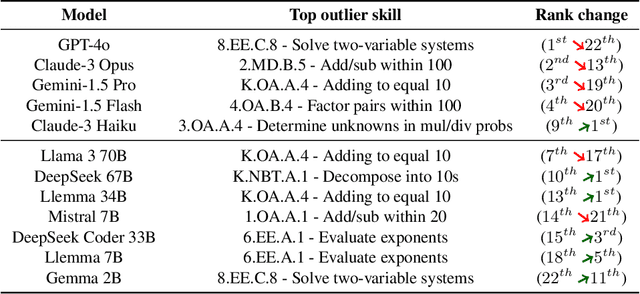
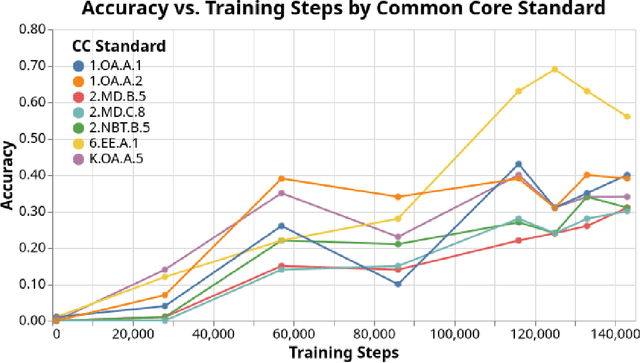
Mathematical problem solving is an important skill for Large Language Models (LLMs), both as an important capability and a proxy for a range of reasoning abilities. Existing benchmarks probe a diverse set of skills, but they yield aggregate accuracy metrics, obscuring specific abilities or weaknesses. Furthermore, they are difficult to extend with new problems, risking data contamination over time. To address these challenges, we propose MathCAMPS: a method to synthesize high-quality mathematical problems at scale, grounded on 44 fine-grained "standards" from the Mathematics Common Core (CC) Standard for K-8 grades. We encode each standard in a formal grammar, allowing us to sample diverse symbolic problems and their answers. We then use LLMs to realize the symbolic problems into word problems. We propose a cycle-consistency method for validating problem faithfulness. Finally, we derive follow-up questions from symbolic structures and convert them into follow-up word problems - a novel task of mathematical dialogue that probes for robustness in understanding. Experiments on 23 LLMs show surprising failures even in the strongest models (in particular when asked simple follow-up questions). Moreover, we evaluate training checkpoints of Pythia 12B on MathCAMPS, allowing us to analyze when particular mathematical skills develop during its training. Our framework enables the community to reproduce and extend our pipeline for a fraction of the typical cost of building new high-quality datasets.
Learning Formal Mathematics From Intrinsic Motivation
Jun 30, 2024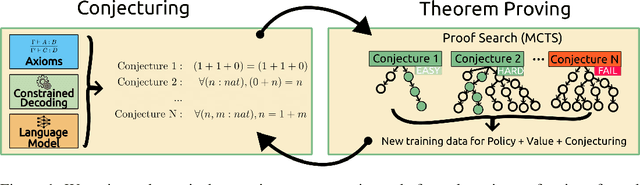
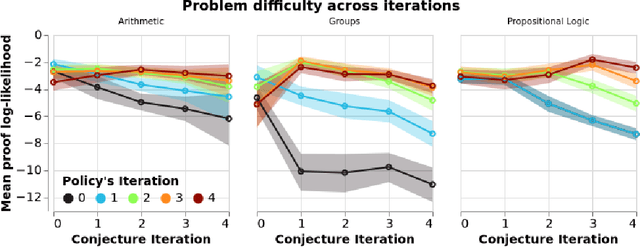
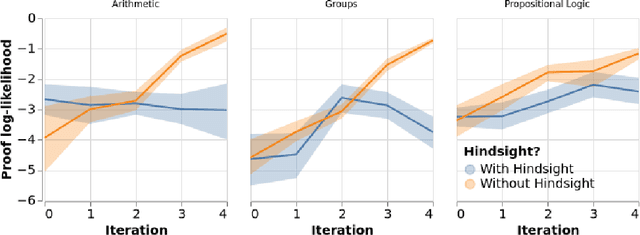
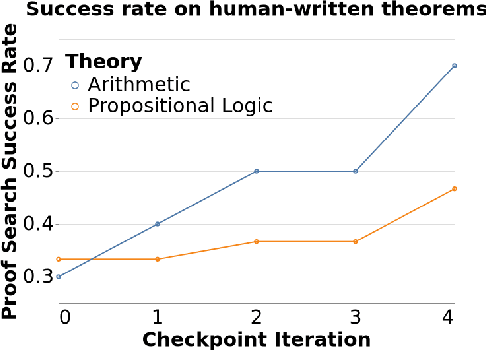
How did humanity coax mathematics from the aether? We explore the Platonic view that mathematics can be discovered from its axioms - a game of conjecture and proof. We describe Minimo (Mathematics from Intrinsic Motivation): an agent that jointly learns to pose challenging problems for itself (conjecturing) and solve them (theorem proving). Given a mathematical domain axiomatized in dependent type theory, we first combine methods for constrained decoding and type-directed synthesis to sample valid conjectures from a language model. Our method guarantees well-formed conjectures by construction, even as we start with a randomly initialized model. We use the same model to represent a policy and value function for guiding proof search. Our agent targets generating hard but provable conjectures - a moving target, since its own theorem proving ability also improves as it trains. We propose novel methods for hindsight relabeling on proof search trees to significantly improve the agent's sample efficiency in both tasks. Experiments on 3 axiomatic domains (propositional logic, arithmetic and group theory) demonstrate that our agent can bootstrap from only the axioms, self-improving in generating true and challenging conjectures and in finding proofs.
Self-Supervised Alignment with Mutual Information: Learning to Follow Principles without Preference Labels
Apr 22, 2024
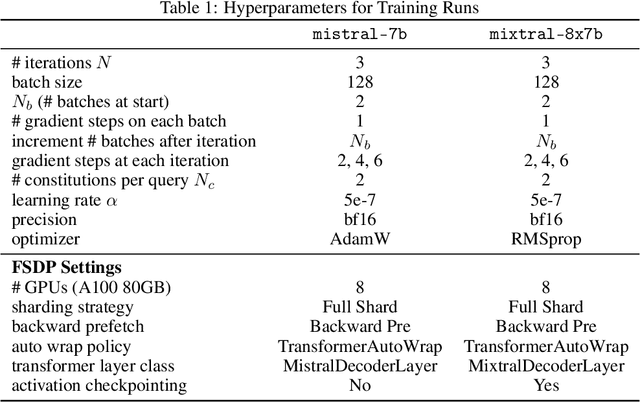


When prompting a language model (LM), users frequently expect the model to adhere to a set of behavioral principles across diverse tasks, such as producing insightful content while avoiding harmful or biased language. Instilling such principles into a model can be resource-intensive and technically challenging, generally requiring human preference labels or examples. We introduce SAMI, a method for teaching a pretrained LM to follow behavioral principles that does not require any preference labels or demonstrations. SAMI is an iterative algorithm that finetunes a pretrained LM to increase the conditional mutual information between constitutions and self-generated responses given queries from a datasest. On single-turn dialogue and summarization, a SAMI-trained mistral-7b outperforms the initial pretrained model, with win rates between 66% and 77%. Strikingly, it also surpasses an instruction-finetuned baseline (mistral-7b-instruct) with win rates between 55% and 57% on single-turn dialogue. SAMI requires a "principle writer" model; to avoid dependence on stronger models, we further evaluate aligning a strong pretrained model (mixtral-8x7b) using constitutions written by a weak instruction-finetuned model (mistral-7b-instruct). The SAMI-trained mixtral-8x7b outperforms both the initial model and the instruction-finetuned model, achieving a 65% win rate on summarization. Our results indicate that a pretrained LM can learn to follow constitutions without using preference labels, demonstrations, or human oversight.
Procedural Dilemma Generation for Evaluating Moral Reasoning in Humans and Language Models
Apr 17, 2024


As AI systems like language models are increasingly integrated into decision-making processes affecting people's lives, it's critical to ensure that these systems have sound moral reasoning. To test whether they do, we need to develop systematic evaluations. We provide a framework that uses a language model to translate causal graphs that capture key aspects of moral dilemmas into prompt templates. With this framework, we procedurally generated a large and diverse set of moral dilemmas -- the OffTheRails benchmark -- consisting of 50 scenarios and 400 unique test items. We collected moral permissibility and intention judgments from human participants for a subset of our items and compared these judgments to those from two language models (GPT-4 and Claude-2) across eight conditions. We find that moral dilemmas in which the harm is a necessary means (as compared to a side effect) resulted in lower permissibility and higher intention ratings for both participants and language models. The same pattern was observed for evitable versus inevitable harmful outcomes. However, there was no clear effect of whether the harm resulted from an agent's action versus from having omitted to act. We discuss limitations of our prompt generation pipeline and opportunities for improving scenarios to increase the strength of experimental effects.
Stream of Search : Learning to Search in Language
Apr 01, 2024Language models are rarely shown fruitful mistakes while training. They then struggle to look beyond the next token, suffering from a snowballing of errors and struggling to predict the consequence of their actions several steps ahead. In this paper, we show how language models can be taught to search by representing the process of search in language, as a flattened string -- a stream of search (SoS). We propose a unified language for search that captures an array of different symbolic search strategies. We demonstrate our approach using the simple yet difficult game of Countdown, where the goal is to combine input numbers with arithmetic operations to reach a target number. We pretrain a transformer-based language model from scratch on a dataset of streams of search generated by heuristic solvers. We find that SoS pretraining increases search accuracy by 25% over models trained to predict only the optimal search trajectory. We further finetune this model with two policy improvement methods: Advantage-Induced Policy Alignment (APA) and Self-Taught Reasoner (STaR). The finetuned SoS models solve 36% of previously unsolved problems, including problems that cannot be solved by any of the heuristic solvers. Our results indicate that language models can learn to solve problems via search, self-improve to flexibly use different search strategies, and potentially discover new ones.
STaR-GATE: Teaching Language Models to Ask Clarifying Questions
Mar 29, 2024When prompting language models to complete a task, users often leave important aspects unsaid. While asking questions could resolve this ambiguity (GATE; Li et al., 2023), models often struggle to ask good questions. We explore a language model's ability to self-improve (STaR; Zelikman et al., 2022) by rewarding the model for generating useful questions-a simple method we dub STaR-GATE. We generate a synthetic dataset of 25,500 unique persona-task prompts to simulate conversations between a pretrained language model-the Questioner-and a Roleplayer whose preferences are unknown to the Questioner. By asking questions, the Questioner elicits preferences from the Roleplayer. The Questioner is iteratively finetuned on questions that increase the probability of high-quality responses to the task, which are generated by an Oracle with access to the Roleplayer's latent preferences. After two iterations of self-improvement, the Questioner asks better questions, allowing it to generate responses that are preferred over responses from the initial model on 72% of tasks. Our results indicate that teaching a language model to ask better questions leads to better personalized responses.