 Add to Chrome
 Add to Firefox
 Add to Edge
GIANTS: Generative Insight Anticipation from Scientific Literature
Apr 10, 2026
Scientific breakthroughs often emerge from synthesizing prior ideas into novel contributions. While language models (LMs) show promise in scientific discovery, their ability to perform this targeted, literature-grounded synthesis remains underexplored. We introduce insight anticipation, a generation task in which a model predicts a downstream paper's core insight from its foundational parent papers. To evaluate this capability, we develop GiantsBench, a benchmark of 17k examples across eight scientific domains, where each example consists of a set of parent papers paired with the core insight of a downstream paper. We evaluate models using an LM judge that scores similarity between generated and ground-truth insights, and show that these similarity scores correlate with expert human ratings. Finally, we present GIANTS-4B, an LM trained via reinforcement learning (RL) to optimize insight anticipation using these similarity scores as a proxy reward. Despite its smaller open-source architecture, GIANTS-4B outperforms proprietary baselines and generalizes to unseen domains, achieving a 34% relative improvement in similarity score over gemini-3-pro. Human evaluations further show that GIANTS-4B produces insights that are more conceptually clear than those of the base model. In addition, SciJudge-30B, a third-party model trained to compare research abstracts by likely citation impact, predicts that insights generated by GIANTS-4B are more likely to lead to higher citations, preferring them over the base model in 68% of pairwise comparisons. We release our code, benchmark, and model to support future research in automated scientific discovery.

Psychometric Alignment: Capturing Human Knowledge Distributions via Language Models
Jul 22, 2024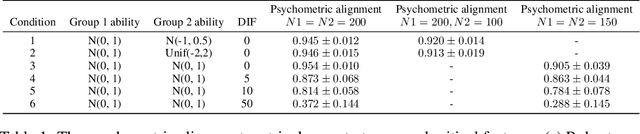
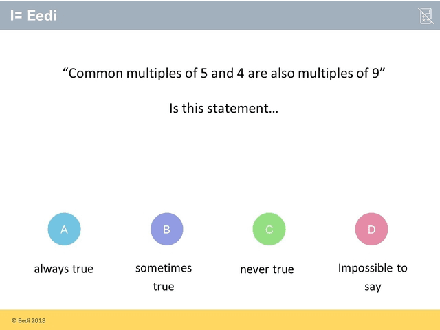
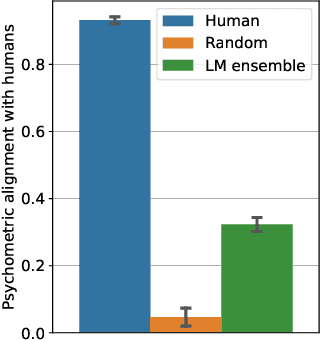
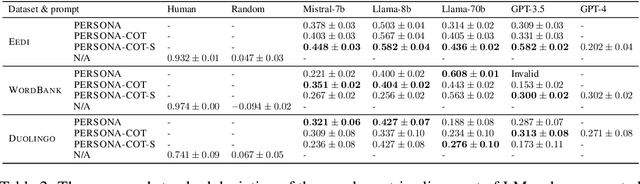
Language models (LMs) are increasingly used to simulate human-like responses in scenarios where accurately mimicking a population's behavior can guide decision-making, such as in developing educational materials and designing public policies. The objective of these simulations is for LMs to capture the variations in human responses, rather than merely providing the expected correct answers. Prior work has shown that LMs often generate unrealistically accurate responses, but there are no established metrics to quantify how closely the knowledge distribution of LMs aligns with that of humans. To address this, we introduce "psychometric alignment," a metric that measures the extent to which LMs reflect human knowledge distribution. Assessing this alignment involves collecting responses from both LMs and humans to the same set of test items and using Item Response Theory to analyze the differences in item functioning between the groups. We demonstrate that our metric can capture important variations in populations that traditional metrics, like differences in accuracy, fail to capture. We apply this metric to assess existing LMs for their alignment with human knowledge distributions across three real-world domains. We find significant misalignment between LMs and human populations, though using persona-based prompts can improve alignment. Interestingly, smaller LMs tend to achieve greater psychometric alignment than larger LMs. Further, training LMs on human response data from the target distribution enhances their psychometric alignment on unseen test items, but the effectiveness of such training varies across domains.
Evaluating and Optimizing Educational Content with Large Language Model Judgments
Mar 05, 2024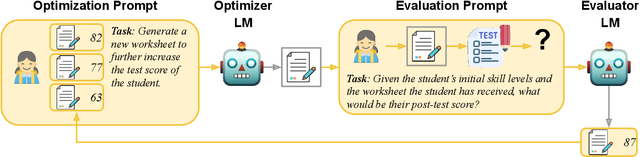
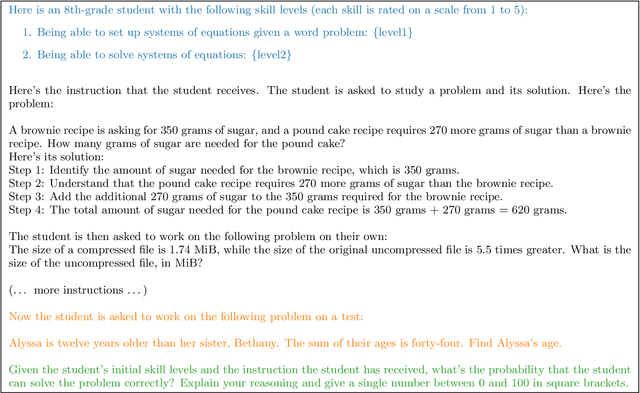
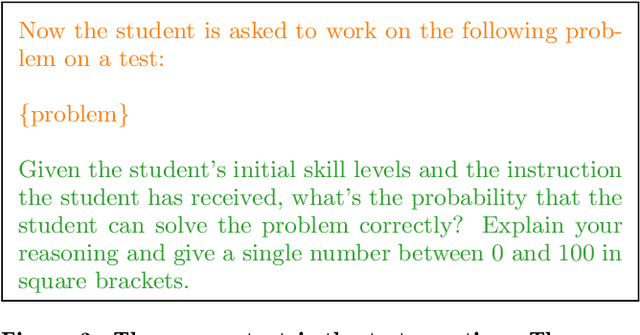
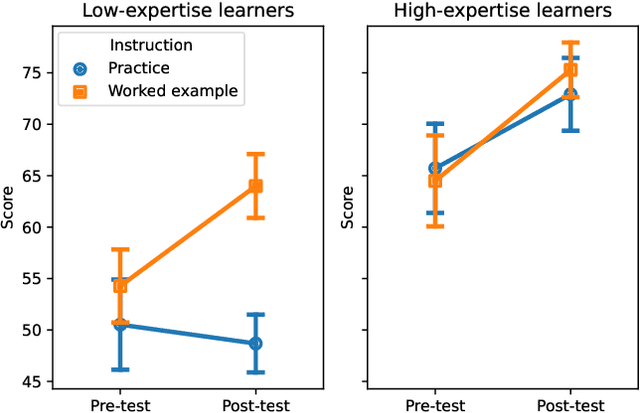
Creating effective educational materials generally requires expensive and time-consuming studies of student learning outcomes. To overcome this barrier, one idea is to build computational models of student learning and use them to optimize instructional materials. However, it is difficult to model the cognitive processes of learning dynamics. We propose an alternative approach that uses Language Models (LMs) as educational experts to assess the impact of various instructions on learning outcomes. Specifically, we use GPT-3.5 to evaluate the overall effect of instructional materials on different student groups and find that it can replicate well-established educational findings such as the Expertise Reversal Effect and the Variability Effect. This demonstrates the potential of LMs as reliable evaluators of educational content. Building on this insight, we introduce an instruction optimization approach in which one LM generates instructional materials using the judgments of another LM as a reward function. We apply this approach to create math word problem worksheets aimed at maximizing student learning gains. Human teachers' evaluations of these LM-generated worksheets show a significant alignment between the LM judgments and human teacher preferences. We conclude by discussing potential divergences between human and LM opinions and the resulting pitfalls of automating instructional design.
Solving Math Word Problems by Combining Language Models With Symbolic Solvers
Apr 16, 2023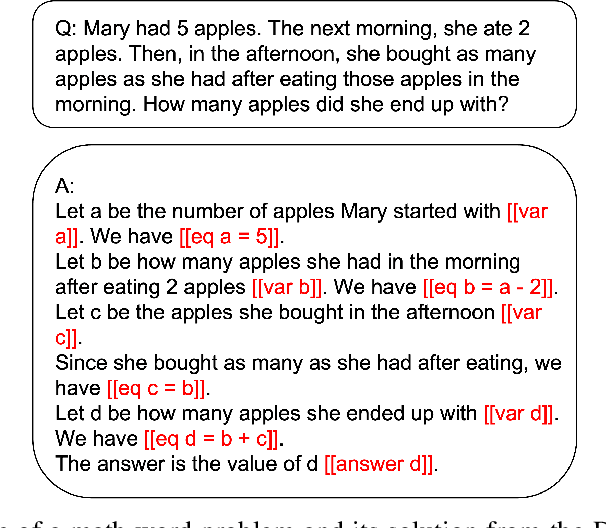
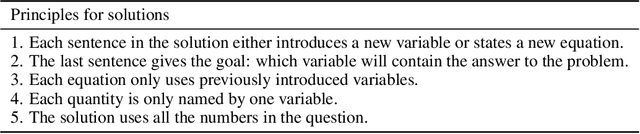
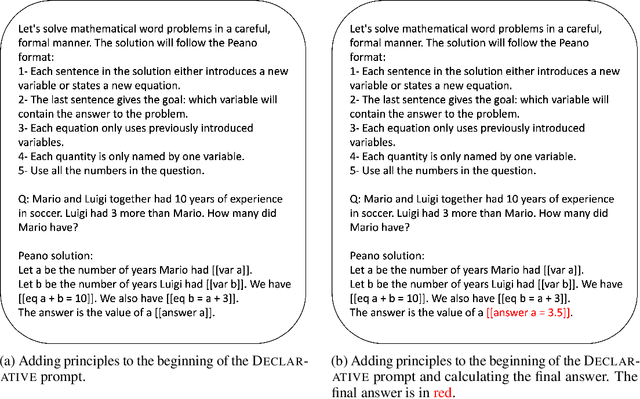
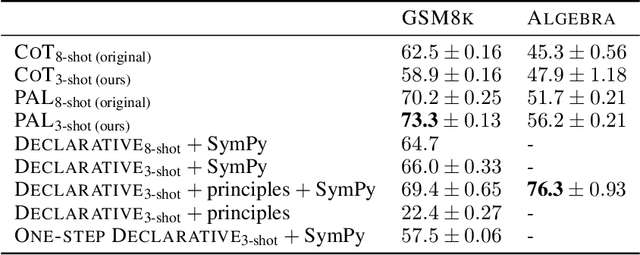
Automatically generating high-quality step-by-step solutions to math word problems has many applications in education. Recently, combining large language models (LLMs) with external tools to perform complex reasoning and calculation has emerged as a promising direction for solving math word problems, but prior approaches such as Program-Aided Language model (PAL) are biased towards simple procedural problems and less effective for problems that require declarative reasoning. We propose an approach that combines an LLM that can incrementally formalize word problems as a set of variables and equations with an external symbolic solver that can solve the equations. Our approach achieves comparable accuracy to the original PAL on the GSM8K benchmark of math word problems and outperforms PAL by an absolute 20% on ALGEBRA, a new dataset of more challenging word problems extracted from Algebra textbooks. Our work highlights the benefits of using declarative and incremental representations when interfacing with an external tool for solving complex math word problems. Our data and prompts are publicly available at https://github.com/joyheyueya/declarative-math-word-problem.