 Add to Chrome
 Add to Firefox
 Add to Edge
Children, but not language models, show accelerating returns in word learning
Aug 17, 2026
Children learn hundreds of words over the first years of their lives, in a process that begins slowly but quickly picks up speed. Prior models describe vocabulary growth as evidence accumulation over time. Here we show that the process is best characterized as accelerating accumulation: children learn more from each additional unit of linguistic experience than they did from the one before. In contrast to children, language models -- even those trained on child-directed speech -- do not accelerate. Instead, they show constant proportional returns on new data, consistent with scaling laws. Children learn using many orders of magnitude less training data than language models; their increasingly efficient use of their learning input is a candidate explanation.

auto-psych: Automating the science of mind using agent-driven theory discovery and experimentation
Jun 24, 2026AI-based scientific automation is increasingly possible by using agents to generate hypotheses, design experiments, and analyze data. Data collection is a major bottleneck in this pipeline, however. Psychology, and computational cognitive science in particular, is well-positioned to benefit from AI experimentation because theories are often represented as code and crowdsourcing platforms enable programmatic human data collection at scale. Here, we apply automated discovery techniques to the project of generating theories in computational cognitive science, with an agent-based system collecting human data independently through crowdsourced survey experiments. As a testbed, we use a classic case study from cognitive psychology: judging which sequences of coin flips seem subjectively more random. Our system, auto-psych, uses nested agent-based discovery loops to generate explanatory theories of human behavior. The inner loop conjectures, fits, and critiques probabilistic cognitive models; the outer loop designs experiments to test these models, launches them online, and analyzes the data. This system can quickly and reliably recover ground-truth theories from synthetic data via systematic experimentation, but the nested structure is critical to model performance. Further, in three independent sequences of human experiments, the system finds theories that fit the data better than theories generated from the scientific literature. This work thus demonstrates the feasibility of automated data collection and theory discovery in computational cognitive science.
LEVANTE-bench: Multi-Scale Comparison of VLMs to Children Using Cognitive Tasks (or, "Is Your VLM Smarter Than a 5th Grader?")
Jun 03, 2026Given the inherently multimodal nature of human experience, vision-language models (VLMs) hold substantial promise for modeling human cognition as it grows and develops with experience. Realizing their potential requires tools for comparing VLMs with human cognitive development across tasks, ages, and populations. We present LEVANTE-bench, a benchmark based on tasks and data from the Learning Variability Network (LEVANTE), which distributes open-source tasks and data measuring children's cognition across languages and cultures. In LEVANTE-bench, we systematically assess VLMs on six tasks, comparing their alignment with children aged 5-12 ($N$ = 1547) across three countries. We compare models at multiple scales, assessing their overall accuracy, their task- and item-level alignment with children, and how well they match children's trial-level error distributions. Alignment was heterogeneous across scales: at the level of tasks and items, more capable models aligned better with humans. However, match to human error distributions varied widely across tasks, and for several tasks, smaller models matched younger children's errors better. In addition, even the best-performing VLMs struggled on matrix reasoning and mental rotation tasks. Thus, current VLM architectures align only partially with the cognitive abilities of children.
EgoBabyVLM: Benchmarking Cross-Modal Learning from Naturalistic Egocentric Video Data
May 18, 2026Children acquire language grounding with remarkable robustness from limited visuo-linguistic input in ways that surpass today's best large multimodal models. Recent research suggests current vision-language models (VLMs) trained on curated web data fail to generalize to the sparse, weakly-aligned egocentric streams produced by wearable devices, embodied agents, and infant head-cams -- and no fixed evaluation pipeline exists for measuring progress on this regime. We train VLMs on datasets with varying degrees of semantic alignment between visual and linguistic inputs, including naturalistic infant and adult egocentric videos, and evaluate them with a comprehensive suite spanning multimodal language grounding and unimodal vision and language tasks. At the core of this suite is Machine-DevBench, a corpus-grounded benchmark of lexical and grammatical competence, automatically generated from the model's training vocabulary across logarithmic frequency bins to eliminate the train/eval mismatch and low statistical power of prior developmental benchmarks. Our results show that current VLM paradigms hinge on the tight semantic alignment of curated data and fail to exploit the weakly-aligned signal that dominates naturalistic egocentric input -- the very regime in which humans thrive. To motivate progress, we introduce the EgoBabyVLM Challenge to drive the development of models capable of grounded language learning from the kind of naturalistic data that human infants experience.
Characterizing the visual representation of objects from the child's view
May 14, 2026Children acquire object category representations from their everyday experiences in the first few years of life. What do the inputs to this learning process look like? We analyzed first-person videos of young children's visual experience at home from the BabyView dataset ($N$ = 31 participants, 868 hours, ages 5--36 months), using a supervised object detection model to extract common object categories from more than 3 million frames. We found that children's object category exposure was highly skewed: a few categories (e.g., cups, chairs) dominated children's visual experiences while most categories appeared rarely, replicating previous findings from a more restricted set of contexts. Category exemplars were highly variable: children encountered objects from unusual angles, in highly cluttered scenes, and partially occluded views; many categories (especially animals) were most frequently viewed as depictions. Surprisingly, despite this variability, detected categories (e.g., giraffes, apples) showed stronger groupings within superordinate categories (e.g., animals, food) relative to groupings derived from canonical photographs of these categories. We found this same pattern when using high-dimensional embeddings from both self-supervised visual and multimodal models; this effect was also recapitulated in densely sampled data from individual children. Understanding the robustness and efficiency of visual category learning will require the development of models that can exploit strong superordinate structure and learn from non-canonical, sparse, and variable exemplars.
Zero-shot World Models Are Developmentally Efficient Learners
Apr 11, 2026Young children demonstrate early abilities to understand their physical world, estimating depth, motion, object coherence, interactions, and many other aspects of physical scene understanding. Children are both data-efficient and flexible cognitive systems, creating competence despite extremely limited training data, while generalizing to myriad untrained tasks -- a major challenge even for today's best AI systems. Here we introduce a novel computational hypothesis for these abilities, the Zero-shot Visual World Model (ZWM). ZWM is based on three principles: a sparse temporally-factored predictor that decouples appearance from dynamics; zero-shot estimation through approximate causal inference; and composition of inferences to build more complex abilities. We show that ZWM can be learned from the first-person experience of a single child, rapidly generating competence across multiple physical understanding benchmarks. It also broadly recapitulates behavioral signatures of child development and builds brain-like internal representations. Our work presents a blueprint for efficient and flexible learning from human-scale data, advancing both a computational account for children's early physical understanding and a path toward data-efficient AI systems.
Bringing Up a Bilingual BabyLM: Investigating Multilingual Language Acquisition Using Small-Scale Models
Mar 31, 2026Multilingualism is incredibly common around the world, leading to many important theoretical and practical questions about how children learn multiple languages at once. For example, does multilingual acquisition lead to delays in learning? Are there better and worse ways to structure multilingual input? Many correlational studies address these questions, but it is surprisingly difficult to get definitive answers because children cannot be randomly assigned to be multilingual and data are typically not matched between languages. We use language model training as a method for simulating a variety of highly controlled exposure conditions, and create matched 100M-word mono- and bilingual datasets using synthetic data and machine translation. We train GPT-2 models on monolingual and bilingual data organized to reflect a range of exposure regimes, and evaluate their performance on perplexity, grammaticality, and semantic knowledge. Across model scales and measures, bilingual models perform similarly to monolingual models in one language, but show strong performance in the second language as well. These results suggest that there are no strong differences between different bilingual exposure regimes, and that bilingual input poses no in-principle challenges for agnostic statistical learners.
Baby Scale: Investigating Models Trained on Individual Children's Language Input
Mar 31, 2026Modern language models (LMs) must be trained on many orders of magnitude more words of training data than human children receive before they begin to produce useful behavior. Assessing the nature and origins of this "data gap" requires benchmarking LMs on human-scale datasets to understand how linguistic knowledge emerges from children's natural training data. Using transcripts from the BabyView dataset (videos from children ages 6-36 months), we investigate (1) scaling performance at child-scale data regimes, (2) variability in model performance across datasets from different children's experiences and linguistic predictors of dataset quality, and (3) relationships between model and child language learning outcomes. LMs trained on child data show acceptable scaling for grammar tasks, but lower scaling on semantic and world knowledge tasks than models trained on synthetic data; we also observe substantial variability on data from different children. Beyond dataset size, performance is most associated with a combination of distributional and interactional linguistic features, broadly consistent with what makes high-quality input for child language development. Finally, model likelihoods for individual words correlate with children's learning of those words, suggesting that properties of child-directed input may influence both model learning and human language development. Overall, understanding what properties make language data efficient for learning can enable more powerful small-scale language models while also shedding light on human language acquisition.
Context informs pragmatic interpretation in vision-language models
Nov 05, 2025Iterated reference games - in which players repeatedly pick out novel referents using language - present a test case for agents' ability to perform context-sensitive pragmatic reasoning in multi-turn linguistic environments. We tested humans and vision-language models on trials from iterated reference games, varying the given context in terms of amount, order, and relevance. Without relevant context, models were above chance but substantially worse than humans. However, with relevant context, model performance increased dramatically over trials. Few-shot reference games with abstract referents remain a difficult task for machine learning models.
Is Child-Directed Speech Effective Training Data for Language Models?
Aug 07, 2024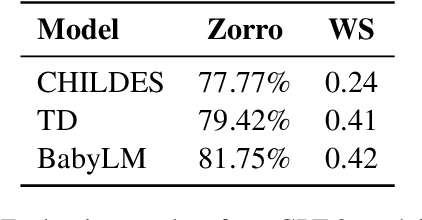
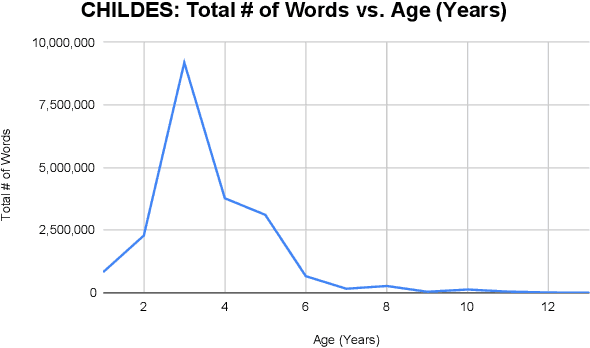
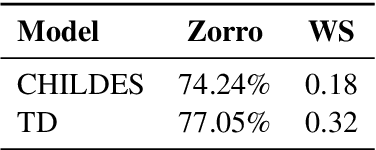
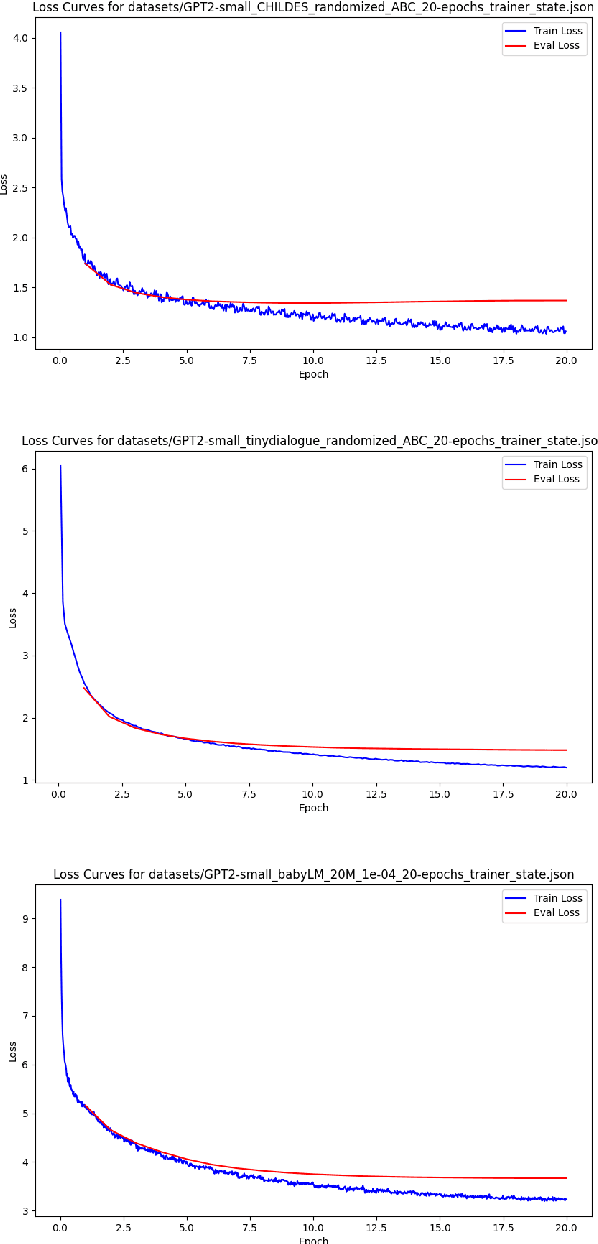
While high-performing language models are typically trained on hundreds of billions of words, human children become fluent language users with a much smaller amount of data. What are the features of the data they receive, and how do these features support language modeling objectives? To investigate this question, we train GPT-2 models on 29M words of English-language child-directed speech and a new matched, synthetic dataset (TinyDialogues), comparing to a heterogeneous blend of datasets from the BabyLM challenge. We evaluate both the syntactic and semantic knowledge of these models using developmentally-inspired evaluations. Through pretraining experiments, we test whether the global developmental ordering or the local discourse ordering of children's training data support high performance relative to other datasets. The local properties of the data affect model results, but somewhat surprisingly, global properties do not. Further, child language input is not uniquely valuable for training language models. These findings support the hypothesis that, rather than proceeding from better data, children's learning is instead substantially more efficient than current language modeling techniques.