 Add to Chrome
 Add to Firefox
 Add to Edge
Attn-GS: Attention-Guided Context Compression for Efficient Personalized LLMs
Feb 08, 2026
Personalizing large language models (LLMs) to individual users requires incorporating extensive interaction histories and profiles, but input token constraints make this impractical due to high inference latency and API costs. Existing approaches rely on heuristic methods such as selecting recent interactions or prompting summarization models to compress user profiles. However, these methods treat context as a monolithic whole and fail to consider how LLMs internally process and prioritize different profile components. We investigate whether LLMs' attention patterns can effectively identify important personalization signals for intelligent context compression. Through preliminary studies on representative personalization tasks, we discover that (a) LLMs' attention patterns naturally reveal important signals, and (b) fine-tuning enhances LLMs' ability to distinguish between relevant and irrelevant information. Based on these insights, we propose Attn-GS, an attention-guided context compression framework that leverages attention feedback from a marking model to mark important personalization sentences, then guides a compression model to generate task-relevant, high-quality compressed user contexts. Extensive experiments demonstrate that Attn-GS significantly outperforms various baselines across different tasks, token limits, and settings, achieving performance close to using full context while reducing token usage by 50 times.

Subspace Alignment for Vision-Language Model Test-time Adaptation
Jan 13, 2026Vision-language models (VLMs), despite their extraordinary zero-shot capabilities, are vulnerable to distribution shifts. Test-time adaptation (TTA) emerges as a predominant strategy to adapt VLMs to unlabeled test data on the fly. However, existing TTA methods heavily rely on zero-shot predictions as pseudo-labels for self-training, which can be unreliable under distribution shifts and misguide adaptation due to two fundamental limitations. First (Modality Gap), distribution shifts induce gaps between visual and textual modalities, making cross-modal relations inaccurate. Second (Visual Nuisance), visual embeddings encode rich but task-irrelevant noise that often overwhelms task-specific semantics under distribution shifts. To address these limitations, we propose SubTTA, which aligns the semantic subspaces of both modalities to enhance zero-shot predictions to better guide the TTA process. To bridge the modality gap, SubTTA extracts the principal subspaces of both modalities and aligns the visual manifold to the textual semantic anchor by minimizing their chordal distance. To eliminate visual nuisance, SubTTA projects the aligned visual features onto the task-specific textual subspace, which filters out task-irrelevant noise by constraining visual embeddings within the valid semantic span, and standard TTA is further performed on the purified space to refine the decision boundaries. Extensive experiments on various benchmarks and VLM architectures demonstrate the effectiveness of SubTTA, yielding an average improvement of 2.24% over state-of-the-art TTA methods.
Towards Knowledge Checking in Retrieval-augmented Generation: A Representation Perspective
Nov 21, 2024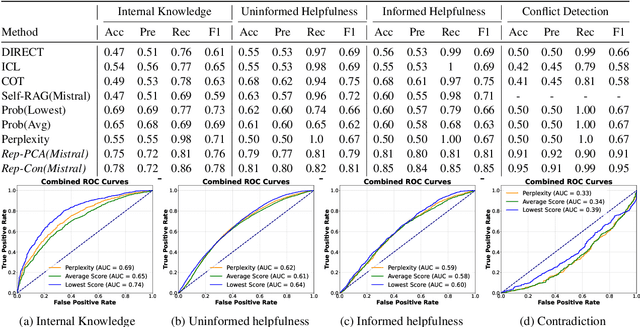
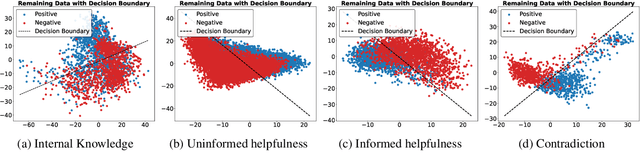
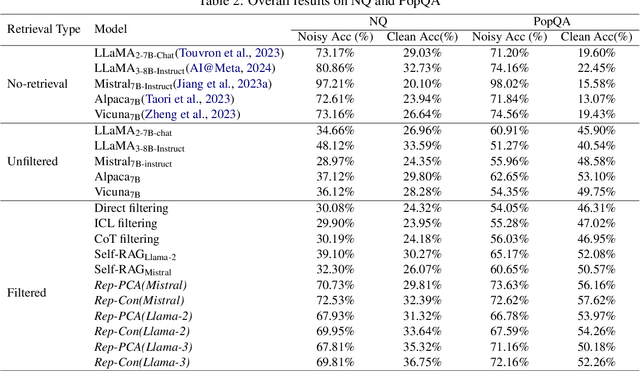
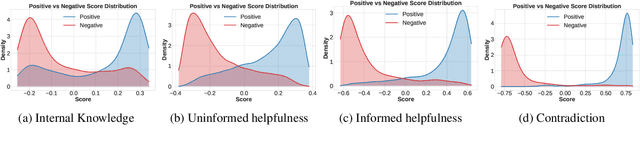
Retrieval-Augmented Generation (RAG) systems have shown promise in enhancing the performance of Large Language Models (LLMs). However, these systems face challenges in effectively integrating external knowledge with the LLM's internal knowledge, often leading to issues with misleading or unhelpful information. This work aims to provide a systematic study on knowledge checking in RAG systems. We conduct a comprehensive analysis of LLM representation behaviors and demonstrate the significance of using representations in knowledge checking. Motivated by the findings, we further develop representation-based classifiers for knowledge filtering. We show substantial improvements in RAG performance, even when dealing with noisy knowledge databases. Our study provides new insights into leveraging LLM representations for enhancing the reliability and effectiveness of RAG systems.
Amazon-M2: A Multilingual Multi-locale Shopping Session Dataset for Recommendation and Text Generation
Jul 19, 2023
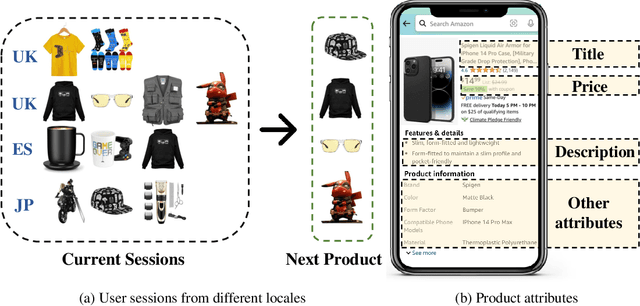
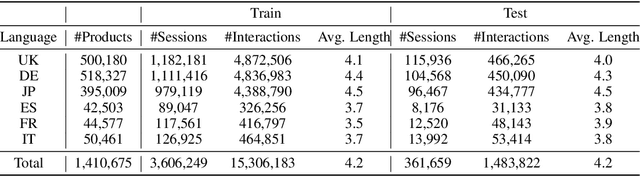
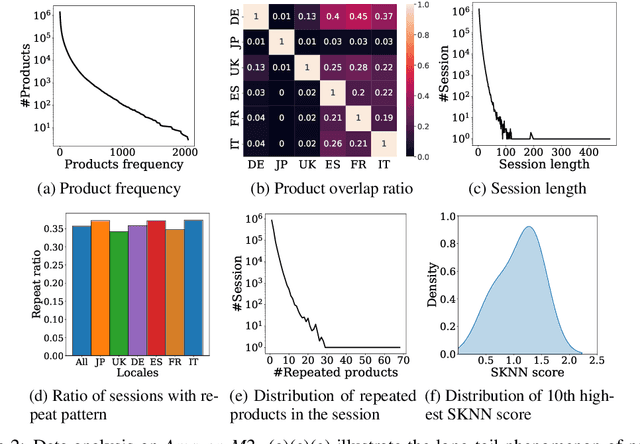
Modeling customer shopping intentions is a crucial task for e-commerce, as it directly impacts user experience and engagement. Thus, accurately understanding customer preferences is essential for providing personalized recommendations. Session-based recommendation, which utilizes customer session data to predict their next interaction, has become increasingly popular. However, existing session datasets have limitations in terms of item attributes, user diversity, and dataset scale. As a result, they cannot comprehensively capture the spectrum of user behaviors and preferences. To bridge this gap, we present the Amazon Multilingual Multi-locale Shopping Session Dataset, namely Amazon-M2. It is the first multilingual dataset consisting of millions of user sessions from six different locales, where the major languages of products are English, German, Japanese, French, Italian, and Spanish. Remarkably, the dataset can help us enhance personalization and understanding of user preferences, which can benefit various existing tasks as well as enable new tasks. To test the potential of the dataset, we introduce three tasks in this work: (1) next-product recommendation, (2) next-product recommendation with domain shifts, and (3) next-product title generation. With the above tasks, we benchmark a range of algorithms on our proposed dataset, drawing new insights for further research and practice. In addition, based on the proposed dataset and tasks, we hosted a competition in the KDD CUP 2023 and have attracted thousands of users and submissions. The winning solutions and the associated workshop can be accessed at our website https://kddcup23.github.io/.