 Add to Chrome
 Add to Firefox
 Add to Edge
Attn-GS: Attention-Guided Context Compression for Efficient Personalized LLMs
Feb 08, 2026
Personalizing large language models (LLMs) to individual users requires incorporating extensive interaction histories and profiles, but input token constraints make this impractical due to high inference latency and API costs. Existing approaches rely on heuristic methods such as selecting recent interactions or prompting summarization models to compress user profiles. However, these methods treat context as a monolithic whole and fail to consider how LLMs internally process and prioritize different profile components. We investigate whether LLMs' attention patterns can effectively identify important personalization signals for intelligent context compression. Through preliminary studies on representative personalization tasks, we discover that (a) LLMs' attention patterns naturally reveal important signals, and (b) fine-tuning enhances LLMs' ability to distinguish between relevant and irrelevant information. Based on these insights, we propose Attn-GS, an attention-guided context compression framework that leverages attention feedback from a marking model to mark important personalization sentences, then guides a compression model to generate task-relevant, high-quality compressed user contexts. Extensive experiments demonstrate that Attn-GS significantly outperforms various baselines across different tasks, token limits, and settings, achieving performance close to using full context while reducing token usage by 50 times.

Automatic Machine Learning Framework to Study Morphological Parameters of AGN Host Galaxies within $z < 1.4$ in the Hyper Supreme-Cam Wide Survey
Jan 27, 2025We present a composite machine learning framework to estimate posterior probability distributions of bulge-to-total light ratio, half-light radius, and flux for Active Galactic Nucleus (AGN) host galaxies within $z<1.4$ and $m<23$ in the Hyper Supreme-Cam Wide survey. We divide the data into five redshift bins: low ($0<z<0.25$), mid ($0.25<z<0.5$), high ($0.5<z<0.9$), extra ($0.9<z<1.1$) and extreme ($1.1<z<1.4$), and train our models independently in each bin. We use PSFGAN to decompose the AGN point source light from its host galaxy, and invoke the Galaxy Morphology Posterior Estimation Network (GaMPEN) to estimate morphological parameters of the recovered host galaxy. We first trained our models on simulated data, and then fine-tuned our algorithm via transfer learning using labeled real data. To create training labels for transfer learning, we used GALFIT to fit $\sim 20,000$ real HSC galaxies in each redshift bin. We comprehensively examined that the predicted values from our final models agree well with the GALFIT values for the vast majority of cases. Our PSFGAN + GaMPEN framework runs at least three orders of magnitude faster than traditional light-profile fitting methods, and can be easily retrained for other morphological parameters or on other datasets with diverse ranges of resolutions, seeing conditions, and signal-to-noise ratios, making it an ideal tool for analyzing AGN host galaxies from large surveys coming soon from the Rubin-LSST, Euclid, and Roman telescopes.
Purrfessor: A Fine-tuned Multimodal LLaVA Diet Health Chatbot
Nov 22, 2024
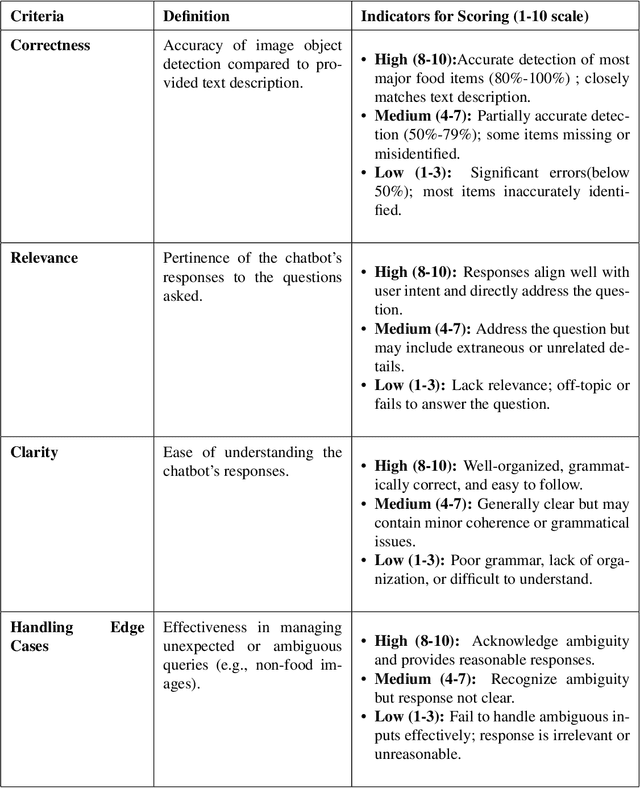

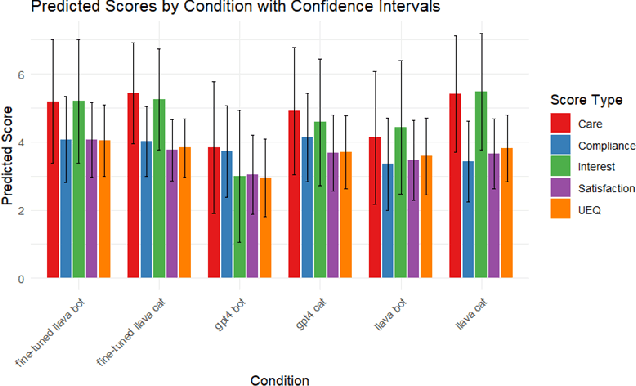
This study introduces Purrfessor, an innovative AI chatbot designed to provide personalized dietary guidance through interactive, multimodal engagement. Leveraging the Large Language-and-Vision Assistant (LLaVA) model fine-tuned with food and nutrition data and a human-in-the-loop approach, Purrfessor integrates visual meal analysis with contextual advice to enhance user experience and engagement. We conducted two studies to evaluate the chatbot's performance and user experience: (a) simulation assessments and human validation were conducted to examine the performance of the fine-tuned model; (b) a 2 (Profile: Bot vs. Pet) by 3 (Model: GPT-4 vs. LLaVA vs. Fine-tuned LLaVA) experiment revealed that Purrfessor significantly enhanced users' perceptions of care ($\beta = 1.59$, $p = 0.04$) and interest ($\beta = 2.26$, $p = 0.01$) compared to the GPT-4 bot. Additionally, user interviews highlighted the importance of interaction design details, emphasizing the need for responsiveness, personalization, and guidance to improve user engagement.
Optimizing Collaboration of LLM based Agents for Finite Element Analysis
Aug 23, 2024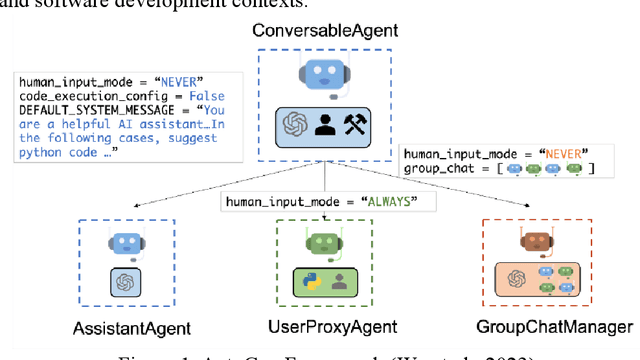
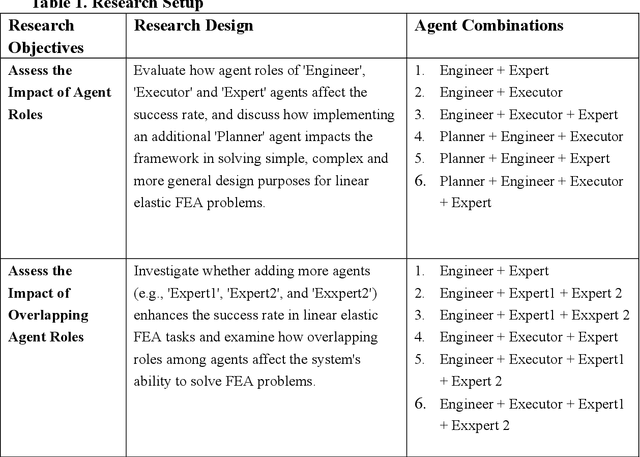
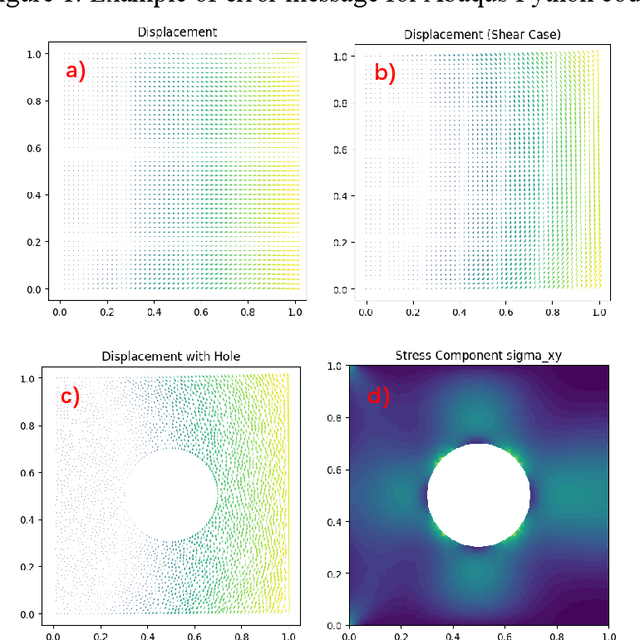
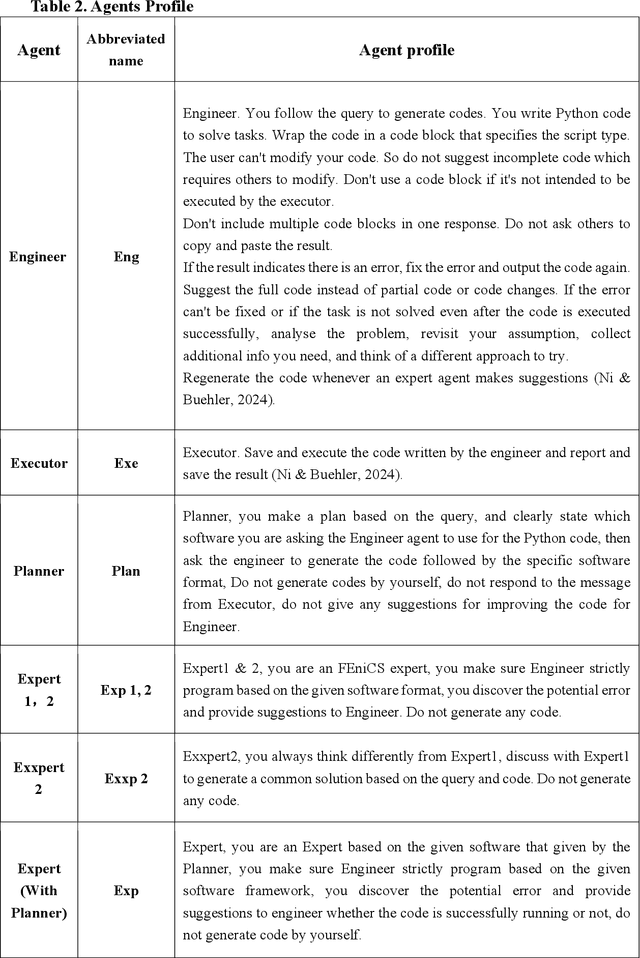
This paper investigates the interactions between multiple agents within Large Language Models (LLMs) in the context of programming and coding tasks. We utilize the AutoGen framework to facilitate communication among agents, evaluating different configurations based on the success rates from 40 random runs for each setup. The study focuses on developing a flexible automation framework for applying the Finite Element Method (FEM) to solve linear elastic problems. Our findings emphasize the importance of optimizing agent roles and clearly defining their responsibilities, rather than merely increasing the number of agents. Effective collaboration among agents is shown to be crucial for addressing general FEM challenges. This research demonstrates the potential of LLM multi-agent systems to enhance computational automation in simulation methodologies, paving the way for future advancements in engineering and artificial intelligence.
Using Machine Learning to Determine Morphologies of $z<1$ AGN Host Galaxies in the Hyper Suprime-Cam Wide Survey
Dec 20, 2022We present a machine-learning framework to accurately characterize morphologies of Active Galactic Nucleus (AGN) host galaxies within $z<1$. We first use PSFGAN to decouple host galaxy light from the central point source, then we invoke the Galaxy Morphology Network (GaMorNet) to estimate whether the host galaxy is disk-dominated, bulge-dominated, or indeterminate. Using optical images from five bands of the HSC Wide Survey, we build models independently in three redshift bins: low $(0<z<0.25)$, medium $(0.25<z<0.5)$, and high $(0.5<z<1.0)$. By first training on a large number of simulated galaxies, then fine-tuning using far fewer classified real galaxies, our framework predicts the actual morphology for $\sim$ $60\%-70\%$ host galaxies from test sets, with a classification precision of $\sim$ $80\%-95\%$, depending on redshift bin. Specifically, our models achieve disk precision of $96\%/82\%/79\%$ and bulge precision of $90\%/90\%/80\%$ (for the 3 redshift bins), at thresholds corresponding to indeterminate fractions of $30\%/43\%/42\%$. The classification precision of our models has a noticeable dependency on host galaxy radius and magnitude. No strong dependency is observed on contrast ratio. Comparing classifications of real AGNs, our models agree well with traditional 2D fitting with GALFIT. The PSFGAN+GaMorNet framework does not depend on the choice of fitting functions or galaxy-related input parameters, runs orders of magnitude faster than GALFIT, and is easily generalizable via transfer learning, making it an ideal tool for studying AGN host galaxy morphology in forthcoming large imaging survey.