 Add to Chrome
 Add to Firefox
 Add to Edge
End-to-End Unmixing with Material Prompts for Hyperspectral Object Tracking
May 20, 2026
Hyperspectral imagery encodes rich material properties that can improve tracking robustness under appearance ambiguity, illumination change, and background clutter. However, due to the limited availability of hyperspectral video data, many existing methods adapt pretrained RGB trackers via spatial or channel fusion strategies, largely neglecting the intrinsic material information in hyperspectral imagery. Moreover, the few material-aware approaches typically rely on external spectral unmixing pipelines that are decoupled from the tracking objective, limiting effective optimization of material representations for target localization. To address these limitations, we formulate hyperspectral object tracking as a joint optimization problem of material decomposition and target localization, coupling the two tasks via a weighted target-oriented unmixing loss that explicitly aligns material representations with localization accuracy. Specifically, we propose a material representation decomposition module for deep learning-based spectral unmixing with adaptive frequency decomposition. Building on the decomposed material representations, we further introduce a dual-branch wavelet-enhanced material prompt module that learns low- and high-frequency material prompts through efficient spatial-material interactions in the frequency domain. The framework is model-agnostic and can be seamlessly generalized to different unmixing backbones. Extensive experiments on standard hyperspectral tracking benchmarks demonstrate state-of-the-art performance and validate the effectiveness of the proposed end-to-end material-aware tracking framework. Code is available at https://github.com/han030927/E2EMPT.

NTIRE 2025 Challenge on Day and Night Raindrop Removal for Dual-Focused Images: Methods and Results
Apr 19, 2025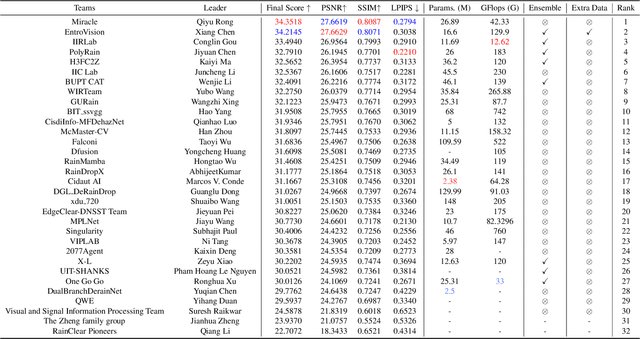
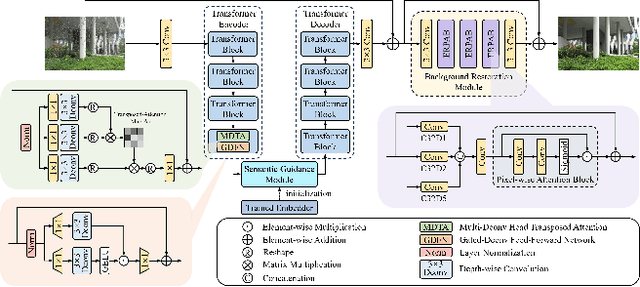
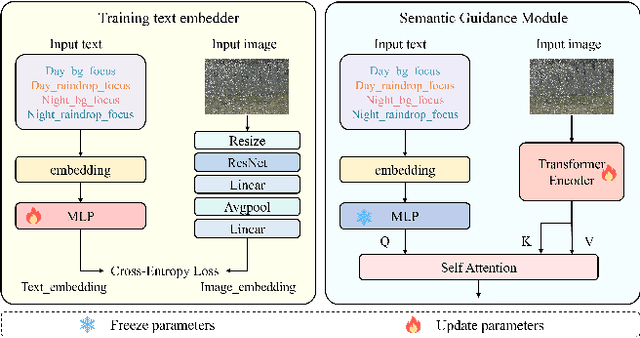
This paper reviews the NTIRE 2025 Challenge on Day and Night Raindrop Removal for Dual-Focused Images. This challenge received a wide range of impressive solutions, which are developed and evaluated using our collected real-world Raindrop Clarity dataset. Unlike existing deraining datasets, our Raindrop Clarity dataset is more diverse and challenging in degradation types and contents, which includes day raindrop-focused, day background-focused, night raindrop-focused, and night background-focused degradations. This dataset is divided into three subsets for competition: 14,139 images for training, 240 images for validation, and 731 images for testing. The primary objective of this challenge is to establish a new and powerful benchmark for the task of removing raindrops under varying lighting and focus conditions. There are a total of 361 participants in the competition, and 32 teams submitting valid solutions and fact sheets for the final testing phase. These submissions achieved state-of-the-art (SOTA) performance on the Raindrop Clarity dataset. The project can be found at https://lixinustc.github.io/CVPR-NTIRE2025-RainDrop-Competition.github.io/.
Hy-Tracker: A Novel Framework for Enhancing Efficiency and Accuracy of Object Tracking in Hyperspectral Videos
Nov 30, 2023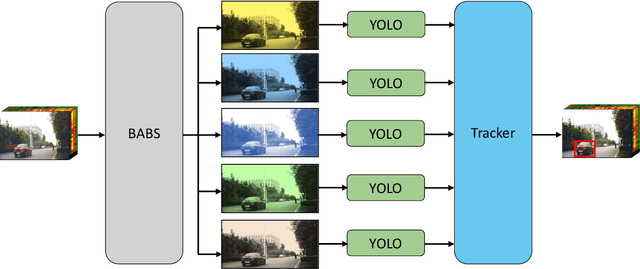

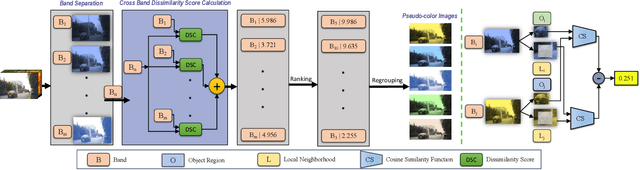

Hyperspectral object tracking has recently emerged as a topic of great interest in the remote sensing community. The hyperspectral image, with its many bands, provides a rich source of material information of an object that can be effectively used for object tracking. While most hyperspectral trackers are based on detection-based techniques, no one has yet attempted to employ YOLO for detecting and tracking the object. This is due to the presence of multiple spectral bands, the scarcity of annotated hyperspectral videos, and YOLO's performance limitation in managing occlusions, and distinguishing object in cluttered backgrounds. Therefore, in this paper, we propose a novel framework called Hy-Tracker, which aims to bridge the gap between hyperspectral data and state-of-the-art object detection methods to leverage the strengths of YOLOv7 for object tracking in hyperspectral videos. Hy-Tracker not only introduces YOLOv7 but also innovatively incorporates a refined tracking module on top of YOLOv7. The tracker refines the initial detections produced by YOLOv7, leading to improved object-tracking performance. Furthermore, we incorporate Kalman-Filter into the tracker, which addresses the challenges posed by scale variation and occlusion. The experimental results on hyperspectral benchmark datasets demonstrate the effectiveness of Hy-Tracker in accurately tracking objects across frames.