 Add to Chrome
 Add to Firefox
 Add to Edge
End-to-End Unmixing with Material Prompts for Hyperspectral Object Tracking
May 20, 2026
Hyperspectral imagery encodes rich material properties that can improve tracking robustness under appearance ambiguity, illumination change, and background clutter. However, due to the limited availability of hyperspectral video data, many existing methods adapt pretrained RGB trackers via spatial or channel fusion strategies, largely neglecting the intrinsic material information in hyperspectral imagery. Moreover, the few material-aware approaches typically rely on external spectral unmixing pipelines that are decoupled from the tracking objective, limiting effective optimization of material representations for target localization. To address these limitations, we formulate hyperspectral object tracking as a joint optimization problem of material decomposition and target localization, coupling the two tasks via a weighted target-oriented unmixing loss that explicitly aligns material representations with localization accuracy. Specifically, we propose a material representation decomposition module for deep learning-based spectral unmixing with adaptive frequency decomposition. Building on the decomposed material representations, we further introduce a dual-branch wavelet-enhanced material prompt module that learns low- and high-frequency material prompts through efficient spatial-material interactions in the frequency domain. The framework is model-agnostic and can be seamlessly generalized to different unmixing backbones. Extensive experiments on standard hyperspectral tracking benchmarks demonstrate state-of-the-art performance and validate the effectiveness of the proposed end-to-end material-aware tracking framework. Code is available at https://github.com/han030927/E2EMPT.

Implicit spatial-frequency fusion of hyperspectral and lidar data via kolmogorov-arnold networks
May 14, 2026Hyperspectral image (HSI) classification is challenging in complex scenes due to spectral ambiguity, spatial heterogeneity, and the strong coupling between material properties and geometric structures. Although LiDAR provides complementary elevation information, most HSI-LiDAR fusion methods rely on CNNs or MLPs with fixed activation functions and linear weights. These methods struggle to model structural discontinuities in LiDAR data, intricate spectral features of HSI, and their interactions. In addition, fusion of the two modalities in both spatial and frequency domains with LiDAR guidance remains underexplored. To address these issues, we propose the Implicit Frequency-Geometry Fusion Network (IFGNet), which leverages Kolmogorov-Arnold Networks (KANs) with learnable spline-based functions to adaptively capture highly nonlinear relationships between hyperspectral and LiDAR features. Furthermore, IFGNet introduces a LiDAR-guided implicit aggregation module in both spatial and frequency domains, enhancing geometry-aware spatial representations while capturing global structural patterns. Experiments on the Houston 2013 and MUUFL benchmarks demonstrate that IFGNet consistently outperforms existing fusion methods in overall accuracy, average accuracy, and Cohen's Kappa, while maintaining an efficient architecture.
A Weak-Signal-Aware Framework for Subsurface Defect Detection: Mechanisms for Enhancing Low-SCR Hyperbolic Signatures
Apr 07, 2026Subsurface defect detection via Ground Penetrating Radar is challenged by "weak signals" faint diffraction hyperbolas with low signal-to-clutter ratios, high wavefield similarity, and geometric degradation. Existing lightweight detectors prioritize efficiency over sensitivity, failing to preserve low-frequency structures or decouple heterogeneous clutter. We propose WSA-Net, a framework designed to enhance faint signatures through physical-feature reconstruction. Moving beyond simple parameter reduction, WSA-Net integrates four mechanisms: Signal preservation using partial convolutions; Clutter suppression via heterogeneous grouping attention; Geometric reconstruction to sharpen hyperbolic arcs; Context anchoring to resolve semantic ambiguities. Evaluations on the RTSTdataset show WSA-Net achieves 0.6958 mAP@0.5 and 164 FPS with only 2.412 M parameters. Results prove that signal-centric awareness in lightweight architectures effectively reduces false negatives in infrastructure inspection.
WS-Net: Weak-Signal Representation Learning and Gated Abundance Reconstruction for Hyperspectral Unmixing via State-Space and Weak Signal Attention Fusion
Mar 10, 2026Weak spectral responses in hyperspectral images are often obscured by dominant endmembers and sensor noise, resulting in inaccurate abundance estimation. This paper introduces WS-Net, a deep unmixing framework specifically designed to address weak-signal collapse through state-space modelling and Weak Signal Attention fusion. The network features a multi-resolution wavelet-fused encoder that captures both high-frequency discontinuities and smooth spectral variations with a hybrid backbone that integrates a Mamba state-space branch for efficient long-range dependency modelling. It also incorporates a Weak Signal Attention branch that selectively enhances low-similarity spectral cues. A learnable gating mechanism adaptively fuses both representations, while the decoder leverages KL-divergence-based regularisation to enforce separability between dominant and weak endmembers. Experiments on one simulated and two real datasets (synthetic dataset, Samson, and Apex) demonstrate consistent improvements over six state-of-the-art baselines, achieving up to 55% and 63% reductions in RMSE and SAD, respectively. The framework maintains stable accuracy under low-SNR conditions, particularly for weak endmembers, establishing WS-Net as a robust and computationally efficient benchmark for weak-signal hyperspectral unmixing.
HSLiNets: Hyperspectral Image and LiDAR Data Fusion Using Efficient Dual Non-Linear Feature Learning Networks
Dec 03, 2024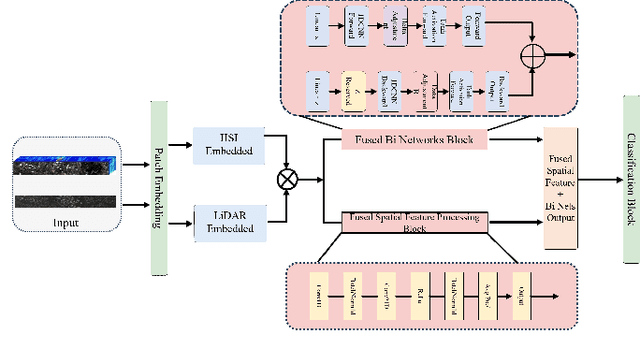
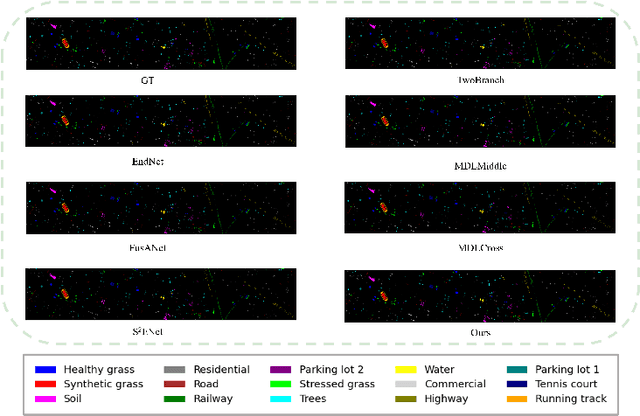
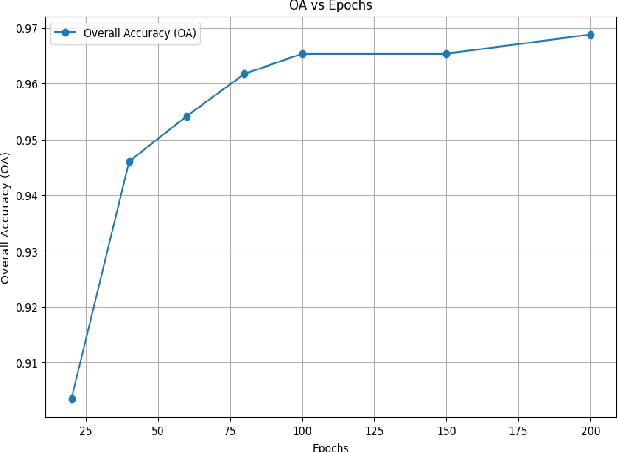
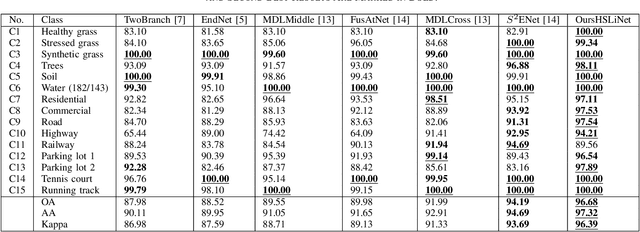
The integration of hyperspectral imaging (HSI) and LiDAR data within new linear feature spaces offers a promising solution to the challenges posed by the high-dimensionality and redundancy inherent in HSIs. This study introduces a dual linear fused space framework that capitalizes on bidirectional reversed convolutional neural network (CNN) pathways, coupled with a specialized spatial analysis block. This approach combines the computational efficiency of CNNs with the adaptability of attention mechanisms, facilitating the effective fusion of spectral and spatial information. The proposed method not only enhances data processing and classification accuracy, but also mitigates the computational burden typically associated with advanced models such as Transformers. Evaluations of the Houston 2013 dataset demonstrate that our approach surpasses existing state-of-the-art models. This advancement underscores the potential of the framework in resource-constrained environments and its significant contributions to the field of remote sensing.
Hyperspectral Images Efficient Spatial and Spectral non-Linear Model with Bidirectional Feature Learning
Dec 03, 2024
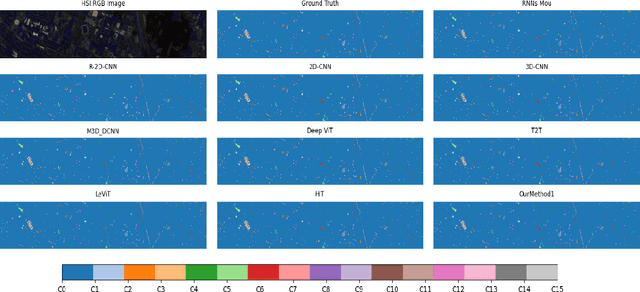
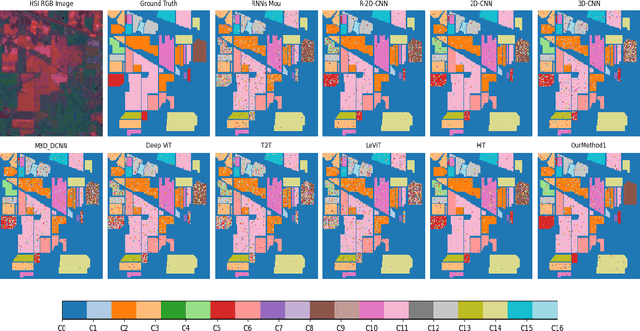

Classifying hyperspectral images (HSIs) is a complex task in remote sensing due to the high-dimensional nature and volume of data involved. To address these challenges, we propose the Spectral-Spatial non-Linear Model, a novel framework that significantly reduces data volume while enhancing classification accuracy. Our model employs a bidirectional reversed convolutional neural network (CNN) to efficiently extract spectral features, complemented by a specialized block for spatial feature analysis. This hybrid approach leverages the operational efficiency of CNNs and incorporates dynamic feature extraction inspired by attention mechanisms, optimizing performance without the high computational demands typically associated with transformer-based models. The SS non-Linear Model is designed to process hyperspectral data bidirectionally, achieving notable classification and efficiency improvements by fusing spectral and spatial features effectively. This approach yields superior classification accuracy compared to existing benchmarks while maintaining computational efficiency, making it suitable for resource-constrained environments. We validate the SS non-Linear Model on three widely recognized datasets, Houston 2013, Indian Pines, and Pavia University, demonstrating its ability to outperform current state-of-the-art models in HSI classification and efficiency. This work highlights the innovative methodology of the SS non-Linear Model and its practical benefits for remote sensing applications, where both data efficiency and classification accuracy are critical. For further details, please refer to our code repository on GitHub: HSILinearModel.