 Add to Chrome
 Add to Firefox
 Add to Edge
ChannelAgent-Empowered Electromagnetic Space World Model: A Case Study on Agent-Driven Channel Generation for 6G AI-Native Air Interface
May 14, 2026
As sixth-generation (6G) wireless networks evolve toward increasingly heterogeneous scenarios, tasks, and service requirements, conventional artificial intelligence (AI) models remain limited in task-aware decision-making and autonomous adaptation. To address this issue, this paper first proposes a ChannelAgent-empowered electromagnetic space world model, in which wireless intelligence is organized into a closed-loop process consisting of multi-modal sensing, ChannelAgent as the intelligent core, and execution with feedback update. As a case study, agent-driven channel generation is instantiated through path loss prediction. Specifically, a task-oriented intelligent feature selection mechanism is designed by integrating reinforcement-learning-inspired policy adaptation with evolutionary search, enabling the agent to iteratively derive compact and task-suitable feature subsets according to the current scenario and performance feedback. Simulation results demonstrate superior performance in both single-scenario and multi-scenario tasks, highlighting the potential of the proposed model for autonomous, adaptive, task-oriented, and closed-loop wireless intelligence.

Phase-Interface Instance Segmentation as a Visual Sensor for Laboratory Process Monitoring
Mar 11, 2026Reliable visual monitoring of chemical experiments remains challenging in transparent glassware, where weak phase boundaries and optical artifacts degrade conventional segmentation. We formulate laboratory phenomena as the time evolution of phase interfaces and introduce the Chemical Transparent Glasses dataset 2.0 (CTG 2.0), a vessel-aware benchmark with 3,668 images, 23 glassware categories, and five multiphase interface types for phase-interface instance segmentation. Building on YOLO11m-seg, we propose LGA-RCM-YOLO, which combines Local-Global Attention (LGA) for robust semantic representation and a Rectangular Self-Calibration Module (RCM) for boundary refinement of thin, elongated interfaces. On CTG 2.0, the proposed model achieves 84.4% AP@0.5 and 58.43% AP@0.5-0.95, improving over the YOLO11m baseline by 6.42 and 8.75 AP points, respectively, while maintaining near real-time inference (13.67 FPS, RTX 3060). An auxiliary color-attribute head further labels liquid instances as colored or colorless with 98.71% precision and 98.32% recall. Finally, we demonstrate continuous process monitoring in separatory-funnel phase separation and crystallization, showing that phase-interface instance segmentation can serve as a practical visual sensor for laboratory automation.
DDRN:a Data Distribution Reconstruction Network for Occluded Person Re-Identification
Oct 09, 2024


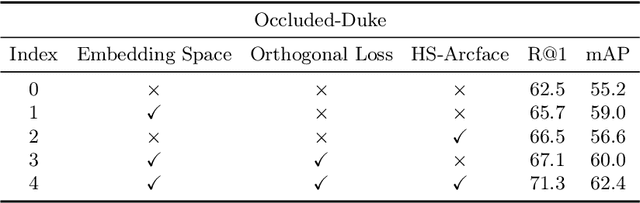
In occluded person re-identification(ReID), severe occlusions lead to a significant amount of irrelevant information that hinders the accurate identification of individuals. These irrelevant cues primarily stem from background interference and occluding interference, adversely affecting the final retrieval results. Traditional discriminative models, which rely on the specific content and positions of the images, often misclassify in cases of occlusion. To address these limitations, we propose the Data Distribution Reconstruction Network (DDRN), a generative model that leverages data distribution to filter out irrelevant details, enhancing overall feature perception ability and reducing irrelevant feature interference. Additionally, severe occlusions lead to the complexity of the feature space. To effectively handle this, we design a multi-center approach through the proposed Hierarchical SubcenterArcface (HS-Arcface) loss function, which can better approximate complex feature spaces. On the Occluded-Duke dataset, we achieved a mAP of 62.4\% (+1.1\%) and a rank-1 accuracy of 71.3\% (+0.6\%), surpassing the latest state-of-the-art methods(FRT) significantly.
Rain Removal from Light Field Images with 4D Convolution and Multi-scale Gaussian Process
Aug 16, 2022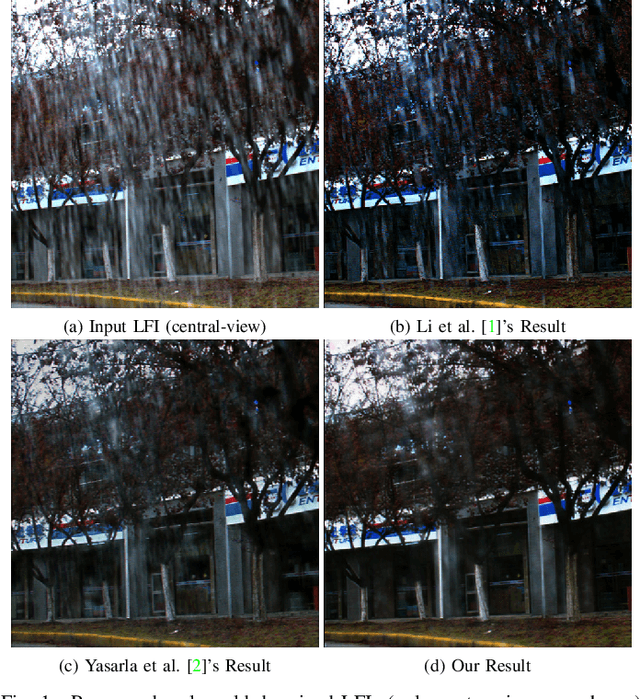
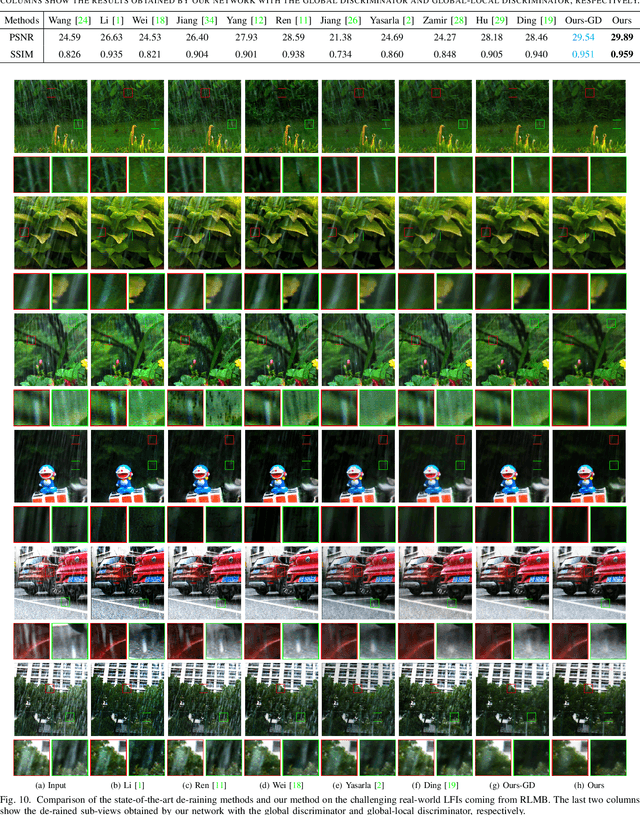
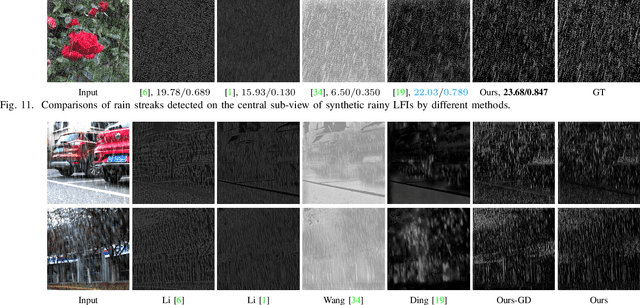
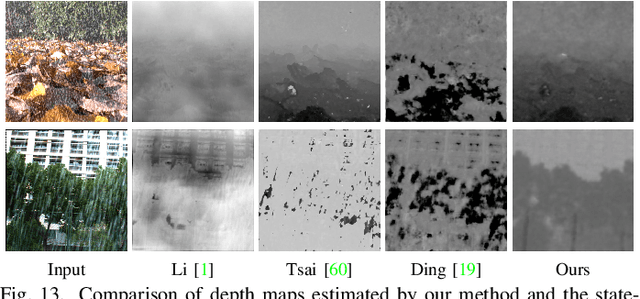
Existing deraining methods mainly focus on a single input image. With just a single input image, it is extremely difficult to accurately detect rain streaks, remove rain streaks, and restore rain-free images. Compared with a single 2D image, a light field image (LFI) embeds abundant 3D structure and texture information of the target scene by recording the direction and position of each incident ray via a plenoptic camera, which has emerged as a popular device in the computer vision and graphics research communities. In this paper, we propose a novel network, 4D-MGP-SRRNet, for rain streak removal from an LFI. Our method takes as input all sub-views of a rainy LFI. In order to make full use of the LFI, we adopt 4D convolutional layers to build the proposed rain steak removal network to simultaneously process all sub-views of the LFI. In the proposed network, the rain detection model, MGPDNet, with a novel Multi-scale Self-guided Gaussian Process (MSGP) module is proposed to detect rain streaks from all sub-views of the input LFI. Semi-supervised learning is introduced to accurately detect rain streaks by training on both virtual-world rainy LFIs and real-world rainy LFIs at multiple scales via calculating pseudo ground truth for real-world rain streaks. All sub-views subtracting the predicted rain streaks are then fed into a 4D residual model to estimate depth maps. Finally, all sub-views concatenated with the corresponding rain streaks and fog maps converted from the estimated depth maps are fed into a rainy LFI restoring model that is based on the adversarial recurrent neural network to progressively eliminate rain streaks and recover the rain-free LFI. Extensive quantitative and qualitative evaluations conducted on both synthetic LFIs and real-world LFIs demonstrate the effectiveness of our proposed method.