 Add to Chrome
 Add to Firefox
 Add to Edge
Phase-Interface Instance Segmentation as a Visual Sensor for Laboratory Process Monitoring
Mar 11, 2026
Reliable visual monitoring of chemical experiments remains challenging in transparent glassware, where weak phase boundaries and optical artifacts degrade conventional segmentation. We formulate laboratory phenomena as the time evolution of phase interfaces and introduce the Chemical Transparent Glasses dataset 2.0 (CTG 2.0), a vessel-aware benchmark with 3,668 images, 23 glassware categories, and five multiphase interface types for phase-interface instance segmentation. Building on YOLO11m-seg, we propose LGA-RCM-YOLO, which combines Local-Global Attention (LGA) for robust semantic representation and a Rectangular Self-Calibration Module (RCM) for boundary refinement of thin, elongated interfaces. On CTG 2.0, the proposed model achieves 84.4% AP@0.5 and 58.43% AP@0.5-0.95, improving over the YOLO11m baseline by 6.42 and 8.75 AP points, respectively, while maintaining near real-time inference (13.67 FPS, RTX 3060). An auxiliary color-attribute head further labels liquid instances as colored or colorless with 98.71% precision and 98.32% recall. Finally, we demonstrate continuous process monitoring in separatory-funnel phase separation and crystallization, showing that phase-interface instance segmentation can serve as a practical visual sensor for laboratory automation.

Source-free Active Domain Adaptation for Diabetic Retinopathy Grading Based on Ultra-wide-field Fundus Image
Sep 19, 2023Domain adaptation (DA) has been widely applied in the diabetic retinopathy (DR) grading of unannotated ultra-wide-field (UWF) fundus images, which can transfer annotated knowledge from labeled color fundus images. However, suffering from huge domain gaps and complex real-world scenarios, the DR grading performance of most mainstream DA is far from that of clinical diagnosis. To tackle this, we propose a novel source-free active domain adaptation (SFADA) in this paper. Specifically, we focus on DR grading problem itself and propose to generate features of color fundus images with continuously evolving relationships of DRs, actively select a few valuable UWF fundus images for labeling with local representation matching, and adapt model on UWF fundus images with DR lesion prototypes. Notably, the SFADA also takes data privacy and computational efficiency into consideration. Extensive experimental results demonstrate that our proposed SFADA achieves state-of-the-art DR grading performance, increasing accuracy by 20.9% and quadratic weighted kappa by 18.63% compared with baseline and reaching 85.36% and 92.38% respectively. These investigations show that the potential of our approach for real clinical practice is promising.
AutoChart: A Dataset for Chart-to-Text Generation Task
Aug 16, 2021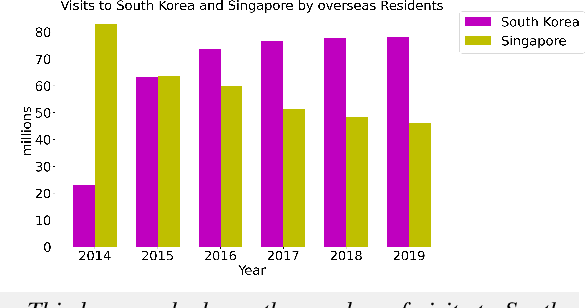
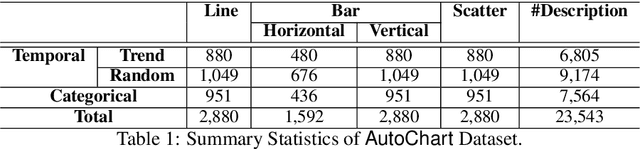
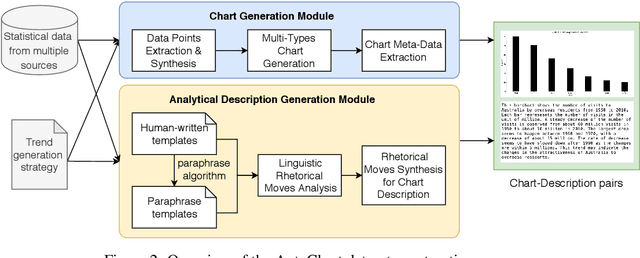
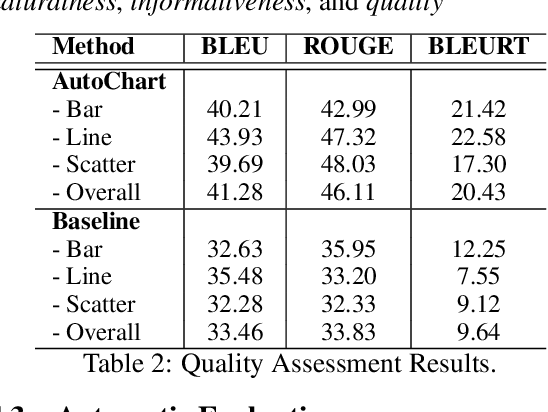
The analytical description of charts is an exciting and important research area with many applications in academia and industry. Yet, this challenging task has received limited attention from the computational linguistics research community. This paper proposes \textsf{AutoChart}, a large dataset for the analytical description of charts, which aims to encourage more research into this important area. Specifically, we offer a novel framework that generates the charts and their analytical description automatically. We conducted extensive human and machine evaluations on the generated charts and descriptions and demonstrate that the generated texts are informative, coherent, and relevant to the corresponding charts.