 Add to Chrome
 Add to Firefox
 Add to Edge
RoadWeaver: Large-Scale Lane-Level HD Map Generation from Scratch for Autonomous Driving Simulation
Aug 12, 2026
Autonomous driving simulation requires diverse and scalable lane-level HD maps to support long-horizon evaluation across complex road networks. Existing approaches either rely on handcrafted or reconstructed real-world maps, which limits scalability, or generate only local road structures rather than complete HD maps. We present RoadWeaver, a coarse-to-fine framework for from-scratch generation of diverse, large-scale HD maps. RoadWeaver first synthesizes a global road layout, expands it into a connected road network, and then constructs lane-level geometry with topologically consistent lane connectivity. Experimental results show that RoadWeaver achieves a 99.8\% reachability, a 10.7\% dead-end ratio, and an endpoint alignment error of 0.24 m. Compared with SOTA generation methods, it reduces endpoint alignment error by 94.4\% while generating complete HD maps in 1.39--3.50 s. The generated maps can be directly deployed in driving simulators, providing scalable simulation environments for future closed-loop evaluation of autonomous driving systems. The training code and an out-of-the-box implementation of RoadWeaver will be released upon acceptance.

Characterizing Treatment-Context Medication Evidence Across Clinic Notes and Structured EHR Medication History
Aug 03, 2026Clinic notes and structured electronic health record (EHR) medication history often contain different medication information. Same-visit disagreement between these sources may result from note-side normalization errors, differences in terminology or timing, or actual differences in documentation. We developed a note-grounded approach that uses large language model (LLM) assisted reference construction, targeted and random human review, deterministic medication normalization, and semantic and temporal comparisons with structured medication history. We evaluated all normalization results on a patient-level held-out test set to limit adaptation to the study cohort. On 5,403 held-out mention rows, exact canonical agreement improved from 0.7226 with surface-exact matching to 0.8429 after lexical cleanup and curated alias mapping. In a random audit of previously unaudited rows, canonical-label agreement was 0.9210 among evaluable valid medication mentions, whereas treatment-action attribution was lower at 0.5326. In the full-cohort characterization analysis, only 16.44% of note-derived rows had same-visit exact overlap with structured medication history, but 55.17% had same-visit semantic overlap, 90.34% had same-visit or +/-30-day overlap, and only 3.97% remained in the strict no-structured-overlap bucket under broad project-level mapping. An ontology-backed sensitivity analysis further showed that held-out strict Observational Medical Outcomes Partnership (OMOP)-backed no-overlap fell from 43.99% to 36.68% after a development-derived alias supplement. These results show that note-to-structured-medication mismatch can arise from normalization errors, differences in terminology, and differences in documentation timing.
A safety-oriented hypothetico-deductive framework for AI-assisted differential diagnosis
Jul 09, 2026Diagnostic error is a major threat to patient safety, yet current large language model (LLM) systems often treat diagnosis as a one-shot prediction task, lacking safeguards against missed high-risk alternatives or rigorous verification of their reasoning. Here, we present AegisDx, a safety-oriented framework for hypothetico-deductive clinical reasoning. AegisDx coordinates specialized LLM components through role-specific contracts, structured intermediate outputs, evidence-retrieval interfaces, and verification gates to generate broad differential diagnoses, enforce explicit screening for dangerous "must-not-miss" conditions, verify reasoning against grounded medical evidence, and structure actionable next steps. We evaluated AegisDx across three layers. On literature-derived case reports from NEJM and JAMA, with GPT-oss-120B as the shared backbone, Top-3 diagnostic accuracy was 59.9% versus 52.1% for the standalone LLM on JAMA cases and 62.7% versus 51.4% on NEJM cases. On cases from Annals of Emergency Medicine, Top-3 accuracy was 85.7% versus 68.6%; against physician-consensus must-not-miss diagnosis sets, AegisDx captured at least one such condition among its top three diagnoses in 78.0% of cases versus 52.0%. In a blinded physician evaluation of 43 real-world emergency department notes from the Yale New Haven Health System compared against GPT-5, AegisDx improved the physician-rated composite safety score from 4.31 to 4.55 on a 5-point scale (adjusted p = 2.1x10^-4), with qualitative gains in must-not-miss identification and reasoning safety. Our findings suggest that engineering diagnostic AI as a safety-oriented reasoning framework, rather than optimizing raw predictive accuracy alone, can provide a safer, more transparent, and clinically meaningful layer of bedside decision support for acute care workflows.
A Stitch in Time Saves Nine: Preserving Policy Compatibility Under Perception Updates in End-to-End Autonomous Driving
Jun 19, 2026End-to-end autonomous driving systems tightly couple perception and decision-making through latent representations. Consequently, updates to perception models can alter these representations and degrade the performance of downstream policies that remain fixed. Existing solutions typically rely on policy retraining or architectural decoupling, both of which incur substantial computation and validation costs. In this paper, we formulate the model stitching problem for end-to-end autonomous driving and test the hypothesis that policy compatibility can be preserved through lightweight latent-space alignment. We study low-complexity model stitching methods, including linear and convolutional stitchers, for restoring compatibility between updated perception modules and frozen downstream policy modules. Experiments demonstrate that stitching effectively preserves downstream driving behavior under diverse perception updates, including changes in random initialization, sensor configuration, and training domain. In the most challenging cross-domain setting from nuScenes to CARLA, convolutional stitching retains over 91\% of the no-shift driving score while reducing adaptation time from \SI{22.18}{h} to \SI{0.91}{h}. These results suggest that model stitching provides an effective and computationally efficient alternative to retraining or fine-tuning for maintaining end-to-end autonomous driving systems. The model will be open-sourced upon paper acceptance at https://github.com/SCP-CN-001/model-stitching to support further research and development in autonomous driving.
Herculean: An Agentic Benchmark for Financial Intelligence
May 14, 2026As AI agents improve, the central question is no longer whether they can solve isolated well-defined financial tasks, but whether they can reliably carry out financial professional work. Existing financial benchmarks offer only a partial view of this ability, as they primarily evaluate static competencies such as question answering, retrieval, summarization, and classification. We introduce Herculean, the first skilled benchmark for agentic financial intelligence spanning four representative workflows, including Trading, Hedging, Market Insights, and Auditing. Each workflow is instantiated as a standardized MCP-based skill environment with its own tools, interaction dynamics, constraints, and success criteria, enabling consistent end-to-end assessment of heterogeneous agent systems. Across frontier agents, we find agents perform relatively well on Trading and Market Insights, but struggle substantially on Hedging and Auditing, where long-horizon coordination, state consistency, and structured verification are critical. Overall, our results point to a key gap in current agents in turning financial reasoning into dependable workflow execution in high-stakes financial workflows.
Ebisu: Benchmarking Large Language Models in Japanese Finance
Feb 01, 2026Japanese finance combines agglutinative, head-final linguistic structure, mixed writing systems, and high-context communication norms that rely on indirect expression and implicit commitment, posing a substantial challenge for LLMs. We introduce Ebisu, a benchmark for native Japanese financial language understanding, comprising two linguistically and culturally grounded, expert-annotated tasks: JF-ICR, which evaluates implicit commitment and refusal recognition in investor-facing Q&A, and JF-TE, which assesses hierarchical extraction and ranking of nested financial terminology from professional disclosures. We evaluate a diverse set of open-source and proprietary LLMs spanning general-purpose, Japanese-adapted, and financial models. Results show that even state-of-the-art systems struggle on both tasks. While increased model scale yields limited improvements, language- and domain-specific adaptation does not reliably improve performance, leaving substantial gaps unresolved. Ebisu provides a focused benchmark for advancing linguistically and culturally grounded financial NLP. All datasets and evaluation scripts are publicly released.
ROAD: Responsibility-Oriented Reward Design for Reinforcement Learning in Autonomous Driving
May 30, 2025Reinforcement learning (RL) in autonomous driving employs a trial-and-error mechanism, enhancing robustness in unpredictable environments. However, crafting effective reward functions remains challenging, as conventional approaches rely heavily on manual design and demonstrate limited efficacy in complex scenarios. To address this issue, this study introduces a responsibility-oriented reward function that explicitly incorporates traffic regulations into the RL framework. Specifically, we introduced a Traffic Regulation Knowledge Graph and leveraged Vision-Language Models alongside Retrieval-Augmented Generation techniques to automate reward assignment. This integration guides agents to adhere strictly to traffic laws, thus minimizing rule violations and optimizing decision-making performance in diverse driving conditions. Experimental validations demonstrate that the proposed methodology significantly improves the accuracy of assigning accident responsibilities and effectively reduces the agent's liability in traffic incidents.
Embodied Escaping: End-to-End Reinforcement Learning for Robot Navigation in Narrow Environment
Mar 05, 2025


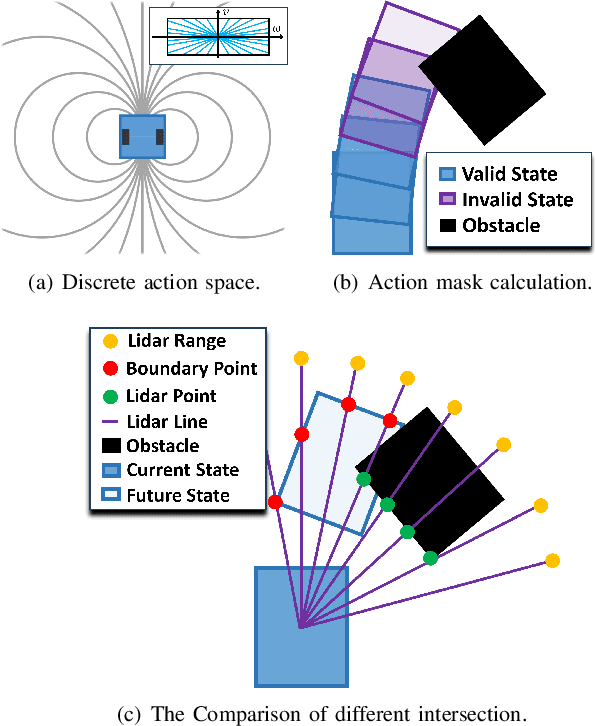
Autonomous navigation is a fundamental task for robot vacuum cleaners in indoor environments. Since their core function is to clean entire areas, robots inevitably encounter dead zones in cluttered and narrow scenarios. Existing planning methods often fail to escape due to complex environmental constraints, high-dimensional search spaces, and high difficulty maneuvers. To address these challenges, this paper proposes an embodied escaping model that leverages reinforcement learning-based policy with an efficient action mask for dead zone escaping. To alleviate the issue of the sparse reward in training, we introduce a hybrid training policy that improves learning efficiency. In handling redundant and ineffective action options, we design a novel action representation to reshape the discrete action space with a uniform turning radius. Furthermore, we develop an action mask strategy to select valid action quickly, balancing precision and efficiency. In real-world experiments, our robot is equipped with a Lidar, IMU, and two-wheel encoders. Extensive quantitative and qualitative experiments across varying difficulty levels demonstrate that our robot can consistently escape from challenging dead zones. Moreover, our approach significantly outperforms compared path planning and reinforcement learning methods in terms of success rate and collision avoidance.
RL-OGM-Parking: Lidar OGM-Based Hybrid Reinforcement Learning Planner for Autonomous Parking
Feb 26, 2025Autonomous parking has become a critical application in automatic driving research and development. Parking operations often suffer from limited space and complex environments, requiring accurate perception and precise maneuvering. Traditional rule-based parking algorithms struggle to adapt to diverse and unpredictable conditions, while learning-based algorithms lack consistent and stable performance in various scenarios. Therefore, a hybrid approach is necessary that combines the stability of rule-based methods and the generalizability of learning-based methods. Recently, reinforcement learning (RL) based policy has shown robust capability in planning tasks. However, the simulation-to-reality (sim-to-real) transfer gap seriously blocks the real-world deployment. To address these problems, we employ a hybrid policy, consisting of a rule-based Reeds-Shepp (RS) planner and a learning-based reinforcement learning (RL) planner. A real-time LiDAR-based Occupancy Grid Map (OGM) representation is adopted to bridge the sim-to-real gap, leading the hybrid policy can be applied to real-world systems seamlessly. We conducted extensive experiments both in the simulation environment and real-world scenarios, and the result demonstrates that the proposed method outperforms pure rule-based and learning-based methods. The real-world experiment further validates the feasibility and efficiency of the proposed method.
End-to-end Driving in High-Interaction Traffic Scenarios with Reinforcement Learning
Oct 03, 2024Dynamic and interactive traffic scenarios pose significant challenges for autonomous driving systems. Reinforcement learning (RL) offers a promising approach by enabling the exploration of driving policies beyond the constraints of pre-collected datasets and predefined conditions, particularly in complex environments. However, a critical challenge lies in effectively extracting spatial and temporal features from sequences of high-dimensional, multi-modal observations while minimizing the accumulation of errors over time. Additionally, efficiently guiding large-scale RL models to converge on optimal driving policies without frequent failures during the training process remains tricky. We propose an end-to-end model-based RL algorithm named Ramble to address these issues. Ramble processes multi-view RGB images and LiDAR point clouds into low-dimensional latent features to capture the context of traffic scenarios at each time step. A transformer-based architecture is then employed to model temporal dependencies and predict future states. By learning a dynamics model of the environment, Ramble can foresee upcoming traffic events and make more informed, strategic decisions. Our implementation demonstrates that prior experience in feature extraction and decision-making plays a pivotal role in accelerating the convergence of RL models toward optimal driving policies. Ramble achieves state-of-the-art performance regarding route completion rate and driving score on the CARLA Leaderboard 2.0, showcasing its effectiveness in managing complex and dynamic traffic situations.