 Add to Chrome
 Add to Firefox
 Add to Edge
Foundation Models to Unlock Real-World Evidence from Nationwide Medical Claims
May 05, 2026
Evidence derived from large-scale real-world data (RWD) is increasingly informing regulatory evaluation and healthcare decision-making. Administrative claims provide population-scale, longitudinal records of healthcare utilization, expenditure, and detailed coding of diagnoses, procedures, and medications, yet their potential as a substrate for healthcare foundation models remains largely unexplored. Here we present ReClaim, a generative transformer trained from scratch on 43.8 billion medical events from more than 200 million enrollees in the MarketScan claims data spanning 2008-2022. ReClaim models longitudinal trajectories across diagnoses, procedures, medications, and expenditure, and was scaled to 140 million, 700 million, and 1.7 billion parameters. Across over 1,000 disease-onset prediction tasks, ReClaim achieved a mean AUC of 75.6%, substantially outperforming disease-specific LightGBM (66.3%) and the transformer-based Delphi model (69.4%), with the largest gains for rare diseases. These advantages held across retrospective and prospective evaluations and in external validation on two independent datasets. Performance improved monotonically with scale, and post-training added 13.8 percentage points over pre-training alone. Beyond disease prediction, ReClaim captured financial outcomes and improved real-world evidence (RWE) analyses: for healthcare expenditure forecasting it increased explained variance from 0.28 to 0.37 relative to LightGBM, and in a target trial emulation it reduced systematic bias by 72% on average relative to Delphi. Together, these results establish administrative claims as a scalable substrate for healthcare foundation models and show that learned representations generalize across time periods and data sources, supporting disease surveillance, expenditure forecasting, and RWE generation.

Quotient-Based Posterior Analysis for Euclidean Latent Space Models
Apr 03, 2026Latent space models are widely used in statistical network analysis and are often fit by Markov chain Monte Carlo. However, posterior summaries of latent coordinates are not canonical because the likelihood depends only on pairwise distances and is invariant under rigid motions of the latent space. Standard post hoc alignment can aid visualization, but the resulting summaries depend on an arbitrary reference configuration. We propose a quotient-based posterior analysis for Euclidean latent space models using the centered Gram map, which represents identifiable latent structure while removing nonidentifiability. This yields intrinsic posterior summaries of mean structure and uncertainty that can be computed directly from posterior samples, together with basic theoretical guarantees including canonicality, existence, and stability. Through simulations and analyses of the Florentine marriage network and a statisticians' coauthorship network, the proposed framework clarifies when alignment-based summaries are stable, when they become reference-sensitive, and which nodes or relationships are weakly identified. These results show how coherent posterior analysis can reveal latent relational structure beyond a single embedding.
ctELM: Decoding and Manipulating Embeddings of Clinical Trials with Embedding Language Models
Jan 26, 2026Text embeddings have become an essential part of a variety of language applications. However, methods for interpreting, exploring and reversing embedding spaces are limited, reducing transparency and precluding potentially valuable generative use cases. In this work, we align Large Language Models to embeddings of clinical trials using the recently reported Embedding Language Model (ELM) method. We develop an open-source, domain-agnostic ELM architecture and training framework, design training tasks for clinical trials, and introduce an expert-validated synthetic dataset. We then train a series of ELMs exploring the impact of tasks and training regimes. Our final model, ctELM, can accurately describe and compare unseen clinical trials from embeddings alone and produce plausible clinical trials from novel vectors. We further show that generated trial abstracts are responsive to moving embeddings along concept vectors for age and sex of study subjects. Our public ELM implementation and experimental results will aid the alignment of Large Language Models to embedding spaces in the biomedical domain and beyond.
Learning over von Mises-Fisher Distributions via a Wasserstein-like Geometry
Apr 19, 2025We introduce a novel, geometry-aware distance metric for the family of von Mises-Fisher (vMF) distributions, which are fundamental models for directional data on the unit hypersphere. Although the vMF distribution is widely employed in a variety of probabilistic learning tasks involving spherical data, principled tools for comparing vMF distributions remain limited, primarily due to the intractability of normalization constants and the absence of suitable geometric metrics. Motivated by the theory of optimal transport, we propose a Wasserstein-like distance that decomposes the discrepancy between two vMF distributions into two interpretable components: a geodesic term capturing the angular separation between mean directions, and a variance-like term quantifying differences in concentration parameters. The derivation leverages a Gaussian approximation in the high-concentration regime to yield a tractable, closed-form expression that respects the intrinsic spherical geometry. We show that the proposed distance exhibits desirable theoretical properties and induces a latent geometric structure on the space of non-degenerate vMF distributions. As a primary application, we develop the efficient algorithms for vMF mixture reduction, enabling structure-preserving compression of mixture models in high-dimensional settings. Empirical results on synthetic datasets and real-world high-dimensional embeddings, including biomedical sentence representations and deep visual features, demonstrate the effectiveness of the proposed geometry in distinguishing distributions and supporting interpretable inference. This work expands the statistical toolbox for directional data analysis by introducing a tractable, transport-inspired distance tailored to the geometry of the hypersphere.
Assessing the Usability of GutGPT: A Simulation Study of an AI Clinical Decision Support System for Gastrointestinal Bleeding Risk
Dec 06, 2023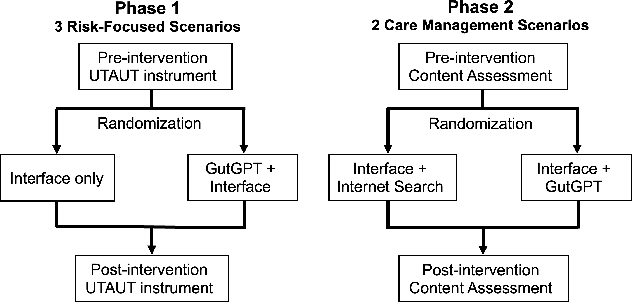
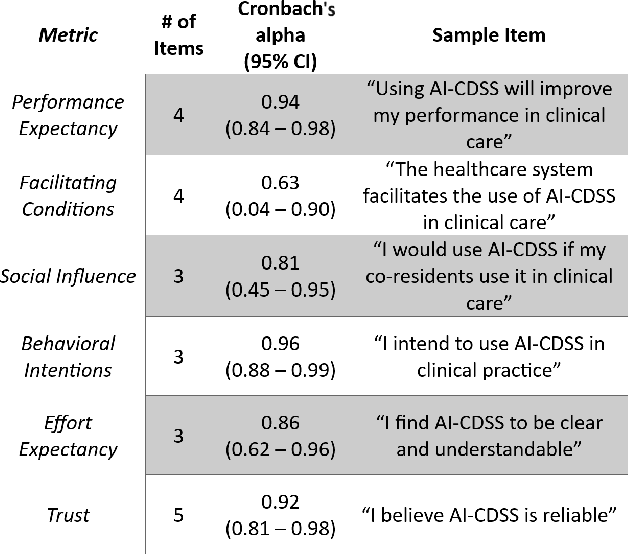
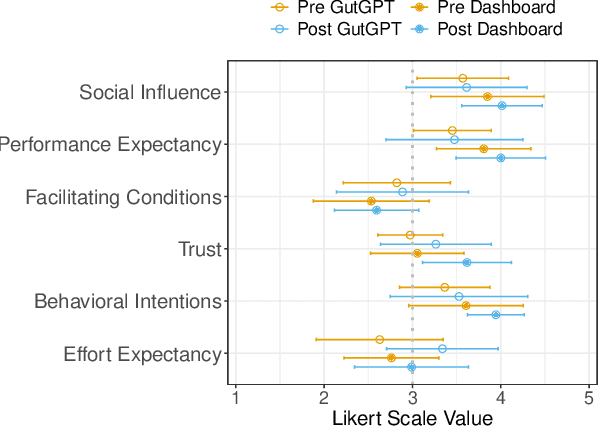
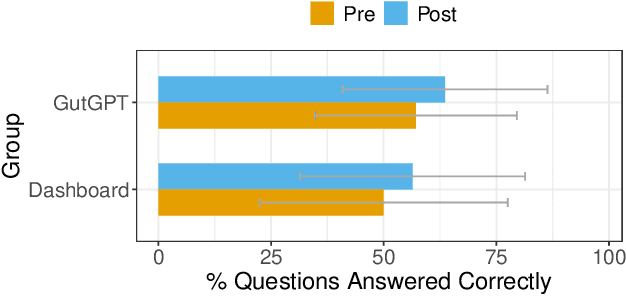
Applications of large language models (LLMs) like ChatGPT have potential to enhance clinical decision support through conversational interfaces. However, challenges of human-algorithmic interaction and clinician trust are poorly understood. GutGPT, a LLM for gastrointestinal (GI) bleeding risk prediction and management guidance, was deployed in clinical simulation scenarios alongside the electronic health record (EHR) with emergency medicine physicians, internal medicine physicians, and medical students to evaluate its effect on physician acceptance and trust in AI clinical decision support systems (AI-CDSS). GutGPT provides risk predictions from a validated machine learning model and evidence-based answers by querying extracted clinical guidelines. Participants were randomized to GutGPT and an interactive dashboard, or the interactive dashboard and a search engine. Surveys and educational assessments taken before and after measured technology acceptance and content mastery. Preliminary results showed mixed effects on acceptance after using GutGPT compared to the dashboard or search engine but appeared to improve content mastery based on simulation performance. Overall, this study demonstrates LLMs like GutGPT could enhance effective AI-CDSS if implemented optimally and paired with interactive interfaces.