 Add to Chrome
 Add to Firefox
 Add to Edge
RoadWeaver: Large-Scale Lane-Level HD Map Generation from Scratch for Autonomous Driving Simulation
Aug 12, 2026
Autonomous driving simulation requires diverse and scalable lane-level HD maps to support long-horizon evaluation across complex road networks. Existing approaches either rely on handcrafted or reconstructed real-world maps, which limits scalability, or generate only local road structures rather than complete HD maps. We present RoadWeaver, a coarse-to-fine framework for from-scratch generation of diverse, large-scale HD maps. RoadWeaver first synthesizes a global road layout, expands it into a connected road network, and then constructs lane-level geometry with topologically consistent lane connectivity. Experimental results show that RoadWeaver achieves a 99.8\% reachability, a 10.7\% dead-end ratio, and an endpoint alignment error of 0.24 m. Compared with SOTA generation methods, it reduces endpoint alignment error by 94.4\% while generating complete HD maps in 1.39--3.50 s. The generated maps can be directly deployed in driving simulators, providing scalable simulation environments for future closed-loop evaluation of autonomous driving systems. The training code and an out-of-the-box implementation of RoadWeaver will be released upon acceptance.

UniLegs: Universal Multi-Legged Robot Control through Morphology-Agnostic Policy Distillation
Jul 30, 2025Developing controllers that generalize across diverse robot morphologies remains a significant challenge in legged locomotion. Traditional approaches either create specialized controllers for each morphology or compromise performance for generality. This paper introduces a two-stage teacher-student framework that bridges this gap through policy distillation. First, we train specialized teacher policies optimized for individual morphologies, capturing the unique optimal control strategies for each robot design. Then, we distill this specialized expertise into a single Transformer-based student policy capable of controlling robots with varying leg configurations. Our experiments across five distinct legged morphologies demonstrate that our approach preserves morphology-specific optimal behaviors, with the Transformer architecture achieving 94.47\% of teacher performance on training morphologies and 72.64\% on unseen robot designs. Comparative analysis reveals that Transformer-based architectures consistently outperform MLP baselines by leveraging attention mechanisms to effectively model joint relationships across different kinematic structures. We validate our approach through successful deployment on a physical quadruped robot, demonstrating the practical viability of our morphology-agnostic control framework. This work presents a scalable solution for developing universal legged robot controllers that maintain near-optimal performance while generalizing across diverse morphologies.
StyleSSP: Sampling StartPoint Enhancement for Training-free Diffusion-based Method for Style Transfer
Jan 20, 2025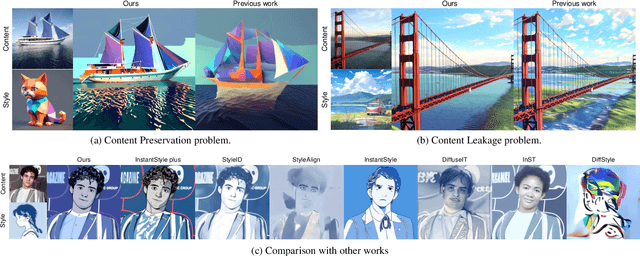


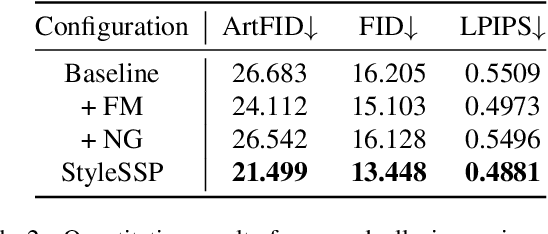
Training-free diffusion-based methods have achieved remarkable success in style transfer, eliminating the need for extensive training or fine-tuning. However, due to the lack of targeted training for style information extraction and constraints on the content image layout, training-free methods often suffer from layout changes of original content and content leakage from style images. Through a series of experiments, we discovered that an effective startpoint in the sampling stage significantly enhances the style transfer process. Based on this discovery, we propose StyleSSP, which focuses on obtaining a better startpoint to address layout changes of original content and content leakage from style image. StyleSSP comprises two key components: (1) Frequency Manipulation: To improve content preservation, we reduce the low-frequency components of the DDIM latent, allowing the sampling stage to pay more attention to the layout of content images; and (2) Negative Guidance via Inversion: To mitigate the content leakage from style image, we employ negative guidance in the inversion stage to ensure that the startpoint of the sampling stage is distanced from the content of style image. Experiments show that StyleSSP surpasses previous training-free style transfer baselines, particularly in preserving original content and minimizing the content leakage from style image.