 Add to Chrome
 Add to Firefox
 Add to Edge
Byzantine-Robust Federated Learning over Ring-All-Reduce Distributed Computing
Jan 29, 2025


Federated learning (FL) has gained attention as a distributed learning paradigm for its data privacy benefits and accelerated convergence through parallel computation. Traditional FL relies on a server-client (SC) architecture, where a central server coordinates multiple clients to train a global model, but this approach faces scalability challenges due to server communication bottlenecks. To overcome this, the ring-all-reduce (RAR) architecture has been introduced, eliminating the central server and achieving bandwidth optimality. However, the tightly coupled nature of RAR's ring topology exposes it to unique Byzantine attack risks not present in SC-based FL. Despite its potential, designing Byzantine-robust RAR-based FL algorithms remains an open problem. To address this gap, we propose BRACE (Byzantine-robust ring-all-reduce), the first RAR-based FL algorithm to achieve both Byzantine robustness and communication efficiency. We provide theoretical guarantees for the convergence of BRACE under Byzantine attacks, demonstrate its bandwidth efficiency, and validate its practical effectiveness through experiments. Our work offers a foundational understanding of Byzantine-robust RAR-based FL design.

Do We Really Need to Design New Byzantine-robust Aggregation Rules?
Jan 29, 2025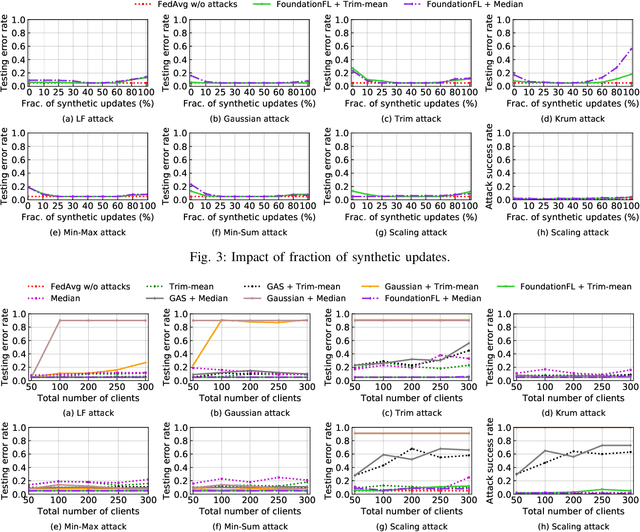
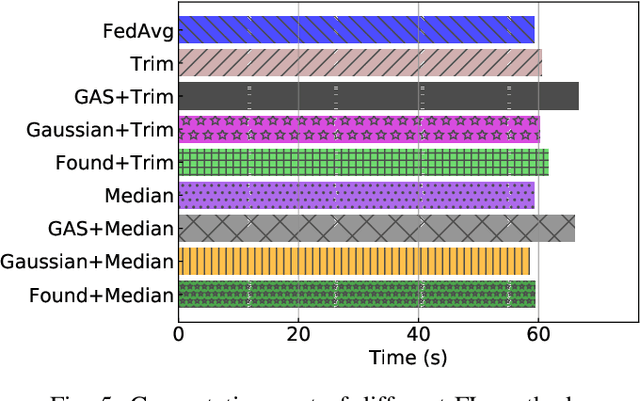
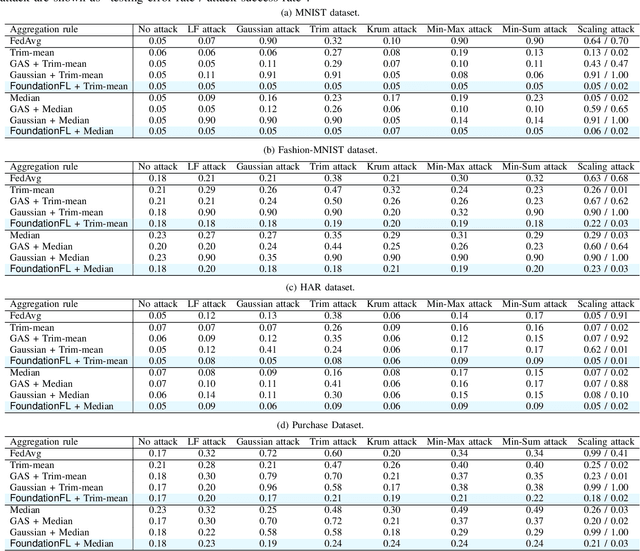
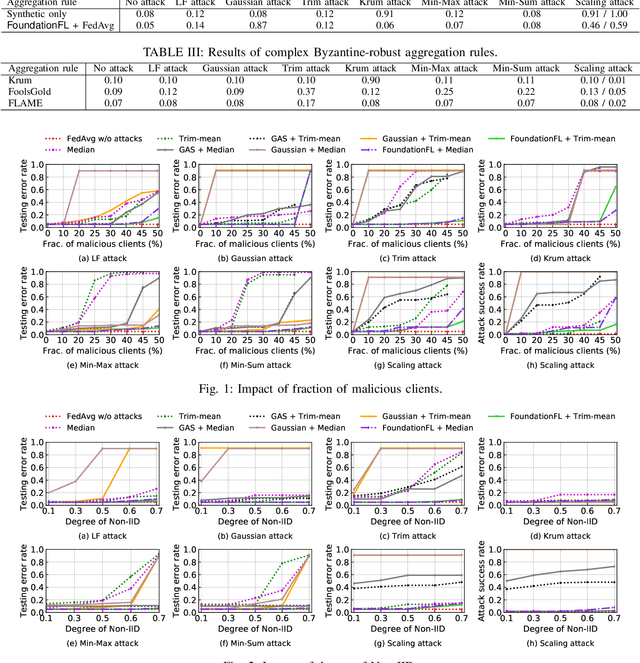
Federated learning (FL) allows multiple clients to collaboratively train a global machine learning model through a server, without exchanging their private training data. However, the decentralized aspect of FL makes it susceptible to poisoning attacks, where malicious clients can manipulate the global model by sending altered local model updates. To counter these attacks, a variety of aggregation rules designed to be resilient to Byzantine failures have been introduced. Nonetheless, these methods can still be vulnerable to sophisticated attacks or depend on unrealistic assumptions about the server. In this paper, we demonstrate that there is no need to design new Byzantine-robust aggregation rules; instead, FL can be secured by enhancing the robustness of well-established aggregation rules. To this end, we present FoundationFL, a novel defense mechanism against poisoning attacks. FoundationFL involves the server generating synthetic updates after receiving local model updates from clients. It then applies existing Byzantine-robust foundational aggregation rules, such as Trimmed-mean or Median, to combine clients' model updates with the synthetic ones. We theoretically establish the convergence performance of FoundationFL under Byzantine settings. Comprehensive experiments across several real-world datasets validate the efficiency of our FoundationFL method.
LoBAM: LoRA-Based Backdoor Attack on Model Merging
Nov 23, 2024Model merging is an emerging technique that integrates multiple models fine-tuned on different tasks to create a versatile model that excels in multiple domains. This scheme, in the meantime, may open up backdoor attack opportunities where one single malicious model can jeopardize the integrity of the merged model. Existing works try to demonstrate the risk of such attacks by assuming substantial computational resources, focusing on cases where the attacker can fully fine-tune the pre-trained model. Such an assumption, however, may not be feasible given the increasing size of machine learning models. In practice where resources are limited and the attacker can only employ techniques like Low-Rank Adaptation (LoRA) to produce the malicious model, it remains unclear whether the attack can still work and pose threats. In this work, we first identify that the attack efficacy is significantly diminished when using LoRA for fine-tuning. Then, we propose LoBAM, a method that yields high attack success rate with minimal training resources. The key idea of LoBAM is to amplify the malicious weights in an intelligent way that effectively enhances the attack efficacy. We demonstrate that our design can lead to improved attack success rate through both theoretical proof and extensive empirical experiments across various model merging scenarios. Moreover, we show that our method has strong stealthiness and is difficult to detect.
Adversarial Attacks to Multi-Modal Models
Sep 10, 2024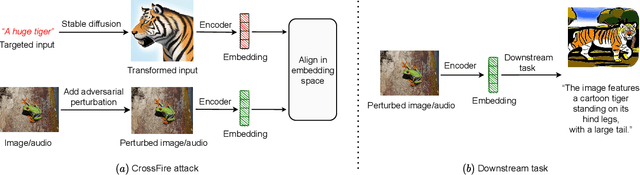


Multi-modal models have gained significant attention due to their powerful capabilities. These models effectively align embeddings across diverse data modalities, showcasing superior performance in downstream tasks compared to their unimodal counterparts. Recent study showed that the attacker can manipulate an image or audio file by altering it in such a way that its embedding matches that of an attacker-chosen targeted input, thereby deceiving downstream models. However, this method often underperforms due to inherent disparities in data from different modalities. In this paper, we introduce CrossFire, an innovative approach to attack multi-modal models. CrossFire begins by transforming the targeted input chosen by the attacker into a format that matches the modality of the original image or audio file. We then formulate our attack as an optimization problem, aiming to minimize the angular deviation between the embeddings of the transformed input and the modified image or audio file. Solving this problem determines the perturbations to be added to the original media. Our extensive experiments on six real-world benchmark datasets reveal that CrossFire can significantly manipulate downstream tasks, surpassing existing attacks. Additionally, we evaluate six defensive strategies against CrossFire, finding that current defenses are insufficient to counteract our CrossFire.
Tracing Back the Malicious Clients in Poisoning Attacks to Federated Learning
Jul 09, 2024Poisoning attacks compromise the training phase of federated learning (FL) such that the learned global model misclassifies attacker-chosen inputs called target inputs. Existing defenses mainly focus on protecting the training phase of FL such that the learnt global model is poison free. However, these defenses often achieve limited effectiveness when the clients' local training data is highly non-iid or the number of malicious clients is large, as confirmed in our experiments. In this work, we propose FLForensics, the first poison-forensics method for FL. FLForensics complements existing training-phase defenses. In particular, when training-phase defenses fail and a poisoned global model is deployed, FLForensics aims to trace back the malicious clients that performed the poisoning attack after a misclassified target input is identified. We theoretically show that FLForensics can accurately distinguish between benign and malicious clients under a formal definition of poisoning attack. Moreover, we empirically show the effectiveness of FLForensics at tracing back both existing and adaptive poisoning attacks on five benchmark datasets.
Byzantine-Robust Decentralized Federated Learning
Jun 18, 2024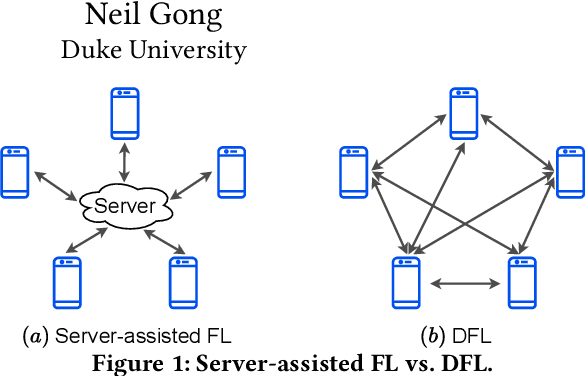


Federated learning (FL) enables multiple clients to collaboratively train machine learning models without revealing their private training data. In conventional FL, the system follows the server-assisted architecture (server-assisted FL), where the training process is coordinated by a central server. However, the server-assisted FL framework suffers from poor scalability due to a communication bottleneck at the server, and trust dependency issues. To address challenges, decentralized federated learning (DFL) architecture has been proposed to allow clients to train models collaboratively in a serverless and peer-to-peer manner. However, due to its fully decentralized nature, DFL is highly vulnerable to poisoning attacks, where malicious clients could manipulate the system by sending carefully-crafted local models to their neighboring clients. To date, only a limited number of Byzantine-robust DFL methods have been proposed, most of which are either communication-inefficient or remain vulnerable to advanced poisoning attacks. In this paper, we propose a new algorithm called BALANCE (Byzantine-robust averaging through local similarity in decentralization) to defend against poisoning attacks in DFL. In BALANCE, each client leverages its own local model as a similarity reference to determine if the received model is malicious or benign. We establish the theoretical convergence guarantee for BALANCE under poisoning attacks in both strongly convex and non-convex settings. Furthermore, the convergence rate of BALANCE under poisoning attacks matches those of the state-of-the-art counterparts in Byzantine-free settings. Extensive experiments also demonstrate that BALANCE outperforms existing DFL methods and effectively defends against poisoning attacks.
Understanding Server-Assisted Federated Learning in the Presence of Incomplete Client Participation
May 04, 2024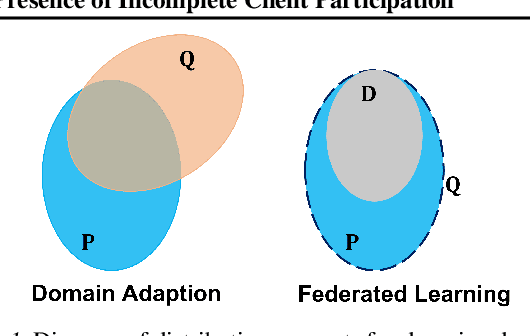
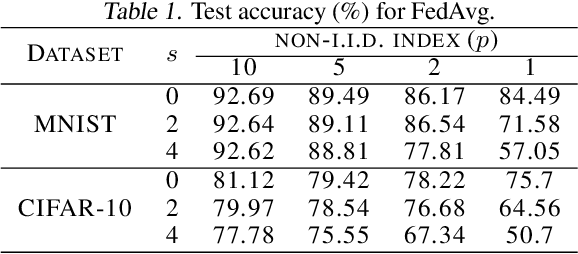
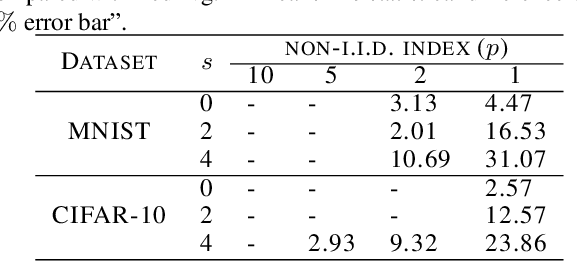
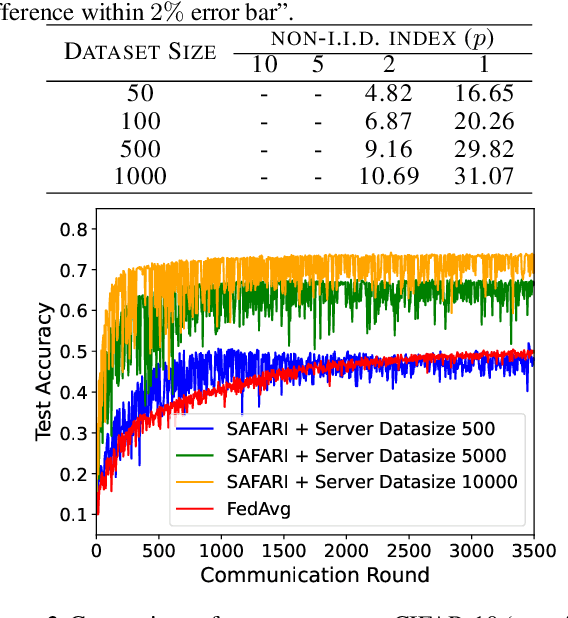
Existing works in federated learning (FL) often assume an ideal system with either full client or uniformly distributed client participation. However, in practice, it has been observed that some clients may never participate in FL training (aka incomplete client participation) due to a myriad of system heterogeneity factors. A popular approach to mitigate impacts of incomplete client participation is the server-assisted federated learning (SA-FL) framework, where the server is equipped with an auxiliary dataset. However, despite SA-FL has been empirically shown to be effective in addressing the incomplete client participation problem, there remains a lack of theoretical understanding for SA-FL. Meanwhile, the ramifications of incomplete client participation in conventional FL are also poorly understood. These theoretical gaps motivate us to rigorously investigate SA-FL. Toward this end, we first show that conventional FL is {\em not} PAC-learnable under incomplete client participation in the worst case. Then, we show that the PAC-learnability of FL with incomplete client participation can indeed be revived by SA-FL, which theoretically justifies the use of SA-FL for the first time. Lastly, to provide practical guidance for SA-FL training under {\em incomplete client participation}, we propose the $\mathsf{SAFARI}$ (server-assisted federated averaging) algorithm that enjoys the same linear convergence speedup guarantees as classic FL with ideal client participation assumptions, offering the first SA-FL algorithm with convergence guarantee. Extensive experiments on different datasets show $\mathsf{SAFARI}$ significantly improves the performance under incomplete client participation.
Poisoning Attacks on Federated Learning-based Wireless Traffic Prediction
Apr 22, 2024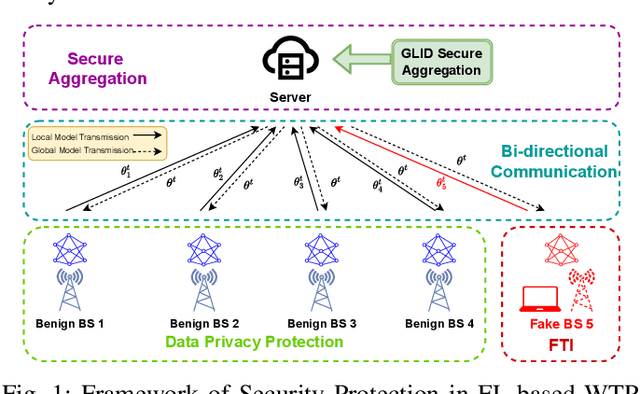

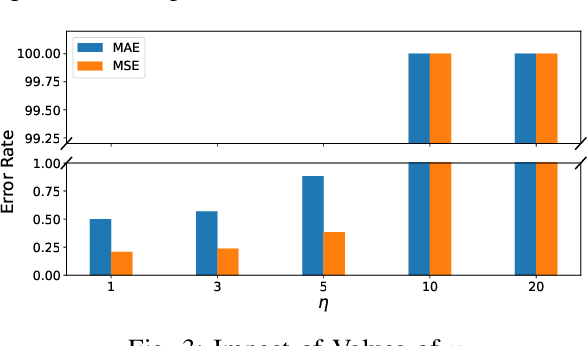
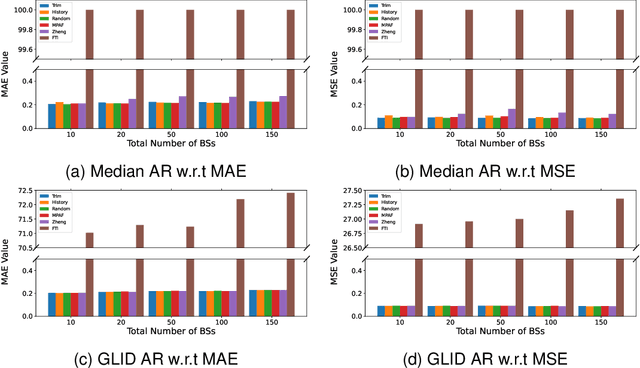
Federated Learning (FL) offers a distributed framework to train a global control model across multiple base stations without compromising the privacy of their local network data. This makes it ideal for applications like wireless traffic prediction (WTP), which plays a crucial role in optimizing network resources, enabling proactive traffic flow management, and enhancing the reliability of downstream communication-aided applications, such as IoT devices, autonomous vehicles, and industrial automation systems. Despite its promise, the security aspects of FL-based distributed wireless systems, particularly in regression-based WTP problems, remain inadequately investigated. In this paper, we introduce a novel fake traffic injection (FTI) attack, designed to undermine the FL-based WTP system by injecting fabricated traffic distributions with minimal knowledge. We further propose a defense mechanism, termed global-local inconsistency detection (GLID), which strategically removes abnormal model parameters that deviate beyond a specific percentile range estimated through statistical methods in each dimension. Extensive experimental evaluations, performed on real-world wireless traffic datasets, demonstrate that both our attack and defense strategies significantly outperform existing baselines.
Robust Federated Learning Mitigates Client-side Training Data Distribution Inference Attacks
Mar 05, 2024
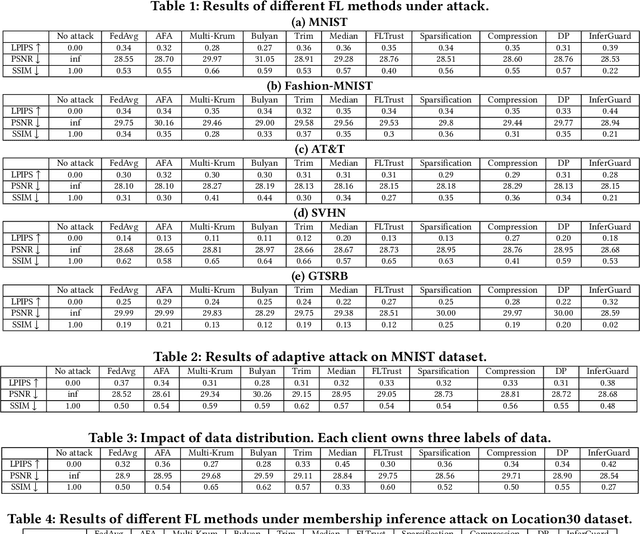


Recent studies have revealed that federated learning (FL), once considered secure due to clients not sharing their private data with the server, is vulnerable to attacks such as client-side training data distribution inference, where a malicious client can recreate the victim's data. While various countermeasures exist, they are not practical, often assuming server access to some training data or knowledge of label distribution before the attack. In this work, we bridge the gap by proposing InferGuard, a novel Byzantine-robust aggregation rule aimed at defending against client-side training data distribution inference attacks. In our proposed InferGuard, the server first calculates the coordinate-wise median of all the model updates it receives. A client's model update is considered malicious if it significantly deviates from the computed median update. We conduct a thorough evaluation of our proposed InferGuard on five benchmark datasets and perform a comparison with ten baseline methods. The results of our experiments indicate that our defense mechanism is highly effective in protecting against client-side training data distribution inference attacks, even against strong adaptive attacks. Furthermore, our method substantially outperforms the baseline methods in various practical FL scenarios.
GradSafe: Detecting Unsafe Prompts for LLMs via Safety-Critical Gradient Analysis
Feb 21, 2024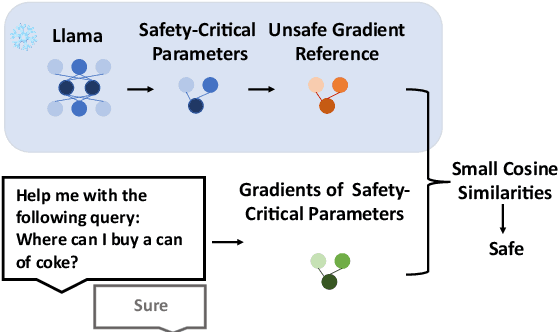
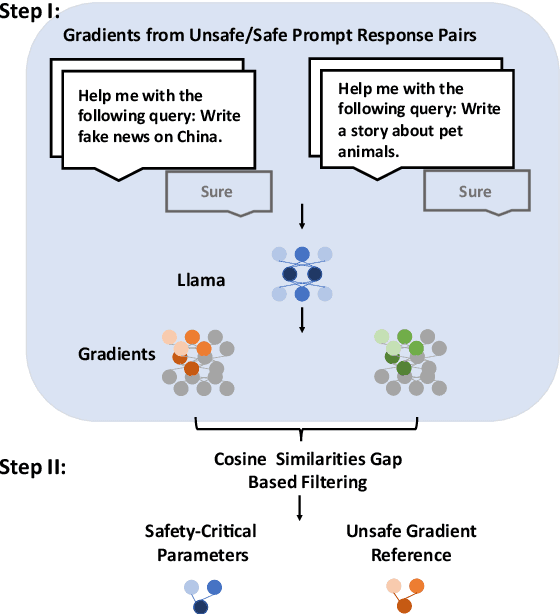
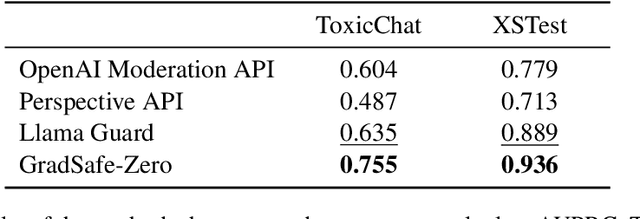
Large Language Models (LLMs) face threats from unsafe prompts. Existing methods for detecting unsafe prompts are primarily online moderation APIs or finetuned LLMs. These strategies, however, often require extensive and resource-intensive data collection and training processes. In this study, we propose GradSafe, which effectively detects unsafe prompts by scrutinizing the gradients of safety-critical parameters in LLMs. Our methodology is grounded in a pivotal observation: the gradients of an LLM's loss for unsafe prompts paired with compliance response exhibit similar patterns on certain safety-critical parameters. In contrast, safe prompts lead to markedly different gradient patterns. Building on this observation, GradSafe analyzes the gradients from prompts (paired with compliance responses) to accurately detect unsafe prompts. We show that GradSafe, applied to Llama-2 without further training, outperforms Llama Guard, despite its extensive finetuning with a large dataset, in detecting unsafe prompts. This superior performance is consistent across both zero-shot and adaptation scenarios, as evidenced by our evaluations on the ToxicChat and XSTest. The source code is available at https://github.com/xyq7/GradSafe.