 Add to Chrome
 Add to Firefox
 Add to Edge
PMF-CL: Pareto-Minimal-Forgetting Continual Learner for Conflicting Tasks
May 18, 2026
In the literature, many continual learning (CL) algorithms have been proposed to address the issue of catastrophic forgetting in ML models (i.e., learning new tasks leads to the loss of performance on previously learned tasks). Although all CL approaches use some form of memory to retain information about past tasks, a grounded understanding of what information needs to be stored to minimize catastrophic forgetting remains elusive. Recently, it has been recognized that under the strong assumption of the existence of a common global minimizer over all tasks, catastrophic forgetting can be completely avoided. However, in practice, tasks rarely have a common global minimizer, and a certain amount of forgetting is inevitable. In this paper, we propose a foundational framework for principled and systematic CL of conflicting tasks using a multi-task learning (MTL) perspective. The approach is based on finding Pareto-optimal solutions, i.e., the solutions which, by definition, minimally forget the previous tasks in the Pareto sense. We derive Pareto-minimal-forgetting CL algorithms for linear and basis-function regression, and general loss functions which have a quadratic upper bound, e.g., logistic regression. For quadratic problems, PMF-CL uses memory-efficient iterative updates with a static memory footage of $\mathcal{O}(d^2)$ for models with $d$ parameters.

Byzantine-Robust Decentralized Federated Learning
Jun 18, 2024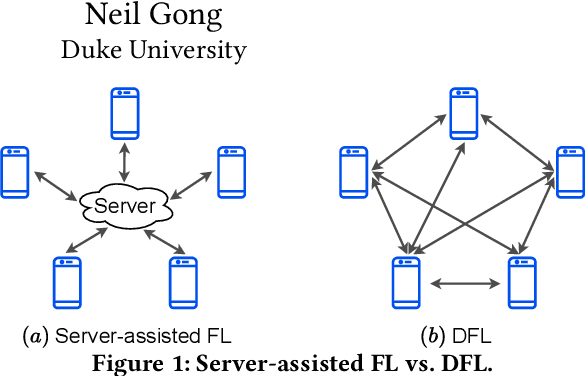


Federated learning (FL) enables multiple clients to collaboratively train machine learning models without revealing their private training data. In conventional FL, the system follows the server-assisted architecture (server-assisted FL), where the training process is coordinated by a central server. However, the server-assisted FL framework suffers from poor scalability due to a communication bottleneck at the server, and trust dependency issues. To address challenges, decentralized federated learning (DFL) architecture has been proposed to allow clients to train models collaboratively in a serverless and peer-to-peer manner. However, due to its fully decentralized nature, DFL is highly vulnerable to poisoning attacks, where malicious clients could manipulate the system by sending carefully-crafted local models to their neighboring clients. To date, only a limited number of Byzantine-robust DFL methods have been proposed, most of which are either communication-inefficient or remain vulnerable to advanced poisoning attacks. In this paper, we propose a new algorithm called BALANCE (Byzantine-robust averaging through local similarity in decentralization) to defend against poisoning attacks in DFL. In BALANCE, each client leverages its own local model as a similarity reference to determine if the received model is malicious or benign. We establish the theoretical convergence guarantee for BALANCE under poisoning attacks in both strongly convex and non-convex settings. Furthermore, the convergence rate of BALANCE under poisoning attacks matches those of the state-of-the-art counterparts in Byzantine-free settings. Extensive experiments also demonstrate that BALANCE outperforms existing DFL methods and effectively defends against poisoning attacks.