 Add to Chrome
 Add to Firefox
 Add to Edge
FinPersona-Bench: A Benchmark for Longitudinal Psychometric Stability of Autonomous Financial Agents
Jul 01, 2026
Large Language Models (LLMs) are increasingly deployed as autonomous financial agents initialized with explicit behavioral mandates such as "preserve capital" or "avoid speculative bets" that are meant to govern every decision throughout deployment. In practice, however, as market context accumulates over long horizons, these mandates gradually lose their behavioral influence, a phenomenon we formalize as Mandate Salience Decay (MSD). To measure MSD objectively, we introduce FinPersona-Bench, a simulation benchmark in which a synthetic market decouples observable price from hidden fundamental value, enabling falsifiable evaluation across three failure modes: trading without signal in calm markets, panic-selling during crashes, and ignoring fundamental value during speculative bubbles. Evaluating 18 leading frontier and open-source LLMs, each assigned one of three behavioral profiles ranging from strict capital preservation to aggressive growth, shows that MSD compounds over time and is model-dependent. In crash scenarios, the behavioral gap between static agents and those receiving periodic mandate re-grounding grows 4.4x from the first to the final quarter of the simulation. The effects of mandate re-grounding are not uniformly positive: it consistently helps conservative agents in low-signal markets but actively worsens behavior for aggressive agents in the same setting. These findings suggest that reliable long-horizon deployment requires selective, mandate-aware re-grounding based on agent profile and market regime.

Distributionally Robust Set Representation Learning Under Inference-Time Element Corruption
May 28, 2026Standard Set Representation Learning methods typically excel on curated data but often overlook the challenge of inference-time element corruption. This refers to scenarios where deployed models encounter element-level degradations, such as outliers or missing components, that may distort set representation and degrade performance. We propose SW-DRSO, a distributionally robust optimization framework tailored for sets. Rather than minimizing loss solely on observed training data, SW-DRSO optimizes a tractable surrogate of the worst-case expected loss over a family of plausible inference-time variations. We introduce a barycentric adversary that approximates the intractable search over corrupted sets by a differentiable training-time optimization over simplex weights. Extensive experiments across four tasks demonstrate that SW-DRSO effectively enhances robustness against corruption while maintaining high overall performance.
PlanRAG-Audio: Planning and Retrieval Augmented Generation for Long-form Audio Understanding
May 19, 2026Long-form audio understanding poses significant challenges for large audio language models (LALMs) due to the extreme length of audio sequences and the need to reason over heterogeneous acoustic cues distributed over time, such as speech content, speaker identity, emotion, and sound events. To address these challenges, we propose \textbf{PlanRAG-Audio}, a planning-based retrieval-augmented generation framework for scalable long-form audio understanding. Rather than having audio LALMs process entire recordings directly, PlanRAG-Audio explicitly plans which modalities and temporal spans are required for a given query, and retrieves only query-relevant information from a structured text and audio database. This retrieval planning enables effective reasoning over complex, cross-domain audio queries while substantially reducing the input length passed to the large language models. Experiments across a wide range of speech/audio retrieval demonstrate that PlanRAG-Audio improves reasoning accuracy and stabilizes performance as audio duration increases by decoupling inference cost from raw audio length.
PMF-CL: Pareto-Minimal-Forgetting Continual Learner for Conflicting Tasks
May 18, 2026In the literature, many continual learning (CL) algorithms have been proposed to address the issue of catastrophic forgetting in ML models (i.e., learning new tasks leads to the loss of performance on previously learned tasks). Although all CL approaches use some form of memory to retain information about past tasks, a grounded understanding of what information needs to be stored to minimize catastrophic forgetting remains elusive. Recently, it has been recognized that under the strong assumption of the existence of a common global minimizer over all tasks, catastrophic forgetting can be completely avoided. However, in practice, tasks rarely have a common global minimizer, and a certain amount of forgetting is inevitable. In this paper, we propose a foundational framework for principled and systematic CL of conflicting tasks using a multi-task learning (MTL) perspective. The approach is based on finding Pareto-optimal solutions, i.e., the solutions which, by definition, minimally forget the previous tasks in the Pareto sense. We derive Pareto-minimal-forgetting CL algorithms for linear and basis-function regression, and general loss functions which have a quadratic upper bound, e.g., logistic regression. For quadratic problems, PMF-CL uses memory-efficient iterative updates with a static memory footage of $\mathcal{O}(d^2)$ for models with $d$ parameters.
FinReporting: An Agentic Workflow for Localized Reporting of Cross-Jurisdiction Financial Disclosures
Apr 07, 2026Financial reporting systems increasingly use large language models (LLMs) to extract and summarize corporate disclosures. However, most assume a single-market setting and do not address structural differences across jurisdictions. Variations in accounting taxonomies, tagging infrastructures (e.g., XBRL vs. PDF), and aggregation conventions make cross-jurisdiction reporting a semantic alignment and verification challenge. We present FinReporting, an agentic workflow for localized cross-jurisdiction financial reporting. The system builds a unified canonical ontology over Income Statement, Balance Sheet, and Cash Flow, and decomposes reporting into auditable stages including filing acquisition, extraction, canonical mapping, and anomaly logging. Rather than using LLMs as free-form generators, FinReporting deploys them as constrained verifiers under explicit decision rules and evidence grounding. Evaluated on annual filings from the US, Japan, and China, the system improves consistency and reliability under heterogeneous reporting regimes. We release an interactive demo supporting cross-market inspection and structured export of localized financial statements. Our demo is available at https://huggingface.co/spaces/BoomQ/FinReporting-Demo . The video describing our system is available at https://www.youtube.com/watch?v=f65jdEL31Kk
Ruka-v2: Tendon Driven Open-Source Dexterous Hand with Wrist and Abduction for Robot Learning
Mar 27, 2026Lack of accessible and dexterous robot hardware has been a significant bottleneck to achieving human-level dexterity in robots. Last year, we released Ruka, a fully open-sourced, tendon-driven humanoid hand with 11 degrees of freedom - 2 per finger and 3 at the thumb - buildable for under $1,300. It was one of the first fully open-sourced humanoid hands, and introduced a novel data-driven approach to finger control that captures tendon dynamics within the control system. Despite these contributions, Ruka lacked two degrees of freedom essential for closely imitating human behavior: wrist mobility and finger adduction/abduction. In this paper, we introduce Ruka-v2: a fully open-sourced, tendon-driven humanoid hand featuring a decoupled 2-DOF parallel wrist and abduction/adduction at the fingers. The parallel wrist adds smooth, independent flexion/extension and radial/ulnar deviation, enabling manipulation in confined environments such as cabinets. Abduction enables motions such as grasping thin objects, in-hand rotation, and calligraphy. We present the design of Ruka-v2 and evaluate it against Ruka through user studies on teleoperated tasks, finding a 51.3% reduction in completion time and a 21.2% increase in success rate. We further demonstrate its full range of applications for robot learning: bimanual and single-arm teleoperation across 13 dexterous tasks, and autonomous policy learning on 3 tasks. All 3D print files, assembly instructions, controller software, and videos are available at https://ruka-hand-v2.github.io/ .
GMPilot: An Expert AI Agent For FDA cGMP Compliance
Mar 21, 2026The pharmaceutical industry is facing challenges with quality management such as high costs of compliance, slow responses and disjointed knowledge. This paper presents GMPilot, a domain-specific AI agent that is designed to support FDA cGMP compliance. GMPilot is based on a curated knowledge base of regulations and historical inspection observations and uses Retrieval-Augmented Generation (RAG) and Reasoning-Acting (ReAct) frameworks to provide real-time and traceable decision support to the quality professionals. In a simulated inspection scenario, GMPilot shows how it can improve the responsiveness and professionalism of quality professionals by providing structured knowledge retrieval and verifiable regulatory and case-based support. Although GMPilot lacks in the aspect of regulatory scope and model interpretability, it is a viable avenue of improving quality management decision-making in the pharmaceutical sector using intelligent approaches and an example of specialized application of AI in highly regulated sectors.
Exploring Protein Language Model Architecture-Induced Biases for Antibody Comprehension
Dec 10, 2025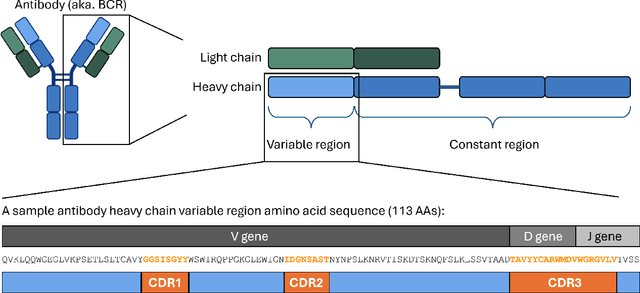

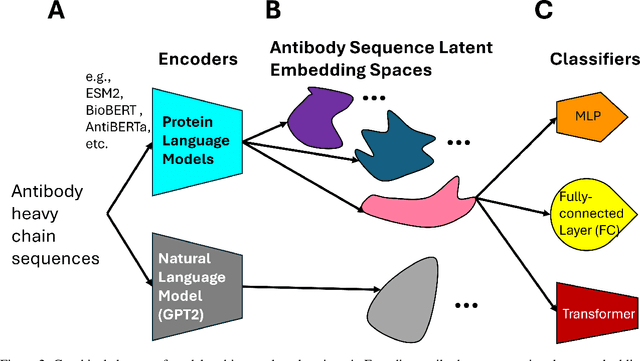
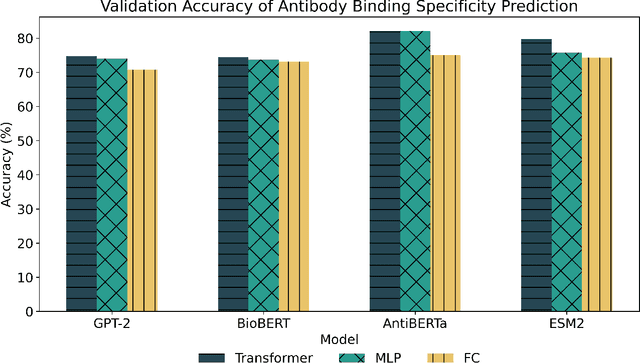
Recent advances in protein language models (PLMs) have demonstrated remarkable capabilities in understanding protein sequences. However, the extent to which different model architectures capture antibody-specific biological properties remains unexplored. In this work, we systematically investigate how architectural choices in PLMs influence their ability to comprehend antibody sequence characteristics and functions. We evaluate three state-of-the-art PLMs-AntiBERTa, BioBERT, and ESM2--against a general-purpose language model (GPT-2) baseline on antibody target specificity prediction tasks. Our results demonstrate that while all PLMs achieve high classification accuracy, they exhibit distinct biases in capturing biological features such as V gene usage, somatic hypermutation patterns, and isotype information. Through attention attribution analysis, we show that antibody-specific models like AntiBERTa naturally learn to focus on complementarity-determining regions (CDRs), while general protein models benefit significantly from explicit CDR-focused training strategies. These findings provide insights into the relationship between model architecture and biological feature extraction, offering valuable guidance for future PLM development in computational antibody design.
Independent Mobility GPT (IDM-GPT): A Self-Supervised Multi-Agent Large Language Model Framework for Customized Traffic Mobility Analysis Using Machine Learning Models
Feb 25, 2025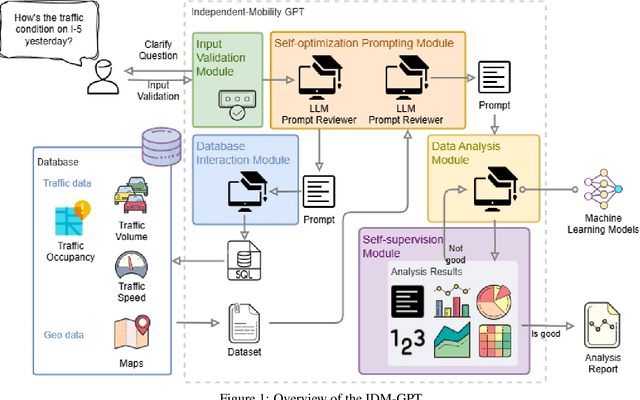
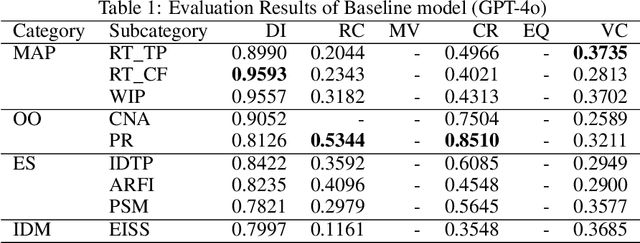
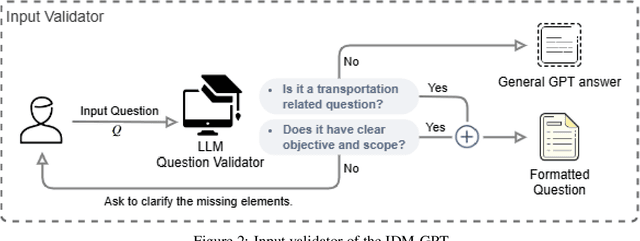
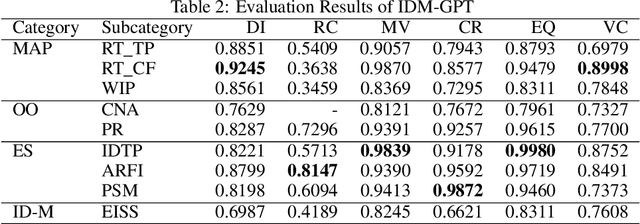
With the urbanization process, an increasing number of sensors are being deployed in transportation systems, leading to an explosion of big data. To harness the power of this vast transportation data, various machine learning (ML) and artificial intelligence (AI) methods have been introduced to address numerous transportation challenges. However, these methods often require significant investment in data collection, processing, storage, and the employment of professionals with expertise in transportation and ML. Additionally, privacy issues are a major concern when processing data for real-world traffic control and management. To address these challenges, the research team proposes an innovative Multi-agent framework named Independent Mobility GPT (IDM-GPT) based on large language models (LLMs) for customized traffic analysis, management suggestions, and privacy preservation. IDM-GPT efficiently connects users, transportation databases, and ML models economically. IDM-GPT trains, customizes, and applies various LLM-based AI agents for multiple functions, including user query comprehension, prompts optimization, data analysis, model selection, and performance evaluation and enhancement. With IDM-GPT, users without any background in transportation or ML can efficiently and intuitively obtain data analysis and customized suggestions in near real-time based on their questions. Experimental results demonstrate that IDM-GPT delivers satisfactory performance across multiple traffic-related tasks, providing comprehensive and actionable insights that support effective traffic management and urban mobility improvement.
Humanity's Last Exam
Jan 24, 2025Benchmarks are important tools for tracking the rapid advancements in large language model (LLM) capabilities. However, benchmarks are not keeping pace in difficulty: LLMs now achieve over 90\% accuracy on popular benchmarks like MMLU, limiting informed measurement of state-of-the-art LLM capabilities. In response, we introduce Humanity's Last Exam (HLE), a multi-modal benchmark at the frontier of human knowledge, designed to be the final closed-ended academic benchmark of its kind with broad subject coverage. HLE consists of 3,000 questions across dozens of subjects, including mathematics, humanities, and the natural sciences. HLE is developed globally by subject-matter experts and consists of multiple-choice and short-answer questions suitable for automated grading. Each question has a known solution that is unambiguous and easily verifiable, but cannot be quickly answered via internet retrieval. State-of-the-art LLMs demonstrate low accuracy and calibration on HLE, highlighting a significant gap between current LLM capabilities and the expert human frontier on closed-ended academic questions. To inform research and policymaking upon a clear understanding of model capabilities, we publicly release HLE at https://lastexam.ai.