 Add to Chrome
 Add to Firefox
 Add to Edge
LightPlanner: Unleashing the Reasoning Capabilities of Lightweight Large Language Models in Task Planning
Mar 11, 2025
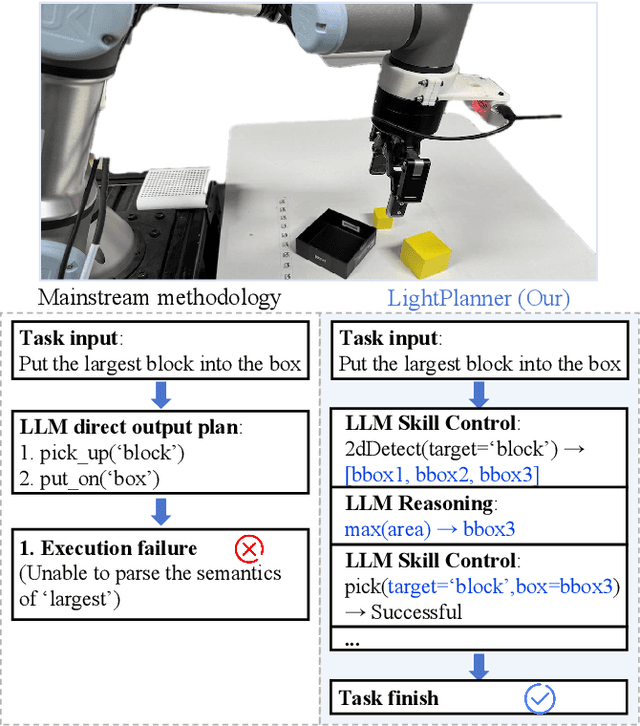
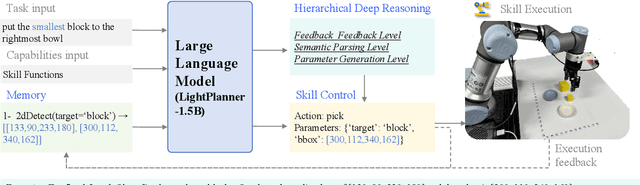
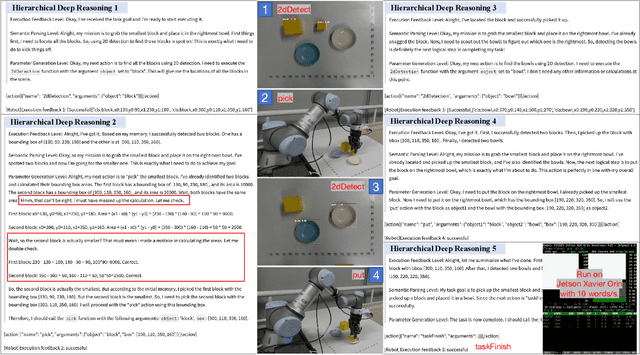
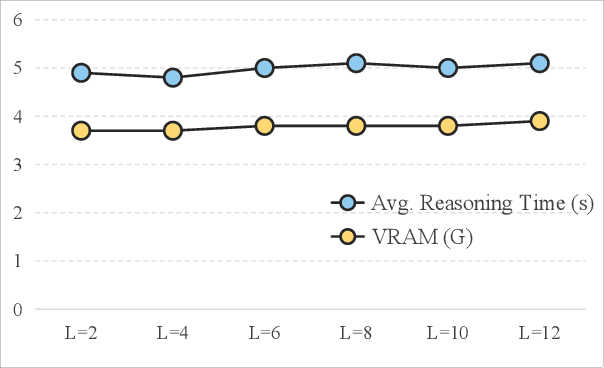
In recent years, lightweight large language models (LLMs) have garnered significant attention in the robotics field due to their low computational resource requirements and suitability for edge deployment. However, in task planning -- particularly for complex tasks that involve dynamic semantic logic reasoning -- lightweight LLMs have underperformed. To address this limitation, we propose a novel task planner, LightPlanner, which enhances the performance of lightweight LLMs in complex task planning by fully leveraging their reasoning capabilities. Unlike conventional planners that use fixed skill templates, LightPlanner controls robot actions via parameterized function calls, dynamically generating parameter values. This approach allows for fine-grained skill control and improves task planning success rates in complex scenarios. Furthermore, we introduce hierarchical deep reasoning. Before generating each action decision step, LightPlanner thoroughly considers three levels: action execution (feedback verification), semantic parsing (goal consistency verification), and parameter generation (parameter validity verification). This ensures the correctness of subsequent action controls. Additionally, we incorporate a memory module to store historical actions, thereby reducing context length and enhancing planning efficiency for long-term tasks. We train the LightPlanner-1.5B model on our LightPlan-40k dataset, which comprises 40,000 action controls across tasks with 2 to 13 action steps. Experiments demonstrate that our model achieves the highest task success rate despite having the smallest number of parameters. In tasks involving spatial semantic reasoning, the success rate exceeds that of ReAct by 14.9 percent. Moreover, we demonstrate LightPlanner's potential to operate on edge devices.

MIGA: Mutual Information-Guided Attack on Denoising Models for Semantic Manipulation
Mar 11, 2025Deep learning-based denoising models have been widely employed in vision tasks, functioning as filters to eliminate noise while retaining crucial semantic information. Additionally, they play a vital role in defending against adversarial perturbations that threaten downstream tasks. However, these models can be intrinsically susceptible to adversarial attacks due to their dependence on specific noise assumptions. Existing attacks on denoising models mainly aim at deteriorating visual clarity while neglecting semantic manipulation, rendering them either easily detectable or limited in effectiveness. In this paper, we propose Mutual Information-Guided Attack (MIGA), the first method designed to directly attack deep denoising models by strategically disrupting their ability to preserve semantic content via adversarial perturbations. By minimizing the mutual information between the original and denoised images, a measure of semantic similarity. MIGA forces the denoiser to produce perceptually clean yet semantically altered outputs. While these images appear visually plausible, they encode systematically distorted semantics, revealing a fundamental vulnerability in denoising models. These distortions persist in denoised outputs and can be quantitatively assessed through downstream task performance. We propose new evaluation metrics and systematically assess MIGA on four denoising models across five datasets, demonstrating its consistent effectiveness in disrupting semantic fidelity. Our findings suggest that denoising models are not always robust and can introduce security risks in real-world applications.
FLARE: A Framework for Stellar Flare Forecasting using Stellar Physical Properties and Historical Records
Feb 25, 2025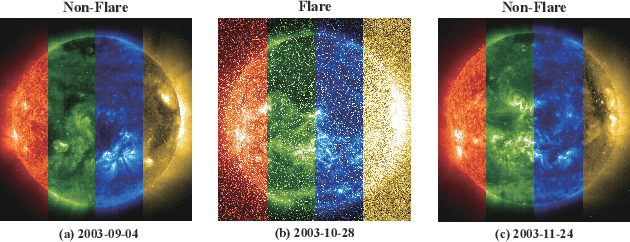
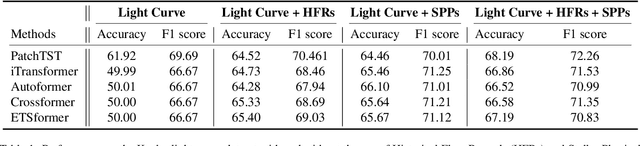
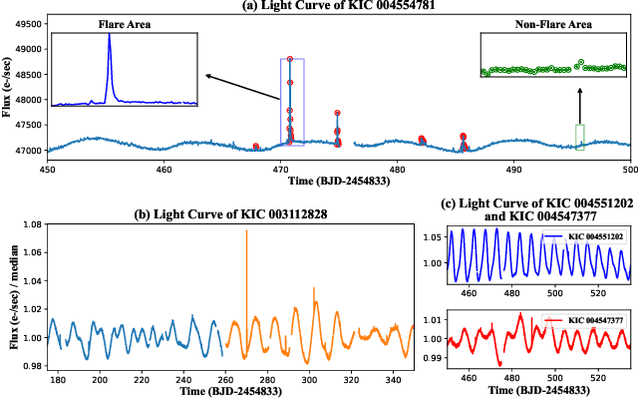
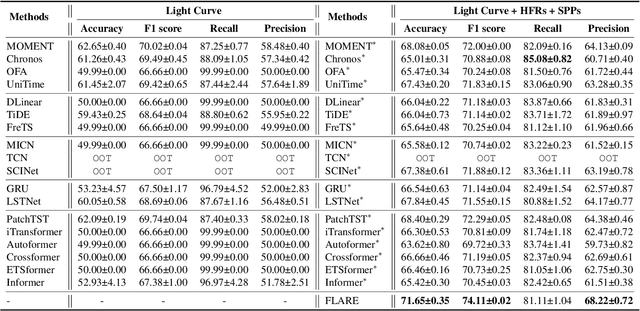
Stellar flare events are critical observational samples for astronomical research; however, recorded flare events remain limited. Stellar flare forecasting can provide additional flare event samples to support research efforts. Despite this potential, no specialized models for stellar flare forecasting have been proposed to date. In this paper, we present extensive experimental evidence demonstrating that both stellar physical properties and historical flare records are valuable inputs for flare forecasting tasks. We then introduce FLARE (Forecasting Light-curve-based Astronomical Records via features Ensemble), the first-of-its-kind large model specifically designed for stellar flare forecasting. FLARE integrates stellar physical properties and historical flare records through a novel Soft Prompt Module and Residual Record Fusion Module. Our experiments on the publicly available Kepler light curve dataset demonstrate that FLARE achieves superior performance compared to other methods across all evaluation metrics. Finally, we validate the forecast capability of our model through a comprehensive case study.
Zero Token-Driven Deep Thinking in LLMs: Unlocking the Full Potential of Existing Parameters via Cyclic Refinement
Feb 17, 2025Resource limitations often constrain the parameter counts of Large Language Models (LLMs), hindering their performance. While existing methods employ parameter sharing to reuse the same parameter set under fixed budgets, such approaches typically force each layer to assume multiple roles with a predetermined number of iterations, restricting efficiency and adaptability. In this work, we propose the Zero Token Transformer (ZTT), which features a head-tail decoupled parameter cycling method. We disentangle the first (head) and last (tail) layers from parameter cycling and iteratively refine only the intermediate layers. Furthermore, we introduce a Zero-Token Mechanism, an internal architectural component rather than an input token, to guide layer-specific computation. At each cycle, the model retrieves a zero token (with trainable key values) from a Zero-Token Pool, integrating it alongside regular tokens in the attention mechanism. The corresponding attention scores not only reflect each layer's computational importance but also enable dynamic early exits without sacrificing overall model accuracy. Our approach achieves superior performance under tight parameter budgets, effectively reduces computational overhead via early exits, and can be readily applied to fine-tune existing pre-trained models for enhanced efficiency and adaptability.
Systematic Outliers in Large Language Models
Feb 10, 2025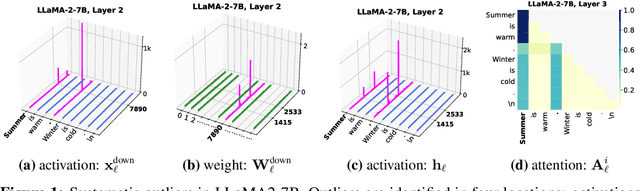
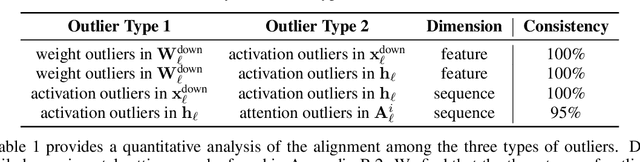
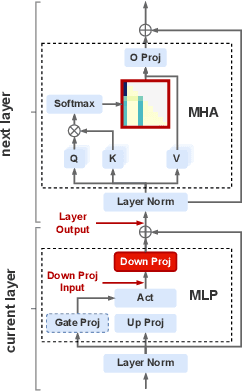
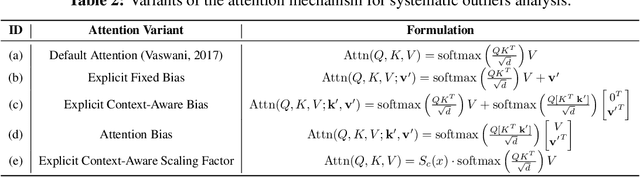
Outliers have been widely observed in Large Language Models (LLMs), significantly impacting model performance and posing challenges for model compression. Understanding the functionality and formation mechanisms of these outliers is critically important. Existing works, however, largely focus on reducing the impact of outliers from an algorithmic perspective, lacking an in-depth investigation into their causes and roles. In this work, we provide a detailed analysis of the formation process, underlying causes, and functions of outliers in LLMs. We define and categorize three types of outliers-activation outliers, weight outliers, and attention outliers-and analyze their distributions across different dimensions, uncovering inherent connections between their occurrences and their ultimate influence on the attention mechanism. Based on these observations, we hypothesize and explore the mechanisms by which these outliers arise and function, demonstrating through theoretical derivations and experiments that they emerge due to the self-attention mechanism's softmax operation. These outliers act as implicit context-aware scaling factors within the attention mechanism. As these outliers stem from systematic influences, we term them systematic outliers. Our study not only enhances the understanding of Transformer-based LLMs but also shows that structurally eliminating outliers can accelerate convergence and improve model compression. The code is avilable at https://github.com/an-yongqi/systematic-outliers.
Label Anything: An Interpretable, High-Fidelity and Prompt-Free Annotator
Feb 05, 2025
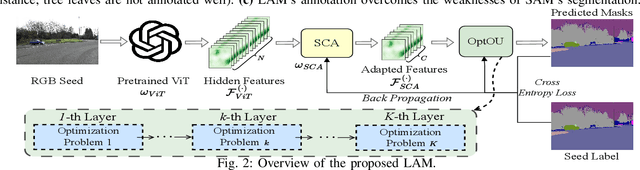
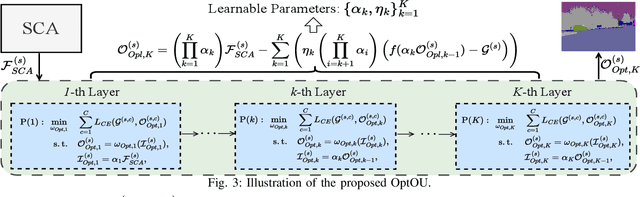

Learning-based street scene semantic understanding in autonomous driving (AD) has advanced significantly recently, but the performance of the AD model is heavily dependent on the quantity and quality of the annotated training data. However, traditional manual labeling involves high cost to annotate the vast amount of required data for training robust model. To mitigate this cost of manual labeling, we propose a Label Anything Model (denoted as LAM), serving as an interpretable, high-fidelity, and prompt-free data annotator. Specifically, we firstly incorporate a pretrained Vision Transformer (ViT) to extract the latent features. On top of ViT, we propose a semantic class adapter (SCA) and an optimization-oriented unrolling algorithm (OptOU), both with a quite small number of trainable parameters. SCA is proposed to fuse ViT-extracted features to consolidate the basis of the subsequent automatic annotation. OptOU consists of multiple cascading layers and each layer contains an optimization formulation to align its output with the ground truth as closely as possible, though which OptOU acts as being interpretable rather than learning-based blackbox nature. In addition, training SCA and OptOU requires only a single pre-annotated RGB seed image, owing to their small volume of learnable parameters. Extensive experiments clearly demonstrate that the proposed LAM can generate high-fidelity annotations (almost 100% in mIoU) for multiple real-world datasets (i.e., Camvid, Cityscapes, and Apolloscapes) and CARLA simulation dataset.
FiLo++: Zero-/Few-Shot Anomaly Detection by Fused Fine-Grained Descriptions and Deformable Localization
Jan 17, 2025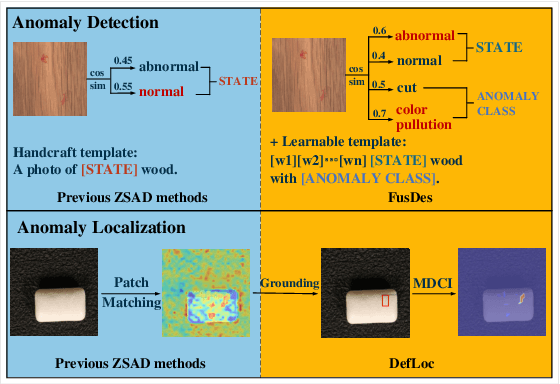
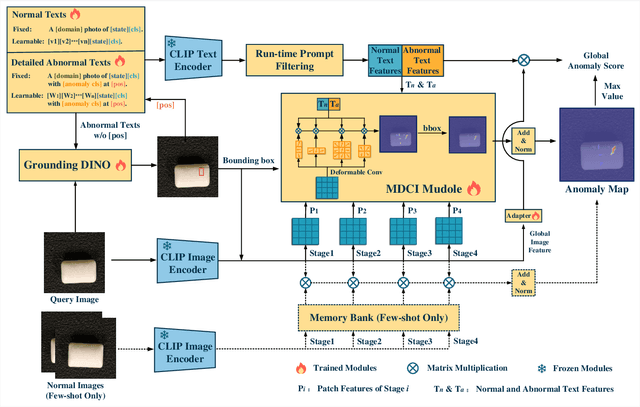
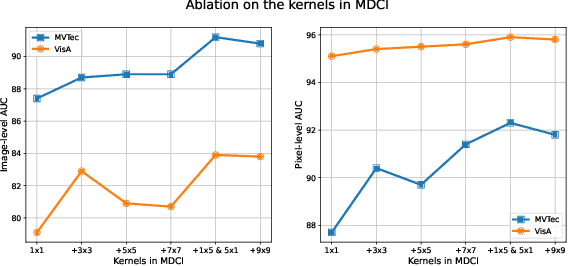
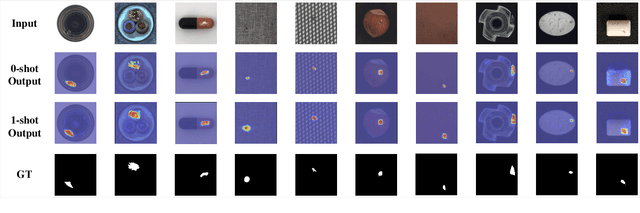
Anomaly detection methods typically require extensive normal samples from the target class for training, limiting their applicability in scenarios that require rapid adaptation, such as cold start. Zero-shot and few-shot anomaly detection do not require labeled samples from the target class in advance, making them a promising research direction. Existing zero-shot and few-shot approaches often leverage powerful multimodal models to detect and localize anomalies by comparing image-text similarity. However, their handcrafted generic descriptions fail to capture the diverse range of anomalies that may emerge in different objects, and simple patch-level image-text matching often struggles to localize anomalous regions of varying shapes and sizes. To address these issues, this paper proposes the FiLo++ method, which consists of two key components. The first component, Fused Fine-Grained Descriptions (FusDes), utilizes large language models to generate anomaly descriptions for each object category, combines both fixed and learnable prompt templates and applies a runtime prompt filtering method, producing more accurate and task-specific textual descriptions. The second component, Deformable Localization (DefLoc), integrates the vision foundation model Grounding DINO with position-enhanced text descriptions and a Multi-scale Deformable Cross-modal Interaction (MDCI) module, enabling accurate localization of anomalies with various shapes and sizes. In addition, we design a position-enhanced patch matching approach to improve few-shot anomaly detection performance. Experiments on multiple datasets demonstrate that FiLo++ achieves significant performance improvements compared with existing methods. Code will be available at https://github.com/CASIA-IVA-Lab/FiLo.
Enhancing Large Vision Model in Street Scene Semantic Understanding through Leveraging Posterior Optimization Trajectory
Jan 03, 2025To improve the generalization of the autonomous driving (AD) perception model, vehicles need to update the model over time based on the continuously collected data. As time progresses, the amount of data fitted by the AD model expands, which helps to improve the AD model generalization substantially. However, such ever-expanding data is a double-edged sword for the AD model. Specifically, as the fitted data volume grows to exceed the the AD model's fitting capacities, the AD model is prone to under-fitting. To address this issue, we propose to use a pretrained Large Vision Models (LVMs) as backbone coupled with downstream perception head to understand AD semantic information. This design can not only surmount the aforementioned under-fitting problem due to LVMs' powerful fitting capabilities, but also enhance the perception generalization thanks to LVMs' vast and diverse training data. On the other hand, to mitigate vehicles' computational burden of training the perception head while running LVM backbone, we introduce a Posterior Optimization Trajectory (POT)-Guided optimization scheme (POTGui) to accelerate the convergence. Concretely, we propose a POT Generator (POTGen) to generate posterior (future) optimization direction in advance to guide the current optimization iteration, through which the model can generally converge within 10 epochs. Extensive experiments demonstrate that the proposed method improves the performance by over 66.48\% and converges faster over 6 times, compared to the existing state-of-the-art approach.
Cracking the Code of Hallucination in LVLMs with Vision-aware Head Divergence
Dec 18, 2024


Large vision-language models (LVLMs) have made substantial progress in integrating large language models (LLMs) with visual inputs, enabling advanced multimodal reasoning. Despite their success, a persistent challenge is hallucination-where generated text fails to accurately reflect visual content-undermining both accuracy and reliability. Existing methods focus on alignment training or decoding refinements but primarily address symptoms at the generation stage without probing the underlying causes. In this work, we investigate the internal mechanisms driving hallucination in LVLMs, with an emphasis on the multi-head attention module. Specifically, we introduce Vision-aware Head Divergence (VHD), a metric that quantifies the sensitivity of attention head outputs to visual context. Based on this, our findings reveal the presence of vision-aware attention heads that are more attuned to visual information; however, the model's overreliance on its prior language patterns is closely related to hallucinations. Building on these insights, we propose Vision-aware Head Reinforcement (VHR), a training-free approach to mitigate hallucination by enhancing the role of vision-aware attention heads. Extensive experiments demonstrate that our method achieves superior performance compared to state-of-the-art approaches in mitigating hallucinations, while maintaining high efficiency with negligible additional time overhead.
UniVAD: A Training-free Unified Model for Few-shot Visual Anomaly Detection
Dec 05, 2024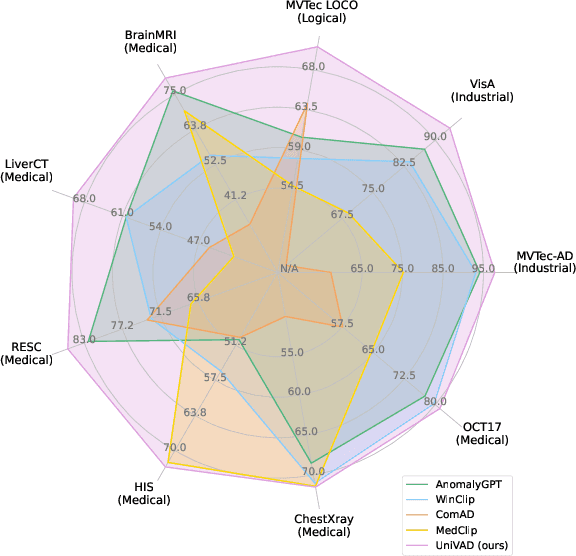
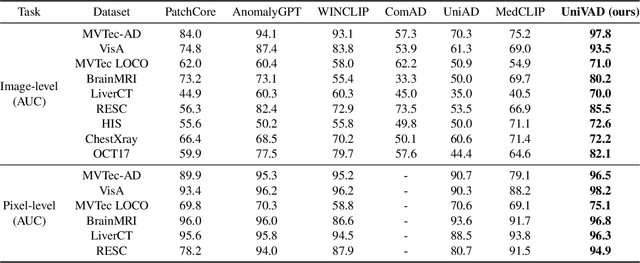

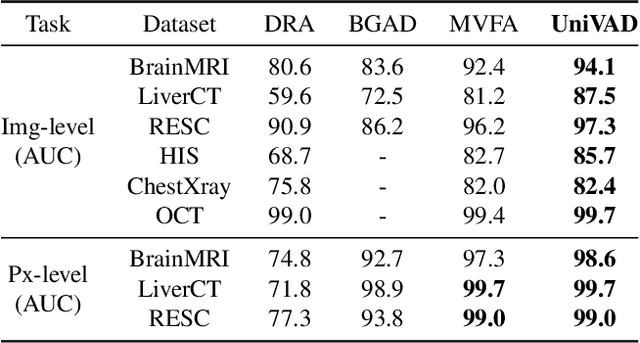
Visual Anomaly Detection (VAD) aims to identify abnormal samples in images that deviate from normal patterns, covering multiple domains, including industrial, logical, and medical fields. Due to the domain gaps between these fields, existing VAD methods are typically tailored to each domain, with specialized detection techniques and model architectures that are difficult to generalize across different domains. Moreover, even within the same domain, current VAD approaches often follow a "one-category-one-model" paradigm, requiring large amounts of normal samples to train class-specific models, resulting in poor generalizability and hindering unified evaluation across domains. To address this issue, we propose a generalized few-shot VAD method, UniVAD, capable of detecting anomalies across various domains, such as industrial, logical, and medical anomalies, with a training-free unified model. UniVAD only needs few normal samples as references during testing to detect anomalies in previously unseen objects, without training on the specific domain. Specifically, UniVAD employs a Contextual Component Clustering ($C^3$) module based on clustering and vision foundation models to segment components within the image accurately, and leverages Component-Aware Patch Matching (CAPM) and Graph-Enhanced Component Modeling (GECM) modules to detect anomalies at different semantic levels, which are aggregated to produce the final detection result. We conduct experiments on nine datasets spanning industrial, logical, and medical fields, and the results demonstrate that UniVAD achieves state-of-the-art performance in few-shot anomaly detection tasks across multiple domains, outperforming domain-specific anomaly detection models. The code will be made publicly available.