 Add to Chrome
 Add to Firefox
 Add to Edge
Beyond Image Borders: Learning Feature Extrapolation for Unbounded Image Composition
Sep 21, 2023
For improving image composition and aesthetic quality, most existing methods modulate the captured images by striking out redundant content near the image borders. However, such image cropping methods are limited in the range of image views. Some methods have been suggested to extrapolate the images and predict cropping boxes from the extrapolated image. Nonetheless, the synthesized extrapolated regions may be included in the cropped image, making the image composition result not real and potentially with degraded image quality. In this paper, we circumvent this issue by presenting a joint framework for both unbounded recommendation of camera view and image composition (i.e., UNIC). In this way, the cropped image is a sub-image of the image acquired by the predicted camera view, and thus can be guaranteed to be real and consistent in image quality. Specifically, our framework takes the current camera preview frame as input and provides a recommendation for view adjustment, which contains operations unlimited by the image borders, such as zooming in or out and camera movement. To improve the prediction accuracy of view adjustment prediction, we further extend the field of view by feature extrapolation. After one or several times of view adjustments, our method converges and results in both a camera view and a bounding box showing the image composition recommendation. Extensive experiments are conducted on the datasets constructed upon existing image cropping datasets, showing the effectiveness of our UNIC in unbounded recommendation of camera view and image composition. The source code, dataset, and pretrained models is available at https://github.com/liuxiaoyu1104/UNIC.

Rethinking Imitation-based Planner for Autonomous Driving
Sep 19, 2023In recent years, imitation-based driving planners have reported considerable success. However, due to the absence of a standardized benchmark, the effectiveness of various designs remains unclear. The newly released nuPlan addresses this issue by offering a large-scale real-world dataset and a standardized closed-loop benchmark for equitable comparisons. Utilizing this platform, we conduct a comprehensive study on two fundamental yet underexplored aspects of imitation-based planners: the essential features for ego planning and the effective data augmentation techniques to reduce compounding errors. Furthermore, we highlight an imitation gap that has been overlooked by current learning systems. Finally, integrating our findings, we propose a strong baseline model-PlanTF. Our results demonstrate that a well-designed, purely imitation-based planner can achieve highly competitive performance compared to state-of-the-art methods involving hand-crafted rules and exhibit superior generalization capabilities in long-tail cases. Our models and benchmarks are publicly available. Project website https://jchengai.github.io/planTF.
MetaF2N: Blind Image Super-Resolution by Learning Efficient Model Adaptation from Faces
Sep 15, 2023Due to their highly structured characteristics, faces are easier to recover than natural scenes for blind image super-resolution. Therefore, we can extract the degradation representation of an image from the low-quality and recovered face pairs. Using the degradation representation, realistic low-quality images can then be synthesized to fine-tune the super-resolution model for the real-world low-quality image. However, such a procedure is time-consuming and laborious, and the gaps between recovered faces and the ground-truths further increase the optimization uncertainty. To facilitate efficient model adaptation towards image-specific degradations, we propose a method dubbed MetaF2N, which leverages the contained Faces to fine-tune model parameters for adapting to the whole Natural image in a Meta-learning framework. The degradation extraction and low-quality image synthesis steps are thus circumvented in our MetaF2N, and it requires only one fine-tuning step to get decent performance. Considering the gaps between the recovered faces and ground-truths, we further deploy a MaskNet for adaptively predicting loss weights at different positions to reduce the impact of low-confidence areas. To evaluate our proposed MetaF2N, we have collected a real-world low-quality dataset with one or multiple faces in each image, and our MetaF2N achieves superior performance on both synthetic and real-world datasets. Source code, pre-trained models, and collected datasets are available at https://github.com/yinzhicun/MetaF2N.
Curriculum Proximal Policy Optimization with Stage-Decaying Clipping for Self-Driving at Unsignalized Intersections
Aug 31, 2023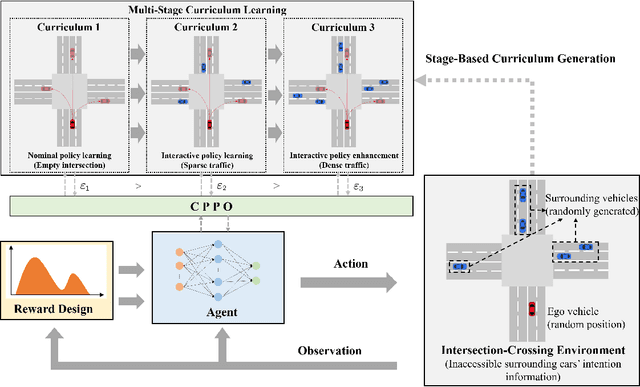
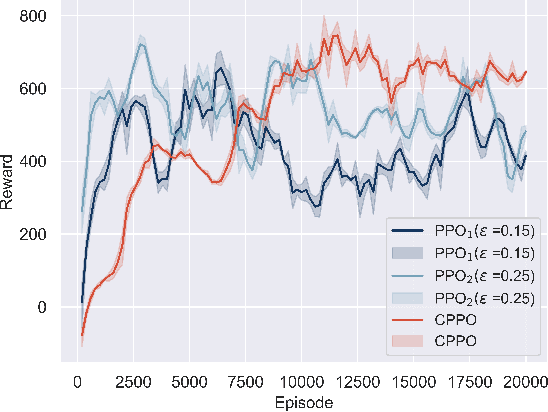
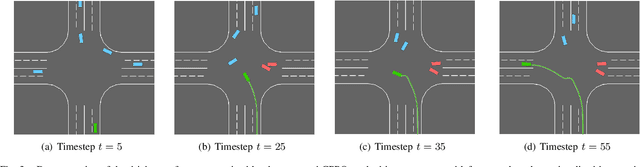
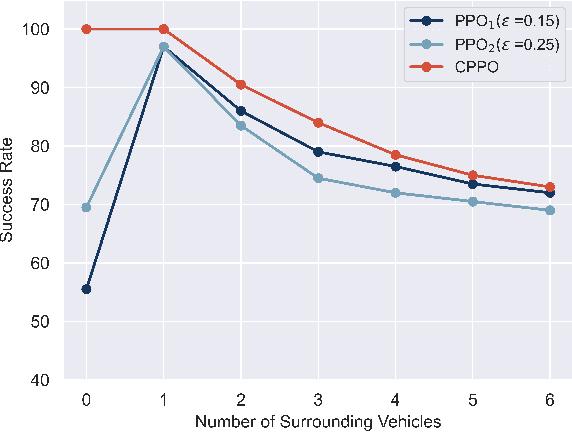
Unsignalized intersections are typically considered as one of the most representative and challenging scenarios for self-driving vehicles. To tackle autonomous driving problems in such scenarios, this paper proposes a curriculum proximal policy optimization (CPPO) framework with stage-decaying clipping. By adjusting the clipping parameter during different stages of training through proximal policy optimization (PPO), the vehicle can first rapidly search for an approximate optimal policy or its neighborhood with a large parameter, and then converges to the optimal policy with a small one. Particularly, the stage-based curriculum learning technology is incorporated into the proposed framework to improve the generalization performance and further accelerate the training process. Moreover, the reward function is specially designed in view of different curriculum settings. A series of comparative experiments are conducted in intersection-crossing scenarios with bi-lane carriageways to verify the effectiveness of the proposed CPPO method. The results show that the proposed approach demonstrates better adaptiveness to different dynamic and complex environments, as well as faster training speed over baseline methods.
Efficient Ray Sampling for Radiance Fields Reconstruction
Aug 29, 2023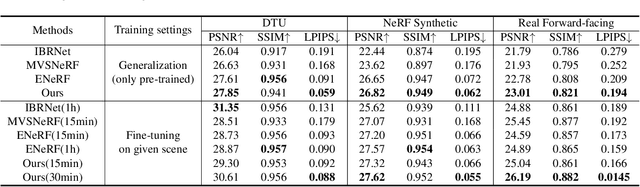
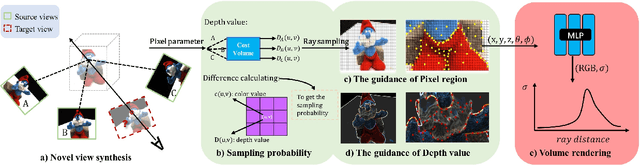
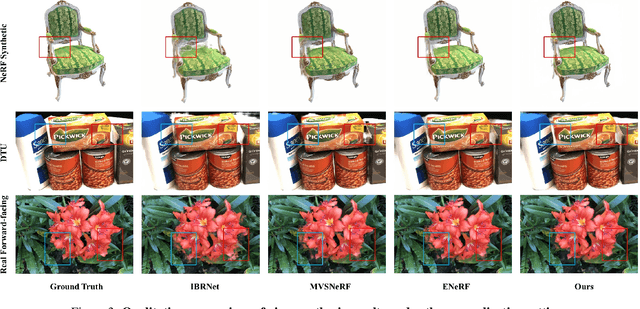
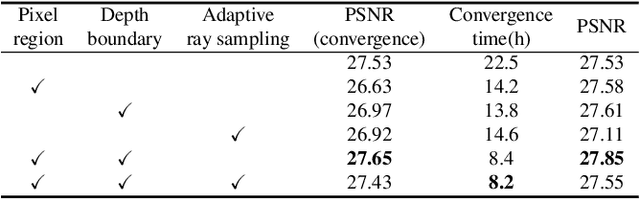
Accelerating neural radiance fields training is of substantial practical value, as the ray sampling strategy profoundly impacts network convergence. More efficient ray sampling can thus directly enhance existing NeRF models' training efficiency. We therefore propose a novel ray sampling approach for neural radiance fields that improves training efficiency while retaining photorealistic rendering results. First, we analyze the relationship between the pixel loss distribution of sampled rays and rendering quality. This reveals redundancy in the original NeRF's uniform ray sampling. Guided by this finding, we develop a sampling method leveraging pixel regions and depth boundaries. Our main idea is to sample fewer rays in training views, yet with each ray more informative for scene fitting. Sampling probability increases in pixel areas exhibiting significant color and depth variation, greatly reducing wasteful rays from other regions without sacrificing precision. Through this method, not only can the convergence of the network be accelerated, but the spatial geometry of a scene can also be perceived more accurately. Rendering outputs are enhanced, especially for texture-complex regions. Experiments demonstrate that our method significantly outperforms state-of-the-art techniques on public benchmark datasets.
Forecast-MAE: Self-supervised Pre-training for Motion Forecasting with Masked Autoencoders
Aug 19, 2023This study explores the application of self-supervised learning (SSL) to the task of motion forecasting, an area that has not yet been extensively investigated despite the widespread success of SSL in computer vision and natural language processing. To address this gap, we introduce Forecast-MAE, an extension of the mask autoencoders framework that is specifically designed for self-supervised learning of the motion forecasting task. Our approach includes a novel masking strategy that leverages the strong interconnections between agents' trajectories and road networks, involving complementary masking of agents' future or history trajectories and random masking of lane segments. Our experiments on the challenging Argoverse 2 motion forecasting benchmark show that Forecast-MAE, which utilizes standard Transformer blocks with minimal inductive bias, achieves competitive performance compared to state-of-the-art methods that rely on supervised learning and sophisticated designs. Moreover, it outperforms the previous self-supervised learning method by a significant margin. Code is available at https://github.com/jchengai/forecast-mae.
Recent Advances in Hierarchical Multi-label Text Classification: A Survey
Jul 30, 2023Hierarchical multi-label text classification aims to classify the input text into multiple labels, among which the labels are structured and hierarchical. It is a vital task in many real world applications, e.g. scientific literature archiving. In this paper, we survey the recent progress of hierarchical multi-label text classification, including the open sourced data sets, the main methods, evaluation metrics, learning strategies and the current challenges. A few future research directions are also listed for community to further improve this field.
Car-Studio: Learning Car Radiance Fields from Single-View and Endless In-the-wild Images
Jul 26, 2023Compositional neural scene graph studies have shown that radiance fields can be an efficient tool in an editable autonomous driving simulator. However, previous studies learned within a sequence of autonomous driving datasets, resulting in unsatisfactory blurring when rotating the car in the simulator. In this letter, we propose a pipeline for learning unconstrained images and building a dataset from processed images. To meet the requirements of the simulator, which demands that the vehicle maintain clarity when the perspective changes and that the contour remains sharp from the background to avoid artifacts when editing, we design a radiation field of the vehicle, a crucial part of the urban scene foreground. Through experiments, we demonstrate that our model achieves competitive performance compared to baselines. Using the datasets built from in-the-wild images, our method gradually presents a controllable appearance editing function. We will release the dataset and code on https://lty2226262.github.io/car-studio/ to facilitate further research in the field.
Adaptive Control of Resource Flow to Optimize Construction Work and Cash Flow via Online Deep Reinforcement Learning
Jul 20, 2023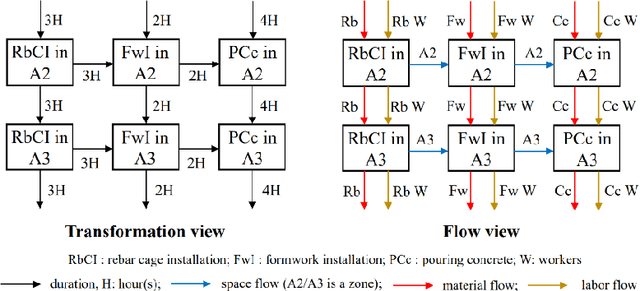
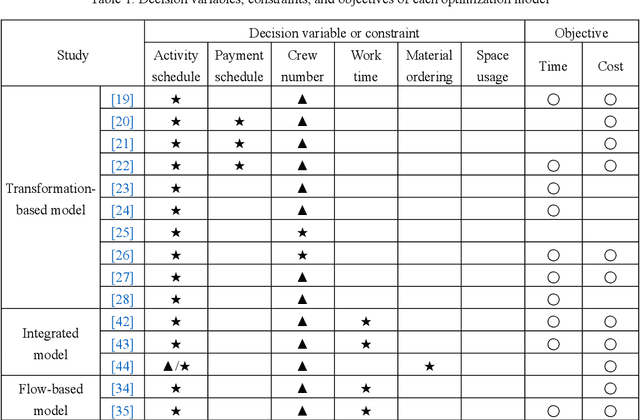
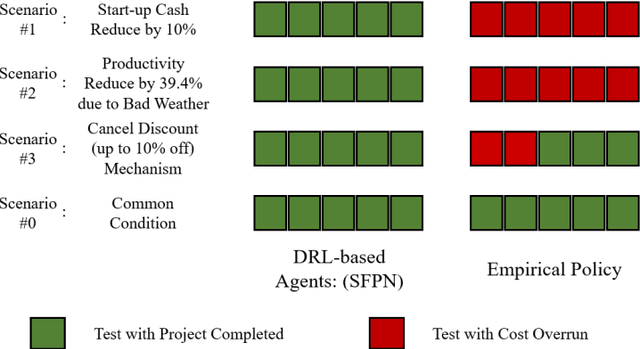

Due to complexity and dynamics of construction work, resource, and cash flows, poor management of them usually leads to time and cost overruns, bankruptcy, even project failure. Existing approaches in construction failed to achieve optimal control of resource flow in a dynamic environment with uncertainty. Therefore, this paper introducess a model and method to adaptive control the resource flows to optimize the work and cash flows of construction projects. First, a mathematical model based on a partially observable Markov decision process is established to formulate the complex interactions of construction work, resource, and cash flows as well as uncertainty and variability of diverse influence factors. Meanwhile, to efficiently find the optimal solutions, a deep reinforcement learning (DRL) based method is introduced to realize the continuous adaptive optimal control of labor and material flows, thereby optimizing the work and cash flows. To assist the training process of DRL, a simulator based on discrete event simulation is also developed to mimic the dynamic features and external environments of a project. Experiments in simulated scenarios illustrate that our method outperforms the vanilla empirical method and genetic algorithm, possesses remarkable capability in diverse projects and external environments, and a hybrid agent of DRL and empirical method leads to the best result. This paper contributes to adaptive control and optimization of coupled work, resource, and cash flows, and may serve as a step stone for adopting DRL technology in construction project management.
Make Text Unlearnable: Exploiting Effective Patterns to Protect Personal Data
Jul 02, 2023This paper addresses the ethical concerns arising from the use of unauthorized public data in deep learning models and proposes a novel solution. Specifically, building on the work of Huang et al. (2021), we extend their bi-level optimization approach to generate unlearnable text using a gradient-based search technique. However, although effective, this approach faces practical limitations, including the requirement of batches of instances and model architecture knowledge that is not readily accessible to ordinary users with limited access to their own data. Furthermore, even with semantic-preserving constraints, unlearnable noise can alter the text's semantics. To address these challenges, we extract simple patterns from unlearnable text produced by bi-level optimization and demonstrate that the data remains unlearnable for unknown models. Additionally, these patterns are not instance- or dataset-specific, allowing users to readily apply them to text classification and question-answering tasks, even if only a small proportion of users implement them on their public content. We also open-source codes to generate unlearnable text and assess unlearnable noise to benefit the public and future studies.