 Add to Chrome
 Add to Firefox
 Add to Edge
The ACL OCL Corpus: advancing Open science in Computational Linguistics
May 24, 2023
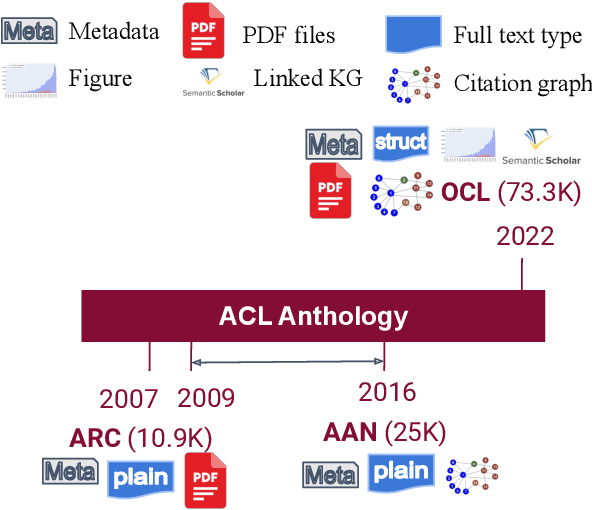
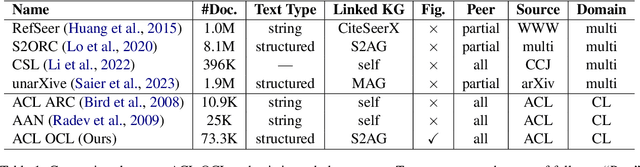
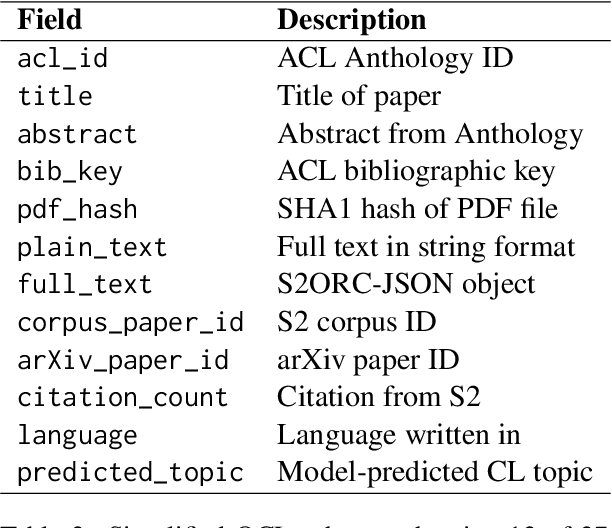
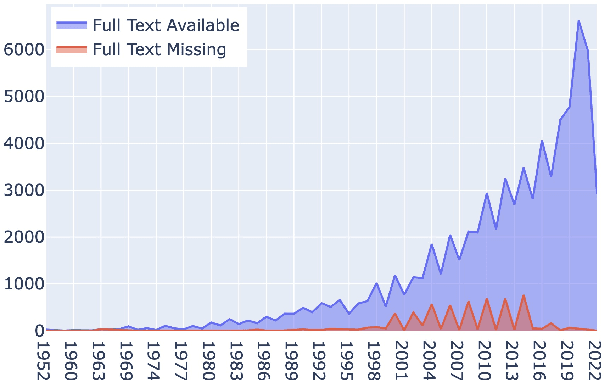
We present a scholarly corpus from the ACL Anthology to assist Open scientific research in the Computational Linguistics domain, named as ACL OCL. Compared with previous ARC and AAN versions, ACL OCL includes structured full-texts with logical sections, references to figures, and links to a large knowledge resource (semantic scholar). ACL OCL contains 74k scientific papers, together with 210k figures extracted up to September 2022. To observe the development in the computational linguistics domain, we detect the topics of all OCL papers with a supervised neural model. We observe ''Syntax: Tagging, Chunking and Parsing'' topic is significantly shrinking and ''Natural Language Generation'' is resurging. Our dataset is open and available to download from HuggingFace in https://huggingface.co/datasets/ACL-OCL/ACL-OCL-Corpus.

ECHo: Event Causality Inference via Human-centric Reasoning
May 24, 2023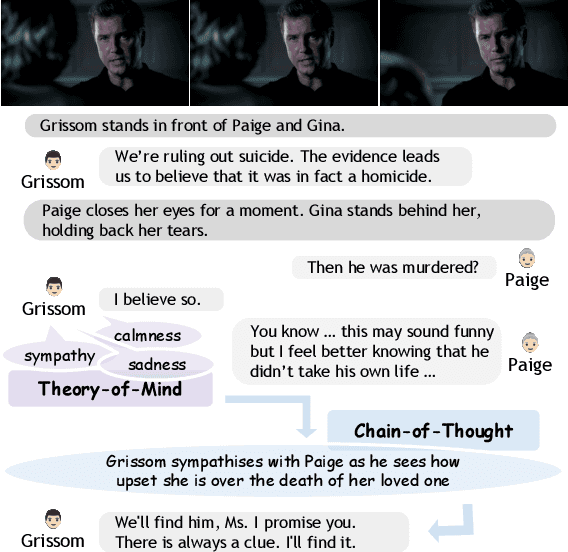
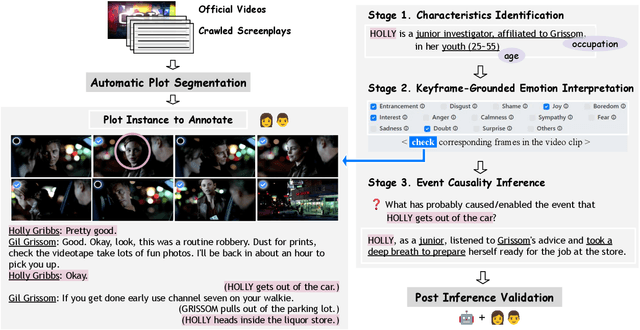
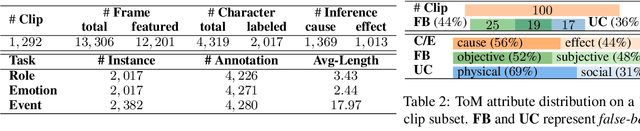
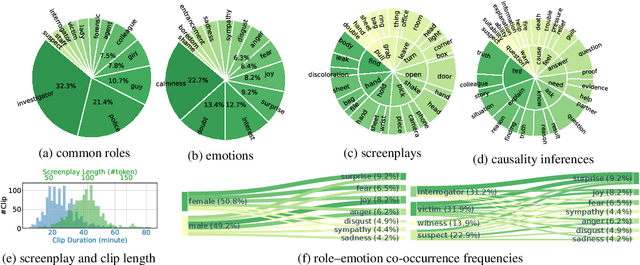
We introduce ECHo, a diagnostic dataset of event causality inference grounded in visual-and-linguistic social scenarios. ECHo employs real-world human-centric deductive information collected from crime drama, bridging the gap in multimodal reasoning towards higher social intelligence through the elicitation of intermediate Theory-of-Mind (ToM). We propose a unified framework aligned with the Chain-of-Thought (CoT) paradigm to assess the reasoning capability of current AI systems. This ToM-enhanced CoT pipeline can accommodate and integrate various large foundation models in zero-shot visual-and-linguistic understanding. With this framework, we scrutinize the advanced large language and multimodal models via three complementary human-centric ECHo tasks. Further analysis demonstrates ECHo as a challenging dataset to expose imperfections and inconsistencies in reasoning.
On the Risk of Misinformation Pollution with Large Language Models
May 23, 2023In this paper, we comprehensively investigate the potential misuse of modern Large Language Models (LLMs) for generating credible-sounding misinformation and its subsequent impact on information-intensive applications, particularly Open-Domain Question Answering (ODQA) systems. We establish a threat model and simulate potential misuse scenarios, both unintentional and intentional, to assess the extent to which LLMs can be utilized to produce misinformation. Our study reveals that LLMs can act as effective misinformation generators, leading to a significant degradation in the performance of ODQA systems. To mitigate the harm caused by LLM-generated misinformation, we explore three defense strategies: prompting, misinformation detection, and majority voting. While initial results show promising trends for these defensive strategies, much more work needs to be done to address the challenge of misinformation pollution. Our work highlights the need for further research and interdisciplinary collaboration to address LLM-generated misinformation and to promote responsible use of LLMs.
Fact-Checking Complex Claims with Program-Guided Reasoning
May 22, 2023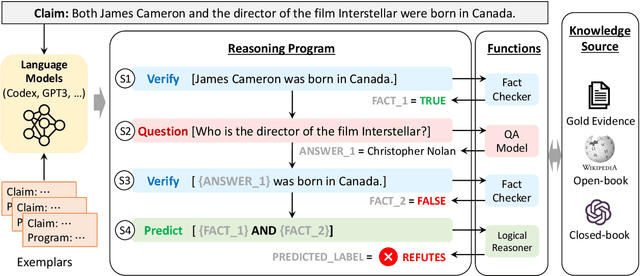
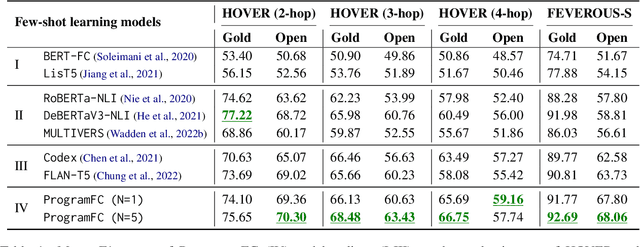
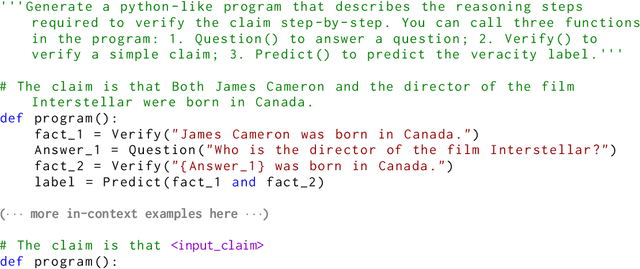
Fact-checking real-world claims often requires collecting multiple pieces of evidence and applying complex multi-step reasoning. In this paper, we present Program-Guided Fact-Checking (ProgramFC), a novel fact-checking model that decomposes complex claims into simpler sub-tasks that can be solved using a shared library of specialized functions. We first leverage the in-context learning ability of large language models to generate reasoning programs to guide the verification process. Afterward, we execute the program by delegating each sub-task to the corresponding sub-task handler. This process makes our model both explanatory and data-efficient, providing clear explanations of its reasoning process and requiring minimal training data. We evaluate ProgramFC on two challenging fact-checking datasets and show that it outperforms seven fact-checking baselines across different settings of evidence availability, with explicit output programs that benefit human debugging. Our codes and data are publicly available at https://github.com/mbzuai-nlp/ProgramFC.
SCITAB: A Challenging Benchmark for Compositional Reasoning and Claim Verification on Scientific Tables
May 22, 2023Scientific fact-checking is crucial for ensuring the accuracy, reliability, and trustworthiness of scientific claims. However, existing benchmarks are limited in terms of their claim diversity, reliance on text-based evidence, and oversimplification of scientific reasoning. To address these gaps, we introduce SCITAB, a novel dataset comprising 1,225 challenging scientific claims requiring compositional reasoning with scientific tables. The claims in SCITAB are derived from the actual scientific statements, and the evidence is presented as tables, closely mirroring real-world fact-checking scenarios. We establish benchmarks on SCITAB using state-of-the-art models, revealing its inherent difficulty and highlighting limitations in existing prompting methods. Our error analysis identifies unique challenges, including ambiguous expressions and irrelevant claims, suggesting future research directions. The code and the data are publicly available at https://github.com/XinyuanLu00/SciTab.
Decomposition Enhances Reasoning via Self-Evaluation Guided Decoding
May 02, 2023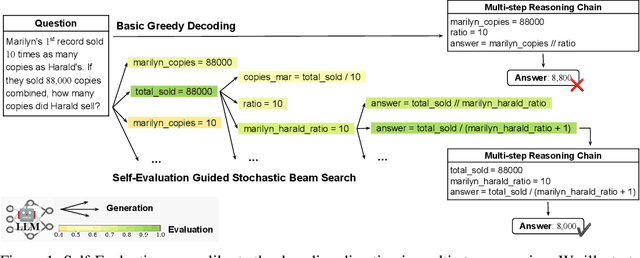
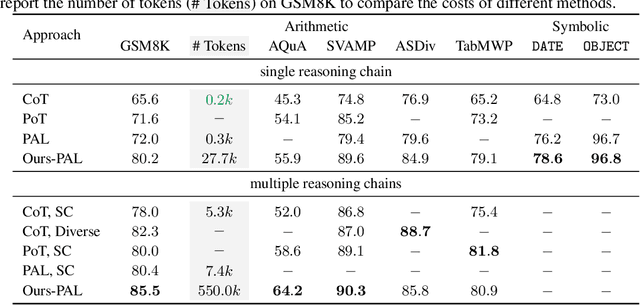
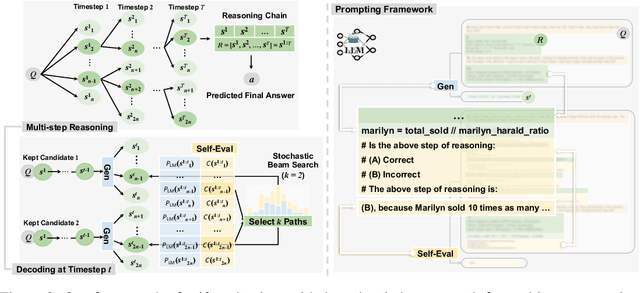

We endow Large Language Models (LLMs) with fine-grained self-evaluation to refine multi-step reasoning inference. We propose an effective prompting approach that integrates self-evaluation guidance through stochastic beam search. Our approach explores the reasoning search space using a well-calibrated automatic criterion. This enables an efficient search to produce higher-quality final predictions. With the self-evaluation guided stochastic beam search, we also balance the quality-diversity trade-off in the generation of reasoning chains. This allows our approach to adapt well with majority voting and surpass the corresponding Codex-backboned baselines by $6.34\%$, $9.56\%$, and $5.46\%$ on the GSM8K, AQuA, and StrategyQA benchmarks, respectively, in few-shot accuracy. Analysis of our decompositional reasoning finds it pinpoints logic failures and leads to higher consistency and robustness. Our code is publicly available at https://github.com/YuxiXie/SelfEval-Guided-Decoding.
Improving Recommendation Systems with User Personality Inferred from Product Reviews
Mar 21, 2023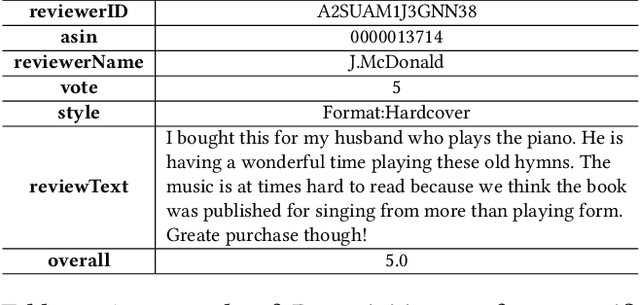
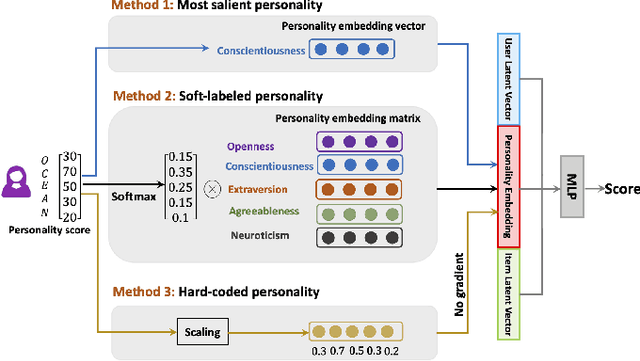
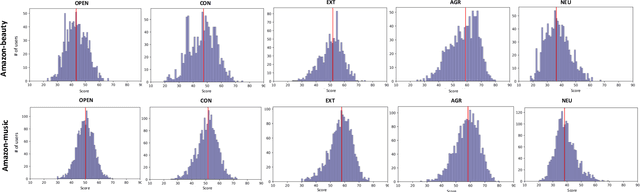
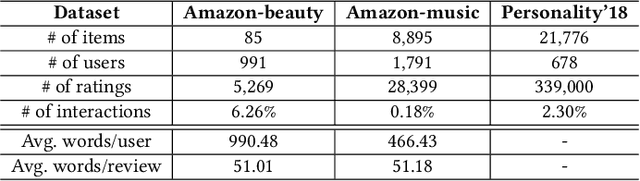
Personality is a psychological factor that reflects people's preferences, which in turn influences their decision-making. We hypothesize that accurate modeling of users' personalities improves recommendation systems' performance. However, acquiring such personality profiles is both sensitive and expensive. We address this problem by introducing a novel method to automatically extract personality profiles from public product review text. We then design and assess three context-aware recommendation architectures that leverage the profiles to test our hypothesis. Experiments on our two newly contributed personality datasets -- Amazon-beauty and Amazon-music -- validate our hypothesis, showing performance boosts of 3--28%.Our analysis uncovers that varying personality types contribute differently to recommendation performance: open and extroverted personalities are most helpful in music recommendation, while a conscientious personality is most helpful in beauty product recommendation.
UDApter -- Efficient Domain Adaptation Using Adapters
Feb 16, 2023We propose two methods to make unsupervised domain adaptation (UDA) more parameter efficient using adapters, small bottleneck layers interspersed with every layer of the large-scale pre-trained language model (PLM). The first method deconstructs UDA into a two-step process: first by adding a domain adapter to learn domain-invariant information and then by adding a task adapter that uses domain-invariant information to learn task representations in the source domain. The second method jointly learns a supervised classifier while reducing the divergence measure. Compared to strong baselines, our simple methods perform well in natural language inference (MNLI) and the cross-domain sentiment classification task. We even outperform unsupervised domain adaptation methods such as DANN and DSN in sentiment classification, and we are within 0.85% F1 for natural language inference task, by fine-tuning only a fraction of the full model parameters. We release our code at https://github.com/declare-lab/domadapter
Towards Knowledge-Intensive Text-to-SQL Semantic Parsing with Formulaic Knowledge
Jan 03, 2023



In this paper, we study the problem of knowledge-intensive text-to-SQL, in which domain knowledge is necessary to parse expert questions into SQL queries over domain-specific tables. We formalize this scenario by building a new Chinese benchmark KnowSQL consisting of domain-specific questions covering various domains. We then address this problem by presenting formulaic knowledge, rather than by annotating additional data examples. More concretely, we construct a formulaic knowledge bank as a domain knowledge base and propose a framework (ReGrouP) to leverage this formulaic knowledge during parsing. Experiments using ReGrouP demonstrate a significant 28.2% improvement overall on KnowSQL.
MM-Align: Learning Optimal Transport-based Alignment Dynamics for Fast and Accurate Inference on Missing Modality Sequences
Oct 23, 2022Existing multimodal tasks mostly target at the complete input modality setting, i.e., each modality is either complete or completely missing in both training and test sets. However, the randomly missing situations have still been underexplored. In this paper, we present a novel approach named MM-Align to address the missing-modality inference problem. Concretely, we propose 1) an alignment dynamics learning module based on the theory of optimal transport (OT) for indirect missing data imputation; 2) a denoising training algorithm to simultaneously enhance the imputation results and backbone network performance. Compared with previous methods which devote to reconstructing the missing inputs, MM-Align learns to capture and imitate the alignment dynamics between modality sequences. Results of comprehensive experiments on three datasets covering two multimodal tasks empirically demonstrate that our method can perform more accurate and faster inference and relieve overfitting under various missing conditions.