 Add to Chrome
 Add to Firefox
 Add to Edge
Modality-Specific Enhancement and Complementary Fusion for Semi-Supervised Multi-Modal Brain Tumor Segmentation
Dec 10, 2025
Semi-supervised learning (SSL) has become a promising direction for medical image segmentation, enabling models to learn from limited labeled data alongside abundant unlabeled samples. However, existing SSL approaches for multi-modal medical imaging often struggle to exploit the complementary information between modalities due to semantic discrepancies and misalignment across MRI sequences. To address this, we propose a novel semi-supervised multi-modal framework that explicitly enhances modality-specific representations and facilitates adaptive cross-modal information fusion. Specifically, we introduce a Modality-specific Enhancing Module (MEM) to strengthen semantic cues unique to each modality via channel-wise attention, and a learnable Complementary Information Fusion (CIF) module to adaptively exchange complementary knowledge between modalities. The overall framework is optimized using a hybrid objective combining supervised segmentation loss and cross-modal consistency regularization on unlabeled data. Extensive experiments on the BraTS 2019 (HGG subset) demonstrate that our method consistently outperforms strong semi-supervised and multi-modal baselines under 1\%, 5\%, and 10\% labeled data settings, achieving significant improvements in both Dice and Sensitivity scores. Ablation studies further confirm the complementary effects of our proposed MEM and CIF in bridging cross-modality discrepancies and improving segmentation robustness under scarce supervision.

Unified Video Editing with Temporal Reasoner
Dec 08, 2025Existing video editing methods face a critical trade-off: expert models offer precision but rely on task-specific priors like masks, hindering unification; conversely, unified temporal in-context learning models are mask-free but lack explicit spatial cues, leading to weak instruction-to-region mapping and imprecise localization. To resolve this conflict, we propose VideoCoF, a novel Chain-of-Frames approach inspired by Chain-of-Thought reasoning. VideoCoF enforces a ``see, reason, then edit" procedure by compelling the video diffusion model to first predict reasoning tokens (edit-region latents) before generating the target video tokens. This explicit reasoning step removes the need for user-provided masks while achieving precise instruction-to-region alignment and fine-grained video editing. Furthermore, we introduce a RoPE alignment strategy that leverages these reasoning tokens to ensure motion alignment and enable length extrapolation beyond the training duration. We demonstrate that with a minimal data cost of only 50k video pairs, VideoCoF achieves state-of-the-art performance on VideoCoF-Bench, validating the efficiency and effectiveness of our approach. Our code, weight, data are available at https://github.com/knightyxp/VideoCoF.
UniADC: A Unified Framework for Anomaly Detection and Classification
Nov 10, 2025In this paper, we introduce the task of unified anomaly detection and classification, which aims to simultaneously detect anomalous regions in images and identify their specific categories. Existing methods typically treat anomaly detection and classification as separate tasks, thereby neglecting their inherent correlation, limiting information sharing, and resulting in suboptimal performance. To address this, we propose UniADC, a unified anomaly detection and classification model that can effectively perform both tasks with only a few or even no anomaly images. Specifically, UniADC consists of two key components: a training-free controllable inpainting network and a multi-task discriminator. The inpainting network can synthesize anomaly images of specific categories by repainting normal regions guided by anomaly priors, and can also repaint few-shot anomaly samples to augment the available anomaly data. The multi-task discriminator is then trained on these synthesized samples, enabling precise anomaly detection and classification by aligning fine-grained image features with anomaly-category embeddings. We conduct extensive experiments on three anomaly detection and classification datasets, including MVTec-FS, MTD, and WFDD, and the results demonstrate that UniADC consistently outperforms existing methods in anomaly detection, localization, and classification. The code is available at https://github.com/cnulab/UniADC.
DiLO: Disentangled Latent Optimization for Learning Shape and Deformation in Grouped Deforming 3D Objects
Nov 08, 2025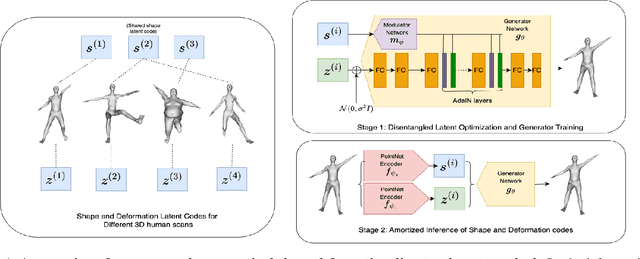
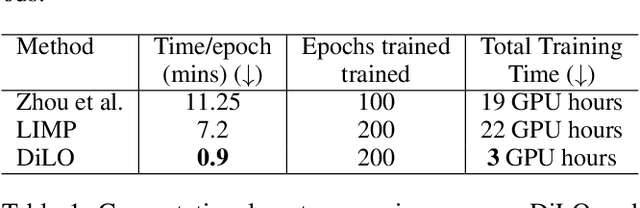
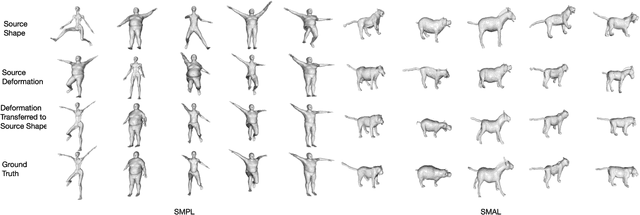
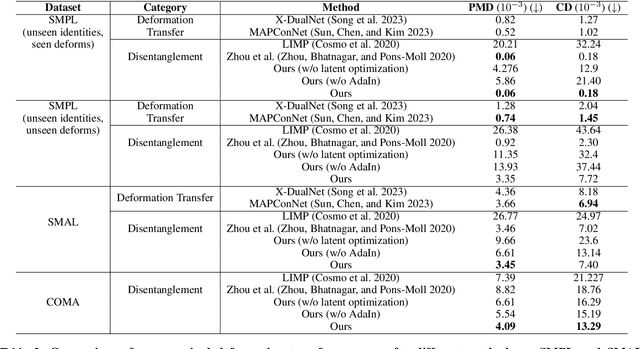
In this work, we propose a disentangled latent optimization-based method for parameterizing grouped deforming 3D objects into shape and deformation factors in an unsupervised manner. Our approach involves the joint optimization of a generator network along with the shape and deformation factors, supported by specific regularization techniques. For efficient amortized inference of disentangled shape and deformation codes, we train two order-invariant PoinNet-based encoder networks in the second stage of our method. We demonstrate several significant downstream applications of our method, including unsupervised deformation transfer, deformation classification, and explainability analysis. Extensive experiments conducted on 3D human, animal, and facial expression datasets demonstrate that our simple approach is highly effective in these downstream tasks, comparable or superior to existing methods with much higher complexity.
Accumulative SGD Influence Estimation for Data Attribution
Oct 30, 2025Modern data-centric AI needs precise per-sample influence. Standard SGD-IE approximates leave-one-out effects by summing per-epoch surrogates and ignores cross-epoch compounding, which misranks critical examples. We propose ACC-SGD-IE, a trajectory-aware estimator that propagates the leave-one-out perturbation across training and updates an accumulative influence state at each step. In smooth strongly convex settings it achieves geometric error contraction and, in smooth non-convex regimes, it tightens error bounds; larger mini-batches further reduce constants. Empirically, on Adult, 20 Newsgroups, and MNIST under clean and corrupted data and both convex and non-convex training, ACC-SGD-IE yields more accurate influence estimates, especially over long epochs. For downstream data cleansing it more reliably flags noisy samples, producing models trained on ACC-SGD-IE cleaned data that outperform those cleaned with SGD-IE.
Semi-MoE: Mixture-of-Experts meets Semi-Supervised Histopathology Segmentation
Sep 17, 2025Semi-supervised learning has been employed to alleviate the need for extensive labeled data for histopathology image segmentation, but existing methods struggle with noisy pseudo-labels due to ambiguous gland boundaries and morphological misclassification. This paper introduces Semi-MOE, to the best of our knowledge, the first multi-task Mixture-of-Experts framework for semi-supervised histopathology image segmentation. Our approach leverages three specialized expert networks: A main segmentation expert, a signed distance field regression expert, and a boundary prediction expert, each dedicated to capturing distinct morphological features. Subsequently, the Multi-Gating Pseudo-labeling module dynamically aggregates expert features, enabling a robust fuse-and-refine pseudo-labeling mechanism. Furthermore, to eliminate manual tuning while dynamically balancing multiple learning objectives, we propose an Adaptive Multi-Objective Loss. Extensive experiments on GlaS and CRAG benchmarks show that our method outperforms state-of-the-art approaches in low-label settings, highlighting the potential of MoE-based architectures in advancing semi-supervised segmentation. Our code is available at https://github.com/vnlvi2k3/Semi-MoE.
FusionMAE: large-scale pretrained model to optimize and simplify diagnostic and control of fusion plasma
Sep 16, 2025In magnetically confined fusion device, the complex, multiscale, and nonlinear dynamics of plasmas necessitate the integration of extensive diagnostic systems to effectively monitor and control plasma behaviour. The complexity and uncertainty arising from these extensive systems and their tangled interrelations has long posed a significant obstacle to the acceleration of fusion energy development. In this work, a large-scale model, fusion masked auto-encoder (FusionMAE) is pre-trained to compress the information from 88 diagnostic signals into a concrete embedding, to provide a unified interface between diagnostic systems and control actuators. Two mechanisms are proposed to ensure a meaningful embedding: compression-reduction and missing-signal reconstruction. Upon completion of pre-training, the model acquires the capability for 'virtual backup diagnosis', enabling the inference of missing diagnostic data with 96.7% reliability. Furthermore, the model demonstrates three emergent capabilities: automatic data analysis, universal control-diagnosis interface, and enhancement of control performance on multiple tasks. This work pioneers large-scale AI model integration in fusion energy, demonstrating how pre-trained embeddings can simplify the system interface, reducing necessary diagnostic systems and optimize operation performance for future fusion reactors.
MEGG: Replay via Maximally Extreme GGscore in Incremental Learning for Neural Recommendation Models
Sep 09, 2025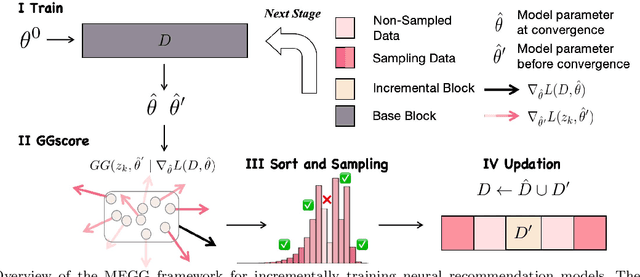
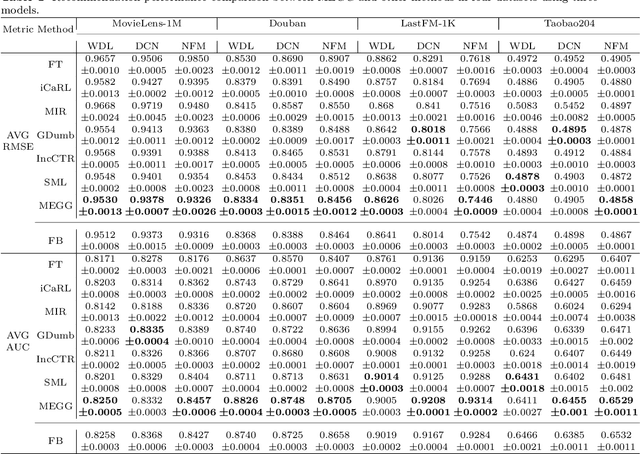
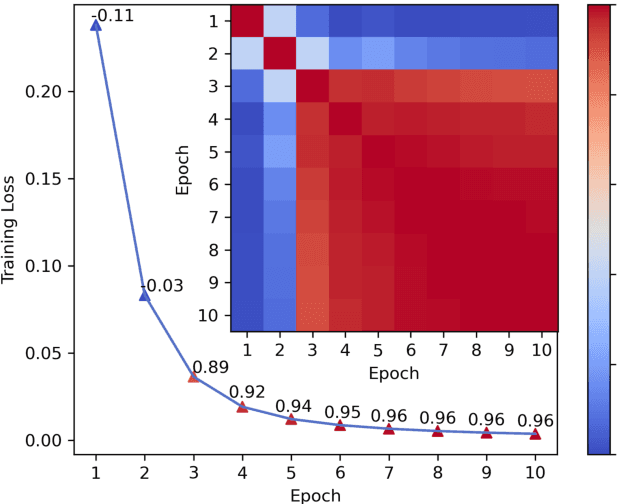
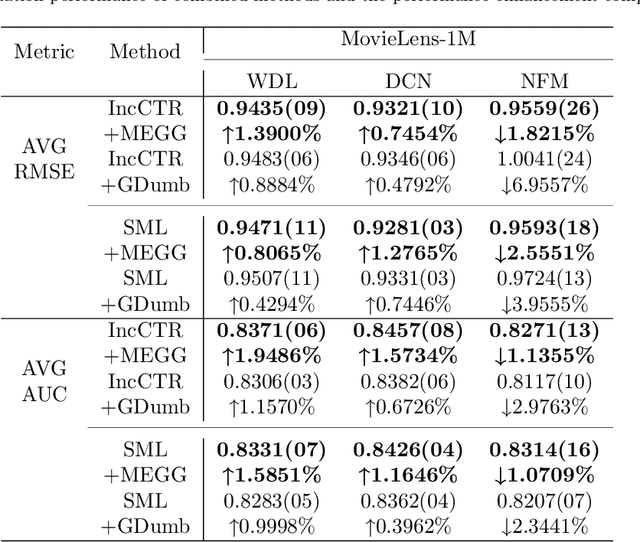
Neural Collaborative Filtering models are widely used in recommender systems but are typically trained under static settings, assuming fixed data distributions. This limits their applicability in dynamic environments where user preferences evolve. Incremental learning offers a promising solution, yet conventional methods from computer vision or NLP face challenges in recommendation tasks due to data sparsity and distinct task paradigms. Existing approaches for neural recommenders remain limited and often lack generalizability. To address this, we propose MEGG, Replay Samples with Maximally Extreme GGscore, an experience replay based incremental learning framework. MEGG introduces GGscore, a novel metric that quantifies sample influence, enabling the selective replay of highly influential samples to mitigate catastrophic forgetting. Being model-agnostic, MEGG integrates seamlessly across architectures and frameworks. Experiments on three neural models and four benchmark datasets show superior performance over state-of-the-art baselines, with strong scalability, efficiency, and robustness. Implementation will be released publicly upon acceptance.
sam-llm: interpretable lane change trajectoryprediction via parametric finetuning
Sep 03, 2025This work introduces SAM-LLM, a novel hybrid architecture that bridges the gap between the contextual reasoning of Large Language Models (LLMs) and the physical precision of kinematic lane change models for autonomous driving. The system is designed for interpretable lane change trajectory prediction by finetuning an LLM to output the core physical parameters of a trajectory model instead of raw coordinates. For lane-keeping scenarios, the model predicts discrete coordinates, but for lane change maneuvers, it generates the parameters for an enhanced Sinusoidal Acceleration Model (SAM), including lateral displacement, maneuver duration, initial lateral velocity, and longitudinal velocity change. This parametric approach yields a complete, continuous, and physically plausible trajectory model that is inherently interpretable and computationally efficient, achieving an 80% reduction in output size compared to coordinate-based methods. The SAM-LLM achieves a state-of-the-art overall intention prediction accuracy of 98.73%, demonstrating performance equivalent to traditional LLM predictors while offering significant advantages in explainability and resource efficiency.
Towards SISO Bistatic Sensing for ISAC
Aug 18, 2025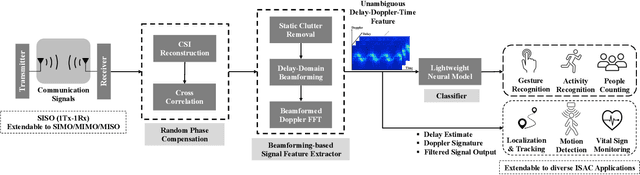
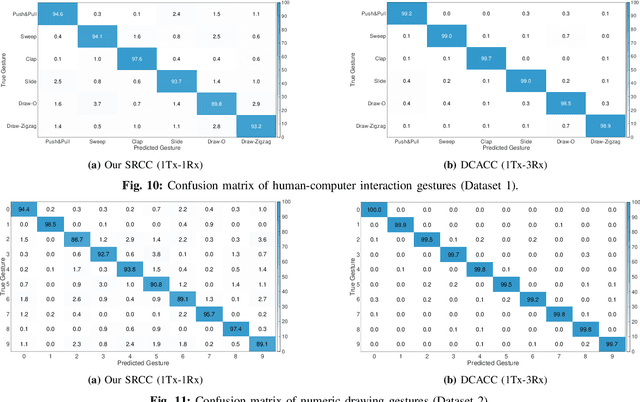
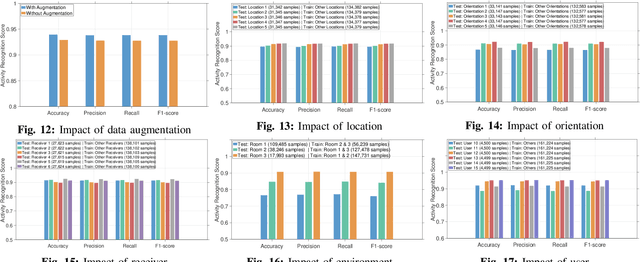
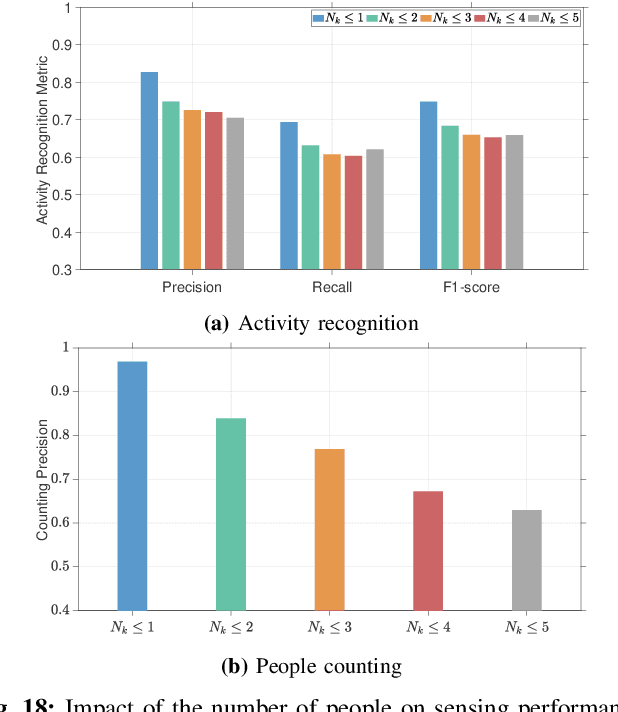
Integrated Sensing and Communication (ISAC) is a key enabler for next-generation wireless systems. However, real-world deployment is often limited to low-cost, single-antenna transceivers. In such bistatic Single-Input Single-Output (SISO) setup, clock asynchrony introduces random phase offsets in Channel State Information (CSI), which cannot be mitigated using conventional multi-antenna methods. This work proposes WiDFS 3.0, a lightweight bistatic SISO sensing framework that enables accurate delay and Doppler estimation from distorted CSI by effectively suppressing Doppler mirroring ambiguity. It operates with only a single antenna at both the transmitter and receiver, making it suitable for low-complexity deployments. We propose a self-referencing cross-correlation (SRCC) method for SISO random phase removal and employ delay-domain beamforming to resolve Doppler ambiguity. The resulting unambiguous delay-Doppler-time features enable robust sensing with compact neural networks. Extensive experiments show that WiDFS 3.0 achieves accurate parameter estimation, with performance comparable to or even surpassing that of prior multi-antenna methods, especially in delay estimation. Validated under single- and multi-target scenarios, the extracted ambiguity-resolved features show strong sensing accuracy and generalization. For example, when deployed on the embedded-friendly MobileViT-XXS with only 1.3M parameters, WiDFS 3.0 consistently outperforms conventional features such as CSI amplitude, mirrored Doppler, and multi-receiver aggregated Doppler.