 Add to Chrome
 Add to Firefox
 Add to Edge
Class-Distribution-Aware Pseudo Labeling for Semi-Supervised Multi-Label Learning
May 04, 2023
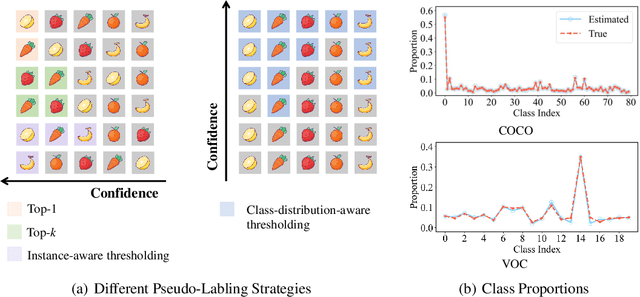
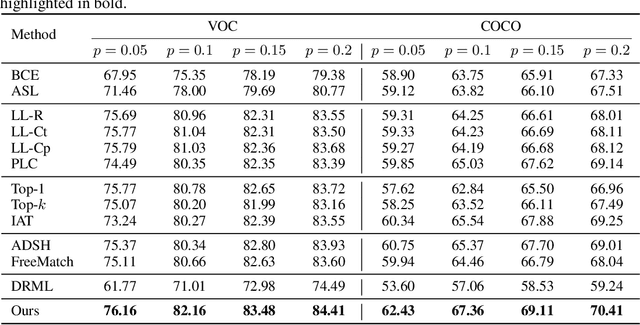

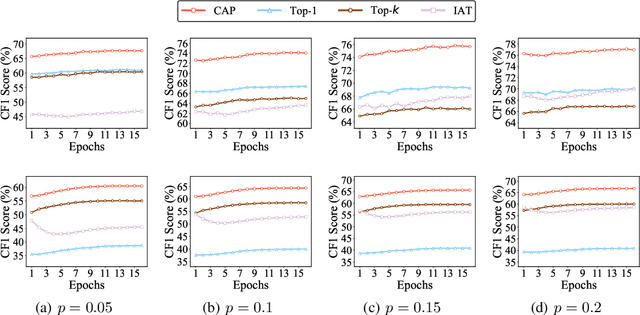
Pseudo labeling is a popular and effective method to leverage the information of unlabeled data. Conventional instance-aware pseudo labeling methods often assign each unlabeled instance with a pseudo label based on its predicted probabilities. However, due to the unknown number of true labels, these methods cannot generalize well to semi-supervised multi-label learning (SSMLL) scenarios, since they would suffer from the risk of either introducing false positive labels or neglecting true positive ones. In this paper, we propose to solve the SSMLL problems by performing Class-distribution-Aware Pseudo labeling (CAP), which encourages the class distribution of pseudo labels to approximate the true one. Specifically, we design a regularized learning framework consisting of the class-aware thresholds to control the number of pseudo labels for each class. Given that the labeled and unlabeled examples are sampled according to the same distribution, we determine the thresholds by exploiting the empirical class distribution, which can be treated as a tight approximation to the true one. Theoretically, we show that the generalization performance of the proposed method is dependent on the pseudo labeling error, which can be significantly reduced by the CAP strategy. Extensive experimental results on multiple benchmark datasets validate that CAP can effectively solve the SSMLL problems.

Enhancing Adversarial Contrastive Learning via Adversarial Invariant Regularization
Apr 30, 2023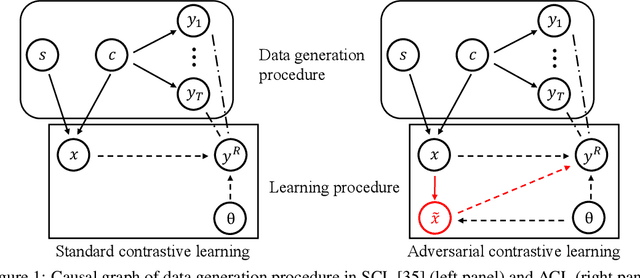
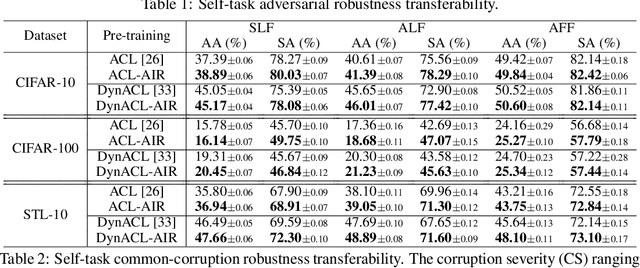
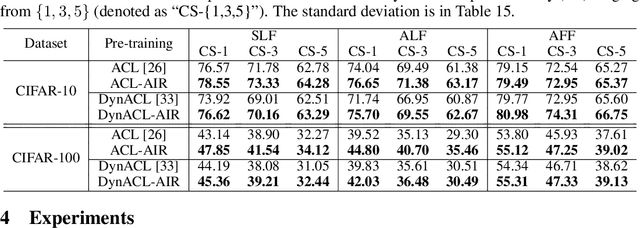
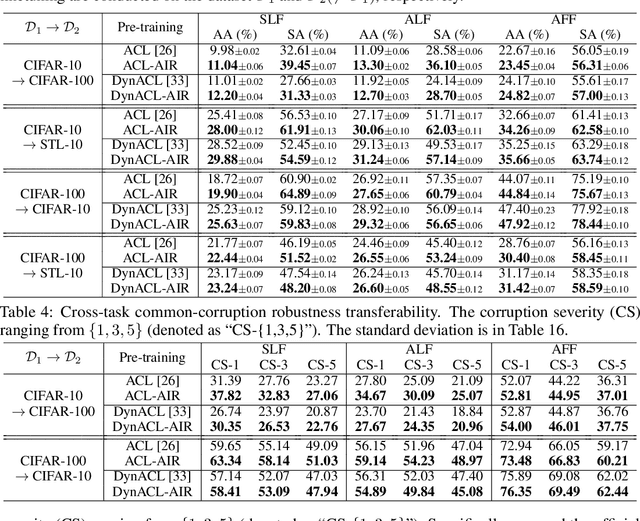
Adversarial contrastive learning (ACL), without requiring labels, incorporates adversarial data with standard contrastive learning (SCL) and outputs a robust representation which is generalizable and resistant to adversarial attacks and common corruptions. The style-independence property of representations has been validated to be beneficial in improving robustness transferability. Standard invariant regularization (SIR) has been proposed to make the learned representations via SCL to be independent of the style factors. However, how to equip robust representations learned via ACL with the style-independence property is still unclear so far. To this end, we leverage the technique of causal reasoning to propose an adversarial invariant regularization (AIR) that enforces robust representations learned via ACL to be style-independent. Then, we enhance ACL using invariant regularization (IR), which is a weighted sum of SIR and AIR. Theoretically, we show that AIR implicitly encourages the prediction of adversarial data and consistency between adversarial and natural data to be independent of data augmentations. We also theoretically demonstrate that the style-independence property of robust representation learned via ACL still holds in downstream tasks, providing generalization guarantees. Empirically, our comprehensive experimental results corroborate that IR can significantly improve the performance of ACL and its variants on various datasets.
Fairness Improves Learning from Noisily Labeled Long-Tailed Data
Mar 22, 2023Both long-tailed and noisily labeled data frequently appear in real-world applications and impose significant challenges for learning. Most prior works treat either problem in an isolated way and do not explicitly consider the coupling effects of the two. Our empirical observation reveals that such solutions fail to consistently improve the learning when the dataset is long-tailed with label noise. Moreover, with the presence of label noise, existing methods do not observe universal improvements across different sub-populations; in other words, some sub-populations enjoyed the benefits of improved accuracy at the cost of hurting others. Based on these observations, we introduce the Fairness Regularizer (FR), inspired by regularizing the performance gap between any two sub-populations. We show that the introduced fairness regularizer improves the performances of sub-populations on the tail and the overall learning performance. Extensive experiments demonstrate the effectiveness of the proposed solution when complemented with certain existing popular robust or class-balanced methods.
Asymptotically Optimal Thompson Sampling Based Policy for the Uniform Bandits and the Gaussian Bandits
Feb 28, 2023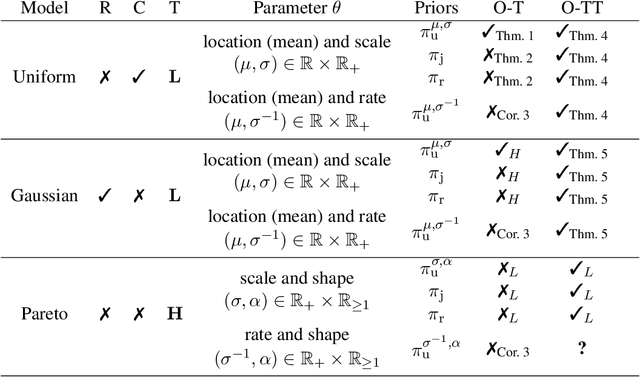
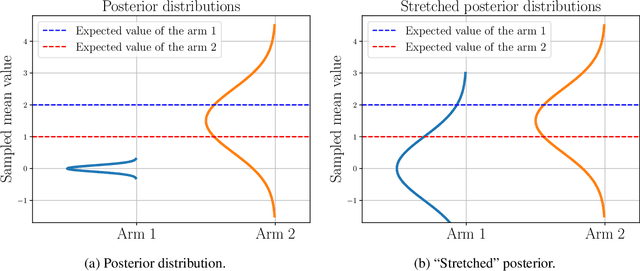
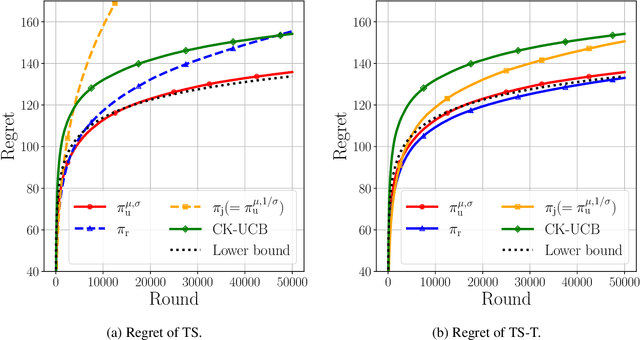
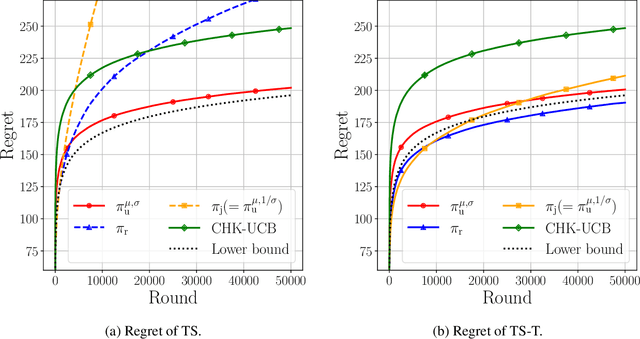
Thompson sampling (TS) for the parametric stochastic multi-armed bandits has been well studied under the one-dimensional parametric models. It is often reported that TS is fairly insensitive to the choice of the prior when it comes to regret bounds. However, this property is not necessarily true when multiparameter models are considered, e.g., a Gaussian model with unknown mean and variance parameters. In this paper, we first extend the regret analysis of TS to the model of uniform distributions with unknown supports. Specifically, we show that a switch of noninformative priors drastically affects the regret in expectation. Through our analysis, the uniform prior is proven to be the optimal choice in terms of the expected regret, while the reference prior and the Jeffreys prior are found to be suboptimal, which is consistent with previous findings in the model of Gaussian distributions. However, the uniform prior is specific to the parameterization of the distributions, meaning that if an agent considers different parameterizations of the same model, the agent with the uniform prior might not always achieve the optimal performance. In light of this limitation, we propose a slightly modified TS-based policy, called TS with Truncation (TS-T), which can achieve the asymptotic optimality for the Gaussian distributions and the uniform distributions by using the reference prior and the Jeffreys prior that are invariant under one-to-one reparameterizations. The pre-processig of the posterior distribution is the key to TS-T, where we add an adaptive truncation procedure on the parameter space of the posterior distributions. Simulation results support our analysis, where TS-T shows the best performance in a finite-time horizon compared to other known optimal policies, while TS with the invariant priors performs poorly.
Efficient Adversarial Contrastive Learning via Robustness-Aware Coreset Selection
Feb 08, 2023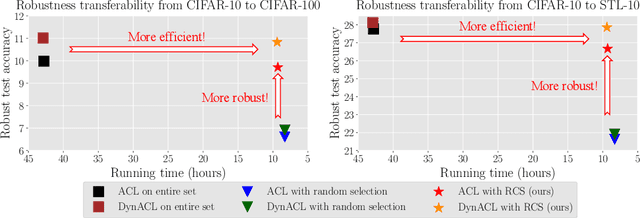
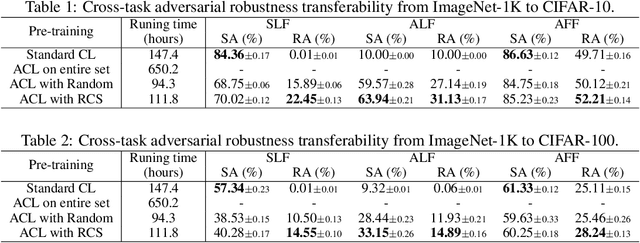
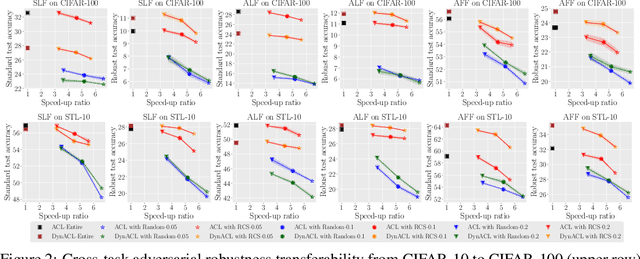
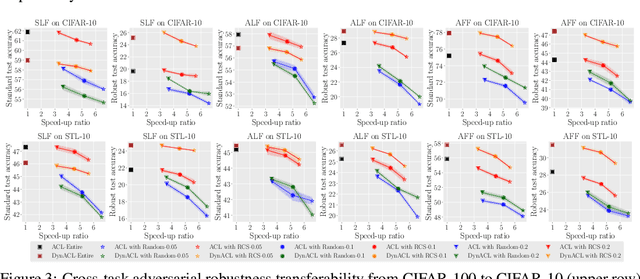
Adversarial contrastive learning (ACL) does not require expensive data annotations but outputs a robust representation that withstands adversarial attacks and also generalizes to a wide range of downstream tasks. However, ACL needs tremendous running time to generate the adversarial variants of all training data, which limits its scalability to large datasets. To speed up ACL, this paper proposes a robustness-aware coreset selection (RCS) method. RCS does not require label information and searches for an informative subset that minimizes a representational divergence, which is the distance of the representation between natural data and their virtual adversarial variants. The vanilla solution of RCS via traversing all possible subsets is computationally prohibitive. Therefore, we theoretically transform RCS into a surrogate problem of submodular maximization, of which the greedy search is an efficient solution with an optimality guarantee for the original problem. Empirically, our comprehensive results corroborate that RCS can speed up ACL by a large margin without significantly hurting the robustness and standard transferability. Notably, to the best of our knowledge, we are the first to conduct ACL efficiently on the large-scale ImageNet-1K dataset to obtain an effective robust representation via RCS.
Adapting to Continuous Covariate Shift via Online Density Ratio Estimation
Feb 06, 2023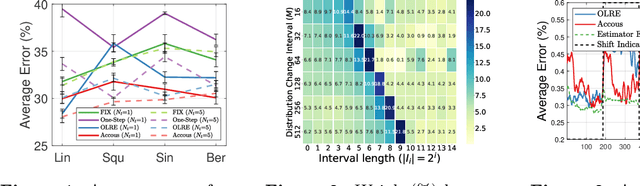
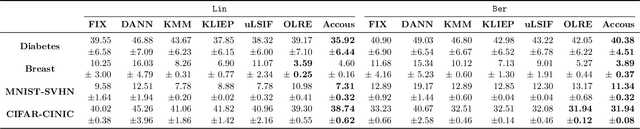
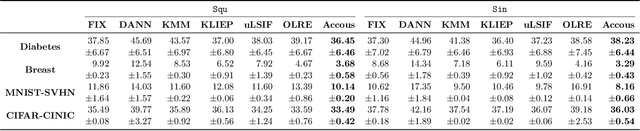
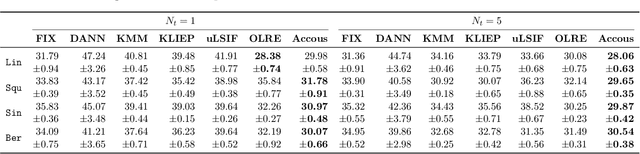
Dealing with distribution shifts is one of the central challenges for modern machine learning. One fundamental situation is the \emph{covariate shift}, where the input distributions of data change from training to testing stages while the input-conditional output distribution remains unchanged. In this paper, we initiate the study of a more challenging scenario -- \emph{continuous} covariate shift -- in which the test data appear sequentially, and their distributions can shift continuously. Our goal is to adaptively train the predictor such that its prediction risk accumulated over time can be minimized. Starting with the importance-weighted learning, we show the method works effectively if the time-varying density ratios of test and train inputs can be accurately estimated. However, existing density ratio estimation methods would fail due to data scarcity at each time step. To this end, we propose an online method that can appropriately reuse historical information. Our density ratio estimation method is proven to perform well by enjoying a dynamic regret bound, which finally leads to an excess risk guarantee for the predictor. Empirical results also validate the effectiveness.
GAT: Guided Adversarial Training with Pareto-optimal Auxiliary Tasks
Feb 06, 2023While leveraging additional training data is well established to improve adversarial robustness, it incurs the unavoidable cost of data collection and the heavy computation to train models. To mitigate the costs, we propose \textit{Guided Adversarial Training } (GAT), a novel adversarial training technique that exploits auxiliary tasks under a limited set of training data. Our approach extends single-task models into multi-task models during the min-max optimization of adversarial training, and drives the loss optimization with a regularization of the gradient curvature across multiple tasks. GAT leverages two types of auxiliary tasks: self-supervised tasks, where the labels are generated automatically, and domain-knowledge tasks, where human experts provide additional labels. Experimentally, under limited data, GAT increases the robust accuracy on CIFAR-10 up to four times (from 11% to 42% robust accuracy) and the robust AUC of CheXpert medical imaging dataset from 50\% to 83\%. On the full CIFAR-10 dataset, GAT outperforms eight state-of-the-art adversarial training strategies. Our large study across five datasets and six tasks demonstrates that task augmentation is an efficient alternative to data augmentation, and can be key to achieving both clean and robust performances.
Optimality of Thompson Sampling with Noninformative Priors for Pareto Bandits
Feb 03, 2023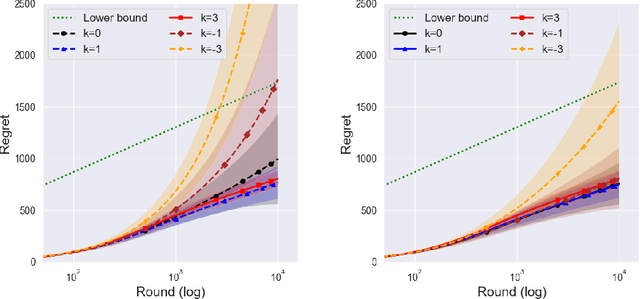
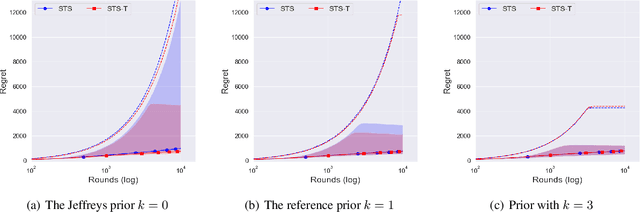
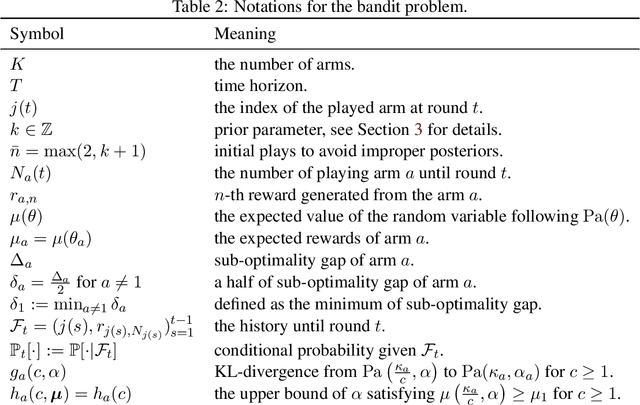
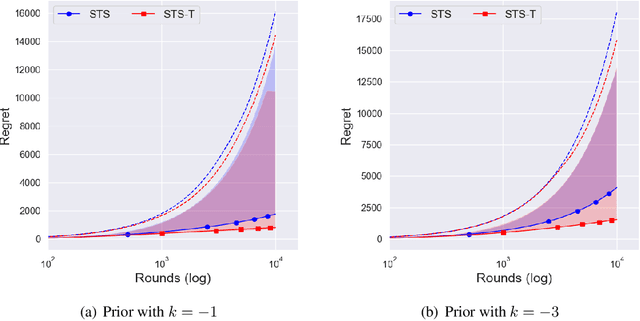
In the stochastic multi-armed bandit problem, a randomized probability matching policy called Thompson sampling (TS) has shown excellent performance in various reward models. In addition to the empirical performance, TS has been shown to achieve asymptotic problem-dependent lower bounds in several models. However, its optimality has been mainly addressed under light-tailed or one-parameter models that belong to exponential families. In this paper, we consider the optimality of TS for the Pareto model that has a heavy tail and is parameterized by two unknown parameters. Specifically, we discuss the optimality of TS with probability matching priors that include the Jeffreys prior and the reference priors. We first prove that TS with certain probability matching priors can achieve the optimal regret bound. Then, we show the suboptimality of TS with other priors, including the Jeffreys and the reference priors. Nevertheless, we find that TS with the Jeffreys and reference priors can achieve the asymptotic lower bound if one uses a truncation procedure. These results suggest carefully choosing noninformative priors to avoid suboptimality and show the effectiveness of truncation procedures in TS-based policies.
Robust computation of optimal transport by $β$-potential regularization
Dec 26, 2022Optimal transport (OT) has become a widely used tool in the machine learning field to measure the discrepancy between probability distributions. For instance, OT is a popular loss function that quantifies the discrepancy between an empirical distribution and a parametric model. Recently, an entropic penalty term and the celebrated Sinkhorn algorithm have been commonly used to approximate the original OT in a computationally efficient way. However, since the Sinkhorn algorithm runs a projection associated with the Kullback-Leibler divergence, it is often vulnerable to outliers. To overcome this problem, we propose regularizing OT with the \beta-potential term associated with the so-called $\beta$-divergence, which was developed in robust statistics. Our theoretical analysis reveals that the $\beta$-potential can prevent the mass from being transported to outliers. We experimentally demonstrate that the transport matrix computed with our algorithm helps estimate a probability distribution robustly even in the presence of outliers. In addition, our proposed method can successfully detect outliers from a contaminated dataset
Representation Learning for Continuous Action Spaces is Beneficial for Efficient Policy Learning
Nov 23, 2022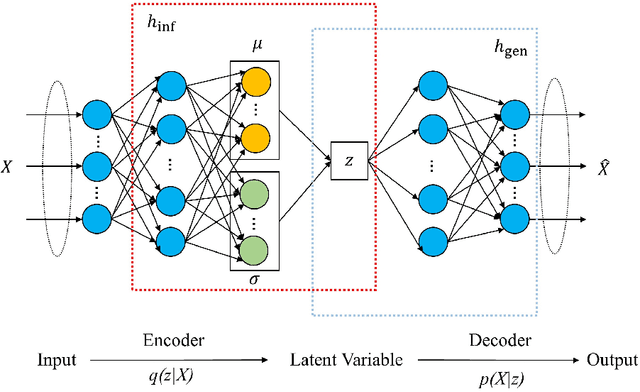
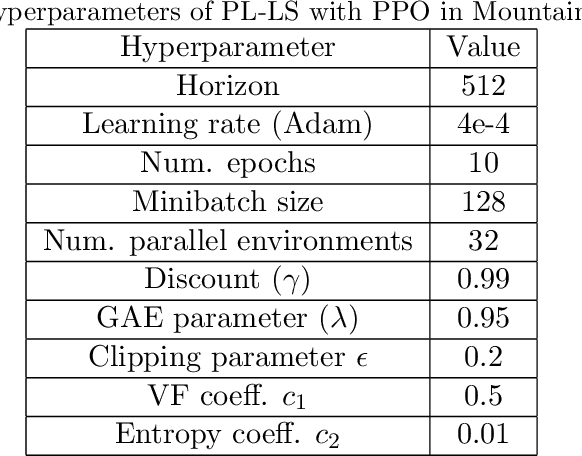
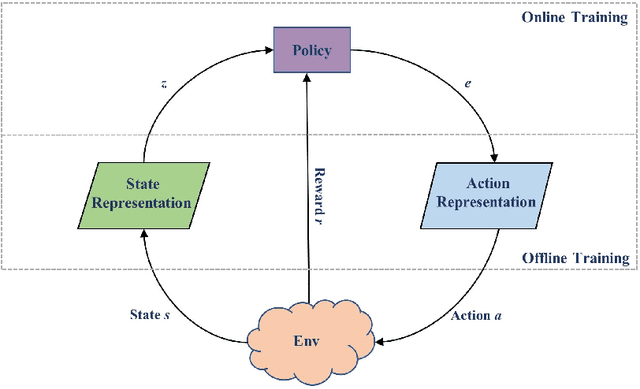
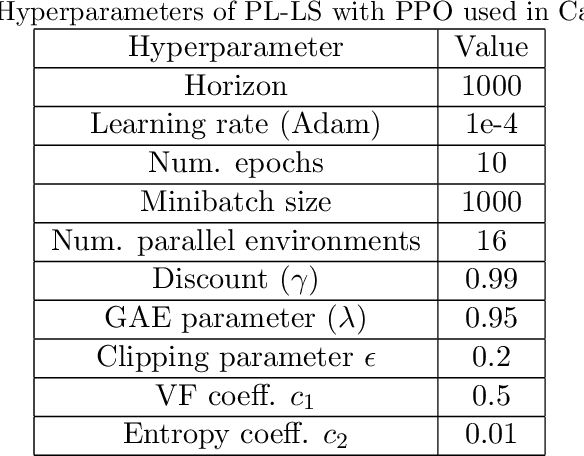
Deep reinforcement learning (DRL) breaks through the bottlenecks of traditional reinforcement learning (RL) with the help of the perception capability of deep learning and has been widely applied in real-world problems.While model-free RL, as a class of efficient DRL methods, performs the learning of state representations simultaneously with policy learning in an end-to-end manner when facing large-scale continuous state and action spaces. However, training such a large policy model requires a large number of trajectory samples and training time. On the other hand, the learned policy often fails to generalize to large-scale action spaces, especially for the continuous action spaces. To address this issue, in this paper we propose an efficient policy learning method in latent state and action spaces. More specifically, we extend the idea of state representations to action representations for better policy generalization capability. Meanwhile, we divide the whole learning task into learning with the large-scale representation models in an unsupervised manner and learning with the small-scale policy model in the RL manner.The small policy model facilitates policy learning, while not sacrificing generalization and expressiveness via the large representation model. Finally,the effectiveness of the proposed method is demonstrated by MountainCar,CarRacing and Cheetah experiments.