 Add to Chrome
 Add to Firefox
 Add to Edge
OLMo: Accelerating the Science of Language Models
Feb 07, 2024

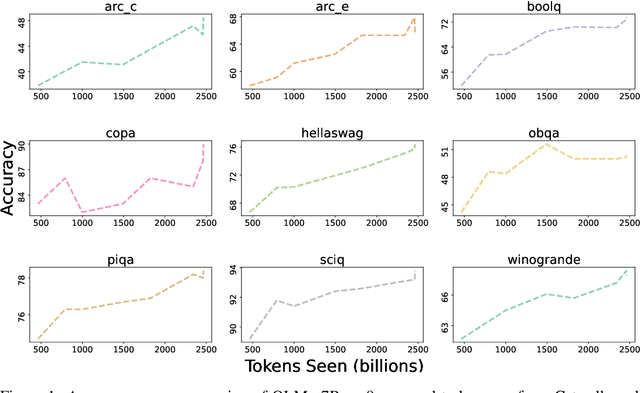


Language models (LMs) have become ubiquitous in both NLP research and in commercial product offerings. As their commercial importance has surged, the most powerful models have become closed off, gated behind proprietary interfaces, with important details of their training data, architectures, and development undisclosed. Given the importance of these details in scientifically studying these models, including their biases and potential risks, we believe it is essential for the research community to have access to powerful, truly open LMs. To this end, this technical report details the first release of OLMo, a state-of-the-art, truly Open Language Model and its framework to build and study the science of language modeling. Unlike most prior efforts that have only released model weights and inference code, we release OLMo and the whole framework, including training data and training and evaluation code. We hope this release will empower and strengthen the open research community and inspire a new wave of innovation.

Dolma: an Open Corpus of Three Trillion Tokens for Language Model Pretraining Research
Jan 31, 2024


Language models have become a critical technology to tackling a wide range of natural language processing tasks, yet many details about how the best-performing language models were developed are not reported. In particular, information about their pretraining corpora is seldom discussed: commercial language models rarely provide any information about their data; even open models rarely release datasets they are trained on, or an exact recipe to reproduce them. As a result, it is challenging to conduct certain threads of language modeling research, such as understanding how training data impacts model capabilities and shapes their limitations. To facilitate open research on language model pretraining, we release Dolma, a three trillion tokens English corpus, built from a diverse mixture of web content, scientific papers, code, public-domain books, social media, and encyclopedic materials. In addition, we open source our data curation toolkit to enable further experimentation and reproduction of our work. In this report, we document Dolma, including its design principles, details about its construction, and a summary of its contents. We interleave this report with analyses and experimental results from training language models on intermediate states of Dolma to share what we have learned about important data curation practices, including the role of content or quality filters, deduplication, and multi-source mixing. Dolma has been used to train OLMo, a state-of-the-art, open language model and framework designed to build and study the science of language modeling.
Infini-gram: Scaling Unbounded n-gram Language Models to a Trillion Tokens
Jan 30, 2024
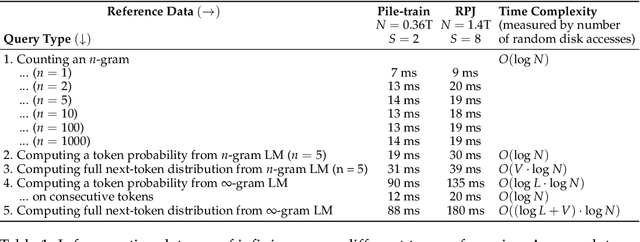

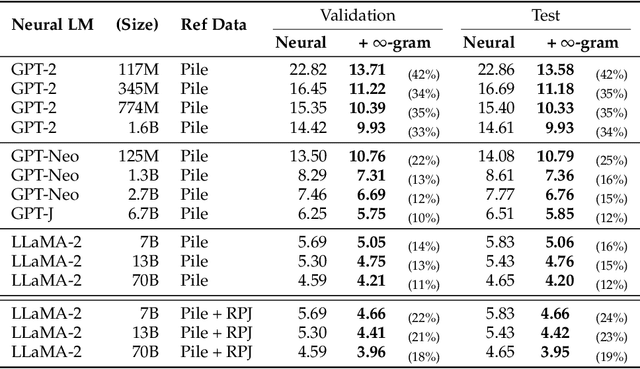
Are n-gram language models still relevant in this era of neural large language models (LLMs)? Our answer is yes, and we show their values in both text analysis and improving neural LLMs. Yet this necessitates modernizing n-gram models in two aspects. First, we train them at the same data scale as neural LLMs -- 1.4 trillion tokens. This is the largest n-gram model ever built. Second, existing n-gram models use small n which hinders their performance; we instead allow n to be arbitrarily large, by introducing a new $\infty$-gram LM with backoff. Instead of pre-computing n-gram count tables (which would be very expensive), we develop an engine named infini-gram -- powered by suffix arrays -- that can compute $\infty$-gram (as well as n-gram with arbitrary n) probabilities with millisecond-level latency. The $\infty$-gram framework and infini-gram engine enable us to conduct many novel and interesting analyses of human-written and machine-generated text: we find that the $\infty$-gram LM has fairly high accuracy for next-token prediction (47%), and can complement neural LLMs to greatly reduce their language modeling perplexities. When analyzing machine-generated text, we also observe irregularities in the machine--$\infty$-gram agreement level with respect to the suffix length, which indicates deficiencies in neural LLM pretraining and the positional embeddings of Transformers. We open-source our infini-gram engine in the hopes of enabling more study on how to best use verbatim information retrieved from large text corpora.
Breaking the Curse of Multilinguality with Cross-lingual Expert Language Models
Jan 19, 2024


Despite their popularity in non-English NLP, multilingual language models often underperform monolingual ones due to inter-language competition for model parameters. We propose Cross-lingual Expert Language Models (X-ELM), which mitigate this competition by independently training language models on subsets of the multilingual corpus. This process specializes X-ELMs to different languages while remaining effective as a multilingual ensemble. Our experiments show that when given the same compute budget, X-ELM outperforms jointly trained multilingual models across all considered languages and that these gains transfer to downstream tasks. X-ELM provides additional benefits over performance improvements: new experts can be iteratively added, adapting X-ELM to new languages without catastrophic forgetting. Furthermore, training is asynchronous, reducing the hardware requirements for multilingual training and democratizing multilingual modeling.
PathFinder: Guided Search over Multi-Step Reasoning Paths
Dec 12, 2023
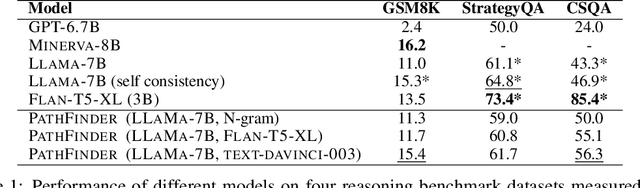


With recent advancements in large language models, methods like chain-of-thought prompting to elicit reasoning chains have been shown to improve results on reasoning tasks. However, tasks that require multiple steps of reasoning still pose significant challenges to state-of-the-art models. Drawing inspiration from the beam search algorithm, we propose PathFinder, a tree-search-based reasoning path generation approach. It enhances diverse branching and multi-hop reasoning through the integration of dynamic decoding, enabled by varying sampling methods and parameters. Using constrained reasoning, PathFinder integrates novel quality constraints, pruning, and exploration methods to enhance the efficiency and the quality of generation. Moreover, it includes scoring and ranking features to improve candidate selection. Our approach outperforms competitive baselines on three complex arithmetic and commonsense reasoning tasks by 6% on average. Our model generalizes well to longer, unseen reasoning chains, reflecting similar complexities to beam search with large branching factors.
Detecting Pretraining Data from Large Language Models
Nov 03, 2023Although large language models (LLMs) are widely deployed, the data used to train them is rarely disclosed. Given the incredible scale of this data, up to trillions of tokens, it is all but certain that it includes potentially problematic text such as copyrighted materials, personally identifiable information, and test data for widely reported reference benchmarks. However, we currently have no way to know which data of these types is included or in what proportions. In this paper, we study the pretraining data detection problem: given a piece of text and black-box access to an LLM without knowing the pretraining data, can we determine if the model was trained on the provided text? To facilitate this study, we introduce a dynamic benchmark WIKIMIA that uses data created before and after model training to support gold truth detection. We also introduce a new detection method Min-K% Prob based on a simple hypothesis: an unseen example is likely to contain a few outlier words with low probabilities under the LLM, while a seen example is less likely to have words with such low probabilities. Min-K% Prob can be applied without any knowledge about the pretraining corpus or any additional training, departing from previous detection methods that require training a reference model on data that is similar to the pretraining data. Moreover, our experiments demonstrate that Min-K% Prob achieves a 7.4% improvement on WIKIMIA over these previous methods. We apply Min-K% Prob to three real-world scenarios, copyrighted book detection, contaminated downstream example detection and privacy auditing of machine unlearning, and find it a consistently effective solution.
In-Context Pretraining: Language Modeling Beyond Document Boundaries
Oct 20, 2023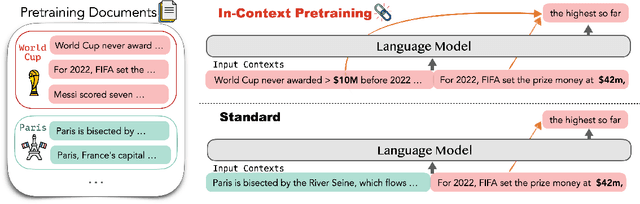

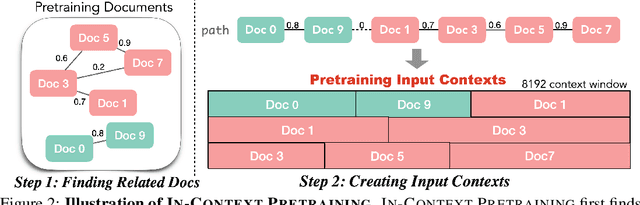

Large language models (LMs) are currently trained to predict tokens given document prefixes, enabling them to directly perform long-form generation and prompting-style tasks which can be reduced to document completion. Existing pretraining pipelines train LMs by concatenating random sets of short documents to create input contexts but the prior documents provide no signal for predicting the next document. We instead present In-Context Pretraining, a new approach where language models are pretrained on a sequence of related documents, thereby explicitly encouraging them to read and reason across document boundaries. We can do In-Context Pretraining by simply changing the document ordering so that each context contains related documents, and directly applying existing pretraining pipelines. However, this document sorting problem is challenging. There are billions of documents and we would like the sort to maximize contextual similarity for every document without repeating any data. To do this, we introduce approximate algorithms for finding related documents with efficient nearest neighbor search and constructing coherent input contexts with a graph traversal algorithm. Our experiments show In-Context Pretraining offers a simple and scalable approach to significantly enhance LMs'performance: we see notable improvements in tasks that require more complex contextual reasoning, including in-context learning (+8%), reading comprehension (+15%), faithfulness to previous contexts (+16%), long-context reasoning (+5%), and retrieval augmentation (+9%).
Personalized Soups: Personalized Large Language Model Alignment via Post-hoc Parameter Merging
Oct 17, 2023While Reinforcement Learning from Human Feedback (RLHF) aligns Large Language Models (LLMs) with general, aggregate human preferences, it is suboptimal for learning diverse, individual perspectives. In this work, we study Reinforcement Learning from Personalized Human Feedback (RLPHF) problem, wherein LLMs are aligned to multiple (sometimes conflicting) preferences by modeling alignment as a Multi-Objective Reinforcement Learning (MORL) problem. Compared to strong single-objective baselines, we show that we can achieve personalized alignment by decomposing preferences into multiple dimensions. These dimensions are defined based on personalizations that are declared as desirable by the user. In this work, we show that they can be efficiently trained independently in a distributed manner and combined effectively post-hoc through parameter merging. The code is available at https://github.com/joeljang/RLPHF.
RA-DIT: Retrieval-Augmented Dual Instruction Tuning
Oct 08, 2023

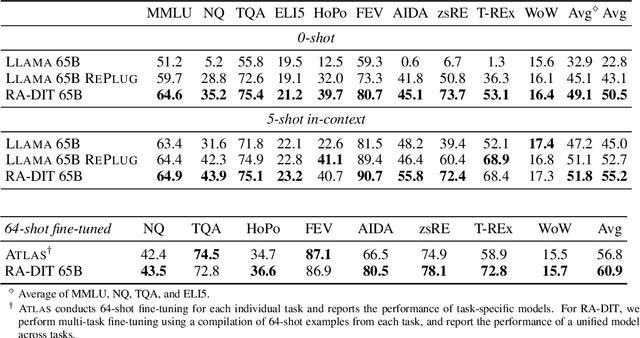

Retrieval-augmented language models (RALMs) improve performance by accessing long-tail and up-to-date knowledge from external data stores, but are challenging to build. Existing approaches require either expensive retrieval-specific modifications to LM pre-training or use post-hoc integration of the data store that leads to suboptimal performance. We introduce Retrieval-Augmented Dual Instruction Tuning (RA-DIT), a lightweight fine-tuning methodology that provides a third option by retrofitting any LLM with retrieval capabilities. Our approach operates in two distinct fine-tuning steps: (1) one updates a pre-trained LM to better use retrieved information, while (2) the other updates the retriever to return more relevant results, as preferred by the LM. By fine-tuning over tasks that require both knowledge utilization and contextual awareness, we demonstrate that each stage yields significant performance improvements, and using both leads to additional gains. Our best model, RA-DIT 65B, achieves state-of-the-art performance across a range of knowledge-intensive zero- and few-shot learning benchmarks, significantly outperforming existing in-context RALM approaches by up to +8.9% in 0-shot setting and +1.4% in 5-shot setting on average.
Demystifying CLIP Data
Oct 02, 2023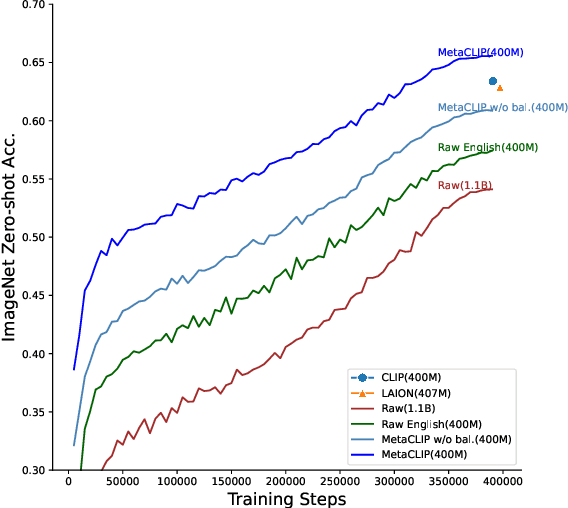

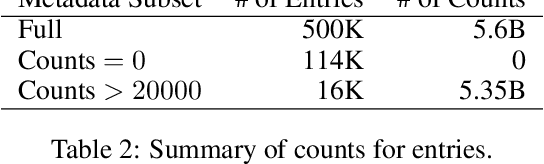
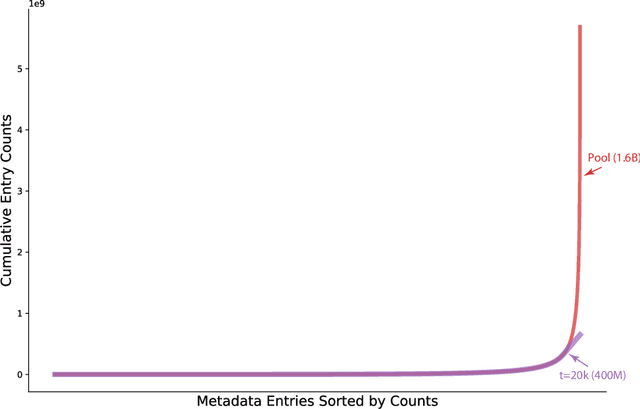
Contrastive Language-Image Pre-training (CLIP) is an approach that has advanced research and applications in computer vision, fueling modern recognition systems and generative models. We believe that the main ingredient to the success of CLIP is its data and not the model architecture or pre-training objective. However, CLIP only provides very limited information about its data and how it has been collected, leading to works that aim to reproduce CLIP's data by filtering with its model parameters. In this work, we intend to reveal CLIP's data curation approach and in our pursuit of making it open to the community introduce Metadata-Curated Language-Image Pre-training (MetaCLIP). MetaCLIP takes a raw data pool and metadata (derived from CLIP's concepts) and yields a balanced subset over the metadata distribution. Our experimental study rigorously isolates the model and training settings, concentrating solely on data. MetaCLIP applied to CommonCrawl with 400M image-text data pairs outperforms CLIP's data on multiple standard benchmarks. In zero-shot ImageNet classification, MetaCLIP achieves 70.8% accuracy, surpassing CLIP's 68.3% on ViT-B models. Scaling to 1B data, while maintaining the same training budget, attains 72.4%. Our observations hold across various model sizes, exemplified by ViT-H achieving 80.5%, without any bells-and-whistles. Curation code and training data distribution on metadata is made available at https://github.com/facebookresearch/MetaCLIP.