 Add to Chrome
 Add to Firefox
 Add to Edge
FactBench: A Dynamic Benchmark for In-the-Wild Language Model Factuality Evaluation
Oct 29, 2024
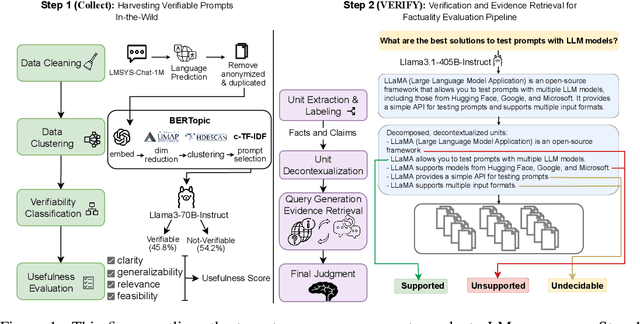
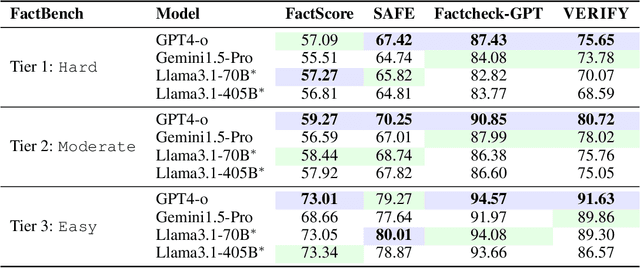
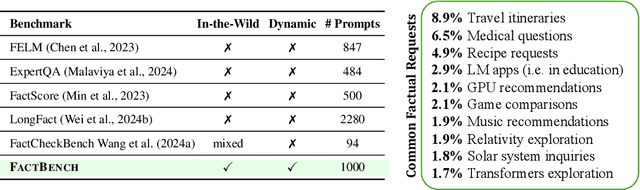

Language models (LMs) are widely used by an increasing number of users, underscoring the challenge of maintaining factuality across a broad range of topics. We first present VERIFY (Verification and Evidence RetrIeval for FactualitY evaluation), a pipeline to evaluate LMs' factuality in real-world user interactions. VERIFY considers the verifiability of LM-generated content and categorizes content units as supported, unsupported, or undecidable based on the retrieved evidence from the Web. Importantly, factuality judgment by VERIFY correlates better with human evaluations than existing methods. Using VERIFY, we identify "hallucination prompts" across diverse topics, i.e., those eliciting the highest rates of incorrect and inconclusive LM responses. These prompts form FactBench, a dataset of 1K prompts across 150 fine-grained topics. Our dataset captures emerging factuality challenges in real-world LM interactions and can be regularly updated with new prompts. We benchmark widely-used LMs from GPT, Gemini, and Llama3.1 family on FactBench, yielding the following key findings: (i) Proprietary models exhibit better factuality, with performance declining from Easy to Hard hallucination prompts. (ii) Llama3.1-405B-Instruct shows comparable or lower factual accuracy than Llama3.1-70B-Instruct across all evaluation methods due to its higher subjectivity that leads to more content labeled as undecidable. (iii) Gemini1.5-Pro shows a significantly higher refusal rate, with over-refusal in 25% of cases. Our code and data are publicly available at https://huggingface.co/spaces/launch/factbench.

Deep Learning-Driven Microstructure Characterization and Vickers Hardness Prediction of Mg-Gd Alloys
Oct 27, 2024


In the field of materials science, exploring the relationship between composition, microstructure, and properties has long been a critical research focus. The mechanical performance of solid-solution Mg-Gd alloys is significantly influenced by Gd content, dendritic structures, and the presence of secondary phases. To better analyze and predict the impact of these factors, this study proposes a multimodal fusion learning framework based on image processing and deep learning techniques. This framework integrates both elemental composition and microstructural features to accurately predict the Vickers hardness of solid-solution Mg-Gd alloys. Initially, deep learning methods were employed to extract microstructural information from a variety of solid-solution Mg-Gd alloy images obtained from literature and experiments. This provided precise grain size and secondary phase microstructural features for performance prediction tasks. Subsequently, these quantitative analysis results were combined with Gd content information to construct a performance prediction dataset. Finally, a regression model based on the Transformer architecture was used to predict the Vickers hardness of Mg-Gd alloys. The experimental results indicate that the Transformer model performs best in terms of prediction accuracy, achieving an R^2 value of 0.9. Additionally, SHAP analysis identified critical values for four key features affecting the Vickers hardness of Mg-Gd alloys, providing valuable guidance for alloy design. These findings not only enhance the understanding of alloy performance but also offer theoretical support for future material design and optimization.
Expanding Chatbot Knowledge in Customer Service: Context-Aware Similar Question Generation Using Large Language Models
Oct 16, 2024


Reliable responses of service chatbots are often achieved by employing retrieval-based methods that restrict answers to a knowledge base comprising predefined question-answer pairs (QA pairs). To accommodate potential variations in how a customer's query may be expressed, it emerges as the favored solution to augment these QA pairs with similar questions that are possibly diverse while remaining semantic consistency. This augmentation task is known as Similar Question Generation (SQG). Traditional methods that heavily rely on human efforts or rule-based techniques suffer from limited diversity or significant semantic deviation from the source question, only capable of producing a finite number of useful questions. To address these limitations, we propose an SQG approach based on Large Language Models (LLMs), capable of producing a substantial number of diverse questions while maintaining semantic consistency to the source QA pair. This is achieved by leveraging LLMs' natural language understanding capability through fine-tuning with specially designed prompts. The experiments conducted on a real customer-service dataset demonstrate that our method surpasses baseline methods by a significant margin in terms of semantic diversity. Human evaluation further confirms that integrating the answer that reflects the customer's intention is crucial for increasing the number of generated questions that meet business requirements.
Closing the Loop: Learning to Generate Writing Feedback via Language Model Simulated Student Revisions
Oct 10, 2024Providing feedback is widely recognized as crucial for refining students' writing skills. Recent advances in language models (LMs) have made it possible to automatically generate feedback that is actionable and well-aligned with human-specified attributes. However, it remains unclear whether the feedback generated by these models is truly effective in enhancing the quality of student revisions. Moreover, prompting LMs with a precise set of instructions to generate feedback is nontrivial due to the lack of consensus regarding the specific attributes that can lead to improved revising performance. To address these challenges, we propose PROF that PROduces Feedback via learning from LM simulated student revisions. PROF aims to iteratively optimize the feedback generator by directly maximizing the effectiveness of students' overall revising performance as simulated by LMs. Focusing on an economic essay assignment, we empirically test the efficacy of PROF and observe that our approach not only surpasses a variety of baseline methods in effectiveness of improving students' writing but also demonstrates enhanced pedagogical values, even though it was not explicitly trained for this aspect.
Narrative-of-Thought: Improving Temporal Reasoning of Large Language Models via Recounted Narratives
Oct 07, 2024



Reasoning about time and temporal relations is an integral aspect of human cognition, essential for perceiving the world and navigating our experiences. Though large language models (LLMs) have demonstrated impressive performance in many reasoning tasks, temporal reasoning remains challenging due to its intrinsic complexity. In this work, we first study an essential task of temporal reasoning -- temporal graph generation, to unveil LLMs' inherent, global reasoning capabilities. We show that this task presents great challenges even for the most powerful LLMs, such as GPT-3.5/4. We also notice a significant performance gap by small models (<10B) that lag behind LLMs by 50%. Next, we study how to close this gap with a budget constraint, e.g., not using model finetuning. We propose a new prompting technique tailored for temporal reasoning, Narrative-of-Thought (NoT), that first converts the events set to a Python class, then prompts a small model to generate a temporally grounded narrative, guiding the final generation of a temporal graph. Extensive experiments showcase the efficacy of NoT in improving various metrics. Notably, NoT attains the highest F1 on the Schema-11 evaluation set, while securing an overall F1 on par with GPT-3.5. NoT also achieves the best structural similarity across the board, even compared with GPT-3.5/4. Our code is available at https://github.com/launchnlp/NoT.
Scalable Fine-tuning from Multiple Data Sources:A First-Order Approximation Approach
Sep 28, 2024We study the problem of fine-tuning a language model (LM) for a target task by optimally using the information from $n$ auxiliary tasks. This problem has broad applications in NLP, such as targeted instruction tuning and data selection in chain-of-thought fine-tuning. The key challenge of this problem is that not all auxiliary tasks are useful to improve the performance of the target task. Thus, choosing the right subset of auxiliary tasks is crucial. Conventional subset selection methods, such as forward & backward selection, are unsuitable for LM fine-tuning because they require repeated training on subsets of auxiliary tasks. This paper introduces a new algorithm to estimate model fine-tuning performances without repeated training. Our algorithm first performs multitask training using the data of all the tasks to obtain a meta initialization. Then, we approximate the model fine-tuning loss of a subset using functional values and gradients from the meta initialization. Empirically, we find that this gradient-based approximation holds with remarkable accuracy for twelve transformer-based LMs. Thus, we can now estimate fine-tuning performances on CPUs within a few seconds. We conduct extensive experiments to validate our approach, delivering a speedup of $30\times$ over conventional subset selection while incurring only $1\%$ error of the true fine-tuning performances. In downstream evaluations of instruction tuning and chain-of-thought fine-tuning, our approach improves over prior methods that utilize gradient or representation similarity for subset selection by up to $3.8\%$.
Turn Every Application into an Agent: Towards Efficient Human-Agent-Computer Interaction with API-First LLM-Based Agents
Sep 25, 2024Multimodal large language models (MLLMs) have enabled LLM-based agents to directly interact with application user interfaces (UIs), enhancing agents' performance in complex tasks. However, these agents often suffer from high latency and low reliability due to the extensive sequential UI interactions. To address this issue, we propose AXIS, a novel LLM-based agents framework prioritize actions through application programming interfaces (APIs) over UI actions. This framework also facilitates the creation and expansion of APIs through automated exploration of applications. Our experiments on Office Word demonstrate that AXIS reduces task completion time by 65%-70% and cognitive workload by 38%-53%, while maintaining accuracy of 97%-98% compare to humans. Our work contributes to a new human-agent-computer interaction (HACI) framework and a fresh UI design principle for application providers in the era of LLMs. It also explores the possibility of turning every applications into agents, paving the way towards an agent-centric operating system (Agent OS).
Attack End-to-End Autonomous Driving through Module-Wise Noise
Sep 12, 2024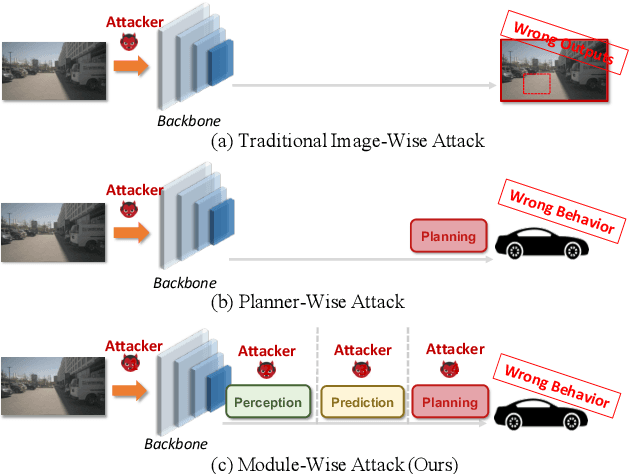
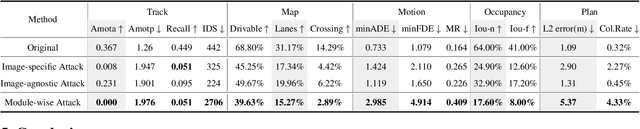
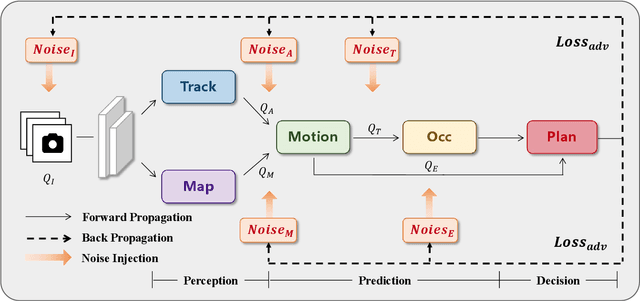
With recent breakthroughs in deep neural networks, numerous tasks within autonomous driving have exhibited remarkable performance. However, deep learning models are susceptible to adversarial attacks, presenting significant security risks to autonomous driving systems. Presently, end-to-end architectures have emerged as the predominant solution for autonomous driving, owing to their collaborative nature across different tasks. Yet, the implications of adversarial attacks on such models remain relatively unexplored. In this paper, we conduct comprehensive adversarial security research on the modular end-to-end autonomous driving model for the first time. We thoroughly consider the potential vulnerabilities in the model inference process and design a universal attack scheme through module-wise noise injection. We conduct large-scale experiments on the full-stack autonomous driving model and demonstrate that our attack method outperforms previous attack methods. We trust that our research will offer fresh insights into ensuring the safety and reliability of autonomous driving systems.
Module-wise Adaptive Adversarial Training for End-to-end Autonomous Driving
Sep 11, 2024

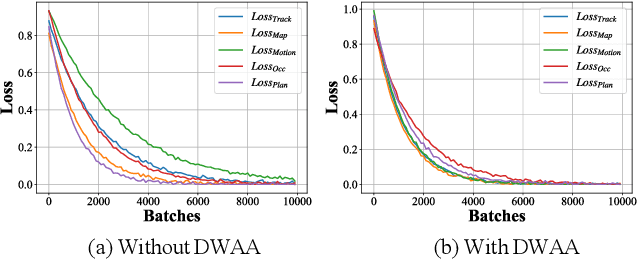

Recent advances in deep learning have markedly improved autonomous driving (AD) models, particularly end-to-end systems that integrate perception, prediction, and planning stages, achieving state-of-the-art performance. However, these models remain vulnerable to adversarial attacks, where human-imperceptible perturbations can disrupt decision-making processes. While adversarial training is an effective method for enhancing model robustness against such attacks, no prior studies have focused on its application to end-to-end AD models. In this paper, we take the first step in adversarial training for end-to-end AD models and present a novel Module-wise Adaptive Adversarial Training (MA2T). However, extending conventional adversarial training to this context is highly non-trivial, as different stages within the model have distinct objectives and are strongly interconnected. To address these challenges, MA2T first introduces Module-wise Noise Injection, which injects noise before the input of different modules, targeting training models with the guidance of overall objectives rather than each independent module loss. Additionally, we introduce Dynamic Weight Accumulation Adaptation, which incorporates accumulated weight changes to adaptively learn and adjust the loss weights of each module based on their contributions (accumulated reduction rates) for better balance and robust training. To demonstrate the efficacy of our defense, we conduct extensive experiments on the widely-used nuScenes dataset across several end-to-end AD models under both white-box and black-box attacks, where our method outperforms other baselines by large margins (+5-10%). Moreover, we validate the robustness of our defense through closed-loop evaluation in the CARLA simulation environment, showing improved resilience even against natural corruption.
Scaling Law with Learning Rate Annealing
Aug 20, 2024



We find that the cross-entropy loss curves of neural language models empirically adhere to a scaling law with learning rate (LR) annealing over training steps ($s$): $$L(s) = L_0 + A\cdot S_1^{-\alpha} - C\cdot S_2$$ Where $S_1$ is forward area and $S_2$ is learning rate annealing area. This formulation takes into account two factors: (1) The forward scaling defined as typical scaling law, and (2) the additional loss drop brought by LR annealing. Therefore, this formulation can describe the full loss curve at each step, rather than the single loss point at the end of training. Applying the scaling law with LR annealing and fitting only one or two training curves, we can accurately predict the loss of language model training at any given step and across any learning rate scheduler (LRS). Furthermore, this equation accurately describes the dynamics during training process, and provides a theoretical verification and explanation for numerous experimental findings of previous studies, particularly those focusing on LR schedule and LR annealing. The resulting insights, also serve as a guide for researchers to select critical LRS in advance by prediction using our equation. Most significantly, since all the points in a full training curve follow the equation, we can achieve accurate loss prediction at any given step across any learning rate scheduler, while expending less than 1\% of the computational cost required by the chinchilla scaling law to fit language modeling loss. This approach extremely democratizes scaling law fitting and predicting in developing large language models.