 Add to Chrome
 Add to Firefox
 Add to Edge
Dictionary-based Pathology Mining with Hard-instance-assisted Classifier Debiasing for Genetic Biomarker Prediction from WSIs
Mar 26, 2026
Prediction of genetic biomarkers, e.g., microsatellite instability in colorectal cancer is crucial for clinical decision making. But, two primary challenges hamper accurate prediction: (1) It is difficult to construct a pathology-aware representation involving the complex interconnections among pathological components. (2) WSIs contain a large proportion of areas unrelated to genetic biomarkers, which make the model easily overfit simple but irrelative instances. We hereby propose a Dictionary-based hierarchical pathology mining with hard-instance-assisted classifier Debiasing framework to address these challenges, dubbed as D2Bio. Our first module, dictionary-based hierarchical pathology mining, is able to mine diverse and very fine-grained pathological contextual interaction without the limit to the distances between patches. The second module, hard-instance-assisted classfier debiasing, learns a debiased classifier via focusing on hard but task-related features, without any additional annotations. Experimental results on five cohorts show the superiority of our method, with over 4% improvement in AUROC compared with the second best on the TCGA-CRC-MSI cohort. Our analysis further shows the clinical interpretability of D2Bio in genetic biomarker diagnosis and potential clinical utility in survival analysis. Code will be available at https://github.com/DeepMed-Lab-ECNU/D2Bio.

Attack End-to-End Autonomous Driving through Module-Wise Noise
Sep 12, 2024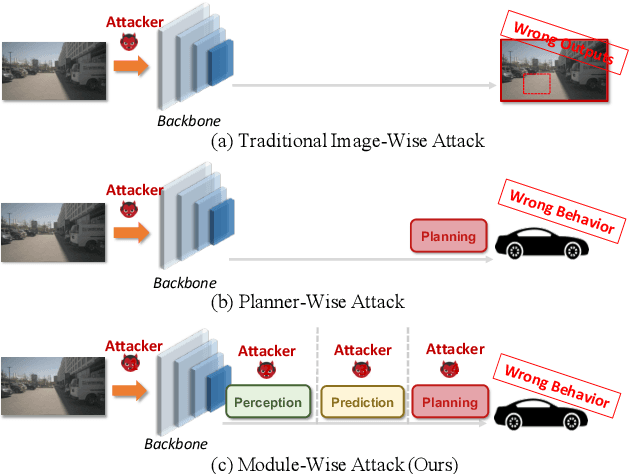
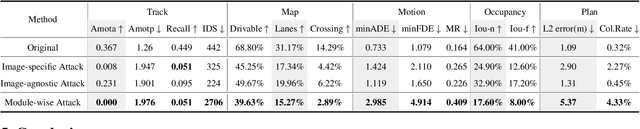
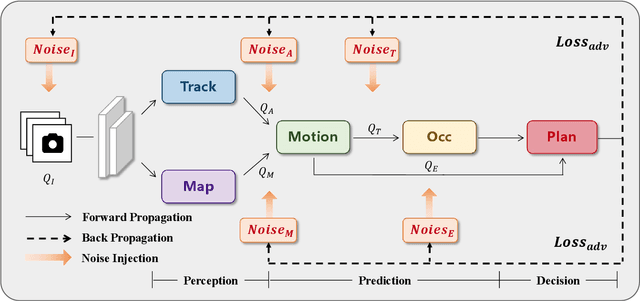
With recent breakthroughs in deep neural networks, numerous tasks within autonomous driving have exhibited remarkable performance. However, deep learning models are susceptible to adversarial attacks, presenting significant security risks to autonomous driving systems. Presently, end-to-end architectures have emerged as the predominant solution for autonomous driving, owing to their collaborative nature across different tasks. Yet, the implications of adversarial attacks on such models remain relatively unexplored. In this paper, we conduct comprehensive adversarial security research on the modular end-to-end autonomous driving model for the first time. We thoroughly consider the potential vulnerabilities in the model inference process and design a universal attack scheme through module-wise noise injection. We conduct large-scale experiments on the full-stack autonomous driving model and demonstrate that our attack method outperforms previous attack methods. We trust that our research will offer fresh insights into ensuring the safety and reliability of autonomous driving systems.
Overview of AI-Debater 2023: The Challenges of Argument Generation Tasks
Jul 24, 2024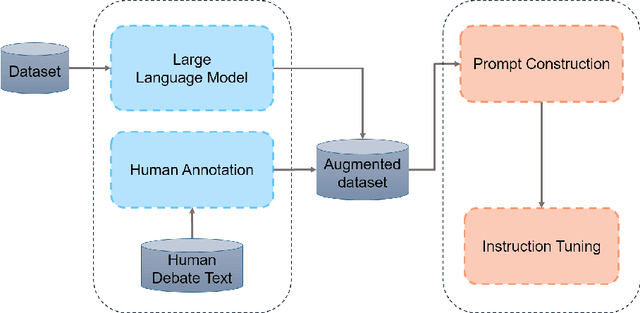
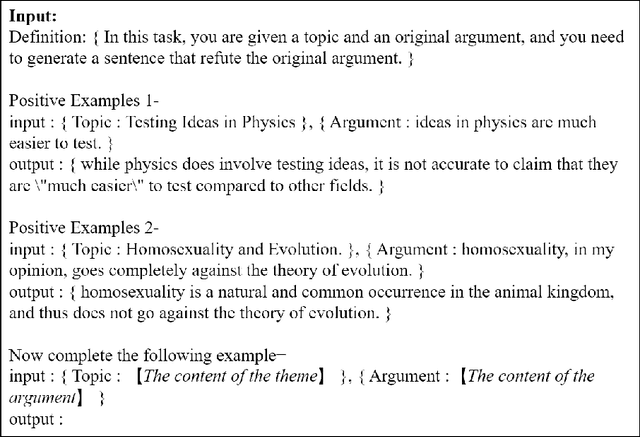
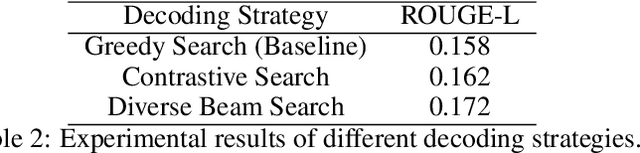
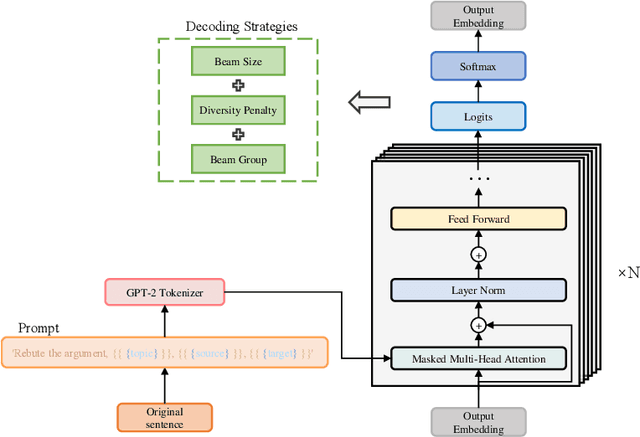
In this paper we present the results of the AI-Debater 2023 Challenge held by the Chinese Conference on Affect Computing (CCAC 2023), and introduce the related datasets. We organize two tracks to handle the argumentative generation tasks in different scenarios, namely, Counter-Argument Generation (Track 1) and Claim-based Argument Generation (Track 2). Each track is equipped with its distinct dataset and baseline model respectively. In total, 32 competing teams register for the challenge, from which we received 11 successful submissions. In this paper, we will present the results of the challenge and a summary of the systems, highlighting commonalities and innovations among participating systems. Datasets and baseline models of the AI-Debater 2023 Challenge have been already released and can be accessed through the official website of the challenge.
Gene-induced Multimodal Pre-training for Image-omic Classification
Sep 06, 2023Histology analysis of the tumor micro-environment integrated with genomic assays is the gold standard for most cancers in modern medicine. This paper proposes a Gene-induced Multimodal Pre-training (GiMP) framework, which jointly incorporates genomics and Whole Slide Images (WSIs) for classification tasks. Our work aims at dealing with the main challenges of multi-modality image-omic classification w.r.t. (1) the patient-level feature extraction difficulties from gigapixel WSIs and tens of thousands of genes, and (2) effective fusion considering high-order relevance modeling. Concretely, we first propose a group multi-head self-attention gene encoder to capture global structured features in gene expression cohorts. We design a masked patch modeling paradigm (MPM) to capture the latent pathological characteristics of different tissues. The mask strategy is randomly masking a fixed-length contiguous subsequence of patch embeddings of a WSI. Finally, we combine the classification tokens of paired modalities and propose a triplet learning module to learn high-order relevance and discriminative patient-level information.After pre-training, a simple fine-tuning can be adopted to obtain the classification results. Experimental results on the TCGA dataset show the superiority of our network architectures and our pre-training framework, achieving 99.47% in accuracy for image-omic classification. The code is publicly available at https://github.com/huangwudiduan/GIMP.