 Add to Chrome
 Add to Firefox
 Add to Edge
Hybrid Force Motion Control with Estimated Surface Normal for Manufacturing Applications
Apr 05, 2024
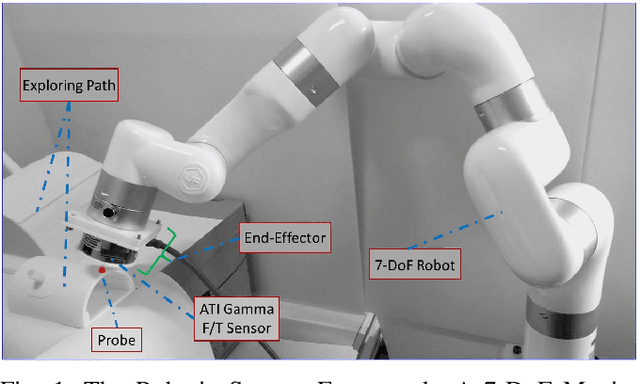
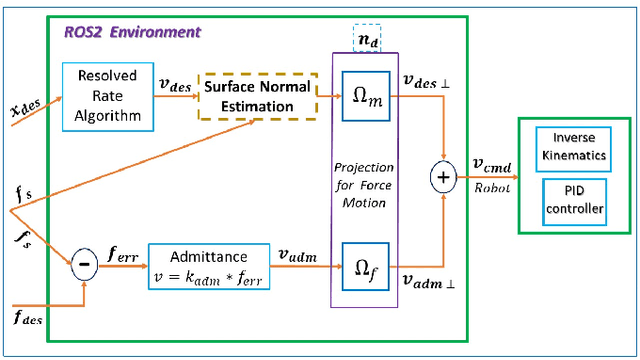
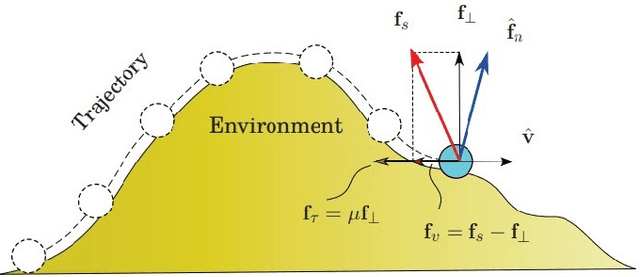
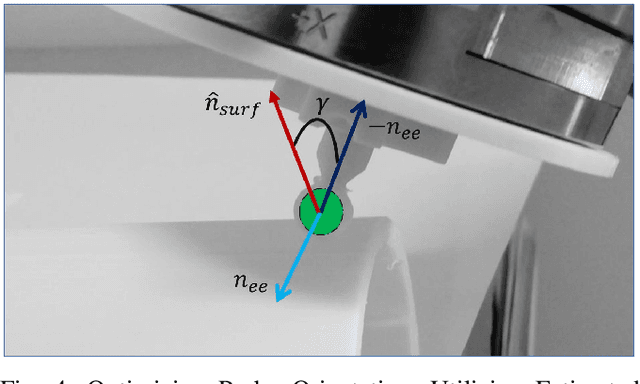
This paper proposes a hybrid force-motion framework that utilizes real-time surface normal updates. The surface normal is estimated via a novel method that leverages force sensing measurements and velocity commands to compensate the friction bias. This approach is critical for robust execution of precision force-controlled tasks in manufacturing, such as thermoplastic tape replacement that traces surfaces or paths on a workpiece subject to uncertainties deviated from the model. We formulated the proposed method and implemented the framework in ROS2 environment. The approach was validated using kinematic simulations and a hardware platform. Specifically, we demonstrated the approach on a 7-DoF manipulator equipped with a force/torque sensor at the end-effector.

A High-Fidelity Simulation Framework for Grasping Stability Analysis in Human Casualty Manipulation
Apr 04, 2024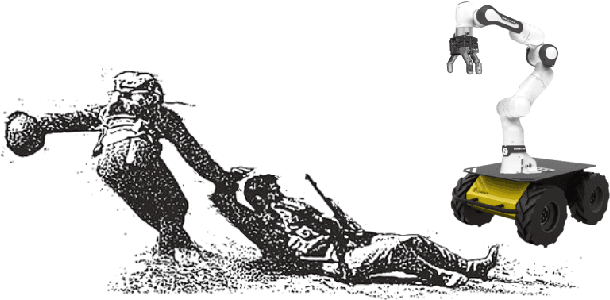

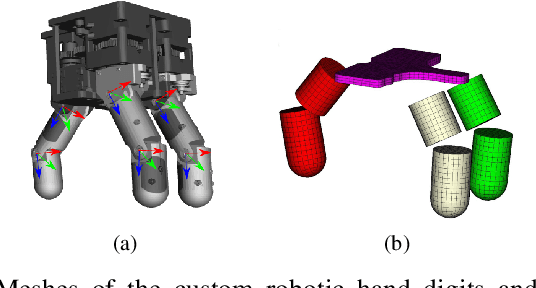
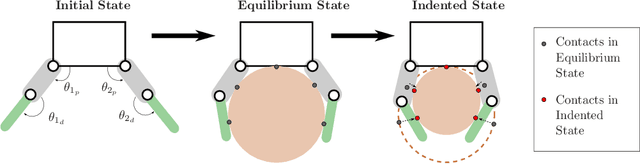
Recently, there has been a growing interest in rescue robots due to their vital role in addressing emergency scenarios and providing crucial support in challenging or hazardous situations where human intervention is difficult. However, very few of these robots are capable of actively engaging with humans and undertaking physical manipulation tasks. This limitation is largely attributed to the absence of tools that can realistically simulate physical interactions, especially the contact mechanisms between a robotic gripper and a human body. In this letter, we aim to address key limitations in current developments towards robotic casualty manipulation. Firstly, we present an integrative simulation framework for casualty manipulation. We adapt a finite element method (FEM) tool into the grasping and manipulation scenario, and the developed framework can provide accurate biomechanical reactions resulting from manipulation. Secondly, we conduct a detailed assessment of grasping stability during casualty grasping and manipulation simulations. To validate the necessity and superior performance of the proposed high-fidelity simulation framework, we conducted a qualitative and quantitative comparison of grasping stability analyses between the proposed framework and the state-of-the-art multi-body physics simulations. Through these efforts, we have taken the first step towards a feasible solution for robotic casualty manipulation.
A Bimanual Teleoperation Framework for Light Duty Underwater Vehicle-Manipulator Systems
Apr 04, 2024In an effort to lower the barrier to entry in underwater manipulation, this paper presents an open-source, user-friendly framework for bimanual teleoperation of a light-duty underwater vehicle-manipulator system (UVMS). This framework allows for the control of the vehicle along with two manipulators and their end-effectors using two low-cost haptic devices. The UVMS kinematics are derived in order to create an independent resolved motion rate controller for each manipulator, which optimally controls the joint positions to achieve a desired end-effector pose. This desired pose is computed in real-time using a teleoperation controller developed to process the dual haptic device input from the user. A physics-based simulation environment is used to implement this framework for two example tasks as well as provide data for error analysis of user commands. The first task illustrates the functionality of the framework through motion control of the vehicle and manipulators using only the haptic devices. The second task is to grasp an object using both manipulators simultaneously, demonstrating precision and coordination using the framework. The framework code is available at https://github.com/stevens-armlab/uvms_bimanual_sim.
Mathematics of multi-agent learning systems at the interface of game theory and artificial intelligence
Mar 09, 2024Evolutionary Game Theory (EGT) and Artificial Intelligence (AI) are two fields that, at first glance, might seem distinct, but they have notable connections and intersections. The former focuses on the evolution of behaviors (or strategies) in a population, where individuals interact with others and update their strategies based on imitation (or social learning). The more successful a strategy is, the more prevalent it becomes over time. The latter, meanwhile, is centered on machine learning algorithms and (deep) neural networks. It is often from a single-agent perspective but increasingly involves multi-agent environments, in which intelligent agents adjust their strategies based on feedback and experience, somewhat akin to the evolutionary process yet distinct in their self-learning capacities. In light of the key components necessary to address real-world problems, including (i) learning and adaptation, (ii) cooperation and competition, (iii) robustness and stability, and altogether (iv) population dynamics of individual agents whose strategies evolve, the cross-fertilization of ideas between both fields will contribute to the advancement of mathematics of multi-agent learning systems, in particular, to the nascent domain of ``collective cooperative intelligence'' bridging evolutionary dynamics and multi-agent reinforcement learning.
XUAT-Copilot: Multi-Agent Collaborative System for Automated User Acceptance Testing with Large Language Model
Jan 10, 2024In past years, we have been dedicated to automating user acceptance testing (UAT) process of WeChat Pay, one of the most influential mobile payment applications in China. A system titled XUAT has been developed for this purpose. However, there is still a human-labor-intensive stage, i.e, test scripts generation, in the current system. Therefore, in this paper, we concentrate on methods of boosting the automation level of the current system, particularly the stage of test scripts generation. With recent notable successes, large language models (LLMs) demonstrate significant potential in attaining human-like intelligence and there has been a growing research area that employs LLMs as autonomous agents to obtain human-like decision-making capabilities. Inspired by these works, we propose an LLM-powered multi-agent collaborative system, named XUAT-Copilot, for automated UAT. The proposed system mainly consists of three LLM-based agents responsible for action planning, state checking and parameter selecting, respectively, and two additional modules for state sensing and case rewriting. The agents interact with testing device, make human-like decision and generate action command in a collaborative way. The proposed multi-agent system achieves a close effectiveness to human testers in our experimental studies and gains a significant improvement of Pass@1 accuracy compared with single-agent architecture. More importantly, the proposed system has launched in the formal testing environment of WeChat Pay mobile app, which saves a considerable amount of manpower in the daily development work.
Spatio-Temporal Anomaly Detection with Graph Networks for Data Quality Monitoring of the Hadron Calorimeter
Nov 07, 2023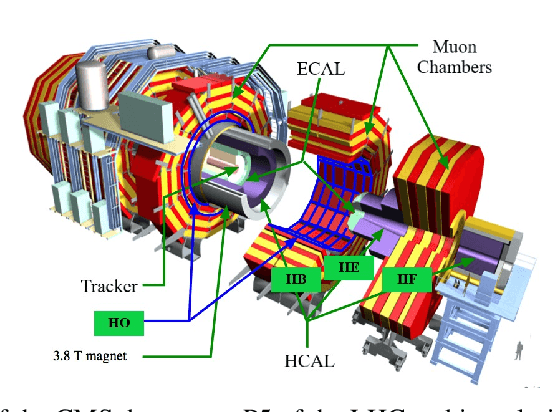
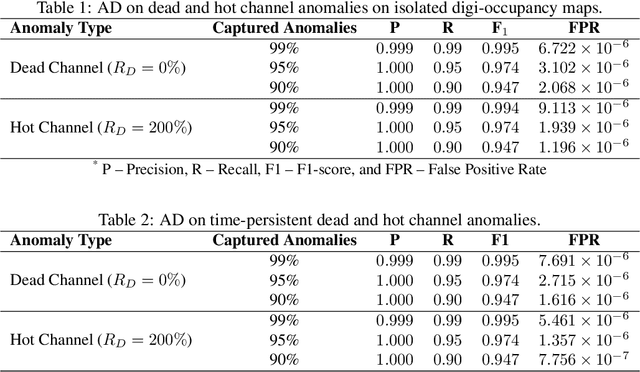

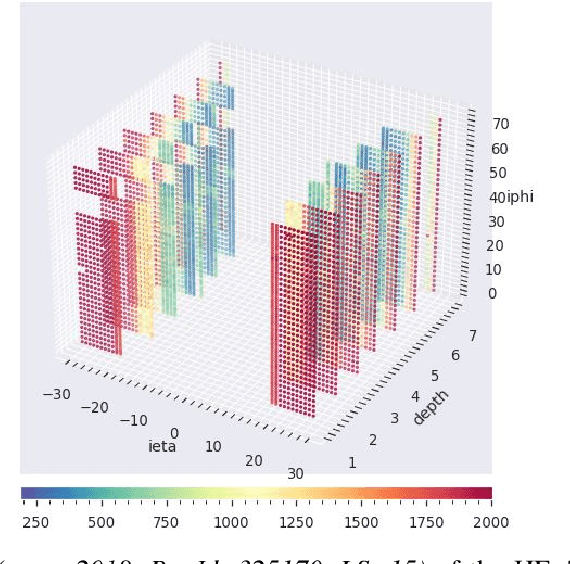
The compact muon solenoid (CMS) experiment is a general-purpose detector for high-energy collision at the large hadron collider (LHC) at CERN. It employs an online data quality monitoring (DQM) system to promptly spot and diagnose particle data acquisition problems to avoid data quality loss. In this study, we present semi-supervised spatio-temporal anomaly detection (AD) monitoring for the physics particle reading channels of the hadronic calorimeter (HCAL) of the CMS using three-dimensional digi-occupancy map data of the DQM. We propose the GraphSTAD system, which employs convolutional and graph neural networks to learn local spatial characteristics induced by particles traversing the detector, and global behavior owing to shared backend circuit connections and housing boxes of the channels, respectively. Recurrent neural networks capture the temporal evolution of the extracted spatial features. We have validated the accuracy of the proposed AD system in capturing diverse channel fault types using the LHC Run-2 collision data sets. The GraphSTAD system has achieved production-level accuracy and is being integrated into the CMS core production system--for real-time monitoring of the HCAL. We have also provided a quantitative performance comparison with alternative benchmark models to demonstrate the promising leverage of the presented system.
CCAE: A Corpus of Chinese-based Asian Englishes
Oct 09, 2023Language models have been foundations in various scenarios of NLP applications, but it has not been well applied in language variety studies, even for the most popular language like English. This paper represents one of the few initial efforts to utilize the NLP technology in the paradigm of World Englishes, specifically in creating a multi-variety corpus for studying Asian Englishes. We present an overview of the CCAE -- Corpus of Chinese-based Asian English, a suite of corpora comprising six Chinese-based Asian English varieties. It is based on 340 million tokens in 448 thousand web documents from six regions. The ontology of data would make the corpus a helpful resource with enormous research potential for Asian Englishes (especially for Chinese Englishes for which there has not been a publicly accessible corpus yet so far) and an ideal source for variety-specific language modeling and downstream tasks, thus setting the stage for NLP-based World Englishes studies. And preliminary experiments on this corpus reveal the practical value of CCAE. Finally, we make CCAE available at \href{https://huggingface.co/datasets/CCAE/CCAE-Corpus}{this https URL}.
Long-term Visual Localization with Mobile Sensors
Apr 16, 2023


Despite the remarkable advances in image matching and pose estimation, image-based localization of a camera in a temporally-varying outdoor environment is still a challenging problem due to huge appearance disparity between query and reference images caused by illumination, seasonal and structural changes. In this work, we propose to leverage additional sensors on a mobile phone, mainly GPS, compass, and gravity sensor, to solve this challenging problem. We show that these mobile sensors provide decent initial poses and effective constraints to reduce the searching space in image matching and final pose estimation. With the initial pose, we are also able to devise a direct 2D-3D matching network to efficiently establish 2D-3D correspondences instead of tedious 2D-2D matching in existing systems. As no public dataset exists for the studied problem, we collect a new dataset that provides a variety of mobile sensor data and significant scene appearance variations, and develop a system to acquire ground-truth poses for query images. We benchmark our method as well as several state-of-the-art baselines and demonstrate the effectiveness of the proposed approach. The code and dataset will be released publicly.
A Redundancy Resolution Method for Free-Floating Underwater Manipulation
Feb 28, 2023Underwater manipulation with free-floating autonomous underwater vehicles (AUVs) is an under-explored research area that this paper addresses. The open-source mechanical, electrical, and software designs of an AUV and continuum manipulator system are provided as a platform for performing this research. The underwater robot system has high degrees of freedom including the vehicle body motion and the manipulator joints. Therefore, when performing a manipulation task, the robot has many different potential trajectories which satisfy the task constraints, and this kinematic redundancy needs to be resolved. This paper provides a method for solving the redundancy problem. The relevant kinematic models are derived in order to build an algorithm to calculate desired joint velocities in real time. Different methods to optimize the algorithm for specific tasks are proposed, including a basic weighting method and a gradient projection method to optimize a user-defined objective function. Both simulation and experimental results are analyzed to assess the performance of this algorithm.
Design Project of an Open-Source, Low-Cost, and Lightweight Robotic Manipulator for High School Students
Feb 21, 2023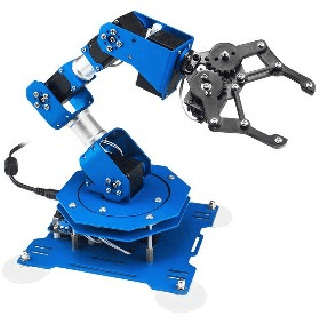
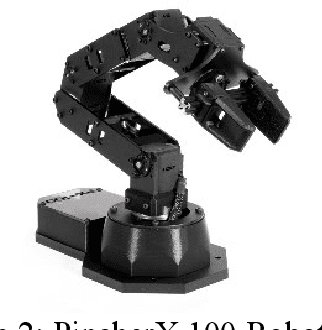
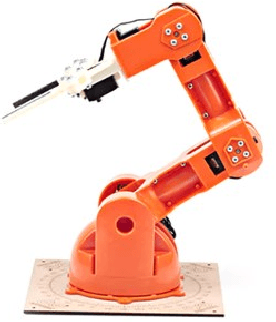
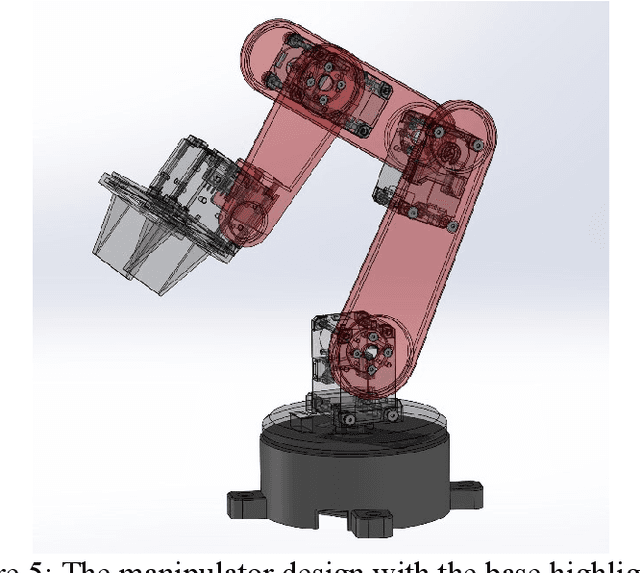
In recent years, there is an increasing interest in high school robotics extracurriculars such as robotics clubs and robotics competitions. The growing demand is a result of more ubiquitous open-source software and affordable off-the-shelf hardware kits, which significantly help lower the barrier for entry-level robotics hobbyists. In this project, we present an open-source, low-cost, and lightweight robotic manipulator designed and developed by a high school researcher under the guidance of a university faculty and a Ph.D. student. We believe the presented project is suitable for high school robotics research and educational activities. Our open-source package consists of mechanical design models, mechatronics specifications, and software program source codes. The mechanical design models include CAD (Computer Aided Design) files that are ready for prototyping (3D printing technology) and serve as an assembly guide accommodated with a complete bill of materials. Electrical wiring diagrams and low-level controllers are documented in detail as part of the open-source software package. The educational objective of this project is to enable high school student teams to replicate and build a robotic manipulator. The engineering experience that high school students acquire in the proposed project is full-stack, including mechanical design, mechatronics, and programming. The project significantly enriches their hands-on engineering experience in a project-based environment. Throughout this project, we discovered that the high school researcher was able to apply multidisciplinary knowledge from K-12 STEM courses to build the robotic manipulator. The researcher was able to go through a system engineering design and development process and obtain skills to use professional engineering tools including SolidWorks and Arduino microcontrollers.