 Add to Chrome
 Add to Firefox
 Add to Edge
Efficient On-Device Diffusion LLM Inference with Mobile NPU
Jun 11, 2026
Diffusion large language models (dLLMs) accelerate generation by denoising multiple tokens in parallel, making them attractive for latency-sensitive mobile inference. However, repeated denoising introduces substantial computation on smartphones. Mobile neural processing units (NPUs) offer high-throughput dense matrix computation, but efficiently exploiting them remains challenging: token commitment shrinks per-block effective workloads, token revision complicates KV cache reuse, and limited NPU-visible address space incurs costly remapping and data transfer overheads. In this paper, we propose llada.cpp, the first NPU-aware inference framework for accelerating dLLMs on smartphones. llada.cpp aligns block-wise dLLM inference with the execution characteristics of mobile NPUs through three techniques. (1) Multi-Block Speculative Decoding fills the shrinking workload in late-stage current-block decoding with speculative future-block tokens. (2) Dual-Path Progressive Revision keeps committed tokens revisable until stable and refreshes unstable tokens through a CPU-side path without stalling dense NPU execution. (3) Swap-Optimized Memory Runtime compacts NPU-visible address layouts and overlaps data staging with NPU computation to reduce remapping and transfer overheads. We implement llada.cpp as an end-to-end framework and evaluate it across diverse hardware platforms and dLLM workloads. llada.cpp reduces LLaDA-8B generation latency by 17x-42x over the CPU baseline with prefix KV cache reuse, while preserving generation quality.

HybriMoE: Hybrid CPU-GPU Scheduling and Cache Management for Efficient MoE Inference
Apr 08, 2025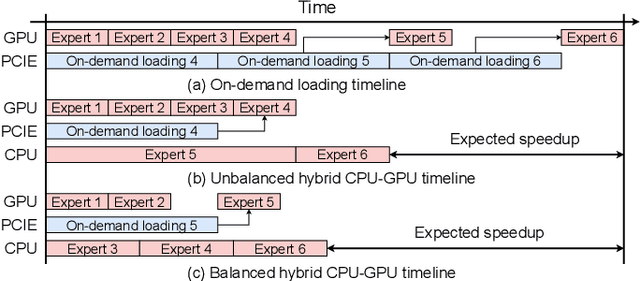
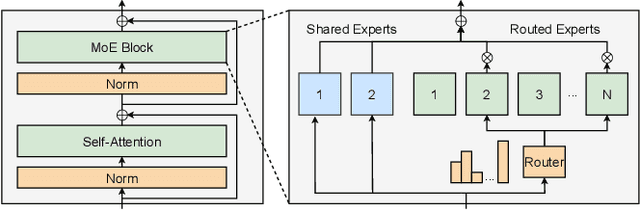
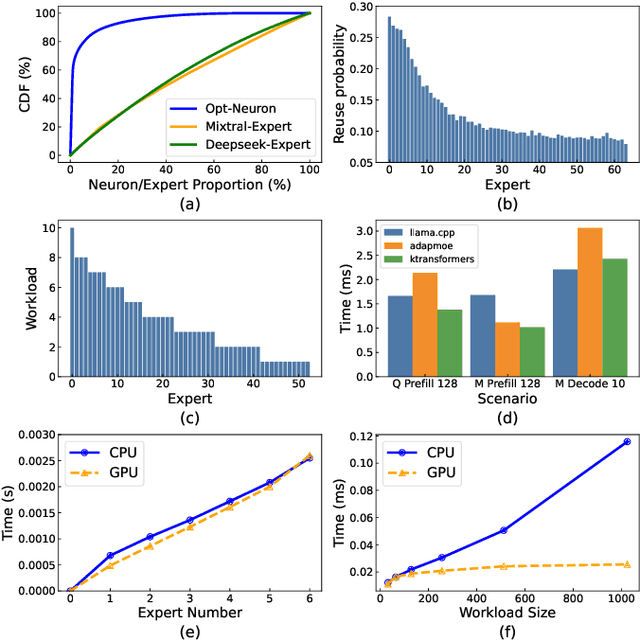
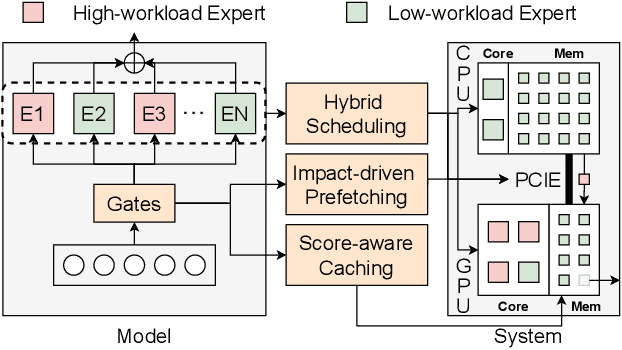
The Mixture of Experts (MoE) architecture has demonstrated significant advantages as it enables to increase the model capacity without a proportional increase in computation. However, the large MoE model size still introduces substantial memory demands, which usually requires expert offloading on resource-constrained platforms and incurs significant overhead. Hybrid CPU-GPU inference has been proposed to leverage CPU computation to reduce expert loading overhead but faces major challenges: on one hand, the expert activation patterns of MoE models are highly unstable, rendering the fixed mapping strategies in existing works inefficient; on the other hand, the hybrid CPU-GPU schedule for MoE is inherently complex due to the diverse expert sizes, structures, uneven workload distribution, etc. To address these challenges, in this paper, we propose HybriMoE, a hybrid CPU-GPU inference framework that improves resource utilization through a novel CPU-GPU scheduling and cache management system. HybriMoE introduces (i) a dynamic intra-layer scheduling strategy to balance workloads across CPU and GPU, (ii) an impact-driven inter-layer prefetching algorithm, and (iii) a score-based caching algorithm to mitigate expert activation instability. We implement HybriMoE on top of the kTransformers framework and evaluate it on three widely used MoE-based LLMs. Experimental results demonstrate that HybriMoE achieves an average speedup of 1.33$\times$ in the prefill stage and 1.70$\times$ in the decode stage compared to state-of-the-art hybrid MoE inference framework. Our code is available at: https://github.com/PKU-SEC-Lab/HybriMoE.