 Add to Chrome
 Add to Firefox
 Add to Edge
VFIMamba: Video Frame Interpolation with State Space Models
Jul 02, 2024
Inter-frame modeling is pivotal in generating intermediate frames for video frame interpolation (VFI). Current approaches predominantly rely on convolution or attention-based models, which often either lack sufficient receptive fields or entail significant computational overheads. Recently, Selective State Space Models (S6) have emerged, tailored specifically for long sequence modeling, offering both linear complexity and data-dependent modeling capabilities. In this paper, we propose VFIMamba, a novel frame interpolation method for efficient and dynamic inter-frame modeling by harnessing the S6 model. Our approach introduces the Mixed-SSM Block (MSB), which initially rearranges tokens from adjacent frames in an interleaved fashion and subsequently applies multi-directional S6 modeling. This design facilitates the efficient transmission of information across frames while upholding linear complexity. Furthermore, we introduce a novel curriculum learning strategy that progressively cultivates proficiency in modeling inter-frame dynamics across varying motion magnitudes, fully unleashing the potential of the S6 model. Experimental findings showcase that our method attains state-of-the-art performance across diverse benchmarks, particularly excelling in high-resolution scenarios. In particular, on the X-TEST dataset, VFIMamba demonstrates a noteworthy improvement of 0.80 dB for 4K frames and 0.96 dB for 2K frames.

EgoVideo: Exploring Egocentric Foundation Model and Downstream Adaptation
Jun 27, 2024

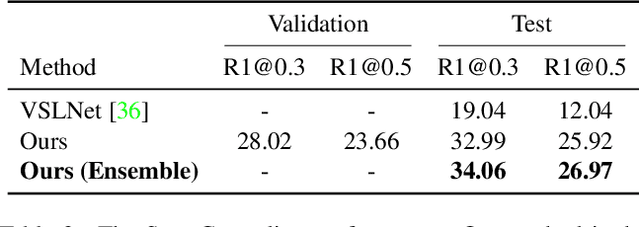

In this report, we present our solutions to the EgoVis Challenges in CVPR 2024, including five tracks in the Ego4D challenge and three tracks in the EPIC-Kitchens challenge. Building upon the video-language two-tower model and leveraging our meticulously organized egocentric video data, we introduce a novel foundation model called EgoVideo. This model is specifically designed to cater to the unique characteristics of egocentric videos and provides strong support for our competition submissions. In the Ego4D challenges, we tackle various tasks including Natural Language Queries, Step Grounding, Moment Queries, Short-term Object Interaction Anticipation, and Long-term Action Anticipation. In addition, we also participate in the EPIC-Kitchens challenge, where we engage in the Action Recognition, Multiple Instance Retrieval, and Domain Adaptation for Action Recognition tracks. By adapting EgoVideo to these diverse tasks, we showcase its versatility and effectiveness in different egocentric video analysis scenarios, demonstrating the powerful representation ability of EgoVideo as an egocentric foundation model. Our codebase and pretrained models are publicly available at https://github.com/OpenGVLab/EgoVideo.
OmniCorpus: A Unified Multimodal Corpus of 10 Billion-Level Images Interleaved with Text
Jun 13, 2024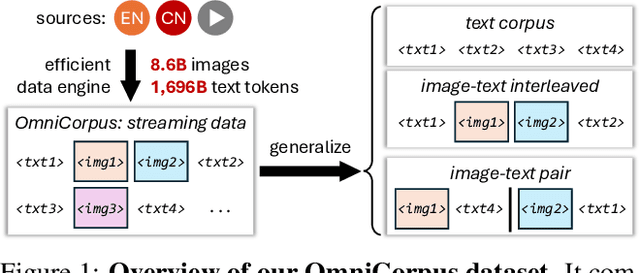


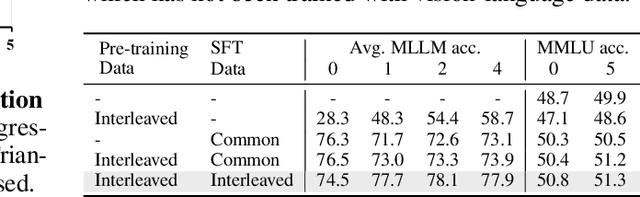
Image-text interleaved data, consisting of multiple images and texts arranged in a natural document format, aligns with the presentation paradigm of internet data and closely resembles human reading habits. Recent studies have shown that such data aids multimodal in-context learning and maintains the capabilities of large language models during multimodal fine-tuning. However, the limited scale and diversity of current image-text interleaved data restrict the development of multimodal large language models. In this paper, we introduce OmniCorpus, a 10 billion-scale image-text interleaved dataset. Using an efficient data engine, we filter and extract large-scale high-quality documents, which contain 8.6 billion images and 1,696 billion text tokens. Compared to counterparts (e.g., MMC4, OBELICS), our dataset 1) has 15 times larger scales while maintaining good data quality; 2) features more diverse sources, including both English and non-English websites as well as video-centric websites; 3) is more flexible, easily degradable from an image-text interleaved format to pure text corpus and image-text pairs. Through comprehensive analysis and experiments, we validate the quality, usability, and effectiveness of the proposed dataset. We hope this could provide a solid data foundation for future multimodal model research. Code and data are released at https://github.com/OpenGVLab/OmniCorpus.
OmniCorpus: An Unified Multimodal Corpus of 10 Billion-Level Images Interleaved with Text
Jun 12, 2024Image-text interleaved data, consisting of multiple images and texts arranged in a natural document format, aligns with the presentation paradigm of internet data and closely resembles human reading habits. Recent studies have shown that such data aids multimodal in-context learning and maintains the capabilities of large language models during multimodal fine-tuning. However, the limited scale and diversity of current image-text interleaved data restrict the development of multimodal large language models. In this paper, we introduce OmniCorpus, a 10 billion-scale image-text interleaved dataset. Using an efficient data engine, we filter and extract large-scale high-quality documents, which contain 8.6 billion images and 1,696 billion text tokens. Compared to counterparts (e.g., MMC4, OBELICS), our dataset 1) has 15 times larger scales while maintaining good data quality; 2) features more diverse sources, including both English and non-English websites as well as video-centric websites; 3) is more flexible, easily degradable from an image-text interleaved format to pure text corpus and image-text pairs. Through comprehensive analysis and experiments, we validate the quality, usability, and effectiveness of the proposed dataset. We hope this could provide a solid data foundation for future multimodal model research. Code and data are released at https://github.com/OpenGVLab/OmniCorpus.
Open-Vocabulary Spatio-Temporal Action Detection
May 17, 2024Spatio-temporal action detection (STAD) is an important fine-grained video understanding task. Current methods require box and label supervision for all action classes in advance. However, in real-world applications, it is very likely to come across new action classes not seen in training because the action category space is large and hard to enumerate. Also, the cost of data annotation and model training for new classes is extremely high for traditional methods, as we need to perform detailed box annotations and re-train the whole network from scratch. In this paper, we propose a new challenging setting by performing open-vocabulary STAD to better mimic the situation of action detection in an open world. Open-vocabulary spatio-temporal action detection (OV-STAD) requires training a model on a limited set of base classes with box and label supervision, which is expected to yield good generalization performance on novel action classes. For OV-STAD, we build two benchmarks based on the existing STAD datasets and propose a simple but effective method based on pretrained video-language models (VLM). To better adapt the holistic VLM for the fine-grained action detection task, we carefully fine-tune it on the localized video region-text pairs. This customized fine-tuning endows the VLM with better motion understanding, thus contributing to a more accurate alignment between video regions and texts. Local region feature and global video feature fusion before alignment is adopted to further improve the action detection performance by providing global context. Our method achieves a promising performance on novel classes.
Accelerating Image Generation with Sub-path Linear Approximation Model
Apr 23, 2024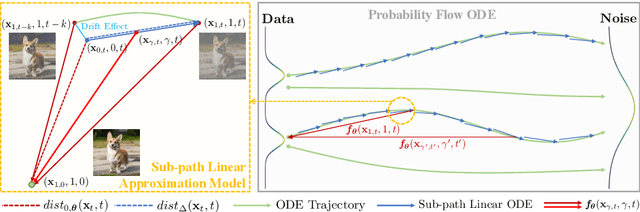
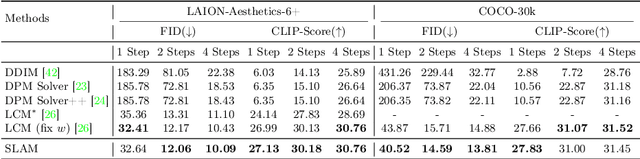
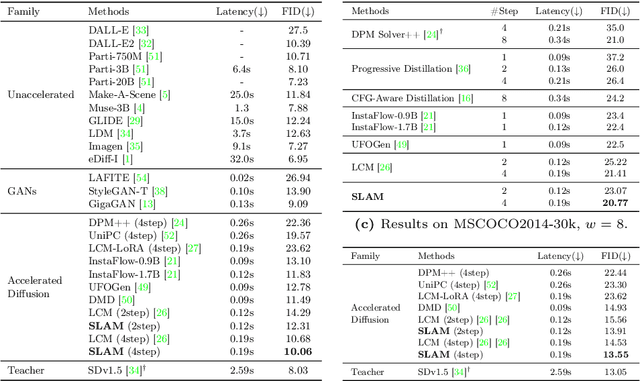
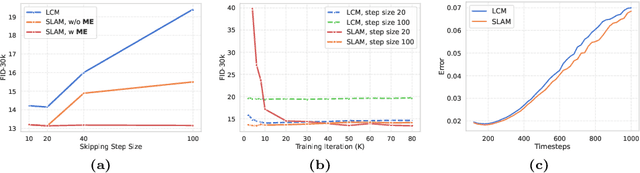
Diffusion models have significantly advanced the state of the art in image, audio, and video generation tasks. However, their applications in practical scenarios are hindered by slow inference speed. Drawing inspiration from the approximation strategies utilized in consistency models, we propose the Sub-path Linear Approximation Model (SLAM), which accelerates diffusion models while maintaining high-quality image generation. SLAM treats the PF-ODE trajectory as a series of PF-ODE sub-paths divided by sampled points, and harnesses sub-path linear (SL) ODEs to form a progressive and continuous error estimation along each individual PF-ODE sub-path. The optimization on such SL-ODEs allows SLAM to construct denoising mappings with smaller cumulative approximated errors. An efficient distillation method is also developed to facilitate the incorporation of more advanced diffusion models, such as latent diffusion models. Our extensive experimental results demonstrate that SLAM achieves an efficient training regimen, requiring only 6 A100 GPU days to produce a high-quality generative model capable of 2 to 4-step generation with high performance. Comprehensive evaluations on LAION, MS COCO 2014, and MS COCO 2017 datasets also illustrate that SLAM surpasses existing acceleration methods in few-step generation tasks, achieving state-of-the-art performance both on FID and the quality of the generated images.
Sparse Global Matching for Video Frame Interpolation with Large Motion
Apr 15, 2024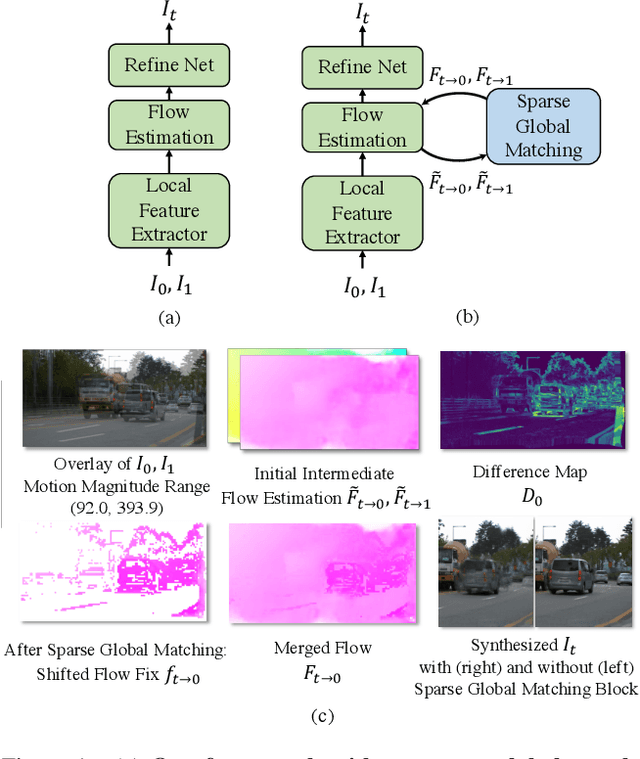
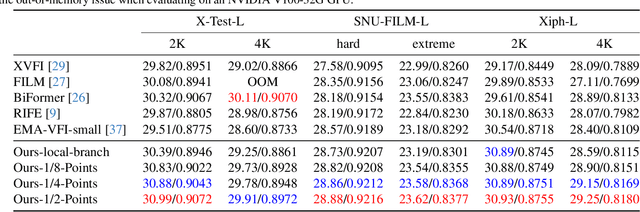
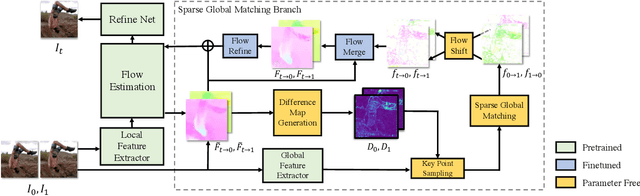
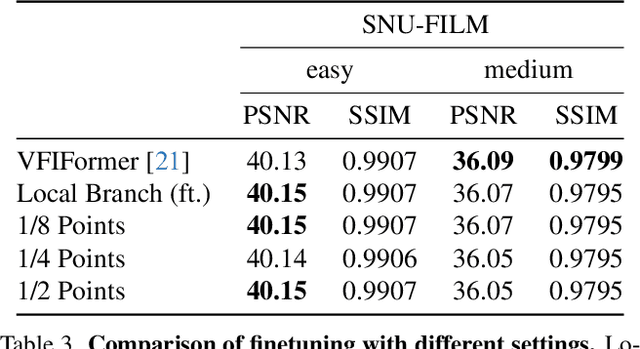
Large motion poses a critical challenge in Video Frame Interpolation (VFI) task. Existing methods are often constrained by limited receptive fields, resulting in sub-optimal performance when handling scenarios with large motion. In this paper, we introduce a new pipeline for VFI, which can effectively integrate global-level information to alleviate issues associated with large motion. Specifically, we first estimate a pair of initial intermediate flows using a high-resolution feature map for extracting local details. Then, we incorporate a sparse global matching branch to compensate for flow estimation, which consists of identifying flaws in initial flows and generating sparse flow compensation with a global receptive field. Finally, we adaptively merge the initial flow estimation with global flow compensation, yielding a more accurate intermediate flow. To evaluate the effectiveness of our method in handling large motion, we carefully curate a more challenging subset from commonly used benchmarks. Our method demonstrates the state-of-the-art performance on these VFI subsets with large motion.
SportsHHI: A Dataset for Human-Human Interaction Detection in Sports Videos
Apr 06, 2024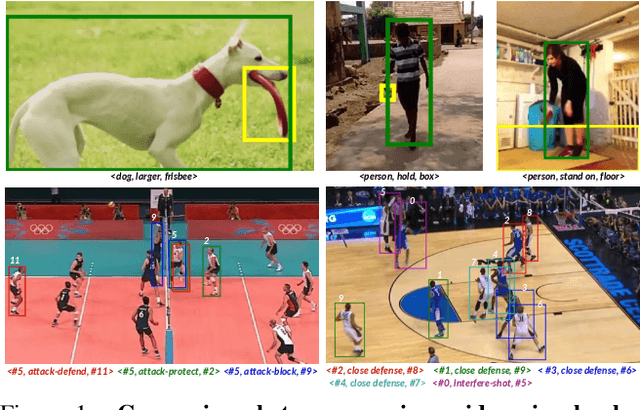
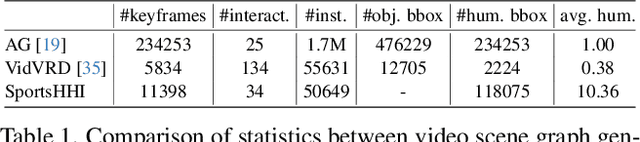
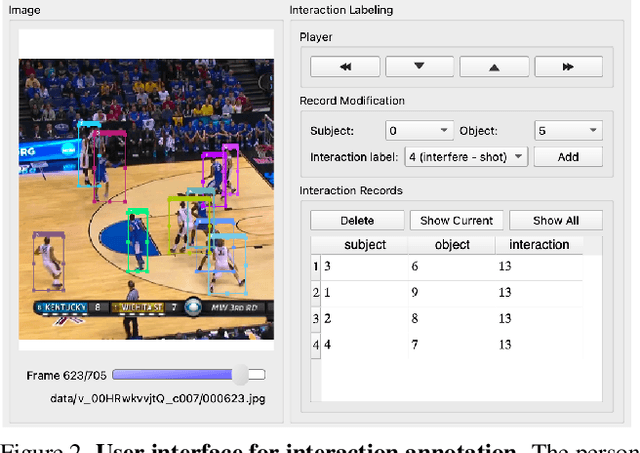
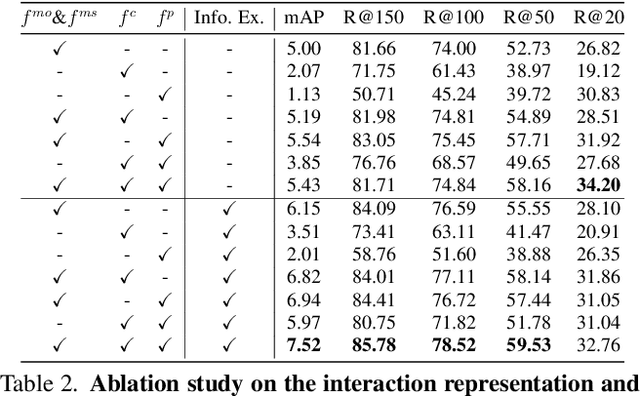
Video-based visual relation detection tasks, such as video scene graph generation, play important roles in fine-grained video understanding. However, current video visual relation detection datasets have two main limitations that hinder the progress of research in this area. First, they do not explore complex human-human interactions in multi-person scenarios. Second, the relation types of existing datasets have relatively low-level semantics and can be often recognized by appearance or simple prior information, without the need for detailed spatio-temporal context reasoning. Nevertheless, comprehending high-level interactions between humans is crucial for understanding complex multi-person videos, such as sports and surveillance videos. To address this issue, we propose a new video visual relation detection task: video human-human interaction detection, and build a dataset named SportsHHI for it. SportsHHI contains 34 high-level interaction classes from basketball and volleyball sports. 118,075 human bounding boxes and 50,649 interaction instances are annotated on 11,398 keyframes. To benchmark this, we propose a two-stage baseline method and conduct extensive experiments to reveal the key factors for a successful human-human interaction detector. We hope that SportsHHI can stimulate research on human interaction understanding in videos and promote the development of spatio-temporal context modeling techniques in video visual relation detection.
Dual DETRs for Multi-Label Temporal Action Detection
Mar 31, 2024Temporal Action Detection (TAD) aims to identify the action boundaries and the corresponding category within untrimmed videos. Inspired by the success of DETR in object detection, several methods have adapted the query-based framework to the TAD task. However, these approaches primarily followed DETR to predict actions at the instance level (i.e., identify each action by its center point), leading to sub-optimal boundary localization. To address this issue, we propose a new Dual-level query-based TAD framework, namely DualDETR, to detect actions from both instance-level and boundary-level. Decoding at different levels requires semantics of different granularity, therefore we introduce a two-branch decoding structure. This structure builds distinctive decoding processes for different levels, facilitating explicit capture of temporal cues and semantics at each level. On top of the two-branch design, we present a joint query initialization strategy to align queries from both levels. Specifically, we leverage encoder proposals to match queries from each level in a one-to-one manner. Then, the matched queries are initialized using position and content prior from the matched action proposal. The aligned dual-level queries can refine the matched proposal with complementary cues during subsequent decoding. We evaluate DualDETR on three challenging multi-label TAD benchmarks. The experimental results demonstrate the superior performance of DualDETR to the existing state-of-the-art methods, achieving a substantial improvement under det-mAP and delivering impressive results under seg-mAP.
Multiple Object Tracking as ID Prediction
Mar 25, 2024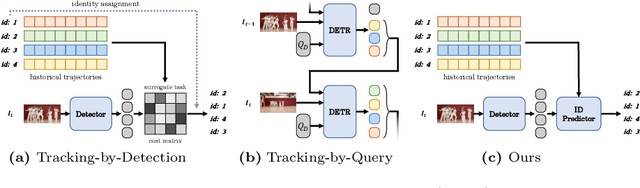
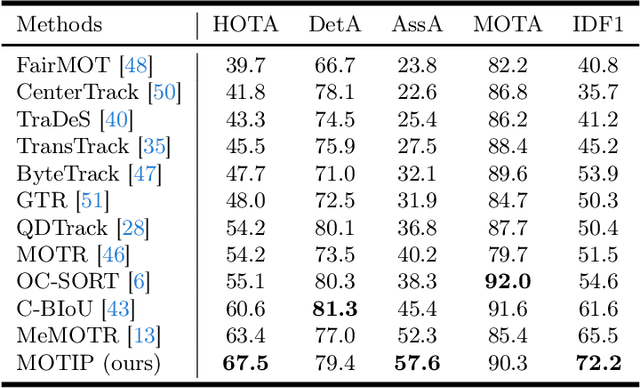
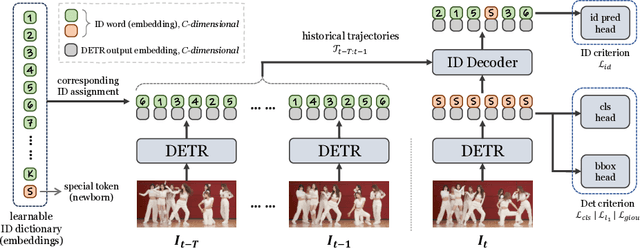
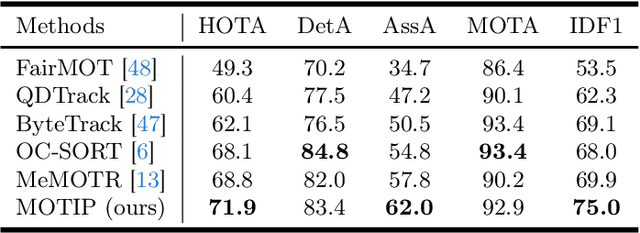
In Multiple Object Tracking (MOT), tracking-by-detection methods have stood the test for a long time, which split the process into two parts according to the definition: object detection and association. They leverage robust single-frame detectors and treat object association as a post-processing step through hand-crafted heuristic algorithms and surrogate tasks. However, the nature of heuristic techniques prevents end-to-end exploitation of training data, leading to increasingly cumbersome and challenging manual modification while facing complicated or novel scenarios. In this paper, we regard this object association task as an End-to-End in-context ID prediction problem and propose a streamlined baseline called MOTIP. Specifically, we form the target embeddings into historical trajectory information while considering the corresponding IDs as in-context prompts, then directly predict the ID labels for the objects in the current frame. Thanks to this end-to-end process, MOTIP can learn tracking capabilities straight from training data, freeing itself from burdensome hand-crafted algorithms. Without bells and whistles, our method achieves impressive state-of-the-art performance in complex scenarios like DanceTrack and SportsMOT, and it performs competitively with other transformer-based methods on MOT17. We believe that MOTIP demonstrates remarkable potential and can serve as a starting point for future research. The code is available at https://github.com/MCG-NJU/MOTIP.