 Add to Chrome
 Add to Firefox
 Add to Edge
Beyond the Mean: Multi-Moment Policy Optimization for LLM Reasoning
Aug 03, 2026
Reinforcement learning has become a central paradigm for improving the reasoning capabilities of large language models. Existing methods generally aim to reduce the failure probabilities induced across problems. In this paper, we introduce a moment-based perspective on policy optimization for LLM reasoning by treating the failure probability of a randomly sampled problem as a random variable and characterizing optimization objectives through its moments. Under this perspective, many existing methods optimize only a single moment of the failure-probability distribution, leaving its broader distributional structure largely uncharacterized. We propose \textbf{M}ulti-\textbf{M}oment \textbf{P}olicy \textbf{O}ptimization (MMPO), a novel policy optimization framework that jointly minimizes multiple moments of the failure-probability distribution. MMPO admits a direct operational interpretation as minimizing the expected truncated time required to obtain the first successful response. Beyond MMPO, we further develop a general moment-transformation framework that systematically induces different moment profiles and provides a unified view of a broader family of policy optimization objectives. Experiments across five mathematical reasoning benchmarks and models of different scales demonstrate that MMPO consistently outperforms strong baselines. We hope this moment-based perspective offers new insights into the design of policy optimization objectives for LLM reasoning.

Information Gain-based Rollout Policy Optimization: An Adaptive Tree-Structured Rollout Approach for Multi-Turn LLM Agents
Jul 07, 2026Reinforcement learning has become a promising paradigm for improving large language model (LLM) agents on long-horizon search tasks, where the agent must make a sequence of intermediate decisions before receiving a final outcome. However, existing methods still face a key limitation: the rollout budget is often allocated without explicitly assessing the utility of intermediate states. As a result, substantial computation may be spent on low-value states, even though different branches can vary drastically in their informativeness. In this paper, we propose Information Gain-based Rollout Policy Optimization (IGRPO), a policy optimization framework that treats intermediate-state informativeness as the organizing principle of rollout collection. Specifically, IGRPO performs budget-aware tree-structured rollouts by allocating expansion budget according to node-level informativeness, so that more informative branches are expanded more frequently while unpromising branches are progressively suppressed. We further demonstrate that the information gain-based rollout induces an explicit limiting teacher distribution over trajectories, which naturally yields a clear policy optimization target, thereby unifying adaptive tree-structured exploration with principled policy learning under a single framework. Experiments on seven challenging search-augmented QA benchmarks demonstrate that IGRPO consistently outperforms strong baselines under the same rollout budget constraints, validating the effectiveness of leveraging the induced teacher distribution to guide policy optimization for long-horizon search agents.
Temporal Residual Guided Diffusion Framework for Event-Driven Video Reconstruction
Jul 15, 2024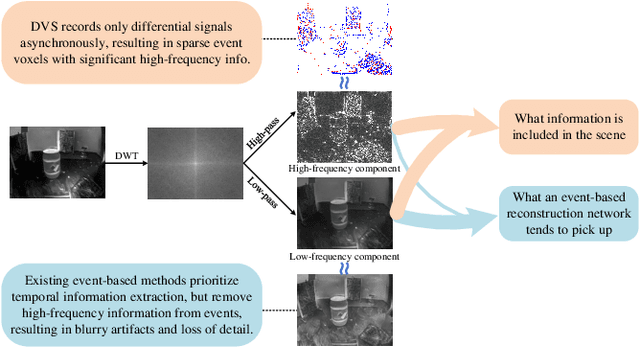
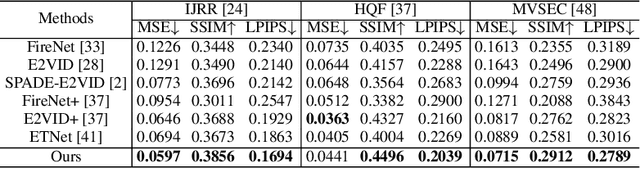


Event-based video reconstruction has garnered increasing attention due to its advantages, such as high dynamic range and rapid motion capture capabilities. However, current methods often prioritize the extraction of temporal information from continuous event flow, leading to an overemphasis on low-frequency texture features in the scene, resulting in over-smoothing and blurry artifacts. Addressing this challenge necessitates the integration of conditional information, encompassing temporal features, low-frequency texture, and high-frequency events, to guide the Denoising Diffusion Probabilistic Model (DDPM) in producing accurate and natural outputs. To tackle this issue, we introduce a novel approach, the Temporal Residual Guided Diffusion Framework, which effectively leverages both temporal and frequency-based event priors. Our framework incorporates three key conditioning modules: a pre-trained low-frequency intensity estimation module, a temporal recurrent encoder module, and an attention-based high-frequency prior enhancement module. In order to capture temporal scene variations from the events at the current moment, we employ a temporal-domain residual image as the target for the diffusion model. Through the combination of these three conditioning paths and the temporal residual framework, our framework excels in reconstructing high-quality videos from event flow, mitigating issues such as artifacts and over-smoothing commonly observed in previous approaches. Extensive experiments conducted on multiple benchmark datasets validate the superior performance of our framework compared to prior event-based reconstruction methods.
Multiple Object Tracking as ID Prediction
Mar 25, 2024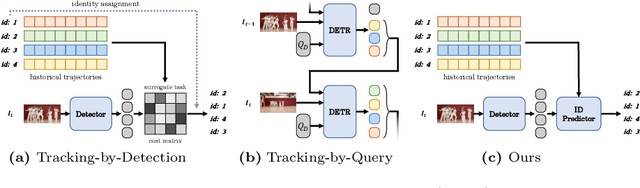
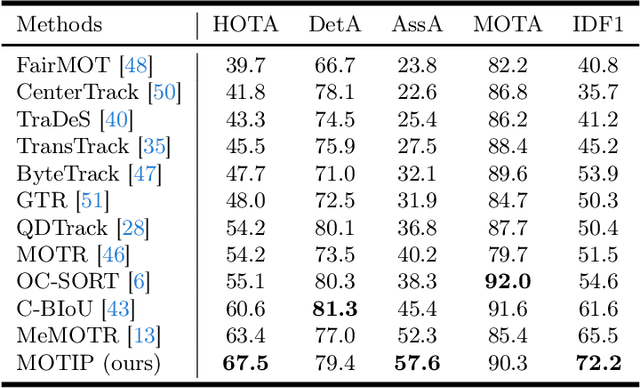
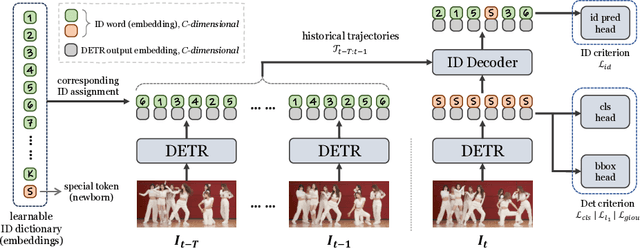
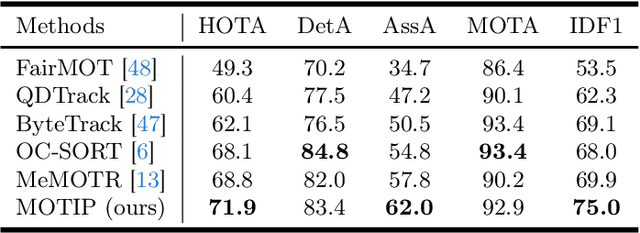
In Multiple Object Tracking (MOT), tracking-by-detection methods have stood the test for a long time, which split the process into two parts according to the definition: object detection and association. They leverage robust single-frame detectors and treat object association as a post-processing step through hand-crafted heuristic algorithms and surrogate tasks. However, the nature of heuristic techniques prevents end-to-end exploitation of training data, leading to increasingly cumbersome and challenging manual modification while facing complicated or novel scenarios. In this paper, we regard this object association task as an End-to-End in-context ID prediction problem and propose a streamlined baseline called MOTIP. Specifically, we form the target embeddings into historical trajectory information while considering the corresponding IDs as in-context prompts, then directly predict the ID labels for the objects in the current frame. Thanks to this end-to-end process, MOTIP can learn tracking capabilities straight from training data, freeing itself from burdensome hand-crafted algorithms. Without bells and whistles, our method achieves impressive state-of-the-art performance in complex scenarios like DanceTrack and SportsMOT, and it performs competitively with other transformer-based methods on MOT17. We believe that MOTIP demonstrates remarkable potential and can serve as a starting point for future research. The code is available at https://github.com/MCG-NJU/MOTIP.