 Add to Chrome
 Add to Firefox
 Add to Edge
APTER: Adaptive Post-Training with Expert-Grounded Rubrics
Aug 14, 2026
As large language models enter professional domains, they must satisfy domain constraints, include critical evidence, and provide complete reasoning rather than merely produce fluent responses. Existing post-training methods often rely on holistic preferences or outcome-level verification, while recent rubric-based methods usually generate rubrics independently for each query. In specialized domains, such unconstrained rubrics may omit critical requirements and vary across samples, hindering the diagnosis and targeted repair of persistent capability deficiencies. We propose APTER (Adaptive Post-Training with Expert-Grounded Rubrics), a framework that integrates structured domain knowledge into fine-grained evaluation, optimization, and diagnosis for specialized complex reasoning. First, expert-grounded rubric construction starts from an expert criteria framework built by domain experts, where each criterion represents a stable professional capability. For each query, APTER selects relevant criteria and instantiates them into query-level rubrics linked to their source criteria, turning reusable expert criteria into executable query-level supervision without reference answers. Second, adaptive post-training uses rubric verdicts as both optimization and criterion-level diagnostic signals. Aggregating low-scoring verdicts by criterion ID reveals persistent deficiencies and triggers targeted supervised fine-tuning updates during reinforcement learning. Experiments on mathematical reasoning and medical question answering show consistent gains across both domains. Across three model generations, APTER improves the mathematics and medical averages over the corresponding base models by up to 15.86 and 8.04 points, respectively. Code and rubric datasets are available at https://github.com/AntDT-APTER/APTER.

ViRC: Enhancing Visual Interleaved Mathematical CoT with Reason Chunking
Dec 17, 2025CoT has significantly enhanced the reasoning ability of LLMs while it faces challenges when extended to multimodal domains, particularly in mathematical tasks. Existing MLLMs typically perform textual reasoning solely from a single static mathematical image, overlooking dynamic visual acquisition during reasoning. In contrast, humans repeatedly examine visual image and employ step-by-step reasoning to prove intermediate propositions. This strategy of decomposing the problem-solving process into key logical nodes adheres to Miller's Law in cognitive science. Inspired by this insight, we propose a ViRC framework for multimodal mathematical tasks, introducing a Reason Chunking mechanism that structures multimodal mathematical CoT into consecutive Critical Reasoning Units (CRUs) to simulate human expert problem-solving patterns. CRUs ensure intra-unit textual coherence for intermediate proposition verification while integrating visual information across units to generate subsequent propositions and support structured reasoning. To this end, we present CRUX dataset by using three visual tools and four reasoning patterns to provide explicitly annotated CRUs across multiple reasoning paths for each mathematical problem. Leveraging the CRUX dataset, we propose a progressive training strategy inspired by human cognitive learning, which includes Instructional SFT, Practice SFT, and Strategic RL, aimed at further strengthening the Reason Chunking ability of the model. The resulting ViRC-7B model achieves a 18.8% average improvement over baselines across multiple mathematical benchmarks. Code is available at https://github.com/Leon-LihongWang/ViRC.
WIDER Face and Pedestrian Challenge 2018: Methods and Results
Feb 19, 2019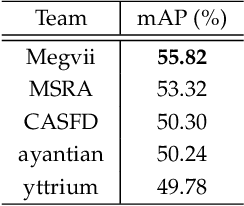
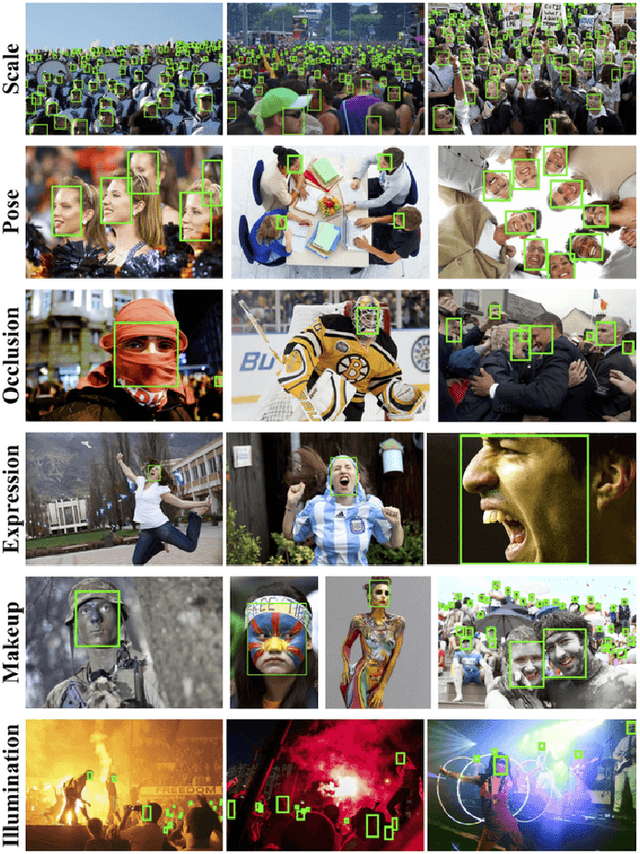
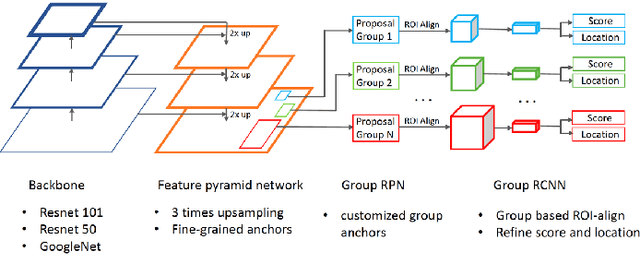
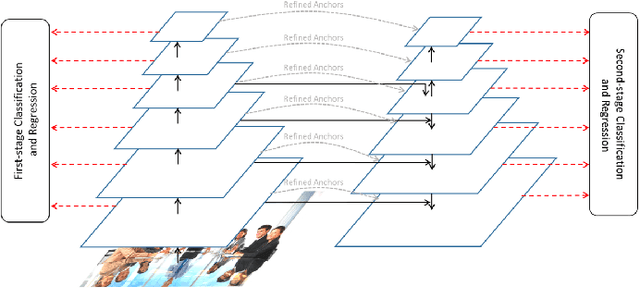
This paper presents a review of the 2018 WIDER Challenge on Face and Pedestrian. The challenge focuses on the problem of precise localization of human faces and bodies, and accurate association of identities. It comprises of three tracks: (i) WIDER Face which aims at soliciting new approaches to advance the state-of-the-art in face detection, (ii) WIDER Pedestrian which aims to find effective and efficient approaches to address the problem of pedestrian detection in unconstrained environments, and (iii) WIDER Person Search which presents an exciting challenge of searching persons across 192 movies. In total, 73 teams made valid submissions to the challenge tracks. We summarize the winning solutions for all three tracks. and present discussions on open problems and potential research directions in these topics.