 Add to Chrome
 Add to Firefox
 Add to Edge
Designing Reward Signals for Portable Query Generation: A Case Study in Industrial Semantic Job Search
Jun 25, 2026
Job-search platforms rely on low-bandwidth query interfaces that often fail to capture the high-dimensional complexity of candidate profiles. We present an end-to-end RLAIF (Reinforcement Learning from AI Feedback) framework to generate \emph{portable} job search queries, terms that abstract away seeker-specific identifiers while preserving generalizable qualifications. This task introduces a highly adversarial reward surface where policy optimization frequently exploits flaws in LLM-as-judge rubrics, resulting in degenerate verbatim-copying behaviors. We conducted comprehensive empirical experiments to isolate the impact of optimization mechanics against structured reward engineering. Our results demonstrate that for critic-free optimizers, performance is overwhelmingly dictated by robust reward shaping, rendering the specific choice of algorithm largely immaterial. While critic-free per-rollout baseline methods (RLOO and REINFORCE++) natively resist reward-hacking, the group-relative advantage normalization in GRPO appears uniquely sensitive to spurious reward signals, making it disproportionately susceptible to exploitation. We show that introducing a deterministic, rule-based reward floor to correct for rewards assigned to verbatim copying mitigates this failure mode, resulting in a substantial $+0.147$ quality improvement on a cross-family evaluation judge. Ultimately, we show that the training-time reward model inflates performance gains by $2.4\times$, confirming that the training success is fundamentally dependent on enforcing reward-shaping disciplines rather than selecting alternative optimizers.

A Unified Structured Query Understanding Framework for Industrial Semantic Search
May 22, 2026Query understanding in large-scale industrial search systems is typically implemented as a cascade of disparate, task-specific components. While individually optimizable, this fragmented architecture incurs high maintenance overhead and results in inconsistent behaviors, particularly for long-tail queries. In this work, we propose and deploy a unified structured query understanding system that consolidates these heterogeneous functions into a single Small Language Model (SLM) that performs schema-constrained generation. To address the data bottlenecks inherent in unified modeling, we introduce Query Illuminator, a dual-purpose framework serving as: (i) a teacher model for high-quality auto-annotation and distillation, and (ii) a surrogate judge for scalable evaluation where human labels are scarce. We validate this approach through extensive offline and online tests within LinkedIn's Job Search system. Furthermore, we demonstrate the framework's horizontal extensibility through a cross-domain case study on People Search. The results show improved user engagement and reduced operational costs, achieved while satisfying strict low-latency serving constraints on limited GPU resources.
High Fidelity Textual User Representation over Heterogeneous Sources via Reinforcement Learning
Feb 07, 2026Effective personalization on large-scale job platforms requires modeling members based on heterogeneous textual sources, including profiles, professional data, and search activity logs. As recommender systems increasingly adopt Large Language Models (LLMs), creating unified, interpretable, and concise representations from heterogeneous sources becomes critical, especially for latency-sensitive online environments. In this work, we propose a novel Reinforcement Learning (RL) framework to synthesize a unified textual representation for each member. Our approach leverages implicit user engagement signals (e.g., clicks, applies) as the primary reward to distill salient information. Additionally, the framework is complemented by rule-based rewards that enforce formatting and length constraints. Extensive offline experiments across multiple LinkedIn products, one of the world's largest job platforms, demonstrate significant improvements in key downstream business metrics. This work provides a practical, labeling-free, and scalable solution for constructing interpretable user representations that are directly compatible with LLM-based systems.
LiGNN: Graph Neural Networks at LinkedIn
Feb 17, 2024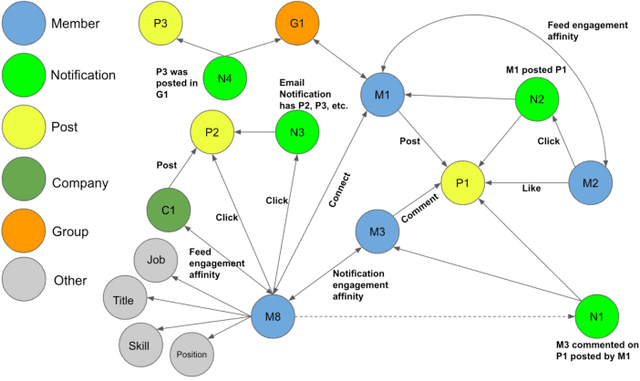
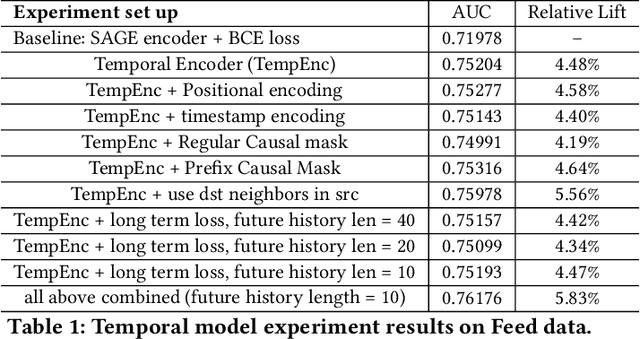
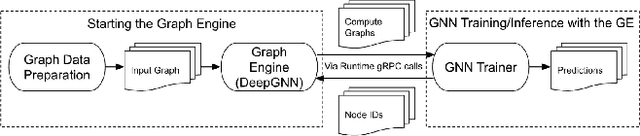
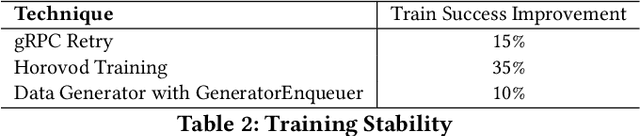
In this paper, we present LiGNN, a deployed large-scale Graph Neural Networks (GNNs) Framework. We share our insight on developing and deployment of GNNs at large scale at LinkedIn. We present a set of algorithmic improvements to the quality of GNN representation learning including temporal graph architectures with long term losses, effective cold start solutions via graph densification, ID embeddings and multi-hop neighbor sampling. We explain how we built and sped up by 7x our large-scale training on LinkedIn graphs with adaptive sampling of neighbors, grouping and slicing of training data batches, specialized shared-memory queue and local gradient optimization. We summarize our deployment lessons and learnings gathered from A/B test experiments. The techniques presented in this work have contributed to an approximate relative improvements of 1% of Job application hearing back rate, 2% Ads CTR lift, 0.5% of Feed engaged daily active users, 0.2% session lift and 0.1% weekly active user lift from people recommendation. We believe that this work can provide practical solutions and insights for engineers who are interested in applying Graph neural networks at large scale.
LiRank: Industrial Large Scale Ranking Models at LinkedIn
Feb 10, 2024

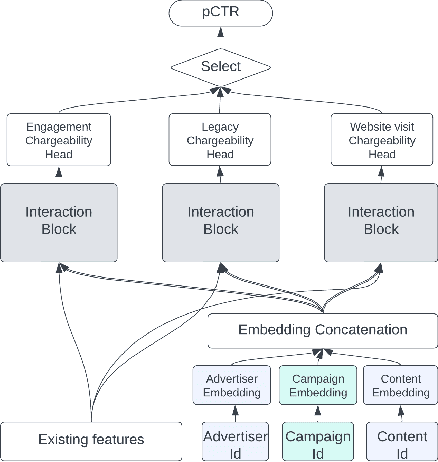

We present LiRank, a large-scale ranking framework at LinkedIn that brings to production state-of-the-art modeling architectures and optimization methods. We unveil several modeling improvements, including Residual DCN, which adds attention and residual connections to the famous DCNv2 architecture. We share insights into combining and tuning SOTA architectures to create a unified model, including Dense Gating, Transformers and Residual DCN. We also propose novel techniques for calibration and describe how we productionalized deep learning based explore/exploit methods. To enable effective, production-grade serving of large ranking models, we detail how to train and compress models using quantization and vocabulary compression. We provide details about the deployment setup for large-scale use cases of Feed ranking, Jobs Recommendations, and Ads click-through rate (CTR) prediction. We summarize our learnings from various A/B tests by elucidating the most effective technical approaches. These ideas have contributed to relative metrics improvements across the board at LinkedIn: +0.5% member sessions in the Feed, +1.76% qualified job applications for Jobs search and recommendations, and +4.3% for Ads CTR. We hope this work can provide practical insights and solutions for practitioners interested in leveraging large-scale deep ranking systems.