 Add to Chrome
 Add to Firefox
 Add to Edge
SPECTRA: Pushing the KV Cache Beyond the 2-Bit Cliff via Spectral Transform Coding
Aug 08, 2026
Large language models (LLMs) increasingly read long inputs in the agentic era, from whole documents and codebases to conversations across many turns. Their inference memory is then dominated by the key-value (KV) cache, the stored attention keys and values of every token the model has read and generated. Because the cache grows with context length and is re-read in full at every generated token, a longer context means more GPU memory. To reduce this cost, most existing methods compress the KV cache by lowering every stored value to the same low precision, a technique known as quantization. They can push this to nearly two bits per value, but rarely further, because quality drops sharply at this 2-bit cliff: four levels are too few for the cache's outlier-heavy values, where a few large entries consume the levels and collapse the rest into noise. A natural remedy is to spend more bits on the channels (feature dimensions) that matter and fewer on the rest, but the raw cache offers no handle: its channels are strongly correlated, so none stands out as more important. Our analysis shows that this handle appears once the cache is rotated into a coordinate system computed from its own statistics, removing these correlations. There, a small fraction of channels carries almost all the information, and spending the budget on those few is far more accurate than spreading it evenly. Guided by this analysis, we develop SPECTRA, a training-free, drop-in codec that re-encodes the cache into this coordinate system and concentrates the bit budget on the channels that carry the signal. On Llama-3.1-8B and Qwen2.5-7B over long-context benchmarks, SPECTRA is near-lossless at 4x compression, competitive at 8x where uniform quantization has collapsed, and reaches up to 12x, pushing usable compression past the 2-bit cliff so the same GPU holds longer contexts and larger batches.

WiSP: A Working-Set View of Mixture-of-Experts Serving on Extremely Low-Resource Hardware
Jun 20, 2026Modern Mixture-of-Experts (MoE) models place most of their parameters in expert layers, yet only a small fraction of those experts are used for any token. The unused weights must still be stored where the GPU can reach them. On commodity GPUs the common fix is layer-level CPU offloading, which keeps memory low but streams all of a layer's experts across PCIe on every forward pass, losing much of MoE's sparsity benefit. We cast low-resource MoE serving as a working-set management problem on the GPU: routed expert weights and the key-value (KV) cache are two streams of memory demand competing for limited VRAM. We realize this in WiSP (Working-Set Paging), a routing-aware expert pager that plugs into an unmodified serving engine with byte-identical outputs. Keeping resident only the experts a workload reuses, WiSP reaches up to 1.95x the decode throughput of static offload at the same memory budget when the model does not fit. We also find that prefetching experts from predicted routing helps little in single-stream decode: the bottleneck is PCIe bandwidth, not prediction accuracy. This shifts the question from prefetching to allocation: how should VRAM be split between experts and the KV cache? We answer with MV-WSA (Marginal-Value Working-Set Allocation), which equalizes marginal latency benefit per byte subject to a KV admission floor. MV-WSA runs either as an offline configurator or as an online controller that resizes both pools while serving. In real serving the offline configurator is the only policy we test that does well on both prefill and decode; in trace-driven simulation it stays within a few percent of a per-workflow oracle while fixed splits are about 20% worse. The online controller adds a further 1.20x without changing model outputs.
Stop Overthinking: A Survey on Efficient Reasoning for Large Language Models
Mar 20, 2025Large Language Models (LLMs) have demonstrated remarkable capabilities in complex tasks. Recent advancements in Large Reasoning Models (LRMs), such as OpenAI o1 and DeepSeek-R1, have further improved performance in System-2 reasoning domains like mathematics and programming by harnessing supervised fine-tuning (SFT) and reinforcement learning (RL) techniques to enhance the Chain-of-Thought (CoT) reasoning. However, while longer CoT reasoning sequences improve performance, they also introduce significant computational overhead due to verbose and redundant outputs, known as the "overthinking phenomenon". In this paper, we provide the first structured survey to systematically investigate and explore the current progress toward achieving efficient reasoning in LLMs. Overall, relying on the inherent mechanism of LLMs, we categorize existing works into several key directions: (1) model-based efficient reasoning, which considers optimizing full-length reasoning models into more concise reasoning models or directly training efficient reasoning models; (2) reasoning output-based efficient reasoning, which aims to dynamically reduce reasoning steps and length during inference; (3) input prompts-based efficient reasoning, which seeks to enhance reasoning efficiency based on input prompt properties such as difficulty or length control. Additionally, we introduce the use of efficient data for training reasoning models, explore the reasoning capabilities of small language models, and discuss evaluation methods and benchmarking.
Decentralized Vehicle Coordination: The Berkeley DeepDrive Drone Dataset
Sep 22, 2022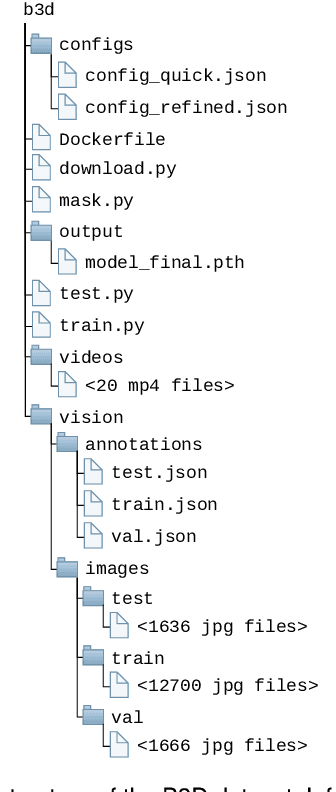
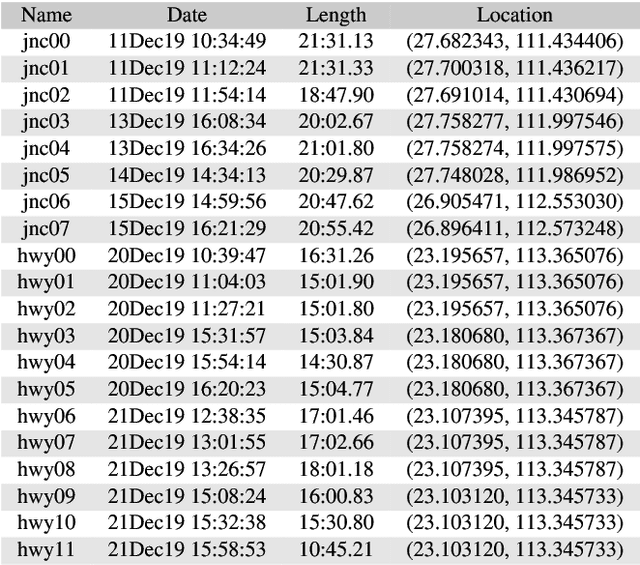
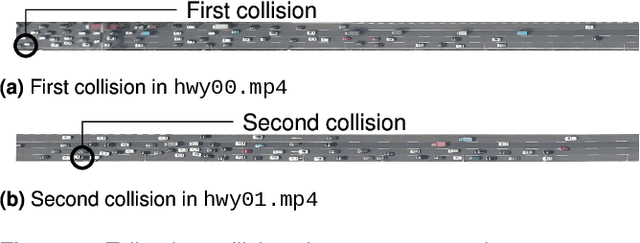
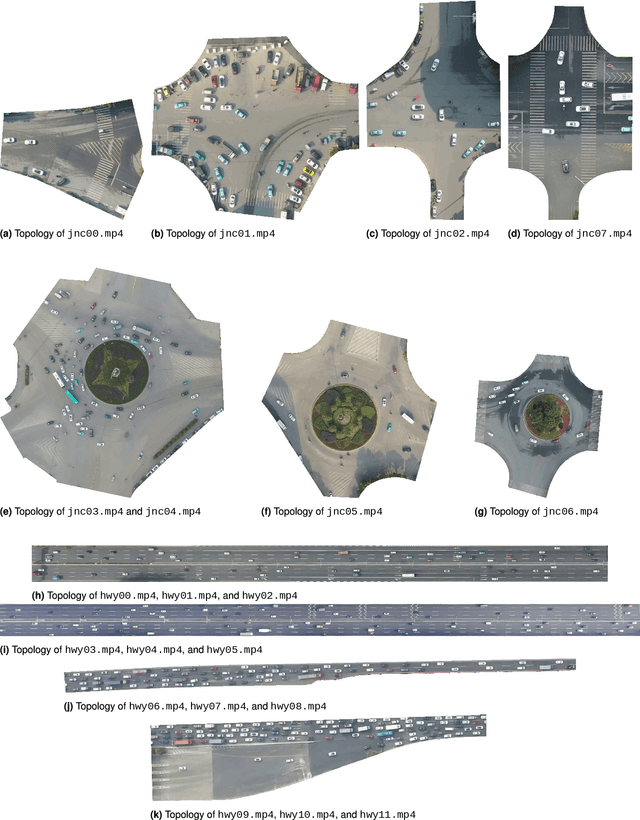
Decentralized multiagent planning has been an important field of research in robotics. An interesting and impactful application in the field is decentralized vehicle coordination in understructured road environments. For example, in an intersection, it is useful yet difficult to deconflict multiple vehicles of intersecting paths in absence of a central coordinator. We learn from common sense that, for a vehicle to navigate through such understructured environments, the driver must understand and conform to the implicit "social etiquette" observed by nearby drivers. To study this implicit driving protocol, we collect the Berkeley DeepDrive Drone dataset. The dataset contains 1) a set of aerial videos recording understructured driving, 2) a collection of images and annotations to train vehicle detection models, and 3) a kit of development scripts for illustrating typical usages. We believe that the dataset is of primary interest for studying decentralized multiagent planning employed by human drivers and, of secondary interest, for computer vision in remote sensing settings.