 Add to Chrome
 Add to Firefox
 Add to Edge
Video Streaming Thinking: VideoLLMs Can Watch and Think Simultaneously
Mar 12, 2026
Online Video Large Language Models (VideoLLMs) play a critical role in supporting responsive, real-time interaction. Existing methods focus on streaming perception, lacking a synchronized logical reasoning stream. However, directly applying test-time scaling methods incurs unacceptable response latency. To address this trade-off, we propose Video Streaming Thinking (VST), a novel paradigm for streaming video understanding. It supports a thinking while watching mechanism, which activates reasoning over incoming video clips during streaming. This design improves timely comprehension and coherent cognition while preserving real-time responsiveness by amortizing LLM reasoning latency over video playback. Furthermore, we introduce a comprehensive post-training pipeline that integrates VST-SFT, which structurally adapts the offline VideoLLM to causal streaming reasoning, and VST-RL, which provides end-to-end improvement through self-exploration in a multi-turn video interaction environment. Additionally, we devise an automated training-data synthesis pipeline that uses video knowledge graphs to generate high-quality streaming QA pairs, with an entity-relation grounded streaming Chain-of-Thought to enforce multi-evidence reasoning and sustained attention to the video stream. Extensive evaluations show that VST-7B performs strongly on online benchmarks, e.g. 79.5% on StreamingBench and 59.3% on OVO-Bench. Meanwhile, VST remains competitive on offline long-form or reasoning benchmarks. Compared with Video-R1, VST responds 15.7 times faster and achieves +5.4% improvement on VideoHolmes, demonstrating higher efficiency and strong generalization across diverse video understanding tasks. Code, data, and models will be released at https://github.com/1ranGuan/VST.

ThinkOmni: Lifting Textual Reasoning to Omni-modal Scenarios via Guidance Decoding
Feb 26, 2026Omni-modal reasoning is essential for intelligent systems to understand and draw inferences from diverse data sources. While existing omni-modal large language models (OLLM) excel at perceiving diverse modalities, they lack the complex reasoning abilities of recent large reasoning models (LRM). However, enhancing the reasoning ability of OLLMs through additional training presents significant challenges, including the need for high-quality data, task-specific adaptation, and substantial computational costs. To address these limitations, we propose ThinkOmni, a training-free and data-free framework that lifts textual reasoning to omni-modal scenarios. ThinkOmni introduces two key components: 1) LRM-as-a-Guide, which leverages off-the-shelf LRMs to guide the OLLM decoding process; 2) Stepwise Contrastive Scaling, which adaptively balances perception and reasoning signals without manual hyperparameter tuning. Experiments on six multi-modal reasoning benchmarks demonstrate that ThinkOmni consistently delivers performance improvements, with main results achieving 70.2 on MathVista and 75.5 on MMAU. Overall, ThinkOmni offers a flexible and generalizable solution for omni-modal reasoning and provides new insights into the generalization and application of reasoning capabilities.
Shuffle-R1: Efficient RL framework for Multimodal Large Language Models via Data-centric Dynamic Shuffle
Aug 07, 2025Reinforcement learning (RL) has emerged as an effective post-training paradigm for enhancing the reasoning capabilities of multimodal large language model (MLLM). However, current RL pipelines often suffer from training inefficiencies caused by two underexplored issues: Advantage Collapsing, where most advantages in a batch concentrate near zero, and Rollout Silencing, where the proportion of rollouts contributing non-zero gradients diminishes over time. These issues lead to suboptimal gradient updates and hinder long-term learning efficiency. To address these issues, we propose Shuffle-R1, a simple yet principled framework that improves RL fine-tuning efficiency by dynamically restructuring trajectory sampling and batch composition. It introduces (1) Pairwise Trajectory Sampling, which selects high-contrast trajectories with large advantages to improve gradient signal quality, and (2) Advantage-based Trajectory Shuffle, which increases exposure of valuable rollouts through informed batch reshuffling. Experiments across multiple reasoning benchmarks show that our framework consistently outperforms strong RL baselines with minimal overhead. These results highlight the importance of data-centric adaptations for more efficient RL training in MLLM.
MoE Jetpack: From Dense Checkpoints to Adaptive Mixture of Experts for Vision Tasks
Jun 07, 2024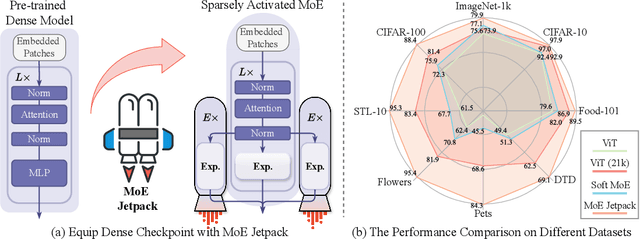
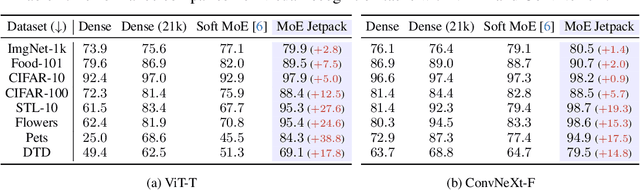
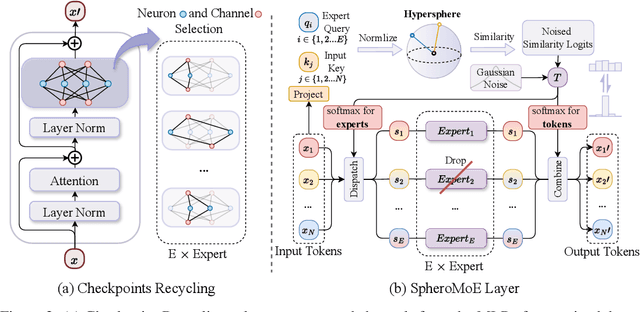

The sparsely activated mixture of experts (MoE) model presents a promising alternative to traditional densely activated (dense) models, enhancing both quality and computational efficiency. However, training MoE models from scratch demands extensive data and computational resources. Moreover, public repositories like timm mainly provide pre-trained dense checkpoints, lacking similar resources for MoE models, hindering their adoption. To bridge this gap, we introduce MoE Jetpack, an effective method for fine-tuning dense checkpoints into MoE models. MoE Jetpack incorporates two key techniques: (1) checkpoint recycling, which repurposes dense checkpoints as initial weights for MoE models, thereby accelerating convergence, enhancing accuracy, and alleviating the computational burden of pre-training; (2) hyperspherical adaptive MoE (SpheroMoE) layer, which optimizes the MoE architecture for better integration of dense checkpoints, enhancing fine-tuning performance. Our experiments on vision tasks demonstrate that MoE Jetpack significantly improves convergence speed and accuracy when fine-tuning dense checkpoints into MoE models. Our code will be publicly available at https://github.com/Adlith/MoE-Jetpack.
End-to-end Video Gaze Estimation via Capturing Head-face-eye Spatial-temporal Interaction Context
Nov 01, 2023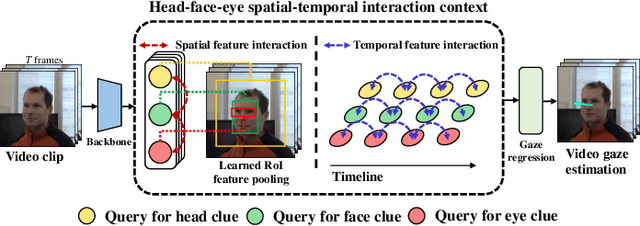
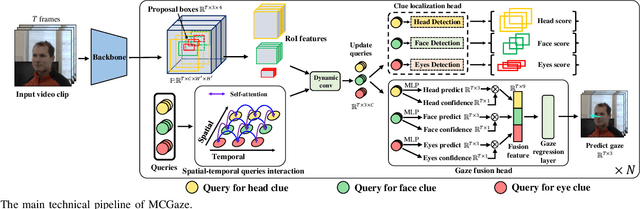
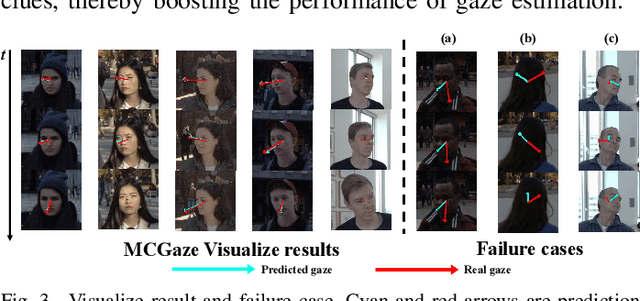
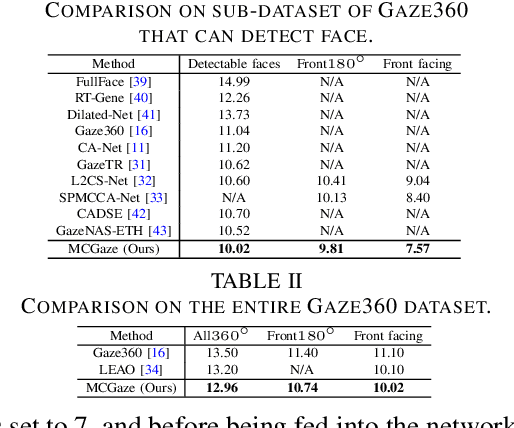
In this letter, we propose a new method, Multi-Clue Gaze (MCGaze), to facilitate video gaze estimation via capturing spatial-temporal interaction context among head, face, and eye in an end-to-end learning way, which has not been well concerned yet. The main advantage of MCGaze is that the tasks of clue localization of head, face, and eye can be solved jointly for gaze estimation in a one-step way, with joint optimization to seek optimal performance. During this, spatial-temporal context exchange happens among the clues on the head, face, and eye. Accordingly, the final gazes obtained by fusing features from various queries can be aware of global clues from heads and faces, and local clues from eyes simultaneously, which essentially leverages performance. Meanwhile, the one-step running way also ensures high running efficiency. Experiments on the challenging Gaze360 dataset verify the superiority of our proposition. The source code will be released at https://github.com/zgchen33/MCGaze.