 Add to Chrome
 Add to Firefox
 Add to Edge
STAR: Structured Tokenization and Target-Aware Interest Representation for PCVR Prediction
Aug 13, 2026
Post-click conversion rate (PCVR) prediction is a core ranking task in industrial recommender systems. Modern ranking models must jointly capture heterogeneous non-sequential features, multi-behavior user sequences, and target-item-aware user interests, while remaining robust to high-cardinality sparse features, missing values, and train-inference inconsistencies. In this paper, we present STAR (Structured Tokenization and Target-Aware Interest Representation), a practical framework for the KDD Cup 2026 Tencent UniRec Challenge. STAR combines structured feature tokenization with target-aware interest representation on top of a HyFormer-style multi-sequence backbone. It introduces high-cardinality signal recovery, explicit user-item interaction tokens, target-aware sequence decoding, and a weighted user-item contrastive auxiliary objective inspired by InfoNCE. We further align the training and inference pipelines by reconstructing feature remapping tables and structural hyperparameters from the saved training configuration. Experiments on the challenge dataset identify the components that most reliably improve ranking AUC, while LogLoss is reported as a calibration diagnostic. The main ablation study shows a large gain from temporal context, with smaller but useful contributions from contrastive alignment, target-aware interest encoding, and high-cardinality sequence feature recovery.

EyeMVP: OCT-Informed Fundus Representation Learning via Paired CFP--OCT Pretraining
Jun 13, 2026Color fundus photography (CFP) is the mainstay for large-scale retinal screening, yet its diagnostic capacity is constrained by the lack of depth-resolved structural information. Optical coherence tomography (OCT) provides cross-sectional retinal anatomy, but is less accessible in population-level screening. Here, we present EyeMVP, a cross-modal retinal foundation model that uses paired CFP--OCT pretraining to learn OCT-informed CFP representations. EyeMVP is pretrained on 674,893 strict same-eye same-day paired CFP--OCT image triples from 112,642 patients across eight hospitals in China. The model uses cross-modal masked reconstruction to enrich CFP representations with OCT-associated supervision, while requiring only CFP images at inference. To accommodate the non-aligned imaging geometry between en-face CFP and cross-sectional OCT, EyeMVP combines source-constrained cross-attention with CFP-derived structural masks. Across 16 downstream tasks, including classification, segmentation, few-shot adaptation, and cross-modal retrieval, EyeMVP outperforms representative retinal foundation models and shows consistent gains on tasks involving macular and optic nerve structure. For CFP-challenging macular diseases, EyeMVP achieves an AUROC of 0.948 for macular edema (vs.~0.852 for EyeCLIP) and 0.825 for myopic macular schisis. In an exploratory reader study, EyeMVP exceeds junior and intermediate ophthalmologist groups but does not reach senior ophthalmologist performance on macular edema, while showing numerically higher balanced accuracy than all reader groups on myopic macular schisis. These results suggest that pixel-level cross-modal reconstruction can enrich CFP representations with OCT-associated supervision, providing a practical route toward stronger CFP-based retinal analysis in screening settings.
Continuous Language Diffusion as a Decoder-Interface Problem
Jun 07, 2026Gaussian-corrupted sentence embeddings have no direct linguistic interpretation, yet continuous diffusion language models can generate fluent text from them. We study this puzzle through Embedded Language Flows (ELF) and identify a decoder-basin mechanism: denoising succeeds when trajectories reach regions where the native decoder can read stable tokens. We introduce a diagnostic protocol for denoisability, semantic recoverability, order sensitivity, decoder compatibility, and trajectory reliability. It exposes failures hidden by scalar metrics: low mean-squared error can discard linguistic content, low perplexity can reflect low-entropy collapse, and clean latent reconstruction can coexist with a narrow decoder basin. A decoder-margin bound explains why token recovery depends on margin and local decoder sensitivity, not latent error alone. Auditing public ELF checkpoints reveals an interface phase diagram: early predictions are weakly readable, mid-trajectory disagreement marks a competition region, and late predictions enter a high-margin final-token basin. Once inside, token realization is surprisingly simple on generated ELF states: frozen T5 token-embedding lookup recovers $93$--$96\%$ of native decoder decisions, and a single linear readout reaches $97.9\%$ agreement at 32k samples, leaving about a 1.1 perplexity gap in a structured residual tail. A conservative margin gate exits $17$--$27\%$ earlier in denoising steps under an explicit diagnostic monitor. Boundary checks on LangFlow, BitstreamDiffusion, and the Continuous Latent Diffusion Language Model (Cola-DLM) show that the same interface questions remain meaningful when the state object and decoder change. Continuous and latent diffusion language models should therefore be evaluated as representation-decoder systems.
Auditing Training-Free 3D Shape Retrieval with Diffused Geodesic Moments
May 27, 2026Reported retrieval scores for training-free shape descriptors conflate local signal design, normalization, aggregation, codebook fitting, and metric choices, making isolated component evaluation difficult. This paper reframes descriptor evaluation as a {\em protocol audit}. We introduce Diffused Geodesic Moments (DGM), a seed-conditioned descriptor that computes sparse implicit heat responses, converts them to distance-like fields, and summarizes each vertex by low-order moments across seeds and scales. DGM is used both as a practical non-spectral baseline and as an instrument for isolating protocol effects. On the registered FAUST benchmark split (FAUST-Reg) and the TOSCA shape collection, aggregation-matched experiments show that an independent Geometric Moment Shape Descriptor baseline built on Heat Kernel Signature features (GMSD-HKS) obtains the highest scores in this implementation ($0.621/0.820$ and $0.865/0.963$ mean average precision (mAP)/top-1), Wave Kernel Signature (WKS) remains a strong classical signal, and DGM is useful mainly when sparse solves, non-spectral deployment, or symmetry-informative seed frames are priorities. The broader finding is methodological: the input field and aggregation protocol can dominate the moment formula. The paper contributes a reproducible protocol-cascade analysis, a cross-shape alignment diagnostic for functional-map compatibility, and concrete recommendations for designing and reporting training-free shape descriptors.
DepthArb: Training-Free Depth-Arbitrated Generation for Occlusion-Robust Image Synthesis
Mar 25, 2026Text-to-image diffusion models frequently exhibit deficiencies in synthesizing accurate occlusion relationships of multiple objects, particularly within dense overlapping regions. Existing training-free layout-guided methods predominantly rely on rigid spatial priors that remain agnostic to depth order, often resulting in concept mixing or illogical occlusion. To address these limitations, we propose DepthArb, a training-free framework that resolves occlusion ambiguities by arbitrating attention competition between interacting objects. Specifically, DepthArb employs two core mechanisms: Attention Arbitration Modulation (AAM), which enforces depth-ordered visibility by suppressing background activations in overlapping regions, and Spatial Compactness Control (SCC), which preserves structural integrity by curbing attention divergence. These mechanisms enable robust occlusion generation without model retraining. To systematically evaluate this capability, we propose OcclBench, a comprehensive benchmark designed to evaluate diverse occlusion scenarios. Extensive evaluations demonstrate that DepthArb consistently outperforms state-of-the-art baselines in both occlusion accuracy and visual fidelity. As a plug-and-play method, DepthArb seamlessly enhances the compositional capabilities of diffusion backbones, offering a novel perspective on spatial layering within generative models.
Enabling Real-Time Colonoscopic Polyp Segmentation on Commodity CPUs via Ultra-Lightweight Architecture
Feb 04, 2026Early detection of colorectal cancer hinges on real-time, accurate polyp identification and resection. Yet current high-precision segmentation models rely on GPUs, making them impractical to deploy in primary hospitals, mobile endoscopy units, or capsule robots. To bridge this gap, we present the UltraSeg family, operating in an extreme-compression regime (<0.3 M parameters). UltraSeg-108K (0.108 M parameters) is optimized for single-center data, while UltraSeg-130K (0.13 M parameters) generalizes to multi-center, multi-modal images. By jointly optimizing encoder-decoder widths, incorporating constrained dilated convolutions to enlarge receptive fields, and integrating a cross-layer lightweight fusion module, the models achieve 90 FPS on a single CPU core without sacrificing accuracy. Evaluated on seven public datasets, UltraSeg retains >94% of the Dice score of a 31 M-parameter U-Net while utilizing only 0.4% of its parameters, establishing a strong, clinically viable baseline for the extreme-compression domain and offering an immediately deployable solution for resource-constrained settings. This work provides not only a CPU-native solution for colonoscopy but also a reproducible blueprint for broader minimally invasive surgical vision applications. Source code is publicly available to ensure reproducibility and facilitate future benchmarking.
LLaVA-RE: Binary Image-Text Relevancy Evaluation with Multimodal Large Language Model
Aug 07, 2025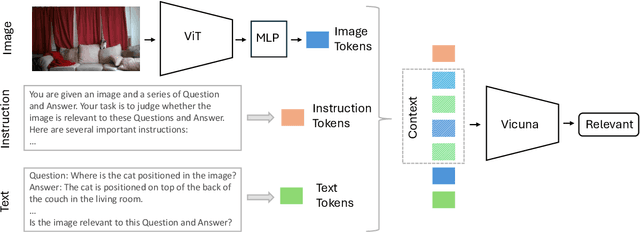
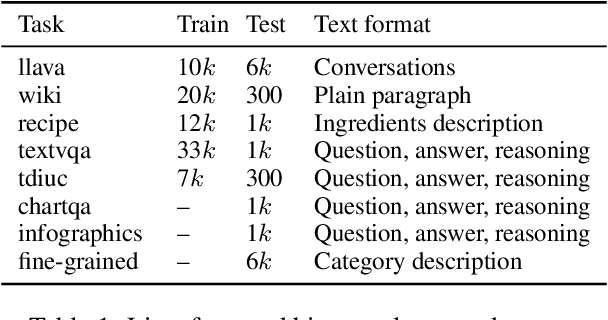
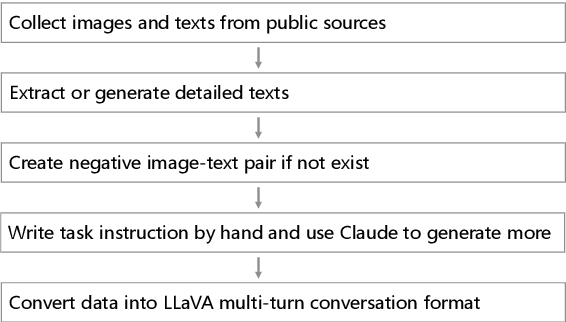
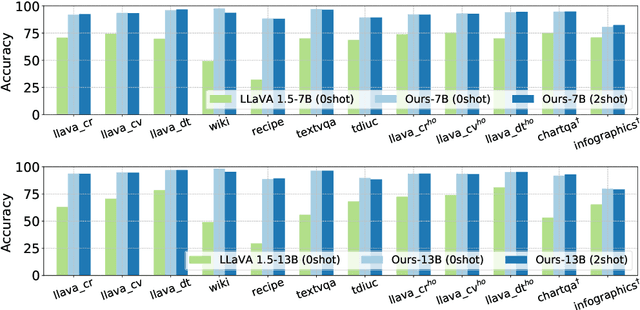
Multimodal generative AI usually involves generating image or text responses given inputs in another modality. The evaluation of image-text relevancy is essential for measuring response quality or ranking candidate responses. In particular, binary relevancy evaluation, i.e., ``Relevant'' vs. ``Not Relevant'', is a fundamental problem. However, this is a challenging task considering that texts have diverse formats and the definition of relevancy varies in different scenarios. We find that Multimodal Large Language Models (MLLMs) are an ideal choice to build such evaluators, as they can flexibly handle complex text formats and take in additional task information. In this paper, we present LLaVA-RE, a first attempt for binary image-text relevancy evaluation with MLLM. It follows the LLaVA architecture and adopts detailed task instructions and multimodal in-context samples. In addition, we propose a novel binary relevancy data set that covers various tasks. Experimental results validate the effectiveness of our framework.
A New Deep-learning-Based Approach For mRNA Optimization: High Fidelity, Computation Efficiency, and Multiple Optimization Factors
May 29, 2025The mRNA optimization is critical for therapeutic and biotechnological applications, since sequence features directly govern protein expression levels and efficacy. However, current methods face significant challenges in simultaneously achieving three key objectives: (1) fidelity (preventing unintended amino acid changes), (2) computational efficiency (speed and scalability), and (3) the scope of optimization variables considered (multi-objective capability). Furthermore, existing methods often fall short of comprehensively incorporating the factors related to the mRNA lifecycle and translation process, including intrinsic mRNA sequence properties, secondary structure, translation elongation kinetics, and tRNA availability. To address these limitations, we introduce \textbf{RNop}, a novel deep learning-based method for mRNA optimization. We collect a large-scale dataset containing over 3 million sequences and design four specialized loss functions, the GPLoss, CAILoss, tAILoss, and MFELoss, which simultaneously enable explicit control over sequence fidelity while optimizing species-specific codon adaptation, tRNA availability, and desirable mRNA secondary structure features. Then, we demonstrate RNop's effectiveness through extensive in silico and in vivo experiments. RNop ensures high sequence fidelity, achieves significant computational throughput up to 47.32 sequences/s, and yields optimized mRNA sequences resulting in a significant increase in protein expression for functional proteins compared to controls. RNop surpasses current methodologies in both quantitative metrics and experimental validation, enlightening a new dawn for efficient and effective mRNA design. Code and models will be available at https://github.com/HudenJear/RPLoss.
Multitemporal Latent Dynamical Framework for Hyperspectral Images Unmixing
May 27, 2025Multitemporal hyperspectral unmixing can capture dynamical evolution of materials. Despite its capability, current methods emphasize variability of endmembers while neglecting dynamics of abundances, which motivates our adoption of neural ordinary differential equations to model abundances temporally. However, this motivation is hindered by two challenges: the inherent complexity in defining, modeling and solving problem, and the absence of theoretical support. To address above challenges, in this paper, we propose a multitemporal latent dynamical (MiLD) unmixing framework by capturing dynamical evolution of materials with theoretical validation. For addressing multitemporal hyperspectral unmixing, MiLD consists of problem definition, mathematical modeling, solution algorithm and theoretical support. We formulate multitemporal unmixing problem definition by conducting ordinary differential equations and developing latent variables. We transfer multitemporal unmixing to mathematical model by dynamical discretization approaches, which describe the discreteness of observed sequence images with mathematical expansions. We propose algorithm to solve problem and capture dynamics of materials, which approximates abundance evolution by neural networks. Furthermore, we provide theoretical support by validating the crucial properties, which verifies consistency, convergence and stability theorems. The major contributions of MiLD include defining problem by ordinary differential equations, modeling problem by dynamical discretization approach, solving problem by multitemporal unmixing algorithm, and presenting theoretical support. Our experiments on both synthetic and real datasets have validated the utility of our work
AI-driven Prediction of Insulin Resistance in Normal Populations: Comparing Models and Criteria
Mar 07, 2025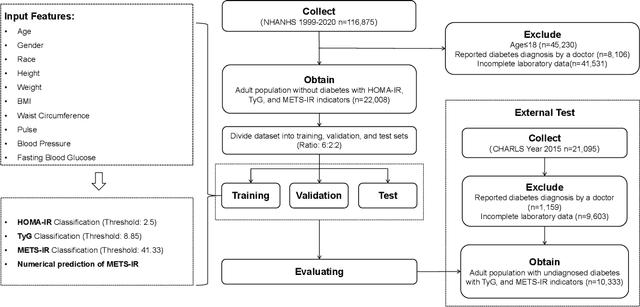
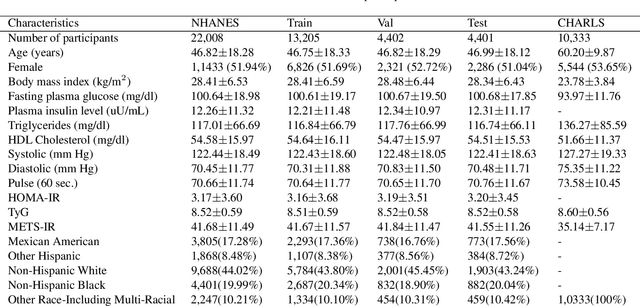
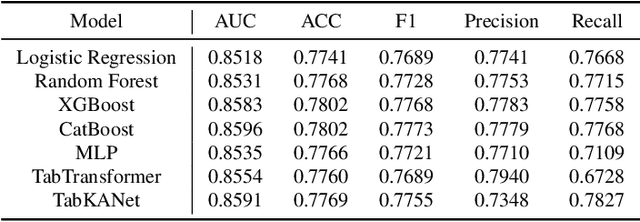
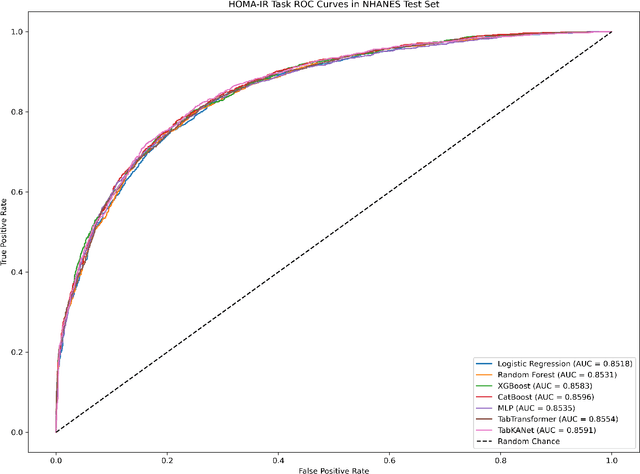
Insulin resistance (IR) is a key precursor to diabetes and a significant risk factor for cardiovascular disease. Traditional IR assessment methods require multiple blood tests. We developed a simple AI model using only fasting blood glucose to predict IR in non-diabetic populations. Data from the NHANES (1999-2020) and CHARLS (2015) studies were used for model training and validation. Input features included age, gender, height, weight, blood pressure, waist circumference, and fasting blood glucose. The CatBoost algorithm achieved AUC values of 0.8596 (HOMA-IR) and 0.7777 (TyG index) in NHANES, with an external AUC of 0.7442 for TyG. For METS-IR prediction, the model achieved AUC values of 0.9731 (internal) and 0.9591 (external), with RMSE values of 3.2643 (internal) and 3.057 (external). SHAP analysis highlighted waist circumference as a key predictor of IR. This AI model offers a minimally invasive and effective tool for IR prediction, supporting early diabetes and cardiovascular disease prevention.