 Add to Chrome
 Add to Firefox
 Add to Edge
UniSim-SLAM: Feed-Forward SLAM with Unified Sim(3) Optimization
Aug 03, 2026
Recent geometric foundation models enable feed-forward inference for SLAM, but their predictions are strongly dependent on the input view set, which leads to geometric inconsistencies and trajectory drift when results are chained over long sequences. Online deployment further exposes a trade-off between the low latency of two-view tracking and the constraint richness of multi-view inference. We introduce UniSim-SLAM, an integrated system that runs lightweight two-view keyframe tracking in the frontend and performs periodic multi-view submap refinement in the backend. To combine predictions defined in heterogeneous local coordinates with inconsistent scales, we formulate a unified multi-level factor graph on $Sim(3)$ that jointly optimizes global keyframe poses and submap poses. The graph integrates temporal view-to-view odometry edges, view-to-submap bridge edges with depth-statistics scale anchoring, and submap-to-submap tie and scale constraints to enforce consistent similarity relations across submaps. Experiments on TUM RGB-D and 7-Scenes show that UniSim-SLAM achieves state-of-the-art accuracy in the uncalibrated setting, reducing trajectory error by $38.5\% $ on TUM RGB-D and $45.9\%$ on 7-Scenes compared to prior best results. Project page: https://vision3d-lab.github.io/unisim-slam/

FeDepth: Federated Learning for Depth Estimation under Robot Heterogeneity
Aug 02, 2026Although recent robot perception research emphasizes training on data from diverse environments to improve generalization, most existing methods still rely on centralized learning, which is inefficient and difficult to scale across heterogeneous robot platforms. Federated learning (FL) offers an alternative by enabling distributed training without raw data transfer, but it suffers from severe performance degradation under domain shifts caused by heterogeneity across clients. In real robotic deployments, data distributions often overlap across platforms, environments, and sensing conditions, making it difficult to partition clients into clearly separated domains. However, this characteristic breaks the assumption of clearly separable client domains commonly used in clustered FL. To address this gap in robot perception, particularly in depth estimation, we introduce two realistic and unexplored non-IID scenarios that reflect heterogeneity in terms of platform, environment, and depth distribution. We then propose FeDepth, a descriptor-based clustered FL framework that models client relationships through soft clustering. Unlike hard clustering methods that assume clearly separated clusters, FeDepth allows clients to participate in multiple clusters, capturing continuous and ambiguous domain transitions commonly observed in robotic environments. Extensive experiments demonstrate that FeDepth consistently improves robustness over standard FL and clustered FL baselines across multiple depth estimation architectures, providing a practical and effective solution for federated robot perception. Our project page is available at https://vision3d-lab.github.io/fedepth/.
LightSplat: Fast and Memory-Efficient Open-Vocabulary 3D Scene Understanding in Five Seconds
Mar 25, 2026Open-vocabulary 3D scene understanding enables users to segment novel objects in complex 3D environments through natural language. However, existing approaches remain slow, memory-intensive, and overly complex due to iterative optimization and dense per-Gaussian feature assignments. To address this, we propose LightSplat, a fast and memory-efficient training-free framework that injects compact 2-byte semantic indices into 3D representations from multi-view images. By assigning semantic indices only to salient regions and managing them with a lightweight index-feature mapping, LightSplat eliminates costly feature optimization and storage overhead. We further ensure semantic consistency and efficient inference via single-step clustering that links geometrically and semantically related masks in 3D. We evaluate our method on LERF-OVS, ScanNet, and DL3DV-OVS across complex indoor-outdoor scenes. As a result, LightSplat achieves state-of-the-art performance with up to 50-400x speedup and 64x lower memory, enabling scalable language-driven 3D understanding. For more details, visit our project page https://vision3d-lab.github.io/lightsplat/.
Not Like Transformers: Drop the Beat Representation for Dance Generation with Mamba-Based Diffusion Model
Mar 09, 2026Dance is a form of human motion characterized by emotional expression and communication, playing a role in various fields such as music, virtual reality, and content creation. Existing methods for dance generation often fail to adequately capture the inherently sequential, rhythmical, and music-synchronized characteristics of dance. In this paper, we propose \emph{MambaDance}, a new dance generation approach that leverages a Mamba-based diffusion model. Mamba, well-suited to handling long and autoregressive sequences, is integrated into our two-stage diffusion architecture, substituting off-the-shelf Transformer. Additionally, considering the critical role of musical beats in dance choreography, we propose a Gaussian-based beat representation to explicitly guide the decoding of dance sequences. Experiments on AIST++ and FineDance datasets for each sequence length show that our proposed method effectively generates plausible dance movements while reflecting essential characteristics, consistently from short to long dances, compared to the previous methods. Additional qualitative results and demo videos are available at \small{https://vision3d-lab.github.io/mambadance}.
Rigidity-Aware 3D Gaussian Deformation from a Single Image
Sep 26, 2025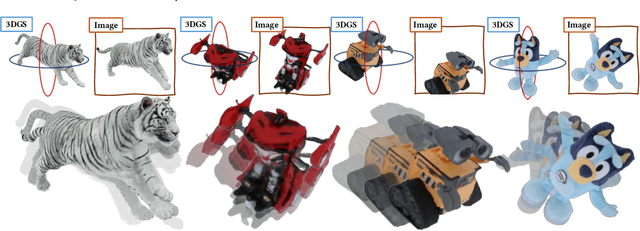
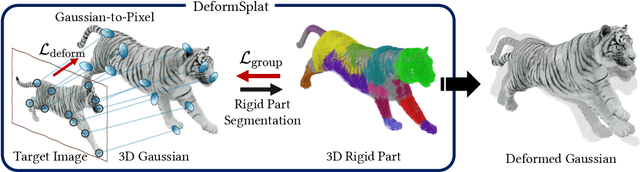
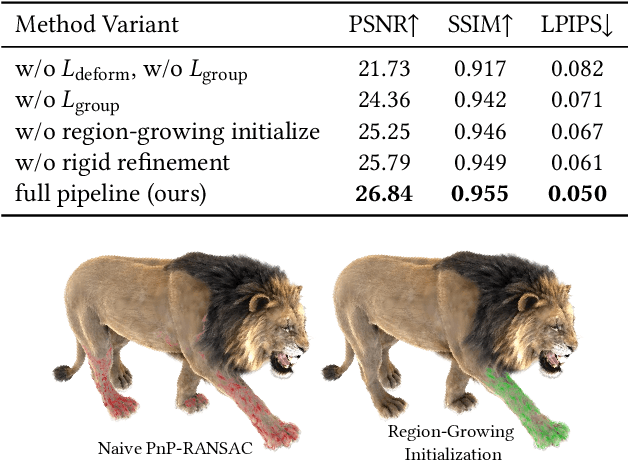
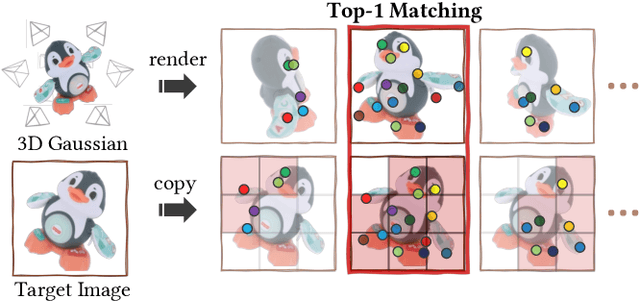
Reconstructing object deformation from a single image remains a significant challenge in computer vision and graphics. Existing methods typically rely on multi-view video to recover deformation, limiting their applicability under constrained scenarios. To address this, we propose DeformSplat, a novel framework that effectively guides 3D Gaussian deformation from only a single image. Our method introduces two main technical contributions. First, we present Gaussian-to-Pixel Matching which bridges the domain gap between 3D Gaussian representations and 2D pixel observations. This enables robust deformation guidance from sparse visual cues. Second, we propose Rigid Part Segmentation consisting of initialization and refinement. This segmentation explicitly identifies rigid regions, crucial for maintaining geometric coherence during deformation. By combining these two techniques, our approach can reconstruct consistent deformations from a single image. Extensive experiments demonstrate that our approach significantly outperforms existing methods and naturally extends to various applications,such as frame interpolation and interactive object manipulation.
LighthouseGS: Indoor Structure-aware 3D Gaussian Splatting for Panorama-Style Mobile Captures
Jul 08, 2025Recent advances in 3D Gaussian Splatting (3DGS) have enabled real-time novel view synthesis (NVS) with impressive quality in indoor scenes. However, achieving high-fidelity rendering requires meticulously captured images covering the entire scene, limiting accessibility for general users. We aim to develop a practical 3DGS-based NVS framework using simple panorama-style motion with a handheld camera (e.g., mobile device). While convenient, this rotation-dominant motion and narrow baseline make accurate camera pose and 3D point estimation challenging, especially in textureless indoor scenes. To address these challenges, we propose LighthouseGS, a novel framework inspired by the lighthouse-like sweeping motion of panoramic views. LighthouseGS leverages rough geometric priors, such as mobile device camera poses and monocular depth estimation, and utilizes the planar structures often found in indoor environments. We present a new initialization method called plane scaffold assembly to generate consistent 3D points on these structures, followed by a stable pruning strategy to enhance geometry and optimization stability. Additionally, we introduce geometric and photometric corrections to resolve inconsistencies from motion drift and auto-exposure in mobile devices. Tested on collected real and synthetic indoor scenes, LighthouseGS delivers photorealistic rendering, surpassing state-of-the-art methods and demonstrating the potential for panoramic view synthesis and object placement.
Structure-from-Sherds++: Robust Incremental 3D Reassembly of Axially Symmetric Pots from Unordered and Mixed Fragment Collections
Feb 19, 2025Reassembling multiple axially symmetric pots from fragmentary sherds is crucial for cultural heritage preservation, yet it poses significant challenges due to thin and sharp fracture surfaces that generate numerous false positive matches and hinder large-scale puzzle solving. Existing global approaches, which optimize all potential fragment pairs simultaneously or data-driven models, are prone to local minima and face scalability issues when multiple pots are intermixed. Motivated by Structure-from-Motion (SfM) for 3D reconstruction from multiple images, we propose an efficient reassembly method for axially symmetric pots based on iterative registration of one sherd at a time, called Structure-from-Sherds++ (SfS++). Our method extends beyond simple replication of incremental SfM and leverages multi-graph beam search to explore multiple registration paths. This allows us to effectively filter out indistinguishable false matches and simultaneously reconstruct multiple pots without requiring prior information such as base or the number of mixed objects. Our approach achieves 87% reassembly accuracy on a dataset of 142 real fragments from 10 different pots, outperforming other methods in handling complex fracture patterns with mixed datasets and achieving state-of-the-art performance. Code and results can be found in our project page https://sj-yoo.info/sfs/.
The Devil is in the Details: Simple Remedies for Image-to-LiDAR Representation Learning
Jan 16, 2025LiDAR is a crucial sensor in autonomous driving, commonly used alongside cameras. By exploiting this camera-LiDAR setup and recent advances in image representation learning, prior studies have shown the promising potential of image-to-LiDAR distillation. These prior arts focus on the designs of their own losses to effectively distill the pre-trained 2D image representations into a 3D model. However, the other parts of the designs have been surprisingly unexplored. We find that fundamental design elements, e.g., the LiDAR coordinate system, quantization according to the existing input interface, and data utilization, are more critical than developing loss functions, which have been overlooked in prior works. In this work, we show that simple fixes to these designs notably outperform existing methods by 16% in 3D semantic segmentation on the nuScenes dataset and 13% in 3D object detection on the KITTI dataset in downstream task performance. We focus on overlooked design choices along the spatial and temporal axes. Spatially, prior work has used cylindrical coordinate and voxel sizes without considering their side effects yielded with a commonly deployed sparse convolution layer input interface, leading to spatial quantization errors in 3D models. Temporally, existing work has avoided cumbersome data curation by discarding unsynced data, limiting the use to only the small portion of data that is temporally synced across sensors. We analyze these effects and propose simple solutions for each overlooked aspect.
A Benchmark Dataset for Collaborative SLAM in Service Environments
Nov 22, 2024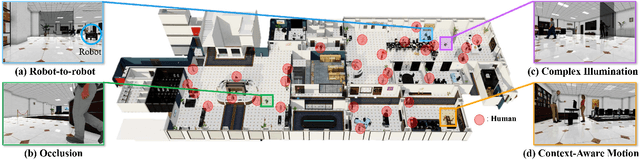
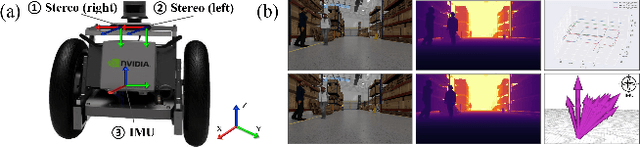
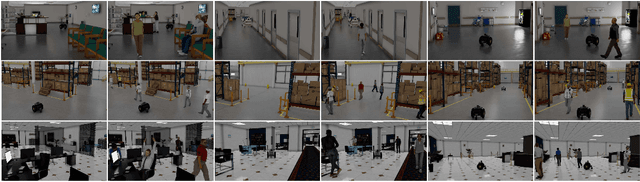
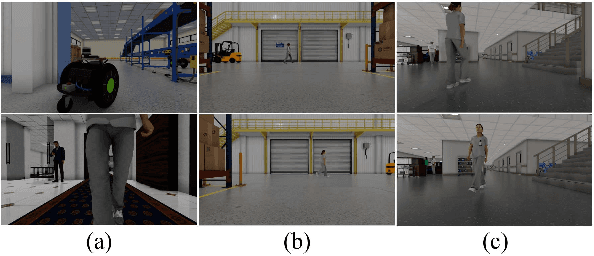
As service environments have become diverse, they have started to demand complicated tasks that are difficult for a single robot to complete. This change has led to an interest in multiple robots instead of a single robot. C-SLAM, as a fundamental technique for multiple service robots, needs to handle diverse challenges such as homogeneous scenes and dynamic objects to ensure that robots operate smoothly and perform their tasks safely. However, existing C-SLAM datasets do not include the various indoor service environments with the aforementioned challenges. To close this gap, we introduce a new multi-modal C-SLAM dataset for multiple service robots in various indoor service environments, called C-SLAM dataset in Service Environments (CSE). We use the NVIDIA Isaac Sim to generate data in various indoor service environments with the challenges that may occur in real-world service environments. By using simulation, we can provide accurate and precisely time-synchronized sensor data, such as stereo RGB, stereo depth, IMU, and ground truth (GT) poses. We configure three common indoor service environments (Hospital, Office, and Warehouse), each of which includes various dynamic objects that perform motions suitable to each environment. In addition, we drive three robots to mimic the actions of real service robots. Through these factors, we generate a more realistic C-SLAM dataset for multiple service robots. We demonstrate our dataset by evaluating diverse state-of-the-art single-robot SLAM and multi-robot SLAM methods. Our dataset is available at https://github.com/vision3d-lab/CSE_Dataset.
* 8 pages, 6 figures, Accepted to IEEE RA-L
VPOcc: Exploiting Vanishing Point for Monocular 3D Semantic Occupancy Prediction
Aug 07, 2024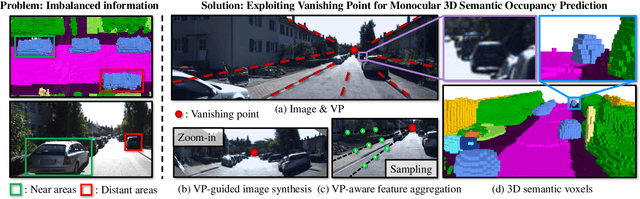

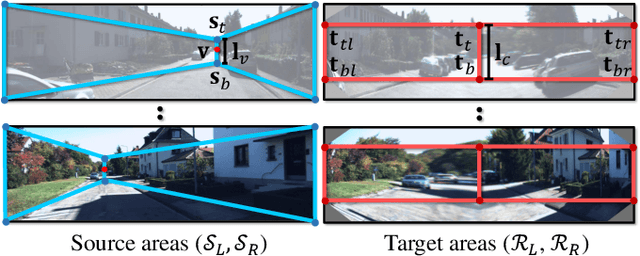
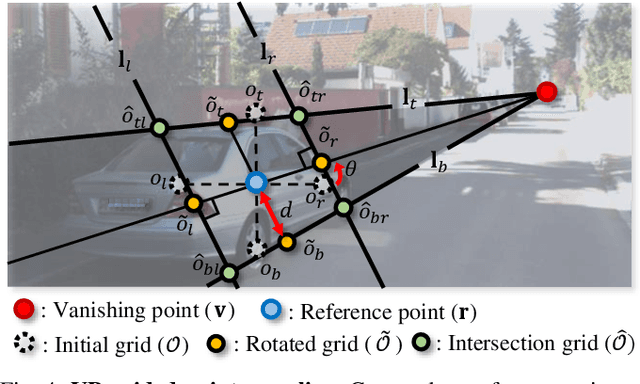
Monocular 3D semantic occupancy prediction is becoming important in robot vision due to the compactness of using a single RGB camera. However, existing methods often do not adequately account for camera perspective geometry, resulting in information imbalance along the depth range of the image. To address this issue, we propose a vanishing point (VP) guided monocular 3D semantic occupancy prediction framework named VPOcc. Our framework consists of three novel modules utilizing VP. First, in the VPZoomer module, we initially utilize VP in feature extraction to achieve information balanced feature extraction across the scene by generating a zoom-in image based on VP. Second, we perform perspective geometry-aware feature aggregation by sampling points towards VP using a VP-guided cross-attention (VPCA) module. Finally, we create an information-balanced feature volume by effectively fusing original and zoom-in voxel feature volumes with a balanced feature volume fusion (BVFV) module. Experiments demonstrate that our method achieves state-of-the-art performance for both IoU and mIoU on SemanticKITTI and SSCBench-KITTI360. These results are obtained by effectively addressing the information imbalance in images through the utilization of VP. Our code will be available at www.github.com/anonymous.