 Add to Chrome
 Add to Firefox
 Add to Edge
Accelerated Likelihood Maximization for Diffusion-based Versatile Content Generation
Jun 30, 2026
Generating diverse, coherent, and plausible content from partially given inputs remains a fundamental challenge for diffusion models. Existing approaches face clear limitations: training-based approaches offer strong task-specific results but require costly computation, and they generalize poorly across tasks. Training-free approaches offer better efficiency, but they do not explicitly optimize over unobserved variables, leading to globally inconsistent results. To address these limitations, we introduce Accelerated Likelihood Maximization (ALM), a novel training-free sampling strategy integrated into the reverse diffusion process that significantly extends the applicability of diffusion models beyond simple generation tasks. Unlike previous methods that implicitly influence missing regions through pre-generated region constraints, we directly optimize the unobserved region during the sampling process, enabling globally coherent and plausible generation. Furthermore, we incorporate an acceleration strategy that significantly improves computational efficiency without sacrificing performance. Experimental results demonstrate that ALM consistently outperforms state-of-the-art methods in various data domains and tasks, establishing a powerful paradigm for versatile content generation.

Analogical Trajectory Transfer
May 14, 2026We study analogical trajectory transfer, where the goal is to translate motion trajectories in one 3D environment to a semantically analogous location in another. Such a capacity would enable machines to perform analogical spatial reasoning, with applications in AR/VR co-presence, content creation, and robotics. However, even semantically similar scenes can still differ substantially in object placement, scale, and layout, so naively matching semantics leads to collisions or geometric distortions. Furthermore, finding where each trajectory point should transfer to has a large search space, as the mapping must preserve semantics and functionality without tearing the trajectory apart or causing collisions. Our key insight is to decompose the problem into spatially segregated subproblems and merge their solutions to produce semantically consistent and spatially coherent transfers. Specifically, we partition scenes into object-centric clusters and estimate cross-scene mappings via hierarchical smooth map prediction, using 3D foundation model features that encode contextual information from object and open-space arrangements. We then combinatorially assemble the per-cluster maps into an initial transfer and refine the result to remove collisions and distortions, yielding a spatially coherent trajectory. Our method does not require training, attains a fast runtime around 0.6 seconds, and outperforms baselines based on LLMs, VLMs, and scene graph matching. We further showcase applications in virtual co-presence, multi-trajectory transfer, camera transfer, and human-to-robot motion transfer, which indicates the broad applicability of our work to AR/VR and robotics.
EgoForce: Robust Online Egocentric Motion Reconstruction via Diffusion Forcing
May 13, 2026With recent advances in embodied agents and AR devices, egocentric observations are readily available as input for real-world interactive online applications. However, egocentric viewpoints can only sporadically observe hands, in addition to the estimated head trajectory. We propose EgoForce, an online framework for reconstructing long-term full-body motion from noisy egocentric input. While existing generative frameworks can robustly handle noisy and sparse measurements, they assume a fixed-length observation window is available and are thus not suitable for real-time applications. Faster inference often relies on autoregressive prediction, sacrificing robustness. In contrast, we adopt a diffusion-based method with a temporally asymmetric noise schedule inspired by Diffusion Forcing. Specifically, our approach models temporally evolving uncertainty and incrementally denoises states as new streaming observations arrive. Combined with a noise-robust imputation strategy, EgoForce progressively generates stable and coherent full-body motion under strict causal constraints. Experiments demonstrate that our online framework outperforms existing online and offline methods, enabling long-horizon, full-body motion reconstruction in challenging egocentric scenarios.
ScaleMoGen: Autoregressive Next-Scale Prediction for Human Motion Generation
May 12, 2026We present ScaleMoGen, a scale-wise autoregressive framework for text-driven human motion generation. Unlike conventional autoregressive approaches that rely on standard next-token prediction, ScaleMoGen frames motion generation as a coarse-to-fine process. We quantize 3D motions into compositional discrete tokens across multiple skeletal-emporal scales of increasing granularity, learning to generate motion by autoregressively predicting next-scale token maps. To maintain structural integrity, our motion tokenizers and quantizers are explicitly designed so that discrete tokens at every scale strictly preserve the skeletal hierarchy. Additionally, we employ bitwise quantization and prediction, which efficiently scale up the tokenizer vocabulary to preserve motion details and stabilize optimization. Extensive experiments demonstrate that ScaleMoGen achieves state-of-the-art performance, establishing an FID of 0.030 (vs. 0.045 for MoMask) on HumanML3D and a CLIP Score of 0.693 (vs. 0.685 for MoMask++) on the SnapMoGen dataset. Furthermore, we demonstrate that our skeletal-temporal multi-scale representation naturally facilitates training-free, text-guided motion editing.
Image-Guided Geometric Stylization of 3D Meshes
Apr 09, 2026Recent generative models can create visually plausible 3D representations of objects. However, the generation process often allows for implicit control signals, such as contextual descriptions, and rarely supports bold geometric distortions beyond existing data distributions. We propose a geometric stylization framework that deforms a 3D mesh, allowing it to express the style of an image. While style is inherently ambiguous, we utilize pre-trained diffusion models to extract an abstract representation of the provided image. Our coarse-to-fine stylization pipeline can drastically deform the input 3D model to express a diverse range of geometric variations while retaining the valid topology of the original mesh and part-level semantics. We also propose an approximate VAE encoder that provides efficient and reliable gradients from mesh renderings. Extensive experiments demonstrate that our method can create stylized 3D meshes that reflect unique geometric features of the pictured assets, such as expressive poses and silhouettes, thereby supporting the creation of distinctive artistic 3D creations. Project page: https://changwoonchoi.github.io/GeoStyle
Recovering Dynamic 3D Sketches from Videos
Mar 27, 2025
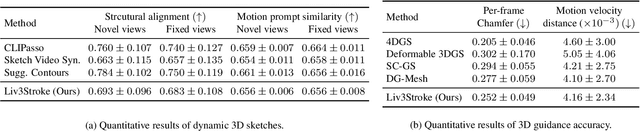
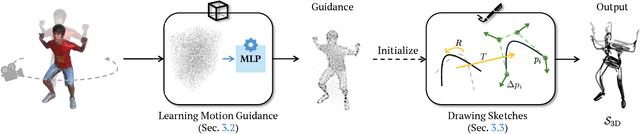
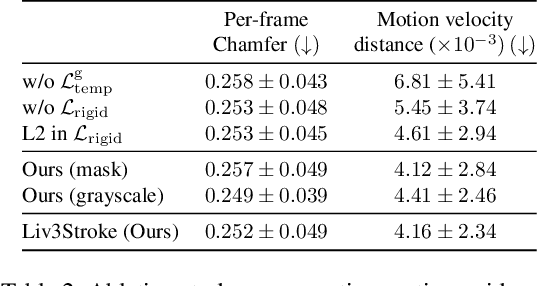
Understanding 3D motion from videos presents inherent challenges due to the diverse types of movement, ranging from rigid and deformable objects to articulated structures. To overcome this, we propose Liv3Stroke, a novel approach for abstracting objects in motion with deformable 3D strokes. The detailed movements of an object may be represented by unstructured motion vectors or a set of motion primitives using a pre-defined articulation from a template model. Just as a free-hand sketch can intuitively visualize scenes or intentions with a sparse set of lines, we utilize a set of parametric 3D curves to capture a set of spatially smooth motion elements for general objects with unknown structures. We first extract noisy, 3D point cloud motion guidance from video frames using semantic features, and our approach deforms a set of curves to abstract essential motion features as a set of explicit 3D representations. Such abstraction enables an understanding of prominent components of motions while maintaining robustness to environmental factors. Our approach allows direct analysis of 3D object movements from video, tackling the uncertainty that typically occurs when translating real-world motion into recorded footage. The project page is accessible via: https://jaeah.me/liv3stroke_web
SceneMI: Motion In-betweening for Modeling Human-Scene Interactions
Mar 20, 2025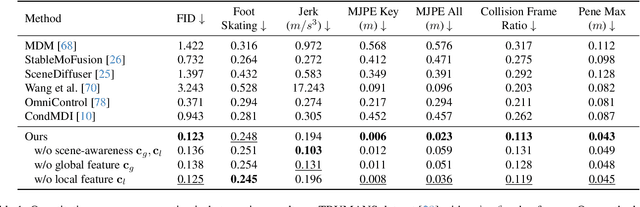
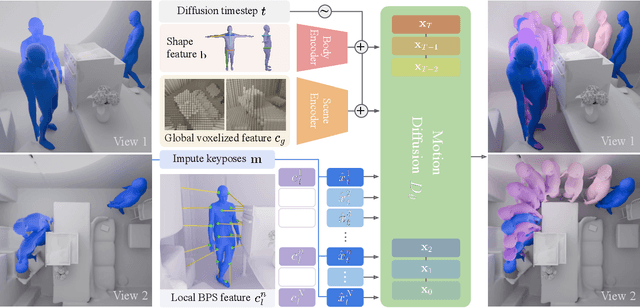
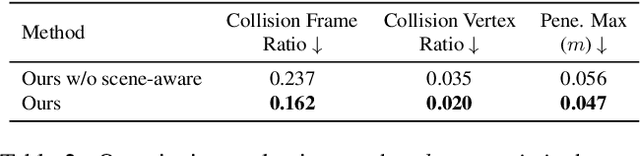
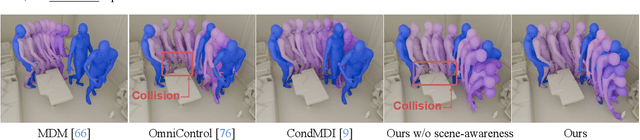
Modeling human-scene interactions (HSI) is essential for understanding and simulating everyday human behaviors. Recent approaches utilizing generative modeling have made progress in this domain; however, they are limited in controllability and flexibility for real-world applications. To address these challenges, we propose reformulating the HSI modeling problem as Scene-aware Motion In-betweening -- a more tractable and practical task. We introduce SceneMI, a framework that supports several practical applications, including keyframe-guided character animation in 3D scenes and enhancing the motion quality of imperfect HSI data. SceneMI employs dual scene descriptors to comprehensively encode global and local scene context. Furthermore, our framework leverages the inherent denoising nature of diffusion models to generalize on noisy keyframes. Experimental results demonstrate SceneMI's effectiveness in scene-aware keyframe in-betweening and generalization to the real-world GIMO dataset, where motions and scenes are acquired by noisy IMU sensors and smartphones. We further showcase SceneMI's applicability in HSI reconstruction from monocular videos.
Learning 3D Scene Analogies with Neural Contextual Scene Maps
Mar 20, 2025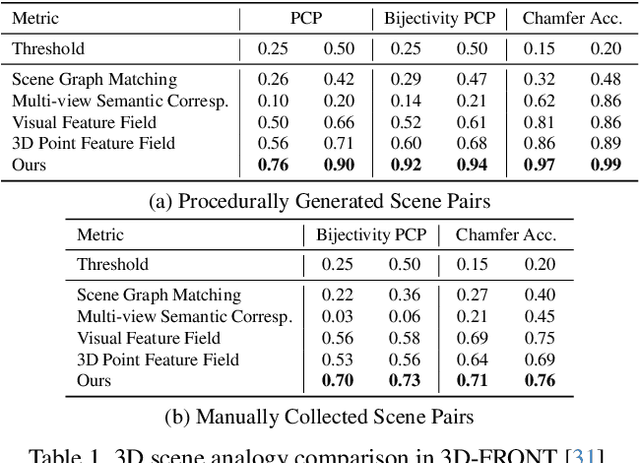
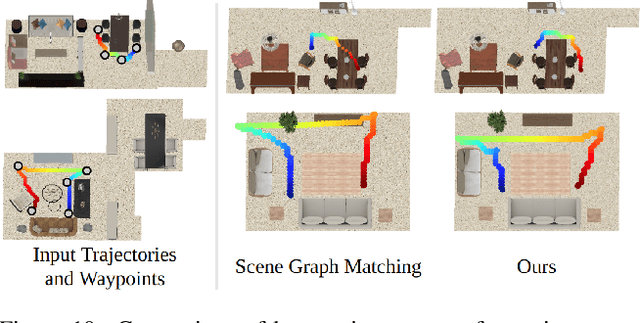
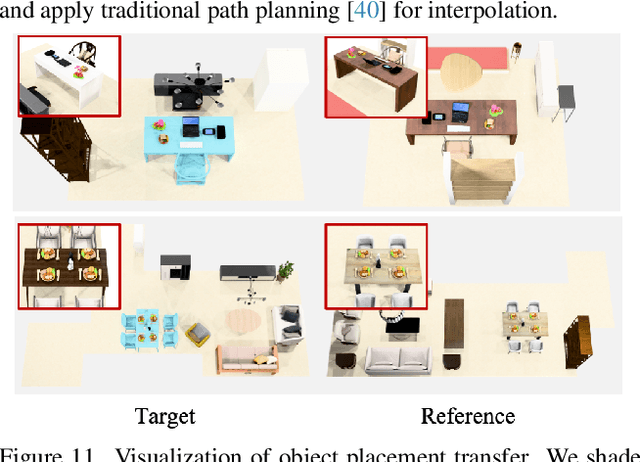
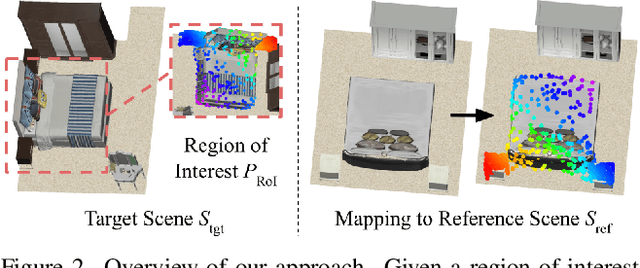
Understanding scene contexts is crucial for machines to perform tasks and adapt prior knowledge in unseen or noisy 3D environments. As data-driven learning is intractable to comprehensively encapsulate diverse ranges of layouts and open spaces, we propose teaching machines to identify relational commonalities in 3D spaces. Instead of focusing on point-wise or object-wise representations, we introduce 3D scene analogies, which are smooth maps between 3D scene regions that align spatial relationships. Unlike well-studied single instance-level maps, these scene-level maps smoothly link large scene regions, potentially enabling unique applications in trajectory transfer in AR/VR, long demonstration transfer for imitation learning, and context-aware object rearrangement. To find 3D scene analogies, we propose neural contextual scene maps, which extract descriptor fields summarizing semantic and geometric contexts, and holistically align them in a coarse-to-fine manner for map estimation. This approach reduces reliance on individual feature points, making it robust to input noise or shape variations. Experiments demonstrate the effectiveness of our approach in identifying scene analogies and transferring trajectories or object placements in diverse indoor scenes, indicating its potential for robotics and AR/VR applications.
Motion Synthesis with Sparse and Flexible Keyjoint Control
Mar 18, 2025Creating expressive character animations is labor-intensive, requiring intricate manual adjustment of animators across space and time. Previous works on controllable motion generation often rely on a predefined set of dense spatio-temporal specifications (e.g., dense pelvis trajectories with exact per-frame timing), limiting practicality for animators. To process high-level intent and intuitive control in diverse scenarios, we propose a practical controllable motions synthesis framework that respects sparse and flexible keyjoint signals. Our approach employs a decomposed diffusion-based motion synthesis framework that first synthesizes keyjoint movements from sparse input control signals and then synthesizes full-body motion based on the completed keyjoint trajectories. The low-dimensional keyjoint movements can easily adapt to various control signal types, such as end-effector position for diverse goal-driven motion synthesis, or incorporate functional constraints on a subset of keyjoints. Additionally, we introduce a time-agnostic control formulation, eliminating the need for frame-specific timing annotations and enhancing control flexibility. Then, the shared second stage can synthesize a natural whole-body motion that precisely satisfies the task requirement from dense keyjoint movements. We demonstrate the effectiveness of sparse and flexible keyjoint control through comprehensive experiments on diverse datasets and scenarios.
Less is More: Improving Motion Diffusion Models with Sparse Keyframes
Mar 18, 2025Recent advances in motion diffusion models have led to remarkable progress in diverse motion generation tasks, including text-to-motion synthesis. However, existing approaches represent motions as dense frame sequences, requiring the model to process redundant or less informative frames. The processing of dense animation frames imposes significant training complexity, especially when learning intricate distributions of large motion datasets even with modern neural architectures. This severely limits the performance of generative motion models for downstream tasks. Inspired by professional animators who mainly focus on sparse keyframes, we propose a novel diffusion framework explicitly designed around sparse and geometrically meaningful keyframes. Our method reduces computation by masking non-keyframes and efficiently interpolating missing frames. We dynamically refine the keyframe mask during inference to prioritize informative frames in later diffusion steps. Extensive experiments show that our approach consistently outperforms state-of-the-art methods in text alignment and motion realism, while also effectively maintaining high performance at significantly fewer diffusion steps. We further validate the robustness of our framework by using it as a generative prior and adapting it to different downstream tasks. Source code and pre-trained models will be released upon acceptance.