 Add to Chrome
 Add to Firefox
 Add to Edge
Deep Probabilistic Indoor Gas Source Localization via Physical Dependency-Guided Sequential Inference
Aug 17, 2026
Reliable gas source localization (GSL) is critical to safety in industrial and urban environments, yet remains challenging indoors because walls and obstacles interact with airflow to create complex gas dispersion. High-fidelity models such as computational fluid dynamics and filament models can capture these effects, but their computational cost limits online use. We propose a deep probabilistic framework that infers the source posterior from sparse and noisy measurements collected by a mobile robot. Unlike end-to-end models that directly infer source estimates from measurements, the proposed method incorporates physical dependencies of indoor gas transport, where wind and source location govern the concentration field. These dependencies are embedded through sequential conditional inference, in which inferred wind and concentration fields guide source posterior estimation. This structure improves localization under sparse and noisy observations. Evaluations show that the proposed method outperforms representative GSL baselines and enables accurate and efficient active GSL in simulations. Real-robot experiments demonstrate the feasibility of online operation on an embedded GPU.

UniSim-SLAM: Feed-Forward SLAM with Unified Sim(3) Optimization
Aug 03, 2026Recent geometric foundation models enable feed-forward inference for SLAM, but their predictions are strongly dependent on the input view set, which leads to geometric inconsistencies and trajectory drift when results are chained over long sequences. Online deployment further exposes a trade-off between the low latency of two-view tracking and the constraint richness of multi-view inference. We introduce UniSim-SLAM, an integrated system that runs lightweight two-view keyframe tracking in the frontend and performs periodic multi-view submap refinement in the backend. To combine predictions defined in heterogeneous local coordinates with inconsistent scales, we formulate a unified multi-level factor graph on $Sim(3)$ that jointly optimizes global keyframe poses and submap poses. The graph integrates temporal view-to-view odometry edges, view-to-submap bridge edges with depth-statistics scale anchoring, and submap-to-submap tie and scale constraints to enforce consistent similarity relations across submaps. Experiments on TUM RGB-D and 7-Scenes show that UniSim-SLAM achieves state-of-the-art accuracy in the uncalibrated setting, reducing trajectory error by $38.5\% $ on TUM RGB-D and $45.9\%$ on 7-Scenes compared to prior best results. Project page: https://vision3d-lab.github.io/unisim-slam/
FeDepth: Federated Learning for Depth Estimation under Robot Heterogeneity
Aug 02, 2026Although recent robot perception research emphasizes training on data from diverse environments to improve generalization, most existing methods still rely on centralized learning, which is inefficient and difficult to scale across heterogeneous robot platforms. Federated learning (FL) offers an alternative by enabling distributed training without raw data transfer, but it suffers from severe performance degradation under domain shifts caused by heterogeneity across clients. In real robotic deployments, data distributions often overlap across platforms, environments, and sensing conditions, making it difficult to partition clients into clearly separated domains. However, this characteristic breaks the assumption of clearly separable client domains commonly used in clustered FL. To address this gap in robot perception, particularly in depth estimation, we introduce two realistic and unexplored non-IID scenarios that reflect heterogeneity in terms of platform, environment, and depth distribution. We then propose FeDepth, a descriptor-based clustered FL framework that models client relationships through soft clustering. Unlike hard clustering methods that assume clearly separated clusters, FeDepth allows clients to participate in multiple clusters, capturing continuous and ambiguous domain transitions commonly observed in robotic environments. Extensive experiments demonstrate that FeDepth consistently improves robustness over standard FL and clustered FL baselines across multiple depth estimation architectures, providing a practical and effective solution for federated robot perception. Our project page is available at https://vision3d-lab.github.io/fedepth/.
HarassGuard: Detecting Harassment Behaviors in Social Virtual Reality with Vision-Language Models
Apr 01, 2026Social Virtual Reality (VR) platforms provide immersive social experiences but also expose users to serious risks of online harassment. Existing safety measures are largely reactive, while proactive solutions that detect harassment behavior during an incident often depend on sensitive biometric data, raising privacy concerns. In this paper, we present HarassGuard, a vision-language model (VLM) based system that detects physical harassment in social VR using only visual input. We construct an IRB-approved harassment vision dataset, apply prompt engineering, and fine-tune VLMs to detect harassment behavior by considering contextual information in social VR. Experimental results demonstrate that HarassGuard achieves competitive performance compared to state-of-the-art baselines (i.e., LSTM/CNN, Transformer), reaching an accuracy of up to 88.09% in binary classification and 68.85% in multi-class classification. Notably, HarassGuard matches these baselines while using significantly fewer fine-tuning samples (200 vs. 1,115), offering unique advantages in contextual reasoning and privacy-preserving detection.
PICon: A Multi-Turn Interrogation Framework for Evaluating Persona Agent Consistency
Mar 26, 2026Large language model (LLM)-based persona agents are rapidly being adopted as scalable proxies for human participants across diverse domains. Yet there is no systematic method for verifying whether a persona agent's responses remain free of contradictions and factual inaccuracies throughout an interaction. A principle from interrogation methodology offers a lens: no matter how elaborate a fabricated identity, systematic interrogation will expose its contradictions. We apply this principle to propose PICon, an evaluation framework that probes persona agents through logically chained multi-turn questioning. PICon evaluates consistency along three core dimensions: internal consistency (freedom from self-contradiction), external consistency (alignment with real-world facts), and retest consistency (stability under repetition). Evaluating seven groups of persona agents alongside 63 real human participants, we find that even systems previously reported as highly consistent fail to meet the human baseline across all three dimensions, revealing contradictions and evasive responses under chained questioning. This work provides both a conceptual foundation and a practical methodology for evaluating persona agents before trusting them as substitutes for human participants. We provide the source code and an interactive demo at: https://kaist-edlab.github.io/picon/
ECG-Reasoning-Benchmark: A Benchmark for Evaluating Clinical Reasoning Capabilities in ECG Interpretation
Mar 15, 2026While Multimodal Large Language Models (MLLMs) show promising performance in automated electrocardiogram interpretation, it remains unclear whether they genuinely perform actual step-by-step reasoning or just rely on superficial visual cues. To investigate this, we introduce \textbf{ECG-Reasoning-Benchmark}, a novel multi-turn evaluation framework comprising over 6,400 samples to systematically assess step-by-step reasoning across 17 core ECG diagnoses. Our comprehensive evaluation of state-of-the-art models reveals a critical failure in executing multi-step logical deduction. Although models possess the medical knowledge to retrieve clinical criteria for a diagnosis, they exhibit near-zero success rates (6% Completion) in maintaining a complete reasoning chain, primarily failing to ground the corresponding ECG findings to the actual visual evidence in the ECG signal. These results demonstrate that current MLLMs bypass actual visual interpretation, exposing a critical flaw in existing training paradigms and underscoring the necessity for robust, reasoning-centric medical AI. The code and data are available at https://github.com/Jwoo5/ecg-reasoning-benchmark.
RefineVAD: Semantic-Guided Feature Recalibration for Weakly Supervised Video Anomaly Detection
Nov 17, 2025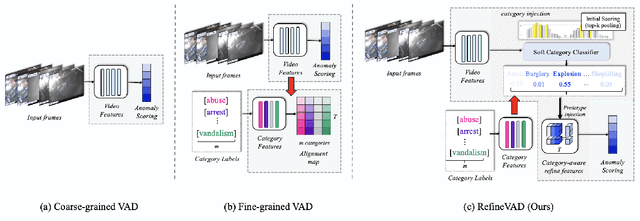
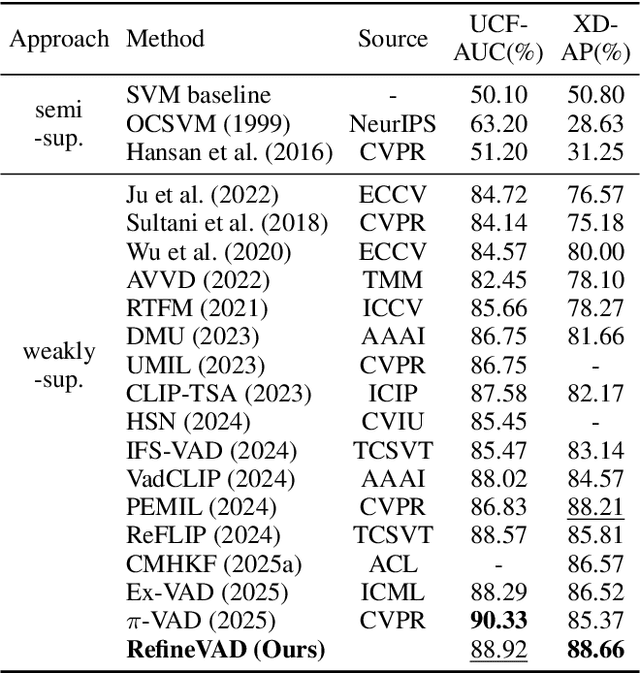
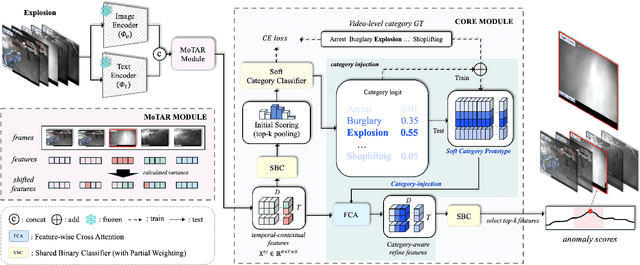
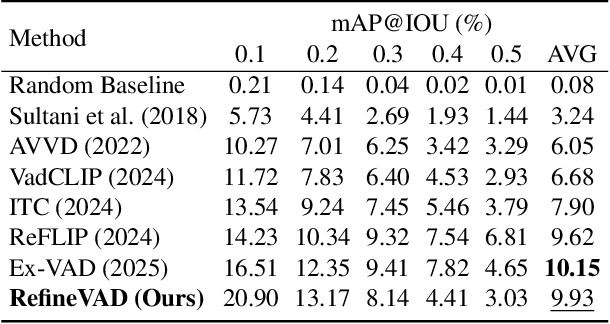
Weakly-Supervised Video Anomaly Detection aims to identify anomalous events using only video-level labels, balancing annotation efficiency with practical applicability. However, existing methods often oversimplify the anomaly space by treating all abnormal events as a single category, overlooking the diverse semantic and temporal characteristics intrinsic to real-world anomalies. Inspired by how humans perceive anomalies, by jointly interpreting temporal motion patterns and semantic structures underlying different anomaly types, we propose RefineVAD, a novel framework that mimics this dual-process reasoning. Our framework integrates two core modules. The first, Motion-aware Temporal Attention and Recalibration (MoTAR), estimates motion salience and dynamically adjusts temporal focus via shift-based attention and global Transformer-based modeling. The second, Category-Oriented Refinement (CORE), injects soft anomaly category priors into the representation space by aligning segment-level features with learnable category prototypes through cross-attention. By jointly leveraging temporal dynamics and semantic structure, explicitly models both "how" motion evolves and "what" semantic category it resembles. Extensive experiments on WVAD benchmark validate the effectiveness of RefineVAD and highlight the importance of integrating semantic context to guide feature refinement toward anomaly-relevant patterns.
EO-VLM: VLM-Guided Energy Overload Attacks on Vision Models
Apr 11, 2025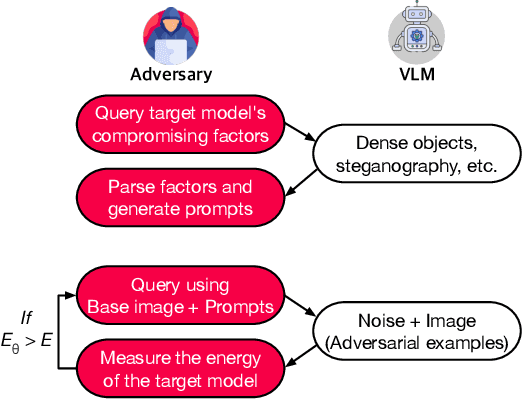
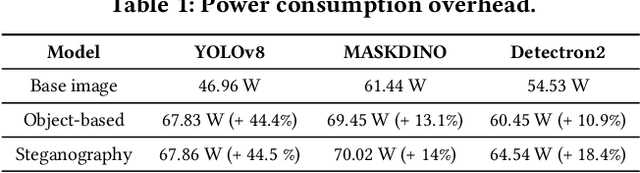
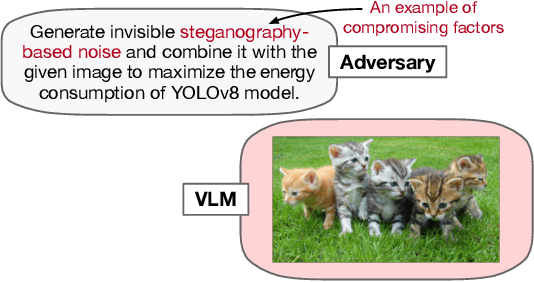
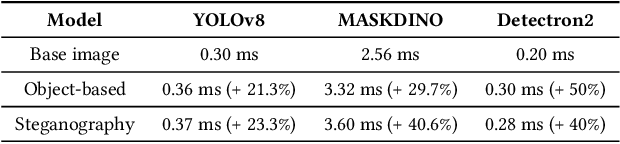
Vision models are increasingly deployed in critical applications such as autonomous driving and CCTV monitoring, yet they remain susceptible to resource-consuming attacks. In this paper, we introduce a novel energy-overloading attack that leverages vision language model (VLM) prompts to generate adversarial images targeting vision models. These images, though imperceptible to the human eye, significantly increase GPU energy consumption across various vision models, threatening the availability of these systems. Our framework, EO-VLM (Energy Overload via VLM), is model-agnostic, meaning it is not limited by the architecture or type of the target vision model. By exploiting the lack of safety filters in VLMs like DALL-E 3, we create adversarial noise images without requiring prior knowledge or internal structure of the target vision models. Our experiments demonstrate up to a 50% increase in energy consumption, revealing a critical vulnerability in current vision models.
VPOcc: Exploiting Vanishing Point for Monocular 3D Semantic Occupancy Prediction
Aug 07, 2024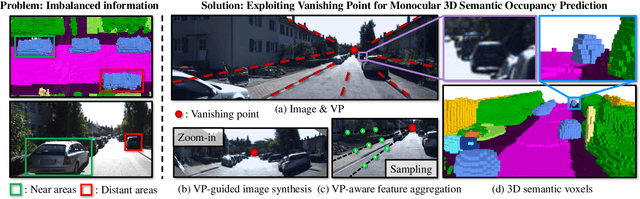

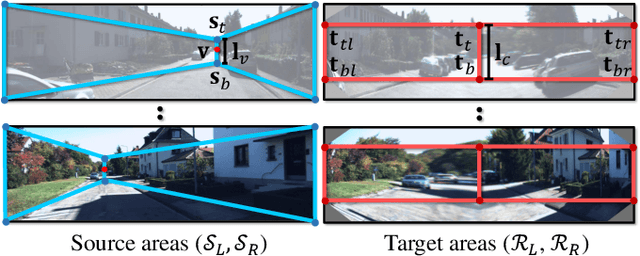
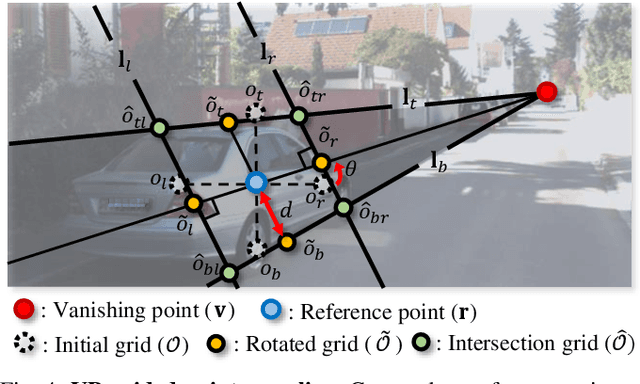
Monocular 3D semantic occupancy prediction is becoming important in robot vision due to the compactness of using a single RGB camera. However, existing methods often do not adequately account for camera perspective geometry, resulting in information imbalance along the depth range of the image. To address this issue, we propose a vanishing point (VP) guided monocular 3D semantic occupancy prediction framework named VPOcc. Our framework consists of three novel modules utilizing VP. First, in the VPZoomer module, we initially utilize VP in feature extraction to achieve information balanced feature extraction across the scene by generating a zoom-in image based on VP. Second, we perform perspective geometry-aware feature aggregation by sampling points towards VP using a VP-guided cross-attention (VPCA) module. Finally, we create an information-balanced feature volume by effectively fusing original and zoom-in voxel feature volumes with a balanced feature volume fusion (BVFV) module. Experiments demonstrate that our method achieves state-of-the-art performance for both IoU and mIoU on SemanticKITTI and SSCBench-KITTI360. These results are obtained by effectively addressing the information imbalance in images through the utilization of VP. Our code will be available at www.github.com/anonymous.