 Add to Chrome
 Add to Firefox
 Add to Edge
UniSim-SLAM: Feed-Forward SLAM with Unified Sim(3) Optimization
Aug 03, 2026
Recent geometric foundation models enable feed-forward inference for SLAM, but their predictions are strongly dependent on the input view set, which leads to geometric inconsistencies and trajectory drift when results are chained over long sequences. Online deployment further exposes a trade-off between the low latency of two-view tracking and the constraint richness of multi-view inference. We introduce UniSim-SLAM, an integrated system that runs lightweight two-view keyframe tracking in the frontend and performs periodic multi-view submap refinement in the backend. To combine predictions defined in heterogeneous local coordinates with inconsistent scales, we formulate a unified multi-level factor graph on $Sim(3)$ that jointly optimizes global keyframe poses and submap poses. The graph integrates temporal view-to-view odometry edges, view-to-submap bridge edges with depth-statistics scale anchoring, and submap-to-submap tie and scale constraints to enforce consistent similarity relations across submaps. Experiments on TUM RGB-D and 7-Scenes show that UniSim-SLAM achieves state-of-the-art accuracy in the uncalibrated setting, reducing trajectory error by $38.5\% $ on TUM RGB-D and $45.9\%$ on 7-Scenes compared to prior best results. Project page: https://vision3d-lab.github.io/unisim-slam/

FeDepth: Federated Learning for Depth Estimation under Robot Heterogeneity
Aug 02, 2026Although recent robot perception research emphasizes training on data from diverse environments to improve generalization, most existing methods still rely on centralized learning, which is inefficient and difficult to scale across heterogeneous robot platforms. Federated learning (FL) offers an alternative by enabling distributed training without raw data transfer, but it suffers from severe performance degradation under domain shifts caused by heterogeneity across clients. In real robotic deployments, data distributions often overlap across platforms, environments, and sensing conditions, making it difficult to partition clients into clearly separated domains. However, this characteristic breaks the assumption of clearly separable client domains commonly used in clustered FL. To address this gap in robot perception, particularly in depth estimation, we introduce two realistic and unexplored non-IID scenarios that reflect heterogeneity in terms of platform, environment, and depth distribution. We then propose FeDepth, a descriptor-based clustered FL framework that models client relationships through soft clustering. Unlike hard clustering methods that assume clearly separated clusters, FeDepth allows clients to participate in multiple clusters, capturing continuous and ambiguous domain transitions commonly observed in robotic environments. Extensive experiments demonstrate that FeDepth consistently improves robustness over standard FL and clustered FL baselines across multiple depth estimation architectures, providing a practical and effective solution for federated robot perception. Our project page is available at https://vision3d-lab.github.io/fedepth/.
A Benchmark Dataset for Collaborative SLAM in Service Environments
Nov 22, 2024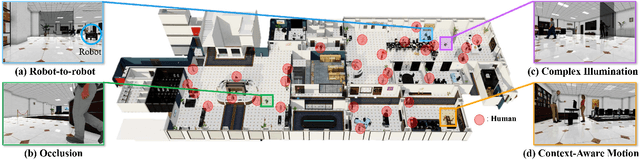
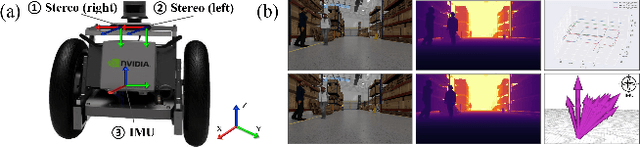
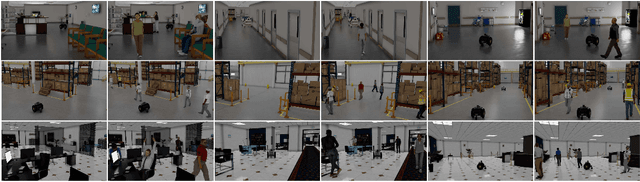
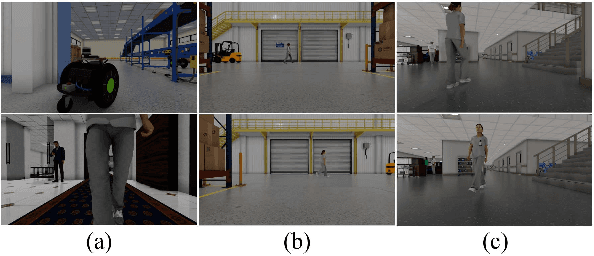
As service environments have become diverse, they have started to demand complicated tasks that are difficult for a single robot to complete. This change has led to an interest in multiple robots instead of a single robot. C-SLAM, as a fundamental technique for multiple service robots, needs to handle diverse challenges such as homogeneous scenes and dynamic objects to ensure that robots operate smoothly and perform their tasks safely. However, existing C-SLAM datasets do not include the various indoor service environments with the aforementioned challenges. To close this gap, we introduce a new multi-modal C-SLAM dataset for multiple service robots in various indoor service environments, called C-SLAM dataset in Service Environments (CSE). We use the NVIDIA Isaac Sim to generate data in various indoor service environments with the challenges that may occur in real-world service environments. By using simulation, we can provide accurate and precisely time-synchronized sensor data, such as stereo RGB, stereo depth, IMU, and ground truth (GT) poses. We configure three common indoor service environments (Hospital, Office, and Warehouse), each of which includes various dynamic objects that perform motions suitable to each environment. In addition, we drive three robots to mimic the actions of real service robots. Through these factors, we generate a more realistic C-SLAM dataset for multiple service robots. We demonstrate our dataset by evaluating diverse state-of-the-art single-robot SLAM and multi-robot SLAM methods. Our dataset is available at https://github.com/vision3d-lab/CSE_Dataset.
* 8 pages, 6 figures, Accepted to IEEE RA-L
AiSDF: Structure-aware Neural Signed Distance Fields in Indoor Scenes
Mar 04, 2024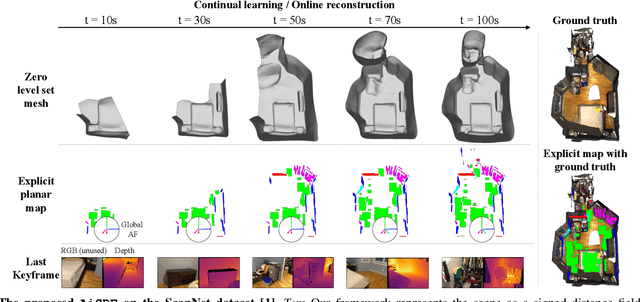
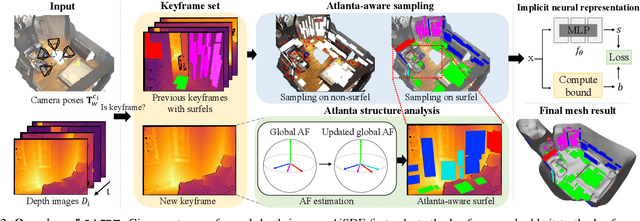
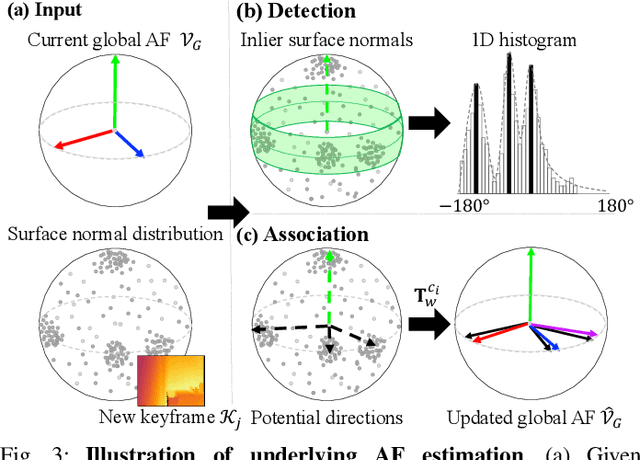
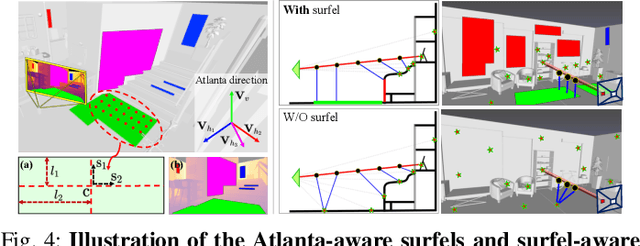
Indoor scenes we are living in are visually homogenous or textureless, while they inherently have structural forms and provide enough structural priors for 3D scene reconstruction. Motivated by this fact, we propose a structure-aware online signed distance fields (SDF) reconstruction framework in indoor scenes, especially under the Atlanta world (AW) assumption. Thus, we dub this incremental SDF reconstruction for AW as AiSDF. Within the online framework, we infer the underlying Atlanta structure of a given scene and then estimate planar surfel regions supporting the Atlanta structure. This Atlanta-aware surfel representation provides an explicit planar map for a given scene. In addition, based on these Atlanta planar surfel regions, we adaptively sample and constrain the structural regularity in the SDF reconstruction, which enables us to improve the reconstruction quality by maintaining a high-level structure while enhancing the details of a given scene. We evaluate the proposed AiSDF on the ScanNet and ReplicaCAD datasets, where we demonstrate that the proposed framework is capable of reconstructing fine details of objects implicitly, as well as structures explicitly in room-scale scenes.