 Add to Chrome
 Add to Firefox
 Add to Edge
Unified Static-Dynamic Pruning for Efficient LLM Inference
Jul 24, 2026
The increasing deployment of large language models (LLMs) has magnified the computational and memory bottlenecks of autoregressive decoding, where low compute intensity and bandwidth-bound kernels dominate inference cost. Weight pruning offers a promising remedy, but existing methods remain confined to either static pruning (SP), which permanently removes redundant weights but lacks adaptivity, or dynamic pruning (DP), which adapts to input sparsity but introduces runtime irregularity. This paper presents SPDP, a unified sparse-inference framework that integrates unstructured SP with input-adaptive DP for efficient LLM inference on GPUs. SPDP co-designs a new Tiled-Column-wise Bitmap Compressed (Tiled-CBC) format and two complementary GPU kernels: (1) a CUDA-core spMspV kernel featuring Hybrid Activation-aware Dynamic Shared-Memory Bitmap Decoding (HAD-SMBD) for fine-grained, runtime activation skipping, and (2) a Tensor-Core SpMM kernel optimized for prefill computation. This joint format-kernel design harmonizes static and dynamic sparsity, maintaining bandwidth-efficient memory access and high compute intensity under both phases of LLM inference. Comprehensive evaluations on inference-optimized GPUs demonstrate that SPDP achieves 1.24x-1.37x average speedup (up to 2.51x) over state-of-the- art sparse frameworks such as SpInfer, while matching. perplexity with up to 25% higher sparsity. SPDP advances the inference efficiency-quality Pareto frontier, showing that unified static-dynamic pruning can deliver substantial throughput and performance-per-watt improvements in large-scale LLM serving

LightSplat: Fast and Memory-Efficient Open-Vocabulary 3D Scene Understanding in Five Seconds
Mar 25, 2026Open-vocabulary 3D scene understanding enables users to segment novel objects in complex 3D environments through natural language. However, existing approaches remain slow, memory-intensive, and overly complex due to iterative optimization and dense per-Gaussian feature assignments. To address this, we propose LightSplat, a fast and memory-efficient training-free framework that injects compact 2-byte semantic indices into 3D representations from multi-view images. By assigning semantic indices only to salient regions and managing them with a lightweight index-feature mapping, LightSplat eliminates costly feature optimization and storage overhead. We further ensure semantic consistency and efficient inference via single-step clustering that links geometrically and semantically related masks in 3D. We evaluate our method on LERF-OVS, ScanNet, and DL3DV-OVS across complex indoor-outdoor scenes. As a result, LightSplat achieves state-of-the-art performance with up to 50-400x speedup and 64x lower memory, enabling scalable language-driven 3D understanding. For more details, visit our project page https://vision3d-lab.github.io/lightsplat/.
Rigidity-Aware 3D Gaussian Deformation from a Single Image
Sep 26, 2025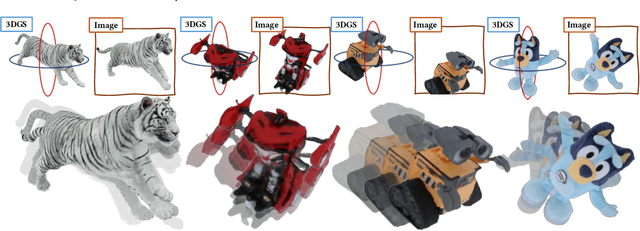
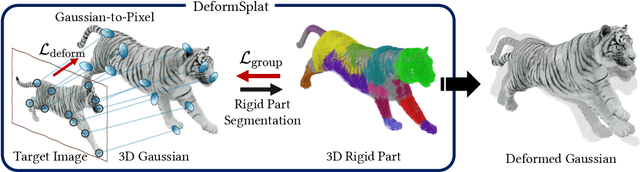
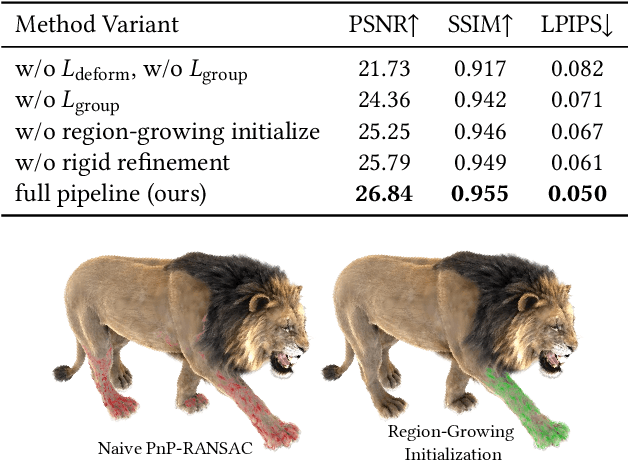
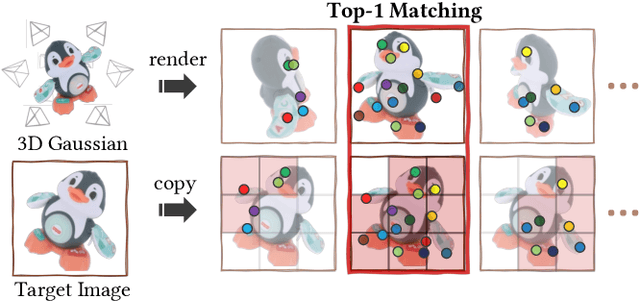
Reconstructing object deformation from a single image remains a significant challenge in computer vision and graphics. Existing methods typically rely on multi-view video to recover deformation, limiting their applicability under constrained scenarios. To address this, we propose DeformSplat, a novel framework that effectively guides 3D Gaussian deformation from only a single image. Our method introduces two main technical contributions. First, we present Gaussian-to-Pixel Matching which bridges the domain gap between 3D Gaussian representations and 2D pixel observations. This enables robust deformation guidance from sparse visual cues. Second, we propose Rigid Part Segmentation consisting of initialization and refinement. This segmentation explicitly identifies rigid regions, crucial for maintaining geometric coherence during deformation. By combining these two techniques, our approach can reconstruct consistent deformations from a single image. Extensive experiments demonstrate that our approach significantly outperforms existing methods and naturally extends to various applications,such as frame interpolation and interactive object manipulation.
Structure-from-Sherds++: Robust Incremental 3D Reassembly of Axially Symmetric Pots from Unordered and Mixed Fragment Collections
Feb 19, 2025Reassembling multiple axially symmetric pots from fragmentary sherds is crucial for cultural heritage preservation, yet it poses significant challenges due to thin and sharp fracture surfaces that generate numerous false positive matches and hinder large-scale puzzle solving. Existing global approaches, which optimize all potential fragment pairs simultaneously or data-driven models, are prone to local minima and face scalability issues when multiple pots are intermixed. Motivated by Structure-from-Motion (SfM) for 3D reconstruction from multiple images, we propose an efficient reassembly method for axially symmetric pots based on iterative registration of one sherd at a time, called Structure-from-Sherds++ (SfS++). Our method extends beyond simple replication of incremental SfM and leverages multi-graph beam search to explore multiple registration paths. This allows us to effectively filter out indistinguishable false matches and simultaneously reconstruct multiple pots without requiring prior information such as base or the number of mixed objects. Our approach achieves 87% reassembly accuracy on a dataset of 142 real fragments from 10 different pots, outperforming other methods in handling complex fracture patterns with mixed datasets and achieving state-of-the-art performance. Code and results can be found in our project page https://sj-yoo.info/sfs/.