 Add to Chrome
 Add to Firefox
 Add to Edge
Early Failure Detection and Intervention in Video Diffusion Models
Mar 15, 2026
Text-to-video (T2V) diffusion models have rapidly advanced, yet generations still occasionally fail in practice, such as low text-video alignment or low perceptual quality. Since diffusion sampling is non-deterministic, it is difficult to know during inference whether a generation will succeed or fail, incurring high computational cost due to trial-and-error regeneration. To address this, we propose an early failure detection and diagnostic intervention pipeline for latent T2V diffusion models. For detection, we design a Real-time Inspection (RI) module that converts latents into intermediate video previews, enabling the use of established text-video alignment scorers for inspection in the RGB space. The RI module completes the conversion and inspection process in just 39.2ms. This is highly efficient considering that CogVideoX-5B requires 4.3s per denoising step when generating a 480p, 49-frame video on an NVIDIA A100 GPU. Subsequently, we trigger a hierarchical and early-exit intervention pipeline only when failure is predicted. Experiments on CogVideoX-5B and Wan2.1-1.3B demonstrate consistency gains on VBench with up to 2.64 times less time overhead compared to post-hoc regeneration. Our method also generalizes to a higher-capacity setting, remaining effective on Wan2.1-14B with 720p resolution and 81-frame generation. Furthermore, our pipeline is plug-and-play and orthogonal to existing techniques, showing seamless compatibility with prompt refinement and sampling guidance methods. We also provide evidence that failure signals emerge early in the denoising process and are detectable within intermediate video previews using standard vision-language evaluators.

HDR-NSFF: High Dynamic Range Neural Scene Flow Fields
Mar 09, 2026Radiance of real-world scenes typically spans a much wider dynamic range than what standard cameras can capture. While conventional HDR methods merge alternating-exposure frames, these approaches are inherently constrained to 2D pixel-level alignment, often leading to ghosting artifacts and temporal inconsistency in dynamic scenes. To address these limitations, we present HDR-NSFF, a paradigm shift from 2D-based merging to 4D spatio-temporal modeling. Our framework reconstructs dynamic HDR radiance fields from alternating-exposure monocular videos by representing the scene as a continuous function of space and time, and is compatible with both neural radiance field and 4D Gaussian Splatting (4DGS) based dynamic representations. This unified end-to-end pipeline explicitly models HDR radiance, 3D scene flow, geometry, and tone-mapping, ensuring physical plausibility and global coherence. We further enhance robustness by (i) extending semantic-based optical flow with DINO features to achieve exposure-invariant motion estimation, and (ii) incorporating a generative prior as a regularizer to compensate for limited observation in monocular captures and saturation-induced information loss. To evaluate HDR space-time view synthesis, we present the first real-world HDR-GoPro dataset specifically designed for dynamic HDR scenes. Experiments demonstrate that HDR-NSFF recovers fine radiance details and coherent dynamics even under challenging exposure variations, thereby achieving state-of-the-art performance in novel space-time view synthesis. Project page: https://shin-dong-yeon.github.io/HDR-NSFF/
JointDiT: Enhancing RGB-Depth Joint Modeling with Diffusion Transformers
May 01, 2025We present JointDiT, a diffusion transformer that models the joint distribution of RGB and depth. By leveraging the architectural benefit and outstanding image prior of the state-of-the-art diffusion transformer, JointDiT not only generates high-fidelity images but also produces geometrically plausible and accurate depth maps. This solid joint distribution modeling is achieved through two simple yet effective techniques that we propose, i.e., adaptive scheduling weights, which depend on the noise levels of each modality, and the unbalanced timestep sampling strategy. With these techniques, we train our model across all noise levels for each modality, enabling JointDiT to naturally handle various combinatorial generation tasks, including joint generation, depth estimation, and depth-conditioned image generation by simply controlling the timestep of each branch. JointDiT demonstrates outstanding joint generation performance. Furthermore, it achieves comparable results in depth estimation and depth-conditioned image generation, suggesting that joint distribution modeling can serve as a replaceable alternative to conditional generation. The project page is available at https://byungki-k.github.io/JointDiT/.
Zero-shot Depth Completion via Test-time Alignment with Affine-invariant Depth Prior
Feb 10, 2025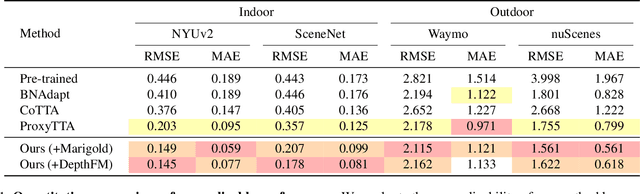
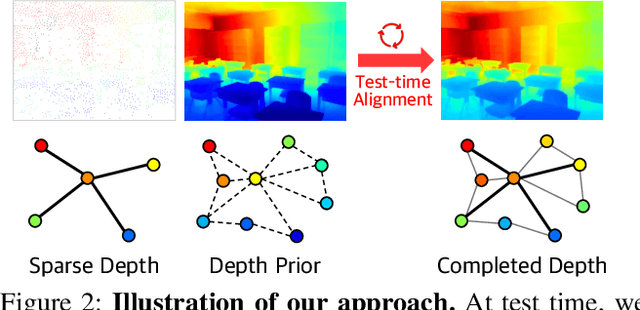
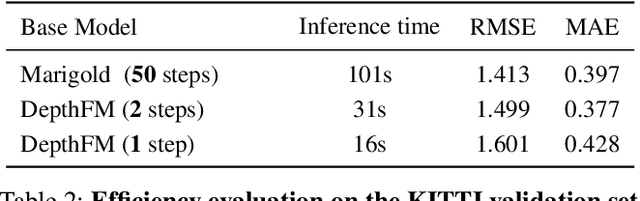
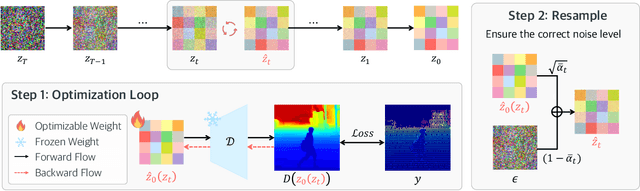
Depth completion, predicting dense depth maps from sparse depth measurements, is an ill-posed problem requiring prior knowledge. Recent methods adopt learning-based approaches to implicitly capture priors, but the priors primarily fit in-domain data and do not generalize well to out-of-domain scenarios. To address this, we propose a zero-shot depth completion method composed of an affine-invariant depth diffusion model and test-time alignment. We use pre-trained depth diffusion models as depth prior knowledge, which implicitly understand how to fill in depth for scenes. Our approach aligns the affine-invariant depth prior with metric-scale sparse measurements, enforcing them as hard constraints via an optimization loop at test-time. Our zero-shot depth completion method demonstrates generalization across various domain datasets, achieving up to a 21\% average performance improvement over the previous state-of-the-art methods while enhancing spatial understanding by sharpening scene details. We demonstrate that aligning a monocular affine-invariant depth prior with sparse metric measurements is a proven strategy to achieve domain-generalizable depth completion without relying on extensive training data. Project page: https://hyoseok1223.github.io/zero-shot-depth-completion/.
The Devil is in the Details: Simple Remedies for Image-to-LiDAR Representation Learning
Jan 16, 2025LiDAR is a crucial sensor in autonomous driving, commonly used alongside cameras. By exploiting this camera-LiDAR setup and recent advances in image representation learning, prior studies have shown the promising potential of image-to-LiDAR distillation. These prior arts focus on the designs of their own losses to effectively distill the pre-trained 2D image representations into a 3D model. However, the other parts of the designs have been surprisingly unexplored. We find that fundamental design elements, e.g., the LiDAR coordinate system, quantization according to the existing input interface, and data utilization, are more critical than developing loss functions, which have been overlooked in prior works. In this work, we show that simple fixes to these designs notably outperform existing methods by 16% in 3D semantic segmentation on the nuScenes dataset and 13% in 3D object detection on the KITTI dataset in downstream task performance. We focus on overlooked design choices along the spatial and temporal axes. Spatially, prior work has used cylindrical coordinate and voxel sizes without considering their side effects yielded with a commonly deployed sparse convolution layer input interface, leading to spatial quantization errors in 3D models. Temporally, existing work has avoided cumbersome data curation by discarding unsynced data, limiting the use to only the small portion of data that is temporally synced across sensors. We analyze these effects and propose simple solutions for each overlooked aspect.
Revisiting Learning-based Video Motion Magnification for Real-time Processing
Mar 04, 2024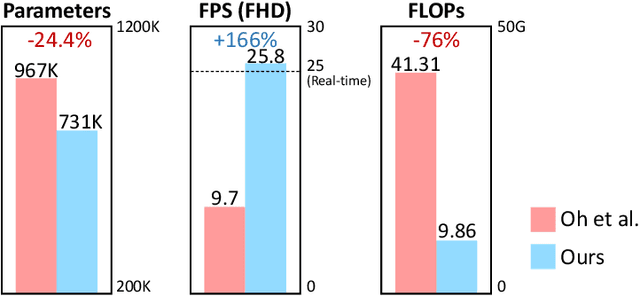
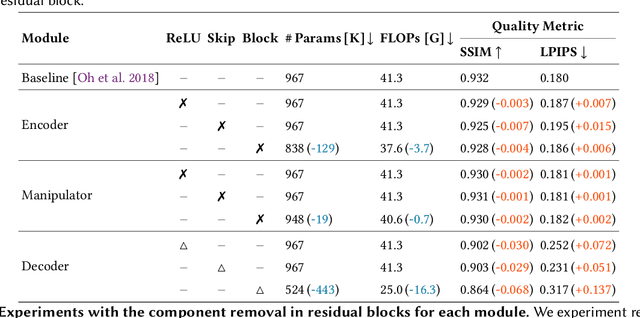
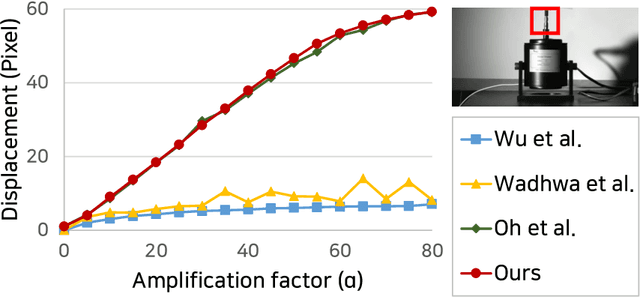
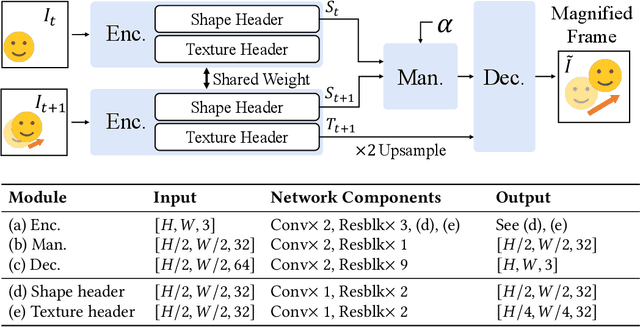
Video motion magnification is a technique to capture and amplify subtle motion in a video that is invisible to the naked eye. The deep learning-based prior work successfully demonstrates the modelling of the motion magnification problem with outstanding quality compared to conventional signal processing-based ones. However, it still lags behind real-time performance, which prevents it from being extended to various online applications. In this paper, we investigate an efficient deep learning-based motion magnification model that runs in real time for full-HD resolution videos. Due to the specified network design of the prior art, i.e. inhomogeneous architecture, the direct application of existing neural architecture search methods is complicated. Instead of automatic search, we carefully investigate the architecture module by module for its role and importance in the motion magnification task. Two key findings are 1) Reducing the spatial resolution of the latent motion representation in the decoder provides a good trade-off between computational efficiency and task quality, and 2) surprisingly, only a single linear layer and a single branch in the encoder are sufficient for the motion magnification task. Based on these findings, we introduce a real-time deep learning-based motion magnification model with4.2X fewer FLOPs and is 2.7X faster than the prior art while maintaining comparable quality.
Learning-based Axial Motion Magnification
Dec 15, 2023Video motion magnification amplifies invisible small motions to be perceptible, which provides humans with spatially dense and holistic understanding about small motions from the scene of interest. This is based on the premise that magnifying small motions enhances the legibility of the motion. In the real world, however, vibrating objects often possess complex systems, having complex natural frequencies, modes, and directions. Existing motion magnification often fails to improve the legibility since the intricate motions still retain complex characteristics even when magnified, which distracts us from analyzing them. In this work, we focus on improving the legibility by proposing a new concept, axial motion magnification, which magnifies decomposed motions along the user-specified direction. Axial motion magnification can be applied to various applications where motions of specific axes are critical, by providing simplified and easily readable motion information. We propose a novel learning-based axial motion magnification method with the Motion Separation Module that enables to disentangle and magnify the motion representation along axes of interest. Further, we build a new synthetic training dataset for the axial motion magnification task. Our proposed method improves the legibility of resulting motions along certain axes, while adding additional user controllability. Our method can be directly adopted to the generic motion magnification and achieves favorable performance against competing methods. Our project page is available at https://axial-momag.github.io/axial-momag/.
The Devil in the Details: Simple and Effective Optical Flow Synthetic Data Generation
Aug 14, 2023Recent work on dense optical flow has shown significant progress, primarily in a supervised learning manner requiring a large amount of labeled data. Due to the expensiveness of obtaining large scale real-world data, computer graphics are typically leveraged for constructing datasets. However, there is a common belief that synthetic-to-real domain gaps limit generalization to real scenes. In this paper, we show that the required characteristics in an optical flow dataset are rather simple and present a simpler synthetic data generation method that achieves a certain level of realism with compositions of elementary operations. With 2D motion-based datasets, we systematically analyze the simplest yet critical factors for generating synthetic datasets. Furthermore, we propose a novel method of utilizing occlusion masks in a supervised method and observe that suppressing gradients on occluded regions serves as a powerful initial state in the curriculum learning sense. The RAFT network initially trained on our dataset outperforms the original RAFT on the two most challenging online benchmarks, MPI Sintel and KITTI 2015.