 Add to Chrome
 Add to Firefox
 Add to Edge
Big, Bright, or Invisible: A Frozen-Feature Benchmark of 3D CT Foundation Models
Aug 06, 2026
Routine CT interpretation is inherently comprehensive, capturing incidental findings across the entire scan volume. 3D CT foundation models could assist this process by providing generalizable representations of anatomy and pathology. To evaluate their diagnostic breadth, we benchmark ten frozen CT encoders across three cohorts of thoracic CT scans, including an unseen internal clinical dataset, using $k$-nearest neighbors, zero-shot prompting, and linear probing. We find no universal state-of-the-art, with rankings fluctuating significantly depending on the evaluation context. While models combining fine-grained image tokenization with vision-language alignment generally perform best, a lightweight supervised encoder remains highly competitive, demonstrating that explicit labels can effectively substitute for scale. Crucially, rather than model architecture, we observe that the primary determinant of performance is a physical bottleneck: a finding's detectability scales with its contrast against surrounding tissue and its spatial extent. Through controlled within-organ comparisons, we empirically demonstrate that widespread or high-contrast abnormalities, such as devices and effusions, are reliably recovered. Conversely, small, low-contrast focal lesions remain a persistent challenge across all evaluated encoders. We attribute this to the inherent limitations of globally pooled embeddings, suggesting that accurately representing small, low-contrast structures will require region- or lesion-level pretraining.

Survival In-Context: Prior-fitted In-context Learning Tabular Foundation Model for Survival Analysis
Mar 31, 2026Survival analysis is crucial for many medical applications but remains challenging for modern machine learning due to limited data, censoring, and the heterogeneity of tabular covariates. While the prior-fitted paradigm, which relies on pretraining models on large collections of synthetic datasets, has recently facilitated tabular foundation models for classification and regression, its suitability for time-to-event modeling remains unclear. We propose a flexible survival data generation framework that defines a rich survival prior with explicit control over covariates and time-event distributions. Building on this prior, we introduce Survival In-Context (SIC), a prior-fitted in-context learning model for survival analysis that is pretrained exclusively on synthetic data. SIC produces individualized survival prediction in a single forward pass, requiring no task-specific training or hyperparameter tuning. Across a broad evaluation on real-world survival datasets, SIC achieves competitive or superior performance compared to classical and deep survival models, particularly in medium-sized data regimes, highlighting the promise of prior-fitted foundation models for survival analysis. The code will be made available upon publication.
Calibrated Confidence Expression for Radiology Report Generation
Mar 31, 2026Safe deployment of Large Vision-Language Models (LVLMs) in radiology report generation requires not only accurate predictions but also clinically interpretable indicators of when outputs should be thoroughly reviewed, enabling selective radiologist verification and reducing the risk of hallucinated findings influencing clinical decisions. One intuitive approach to this is verbalized confidence, where the model explicitly states its certainty. However, current state-of-the-art language models are often overconfident, and research on calibration in multimodal settings such as radiology report generation is limited. To address this gap, we introduce ConRad (Confidence Calibration for Radiology Reports), a reinforcement learning framework for fine-tuning medical LVLMs to produce calibrated verbalized confidence estimates alongside radiology reports. We study two settings: a single report-level confidence score and a sentence-level variant assigning a confidence to each claim. Both are trained using the GRPO algorithm with reward functions based on the logarithmic scoring rule, which incentivizes truthful self-assessment by penalizing miscalibration and guarantees optimal calibration under reward maximization. Experimentally, ConRad substantially improves calibration and outperforms competing methods. In a clinical evaluation we show that ConRad's report level scores are well aligned with clinicians' judgment. By highlighting full reports or low-confidence statements for targeted review, ConRad can support safer clinical integration of AI-assistance for report generation.
Parametric shape models for vessels learned from segmentations via differentiable voxelization
Jul 03, 2025Vessels are complex structures in the body that have been studied extensively in multiple representations. While voxelization is the most common of them, meshes and parametric models are critical in various applications due to their desirable properties. However, these representations are typically extracted through segmentations and used disjointly from each other. We propose a framework that joins the three representations under differentiable transformations. By leveraging differentiable voxelization, we automatically extract a parametric shape model of the vessels through shape-to-segmentation fitting, where we learn shape parameters from segmentations without the explicit need for ground-truth shape parameters. The vessel is parametrized as centerlines and radii using cubic B-splines, ensuring smoothness and continuity by construction. Meshes are differentiably extracted from the learned shape parameters, resulting in high-fidelity meshes that can be manipulated post-fit. Our method can accurately capture the geometry of complex vessels, as demonstrated by the volumetric fits in experiments on aortas, aneurysms, and brain vessels.
Automated Thoracolumbar Stump Rib Detection and Analysis in a Large CT Cohort
May 08, 2025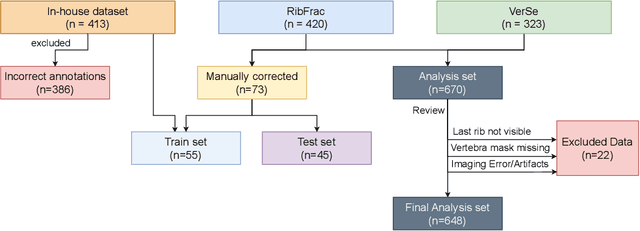
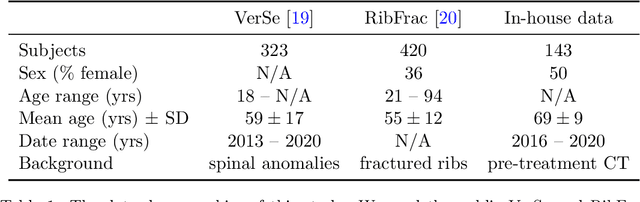
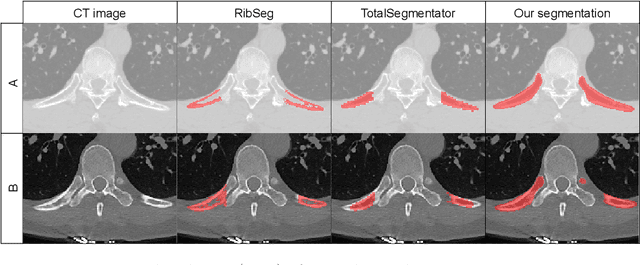
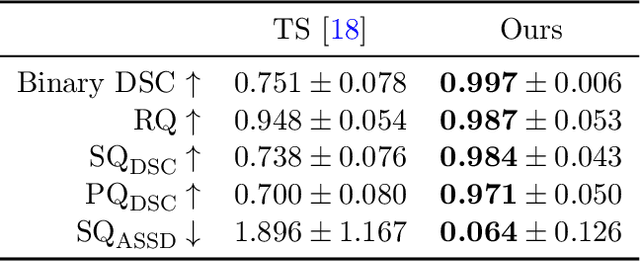
Thoracolumbar stump ribs are one of the essential indicators of thoracolumbar transitional vertebrae or enumeration anomalies. While some studies manually assess these anomalies and describe the ribs qualitatively, this study aims to automate thoracolumbar stump rib detection and analyze their morphology quantitatively. To this end, we train a high-resolution deep-learning model for rib segmentation and show significant improvements compared to existing models (Dice score 0.997 vs. 0.779, p-value < 0.01). In addition, we use an iterative algorithm and piece-wise linear interpolation to assess the length of the ribs, showing a success rate of 98.2%. When analyzing morphological features, we show that stump ribs articulate more posteriorly at the vertebrae (-19.2 +- 3.8 vs -13.8 +- 2.5, p-value < 0.01), are thinner (260.6 +- 103.4 vs. 563.6 +- 127.1, p-value < 0.01), and are oriented more downwards and sideways within the first centimeters in contrast to full-length ribs. We show that with partially visible ribs, these features can achieve an F1-score of 0.84 in differentiating stump ribs from regular ones. We publish the model weights and masks for public use.
Enhanced Diagnostic Fidelity in Pathology Whole Slide Image Compression via Deep Learning
Mar 14, 2025Accurate diagnosis of disease often depends on the exhaustive examination of Whole Slide Images (WSI) at microscopic resolution. Efficient handling of these data-intensive images requires lossy compression techniques. This paper investigates the limitations of the widely-used JPEG algorithm, the current clinical standard, and reveals severe image artifacts impacting diagnostic fidelity. To overcome these challenges, we introduce a novel deep-learning (DL)-based compression method tailored for pathology images. By enforcing feature similarity of deep features between the original and compressed images, our approach achieves superior Peak Signal-to-Noise Ratio (PSNR), Multi-Scale Structural Similarity Index (MS-SSIM), and Learned Perceptual Image Patch Similarity (LPIPS) scores compared to JPEG-XL, Webp, and other DL compression methods.
Self-Supervised Radiograph Anatomical Region Classification -- How Clean Is Your Real-World Data?
Dec 20, 2024Modern deep learning-based clinical imaging workflows rely on accurate labels of the examined anatomical region. Knowing the anatomical region is required to select applicable downstream models and to effectively generate cohorts of high quality data for future medical and machine learning research efforts. However, this information may not be available in externally sourced data or generally contain data entry errors. To address this problem, we show the effectiveness of self-supervised methods such as SimCLR and BYOL as well as supervised contrastive deep learning methods in assigning one of 14 anatomical region classes in our in-house dataset of 48,434 skeletal radiographs. We achieve a strong linear evaluation accuracy of 96.6% with a single model and 97.7% using an ensemble approach. Furthermore, only a few labeled instances (1% of the training set) suffice to achieve an accuracy of 92.2%, enabling usage in low-label and thus low-resource scenarios. Our model can be used to correct data entry mistakes: a follow-up analysis of the test set errors of our best-performing single model by an expert radiologist identified 35% incorrect labels and 11% out-of-domain images. When accounted for, the radiograph anatomical region labelling performance increased -- without and with an ensemble, respectively -- to a theoretical accuracy of 98.0% and 98.8%.
Unlocking the Potential of Digital Pathology: Novel Baselines for Compression
Dec 17, 2024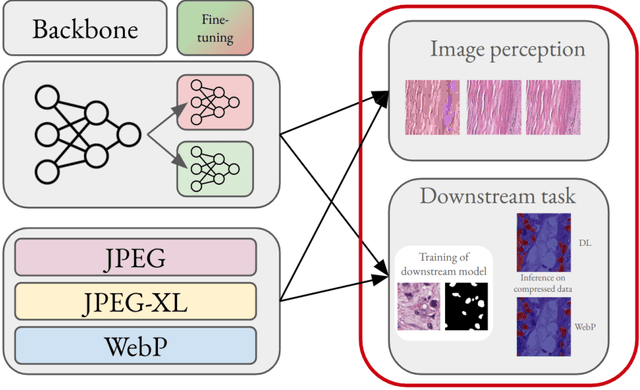
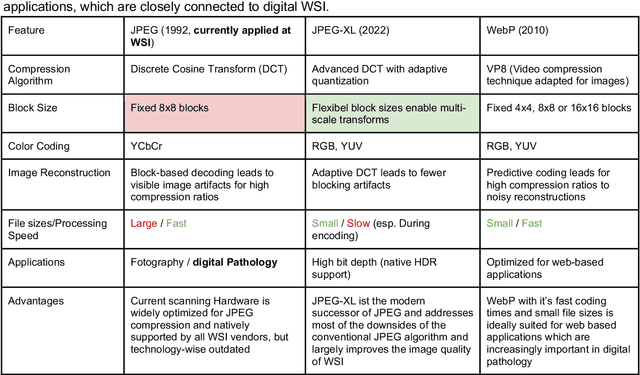
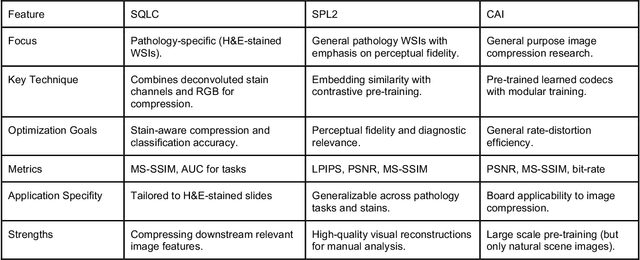
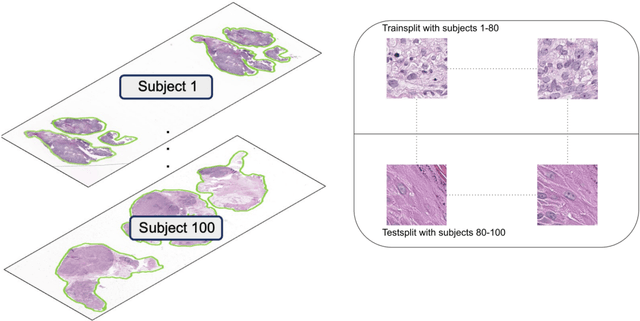
Digital pathology offers a groundbreaking opportunity to transform clinical practice in histopathological image analysis, yet faces a significant hurdle: the substantial file sizes of pathological Whole Slide Images (WSI). While current digital pathology solutions rely on lossy JPEG compression to address this issue, lossy compression can introduce color and texture disparities, potentially impacting clinical decision-making. While prior research addresses perceptual image quality and downstream performance independently of each other, we jointly evaluate compression schemes for perceptual and downstream task quality on four different datasets. In addition, we collect an initially uncompressed dataset for an unbiased perceptual evaluation of compression schemes. Our results show that deep learning models fine-tuned for perceptual quality outperform conventional compression schemes like JPEG-XL or WebP for further compression of WSI. However, they exhibit a significant bias towards the compression artifacts present in the training data and struggle to generalize across various compression schemes. We introduce a novel evaluation metric based on feature similarity between original files and compressed files that aligns very well with the actual downstream performance on the compressed WSI. Our metric allows for a general and standardized evaluation of lossy compression schemes and mitigates the requirement to independently assess different downstream tasks. Our study provides novel insights for the assessment of lossy compression schemes for WSI and encourages a unified evaluation of lossy compression schemes to accelerate the clinical uptake of digital pathology.
General Vision Encoder Features as Guidance in Medical Image Registration
Jul 18, 2024General vision encoders like DINOv2 and SAM have recently transformed computer vision. Even though they are trained on natural images, such encoder models have excelled in medical imaging, e.g., in classification, segmentation, and registration. However, no in-depth comparison of different state-of-the-art general vision encoders for medical registration is available. In this work, we investigate how well general vision encoder features can be used in the dissimilarity metrics for medical image registration. We explore two encoders that were trained on natural images as well as one that was fine-tuned on medical data. We apply the features within the well-established B-spline FFD registration framework. In extensive experiments on cardiac cine MRI data, we find that using features as additional guidance for conventional metrics improves the registration quality. The code is available at github.com/compai-lab/2024-miccai-koegl.
Data-Driven Tissue- and Subject-Specific Elastic Regularization for Medical Image Registration
Jul 05, 2024


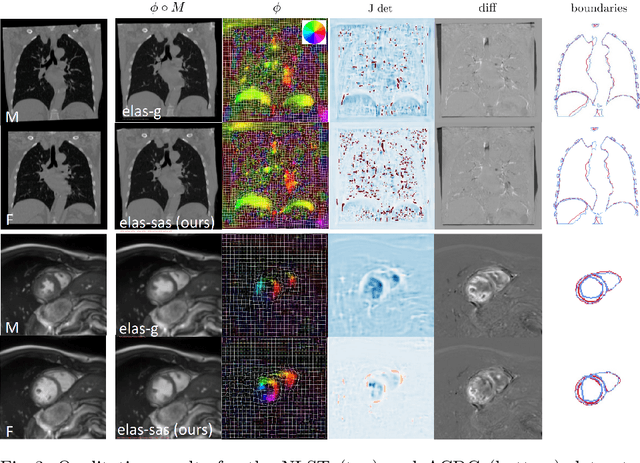
Physics-inspired regularization is desired for intra-patient image registration since it can effectively capture the biomechanical characteristics of anatomical structures. However, a major challenge lies in the reliance on physical parameters: Parameter estimations vary widely across the literature, and the physical properties themselves are inherently subject-specific. In this work, we introduce a novel data-driven method that leverages hypernetworks to learn the tissue-dependent elasticity parameters of an elastic regularizer. Notably, our approach facilitates the estimation of patient-specific parameters without the need to retrain the network. We evaluate our method on three publicly available 2D and 3D lung CT and cardiac MR datasets. We find that with our proposed subject-specific tissue-dependent regularization, a higher registration quality is achieved across all datasets compared to using a global regularizer. The code is available at https://github.com/compai-lab/2024-miccai-reithmeir.