 Add to Chrome
 Add to Firefox
 Add to Edge
GLOW-FDG: Generalized cancer LesiOn Whole-body segmentation model for $^{18}$F-FDG-PET/CT
Jul 04, 2026
Whole-body fluorodeoxyglucose positron emission tomography combined with computed tomography is widely used in cancer care, but manual lesion delineation is slow, subjective, and difficult to scale. We present GLOW-FDG, an open-source artificial intelligence model for whole-body cancer lesion segmentation in fluorodeoxyglucose positron emission tomography and computed tomography. The model was trained on 1,563 scans spanning multiple cancer types and evaluated on 185 external scans from independent institutions. Across breast cancer, nonmetastatic and oligometastatic lung cancer, head and neck cancer, and metastatic melanoma, GLOW-FDG consistently outperformed publicly available benchmark models in lesion detection, while reducing false positives and maintaining strong segmentation accuracy. Quantification of total tumor burden and total lesion glycolysis was robust across cohorts, and performance approached the variability observed between expert radiation oncologists. These results support GLOW-FDG as a generalizable tool for automated cancer segmentation and quantitative imaging biomarker extraction in whole-body imaging.

An Open-Source Monitoring Framework for Data Exploration and Progress Tracking in Multi-Center Radiology Studies
Jun 15, 2026Multi-center studies are crucial for advancing medical and radiological research. Data exploration, collaboration discovery, and study progress monitoring are essential for maximizing their potential. However, in practice these processes often rely on manual communication and shared tables, which quickly become outdated and hinder efficient coordination in large distributed studies. This highlights the need for dedicated monitoring solutions that provide transparent and up-to-date insights into study progress. We propose a lightweight, open-source monitoring architecture for multi-center studies based on the widely used Grafana-Prometheus stack. The framework collects aggregated monitoring metrics from distributed study sites and visualizes them through configurable dashboards. As a real-world deployment example, the framework is integrated into the medical imaging platform Kaapana and evaluated within a large multi-center research network. By deploying our solution within the Germany-wide RACOON consortium, we demonstrate its ability to enable privacy-preserving data exploration and study progress monitoring across all 38 German university clinics. The monitoring framework supports transparent coordination of distributed research activities and can facilitate more efficient management of large-scale multi-center studies. The source code and Kaapana integration are publicly available at https://github.com/MIC-DKFZ/study-monitoring-kaapana.
Exploiting Longitudinal Context in Clinician-Verified Interactive Lesion Tracking
May 22, 2026Tracking tumor lesions across serial CT scans is essential for oncological response assessment. Existing automated methods face a fundamental trade-off: end-to-end trackers achieve high automation but offer no opportunity to correct silent tracking failures, while decoupled registration-segmentation pipelines permit user verification yet discard the lesion's prior appearance, limiting accuracy in ambiguous cases. In this work, we propose a Verified Tracking paradigm: a clinician verifies a registration-proposed prompt, which the model leverages alongside the baseline lesion appearance to resolve segmentation ambiguities. We present a unified framework combining early spatial prompt fusion with latent temporal difference weighting for longitudinally-informed segmentation. To address data scarcity, we leverage large-scale synthetic pretraining, proving essential for exploiting longitudinal context, improving performance by up to 4.5 Dice points over training from scratch. Our approach secured first place in the MICCAI autoPET IV challenge. We further curate and release PanTrack, a new longitudinal pancreatic cancer benchmark, to assess out-of-distribution generalization. Experiments show that our model outperforms prior work in both fully automatic and the proposed verified tracking setting offering a clinically safe middle ground between automation and control. Code, model and dataset will be released at https://github.com/MIC-DKFZ/LongiSeg
Kaapana: A Comprehensive Open-Source Platform for Integrating AI in Medical Imaging Research Environments
Dec 10, 2025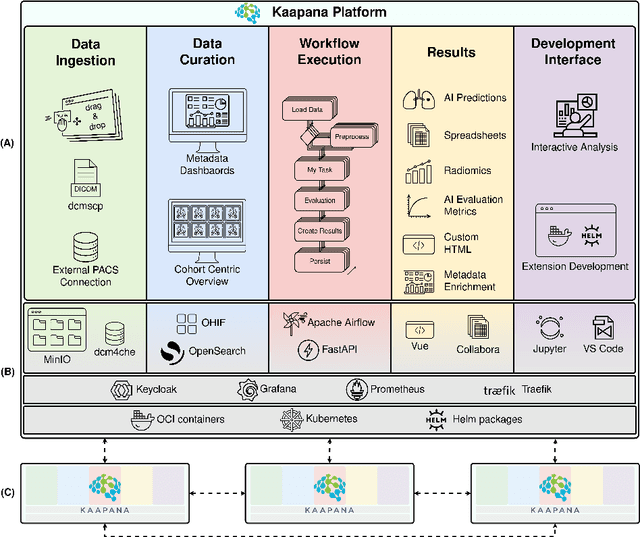
Developing generalizable AI for medical imaging requires both access to large, multi-center datasets and standardized, reproducible tooling within research environments. However, leveraging real-world imaging data in clinical research environments is still hampered by strict regulatory constraints, fragmented software infrastructure, and the challenges inherent in conducting large-cohort multicentre studies. This leads to projects that rely on ad-hoc toolchains that are hard to reproduce, difficult to scale beyond single institutions and poorly suited for collaboration between clinicians and data scientists. We present Kaapana, a comprehensive open-source platform for medical imaging research that is designed to bridge this gap. Rather than building single-use, site-specific tooling, Kaapana provides a modular, extensible framework that unifies data ingestion, cohort curation, processing workflows and result inspection under a common user interface. By bringing the algorithm to the data, it enables institutions to keep control over their sensitive data while still participating in distributed experimentation and model development. By integrating flexible workflow orchestration with user-facing applications for researchers, Kaapana reduces technical overhead, improves reproducibility and enables conducting large-scale, collaborative, multi-centre imaging studies. We describe the core concepts of the platform and illustrate how they can support diverse use cases, from local prototyping to nation-wide research networks. The open-source codebase is available at https://github.com/kaapana/kaapana
VoxTell: Free-Text Promptable Universal 3D Medical Image Segmentation
Nov 14, 2025We introduce VoxTell, a vision-language model for text-prompted volumetric medical image segmentation. It maps free-form descriptions, from single words to full clinical sentences, to 3D masks. Trained on 62K+ CT, MRI, and PET volumes spanning over 1K anatomical and pathological classes, VoxTell uses multi-stage vision-language fusion across decoder layers to align textual and visual features at multiple scales. It achieves state-of-the-art zero-shot performance across modalities on unseen datasets, excelling on familiar concepts while generalizing to related unseen classes. Extensive experiments further demonstrate strong cross-modality transfer, robustness to linguistic variations and clinical language, as well as accurate instance-specific segmentation from real-world text. Code is available at: https://www.github.com/MIC-DKFZ/VoxTell
MeisenMeister: A Simple Two Stage Pipeline for Breast Cancer Classification on MRI
Oct 31, 2025The ODELIA Breast MRI Challenge 2025 addresses a critical issue in breast cancer screening: improving early detection through more efficient and accurate interpretation of breast MRI scans. Even though methods for general-purpose whole-body lesion segmentation as well as multi-time-point analysis exist, breast cancer detection remains highly challenging, largely due to the limited availability of high-quality segmentation labels. Therefore, developing robust classification-based approaches is crucial for the future of early breast cancer detection, particularly in applications such as large-scale screening. In this write-up, we provide a comprehensive overview of our approach to the challenge. We begin by detailing the underlying concept and foundational assumptions that guided our work. We then describe the iterative development process, highlighting the key stages of experimentation, evaluation, and refinement that shaped the evolution of our solution. Finally, we present the reasoning and evidence that informed the design choices behind our final submission, with a focus on performance, robustness, and clinical relevance. We release our full implementation publicly at https://github.com/MIC-DKFZ/MeisenMeister
Inclusive, Differentially Private Federated Learning for Clinical Data
May 28, 2025Federated Learning (FL) offers a promising approach for training clinical AI models without centralizing sensitive patient data. However, its real-world adoption is hindered by challenges related to privacy, resource constraints, and compliance. Existing Differential Privacy (DP) approaches often apply uniform noise, which disproportionately degrades model performance, even among well-compliant institutions. In this work, we propose a novel compliance-aware FL framework that enhances DP by adaptively adjusting noise based on quantifiable client compliance scores. Additionally, we introduce a compliance scoring tool based on key healthcare and security standards to promote secure, inclusive, and equitable participation across diverse clinical settings. Extensive experiments on public datasets demonstrate that integrating under-resourced, less compliant clinics with highly regulated institutions yields accuracy improvements of up to 15% over traditional FL. This work advances FL by balancing privacy, compliance, and performance, making it a viable solution for real-world clinical workflows in global healthcare.
nnInteractive: Redefining 3D Promptable Segmentation
Mar 11, 2025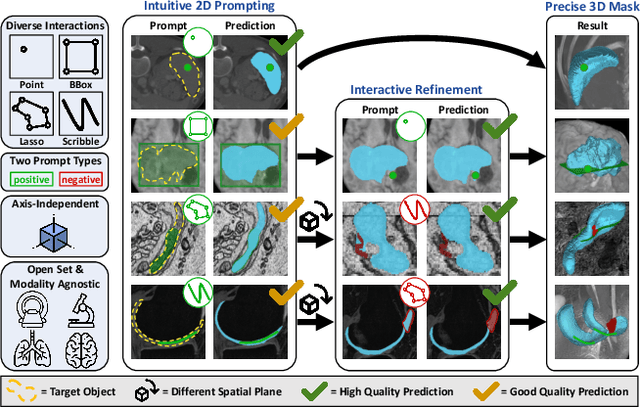
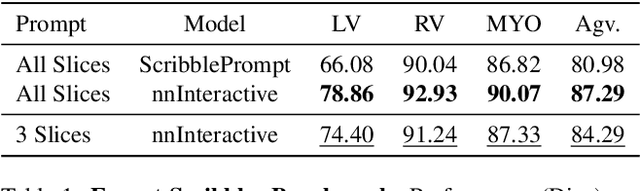
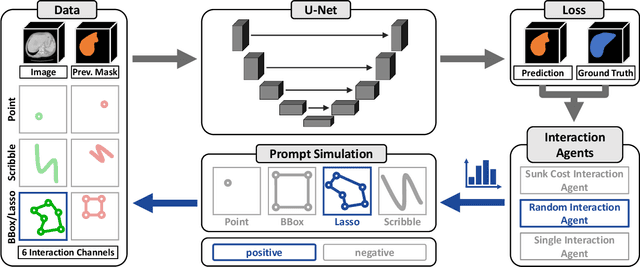
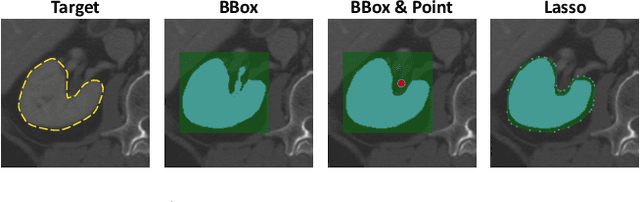
Accurate and efficient 3D segmentation is essential for both clinical and research applications. While foundation models like SAM have revolutionized interactive segmentation, their 2D design and domain shift limitations make them ill-suited for 3D medical images. Current adaptations address some of these challenges but remain limited, either lacking volumetric awareness, offering restricted interactivity, or supporting only a small set of structures and modalities. Usability also remains a challenge, as current tools are rarely integrated into established imaging platforms and often rely on cumbersome web-based interfaces with restricted functionality. We introduce nnInteractive, the first comprehensive 3D interactive open-set segmentation method. It supports diverse prompts-including points, scribbles, boxes, and a novel lasso prompt-while leveraging intuitive 2D interactions to generate full 3D segmentations. Trained on 120+ diverse volumetric 3D datasets (CT, MRI, PET, 3D Microscopy, etc.), nnInteractive sets a new state-of-the-art in accuracy, adaptability, and usability. Crucially, it is the first method integrated into widely used image viewers (e.g., Napari, MITK), ensuring broad accessibility for real-world clinical and research applications. Extensive benchmarking demonstrates that nnInteractive far surpasses existing methods, setting a new standard for AI-driven interactive 3D segmentation. nnInteractive is publicly available: https://github.com/MIC-DKFZ/napari-nninteractive (Napari plugin), https://www.mitk.org/MITK-nnInteractive (MITK integration), https://github.com/MIC-DKFZ/nnInteractive (Python backend).