 Add to Chrome
 Add to Firefox
 Add to Edge
Resolution Meets Reduction: Efficient Visual Context for 3D Radiology Report Generation
Aug 09, 2026
Vision-language models offer a promising path toward automating radiology report generation, but applying them to full 3D CT volumes poses substantial computational challenges. Modern foundation vision encoders (VEs) can produce tens of thousands of vision tokens per scan, making the visual sequence passed to the large language model (LLM) a primary computational bottleneck. Vision-to-language projectors can compress this sequence to reduce computation, but may discard clinically relevant detail; conversely, effective compression can accommodate higher-resolution inputs while keeping the downstream token count fixed. How this vision-token budget should be allocated across input field of view, spatial resolution, and vision-to-language projection therefore remains an open design question. We systematically evaluate four heterogeneous VEs (CNN- and ViT-based), five token-reducing projectors at up to 64x compression alongside a non-reducing MLP projector baseline, and five instruction-tuned LLMs (1.7B--4B) on two large-scale CT report datasets (CT-RATE and Merlin). At matched LLM token budgets, anatomy-guided region of interest cropping is the most consistent strategy, improving clinical macro F1 in 19 of 20 settings by +3.7 points on average for the 3D ViT Primus encoder and +1.1 for the slice-based 2D ViT Curia encoder. Increasing input resolution further is strongly projector-dependent: the PerceiverResampler, paired with higher-resolution Curia features, yields the strongest configuration in the resolution study on both datasets. Our best configurations achieve state-of-the-art clinical macro F1 on the test sets, reaching 49.5 on CT-RATE and 49.0 on Merlin. Code and models will be published upon publication.

VoxTell: Free-Text Promptable Universal 3D Medical Image Segmentation
Nov 14, 2025We introduce VoxTell, a vision-language model for text-prompted volumetric medical image segmentation. It maps free-form descriptions, from single words to full clinical sentences, to 3D masks. Trained on 62K+ CT, MRI, and PET volumes spanning over 1K anatomical and pathological classes, VoxTell uses multi-stage vision-language fusion across decoder layers to align textual and visual features at multiple scales. It achieves state-of-the-art zero-shot performance across modalities on unseen datasets, excelling on familiar concepts while generalizing to related unseen classes. Extensive experiments further demonstrate strong cross-modality transfer, robustness to linguistic variations and clinical language, as well as accurate instance-specific segmentation from real-world text. Code is available at: https://www.github.com/MIC-DKFZ/VoxTell
nnInteractive: Redefining 3D Promptable Segmentation
Mar 11, 2025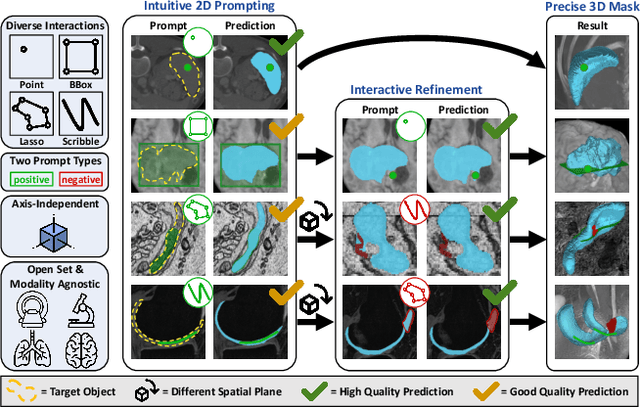
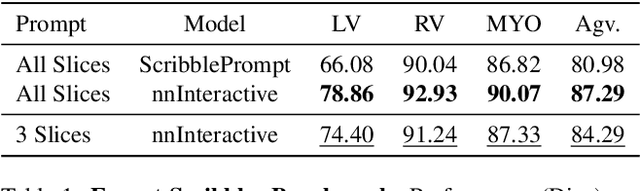
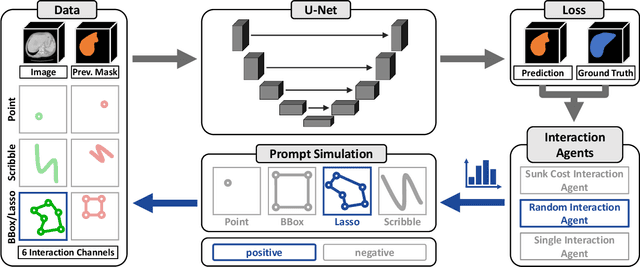
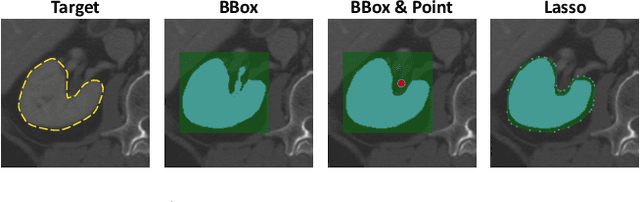
Accurate and efficient 3D segmentation is essential for both clinical and research applications. While foundation models like SAM have revolutionized interactive segmentation, their 2D design and domain shift limitations make them ill-suited for 3D medical images. Current adaptations address some of these challenges but remain limited, either lacking volumetric awareness, offering restricted interactivity, or supporting only a small set of structures and modalities. Usability also remains a challenge, as current tools are rarely integrated into established imaging platforms and often rely on cumbersome web-based interfaces with restricted functionality. We introduce nnInteractive, the first comprehensive 3D interactive open-set segmentation method. It supports diverse prompts-including points, scribbles, boxes, and a novel lasso prompt-while leveraging intuitive 2D interactions to generate full 3D segmentations. Trained on 120+ diverse volumetric 3D datasets (CT, MRI, PET, 3D Microscopy, etc.), nnInteractive sets a new state-of-the-art in accuracy, adaptability, and usability. Crucially, it is the first method integrated into widely used image viewers (e.g., Napari, MITK), ensuring broad accessibility for real-world clinical and research applications. Extensive benchmarking demonstrates that nnInteractive far surpasses existing methods, setting a new standard for AI-driven interactive 3D segmentation. nnInteractive is publicly available: https://github.com/MIC-DKFZ/napari-nninteractive (Napari plugin), https://www.mitk.org/MITK-nnInteractive (MITK integration), https://github.com/MIC-DKFZ/nnInteractive (Python backend).