 Add to Chrome
 Add to Firefox
 Add to Edge
Breaking Dual Bottlenecks: Evolving Unified Multimodal Models into Self-Adaptive Interleaved Visual Reasoners
May 14, 2026
Recent unified models integrate multimodal understanding and generation within a single framework. However, an "understanding-generation gap" persists, where models can capture user intent but often fail to translate this semantic knowledge into precise pixel-level manipulation. This gap results in two bottlenecks in anything-to-image task (X2I): the attention entanglement bottleneck, where blind planning struggles with complex prompts, and the visual refinement bottleneck, where unstructured feedback fails to correct imperfections efficiently. In this paper, we propose a novel framework that empowers unified models to autonomously switch between generation strategies based on instruction complexity and model capability. To achieve this, we construct a hierarchical data pipeline that constructs execution paths across three adaptive modes: direct generation for simple cases, self-reflection for quality refinement, and multi-step planning for decomposing complex scenarios. Building on this pipeline, we contribute a high-quality dataset with over 50,000 samples and implement a two-stage training strategy comprising SFT and RL. Specifically, we design step-wise reasoning rewards to ensure logical consistency and intra-group complexity penalty to prevent redundant computational overhead. Extensive experiments demonstrate that our method outperforms existing baselines on X2I, achieving superior generation fidelity among simple-to-complex instructions. The code is released at https://github.com/WeChatCV/Interleaved_Visual_Reasoner.

CIAR: Interval-based Collaborative Decoding for Image Generation Acceleration
Mar 26, 2026Auto-regressive (AR) models have recently made notable progress in image generation, achieving performance comparable to diffusion-based approaches. However, their computational intensity and sequential nature impede on-device deployment, causing disruptive latency. We address this via a cloud-device collaboration framework \textbf{CIAR}, which utilizes on-device self-verification to handle two key properties of visual synthesis: \textit{the vast token vocabulary} required for high-fidelity images and \textit{inherent spatial redundancy} which leads to extreme predictability in homogeneous regions, while object boundaries exhibit high uncertainty. Uniform verification wastes resources on such redundant tokens. Our solution centers on an on-device token uncertainty quantifier, which adopts continuous probability intervals to accelerate processing and make it feasible for large visual vocabularies instead of conventional discrete solution sets. Additionally, we incorporate a Interval-enhanced decoding module to further speed up decoding while maintaining visual fidelity and semantic consistency via a distribution alignment training strategy. Extensive experiments demonstrate that CIAR achieves a 2.18x speed-up and reduces cloud requests by 70\%, while preserving image quality compared to existing methods.
Optimize Incompatible Parameters through Compatibility-aware Knowledge Integration
Jan 10, 2025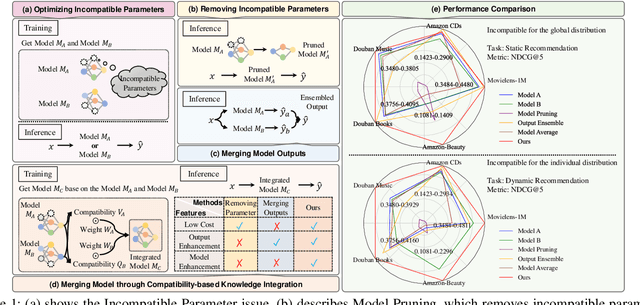

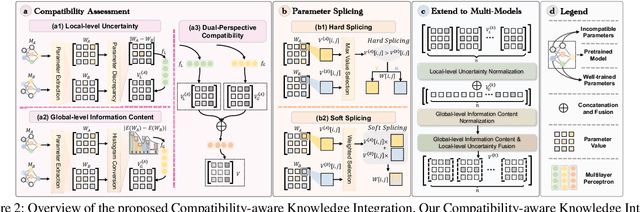
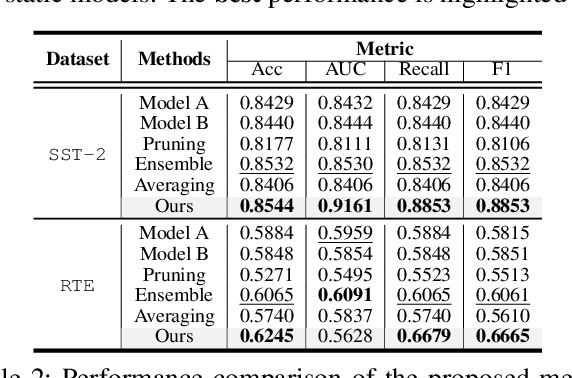
Deep neural networks have become foundational to advancements in multiple domains, including recommendation systems, natural language processing, and so on. Despite their successes, these models often contain incompatible parameters that can be underutilized or detrimental to model performance, particularly when faced with specific, varying data distributions. Existing research excels in removing such parameters or merging the outputs of multiple different pretrained models. However, the former focuses on efficiency rather than performance, while the latter requires several times more computing and storage resources to support inference. In this paper, we set the goal to explicitly improve these incompatible parameters by leveraging the complementary strengths of different models, thereby directly enhancing the models without any additional parameters. Specifically, we propose Compatibility-aware Knowledge Integration (CKI), which consists of Parameter Compatibility Assessment and Parameter Splicing, which are used to evaluate the knowledge content of multiple models and integrate the knowledge into one model, respectively. The integrated model can be used directly for inference or for further fine-tuning. We conduct extensive experiments on various datasets for recommendation and language tasks, and the results show that Compatibility-aware Knowledge Integration can effectively optimize incompatible parameters under multiple tasks and settings to break through the training limit of the original model without increasing the inference cost.
StructGPT: A General Framework for Large Language Model to Reason over Structured Data
May 16, 2023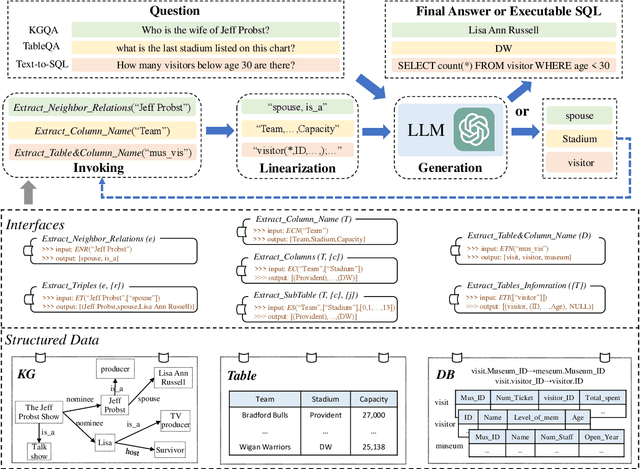
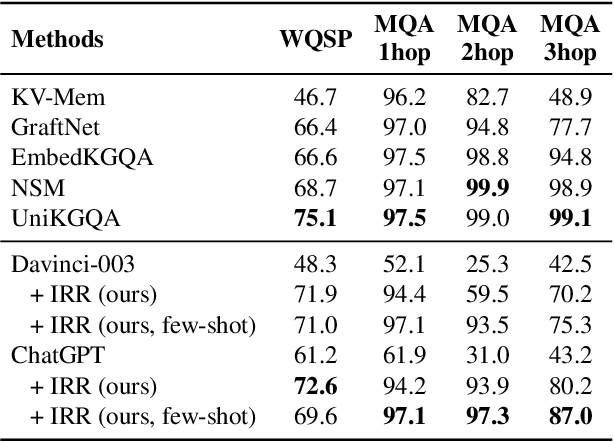
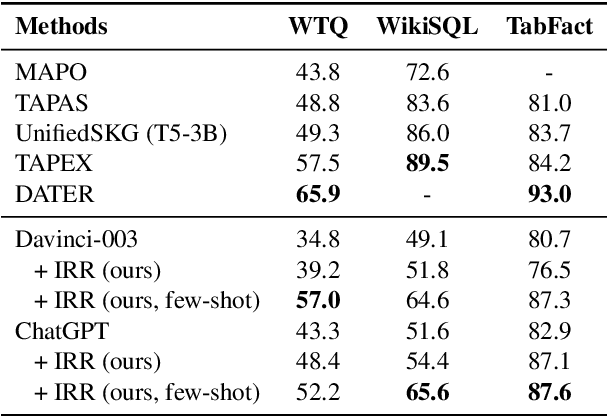
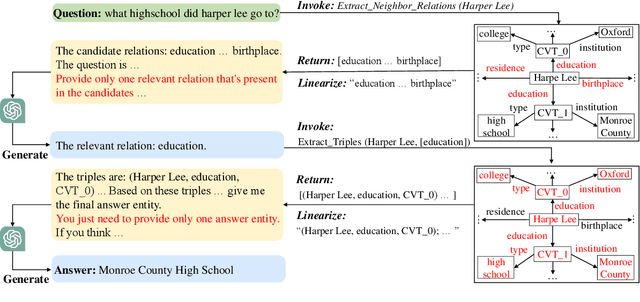
In this paper, we study how to improve the zero-shot reasoning ability of large language models~(LLMs) over structured data in a unified way. Inspired by the study on tool augmentation for LLMs, we develop an \emph{Iterative Reading-then-Reasoning~(IRR)} approach for solving question answering tasks based on structured data, called \textbf{StructGPT}. In our approach, we construct the specialized function to collect relevant evidence from structured data (\ie \emph{reading}), and let LLMs concentrate the reasoning task based on the collected information (\ie \emph{reasoning}). Specially, we propose an \emph{invoking-linearization-generation} procedure to support LLMs in reasoning on the structured data with the help of the external interfaces. By iterating this procedures with provided interfaces, our approach can gradually approach the target answer to a given query. Extensive experiments conducted on three types of structured data demonstrate the effectiveness of our approach, which can significantly boost the performance of ChatGPT and achieve comparable performance against the full-data supervised-tuning baselines. Our codes and data are publicly available at~\url{https://github.com/RUCAIBox/StructGPT}.