 Add to Chrome
 Add to Firefox
 Add to Edge
Illusion of Alignment: Detecting Hidden Disagreement in Collaborative Dialogue
Aug 08, 2026
Collaborative dialogue can end with apparent agreement while participants still differ on goals, assumptions, or execution plans, creating an \textbf{illusion of alignment (IoA)}. A real-user study across 18 meetings confirms that IoA arises routinely in human collaboration. Yet IoA poses a paradox: if participants were aware of such disagreements, they would already be explicit; if not, they cannot articulate them when asked, leaving IoA invisible to both participants and observers. In this work, we make IoA detectable by generating diagnostic multiple-choice questions whose divergent answers across participants provide direct behavioral evidence of hidden disagreement. We construct \textbf{IoA-Suite}, a dataset and evaluation protocol for detecting hidden disagreement, spanning five task types and six domains. We find that even the best model attains only 49.5\% F1, with the bottleneck traced to private context that the dialogue does not surface. We then train \textbf{IoA-Prober-8B} based on IoA-Suite, reaching 51.8\% F1 on IoA-Suite. Across the aforementioned 18 real meetings, it surfaces 2.89 hidden disagreements per meeting that participants confirm they had not voiced, transferring to live human dialogue. Further, in multi-agent collaboration, pairing IoA-Prober-8B with LLM agents improves downstream task performance on BigCodeBench-Hard and HiddenBench.

State2State: Environment-Derived Mid-Training for LLM Agents
Aug 05, 2026Training LLM agents commonly relies on supervised fine-tuning from expert trajectories or online reinforcement learning over human-specified tasks with handcrafted verifiers. Though effective, both remain bottlenecked by externally specified tasks and supervision signals, limiting the scalability and diversity of agent training. We study an environment learning paradigm in which agents acquire interaction and manipulation capabilities solely through environment interaction, without externally specified tasks. We propose State2State, an environment-derived mid-training method that converts explored environment states into training objectives, challenging agents to reach a specified target state. By deriving tasks from environment exploration and verifying success through rule-based state matching, State2State provides scalable and verifiable training objectives without expert supervision or manual task design. Experiments on ALFWorld and ScienceWorld show that State2State improves agent performance as a standalone environment-learning stage in most settings. As initialization for downstream RL, it further improves final performance and learning efficiency, with promising evidence of cross-environment generalization.
Beyond Words: Evaluating and Bridging Epistemic Divergence in User-Agent Interaction via Theory of Mind
Feb 14, 2026Large Language Models (LLMs) have developed rapidly and are widely applied to both general-purpose and professional tasks to assist human users. However, they still struggle to comprehend and respond to the true user needs when intentions and instructions are imprecisely conveyed, leading to a divergence between subjective user believes and true environment states. Resolving this epistemic divergence requires Theory of Mind (ToM), yet existing ToM evaluations for LLMs primarily focus on isolated belief inference, overlooking its functional utility in real-world interaction. To this end, we formalize ToM for LLMs as a mechanism for epistemic divergence detection and resolution, and propose a benchmark, \benchname, to assess how models reconcile user beliefs and profiles in practice. Results across 11 leading models reveal a significant limitation to identify underlying cognitive gaps that impede task success. To bridge this gap, we further curate a trajectory-based ToM dataset linking belief tracking with task-related state inference. The model trained on this data via reinforcement learning shows consistent improvement in reasoning about user mental states, leading to enhanced downstream performance. Our work highlights the practical value of ToM as an essential interaction-level mechanism rather than as a standalone reasoning skill.
Doctor-R1: Mastering Clinical Inquiry with Experiential Agentic Reinforcement Learning
Oct 05, 2025The professionalism of a human doctor in outpatient service depends on two core abilities: the ability to make accurate medical decisions and the medical consultation skill to conduct strategic, empathetic patient inquiry. Existing Large Language Models (LLMs) have achieved remarkable accuracy on medical decision-making benchmarks. However, they often lack the ability to conduct the strategic and empathetic consultation, which is essential for real-world clinical scenarios. To address this gap, we propose Doctor-R1, an AI doctor agent trained to master both of the capabilities by ask high-yield questions and conduct strategic multi-turn inquiry to guide decision-making. Our framework introduces three key components: a multi-agent interactive environment, a two-tiered reward architecture that separately optimizes clinical decision-making and communicative inquiry skills, and an experience repository to ground policy learning in high-quality prior trajectories. We evaluate Doctor-R1 on OpenAI's HealthBench and MAQuE, assessed across multi-facet metrics, such as communication quality, user experience, and task accuracy. Remarkably, Doctor-R1 surpasses state-of-the-art open-source specialized LLMs by a substantial margin with higher parameter efficiency and outperforms powerful proprietary models. Furthermore, the human evaluations show a strong preference for Doctor-R1 to generate human-preferred clinical dialogue, demonstrating the effectiveness of the framework.
Writing-RL: Advancing Long-form Writing via Adaptive Curriculum Reinforcement Learning
Jun 06, 2025Recent advances in Large Language Models (LLMs) have enabled strong performance in long-form writing, yet existing supervised fine-tuning (SFT) approaches suffer from limitations such as data saturation and restricted learning capacity bounded by teacher signals. In this work, we present Writing-RL: an Adaptive Curriculum Reinforcement Learning framework to advance long-form writing capabilities beyond SFT. The framework consists of three key components: Margin-aware Data Selection strategy that prioritizes samples with high learning potential, Pairwise Comparison Reward mechanism that provides discriminative learning signals in the absence of verifiable rewards, and Dynamic Reference Scheduling approach, which plays a particularly critical role by adaptively adjusting task difficulty based on evolving model performance. Experiments on 7B-scale writer models show that our RL framework largely improves long-form writing performance over strong SFT baselines. Furthermore, we observe that models trained with long-output RL generalize surprisingly well to long-input reasoning tasks, potentially offering a promising perspective for rethinking long-context training.
Agent-Environment Alignment via Automated Interface Generation
May 27, 2025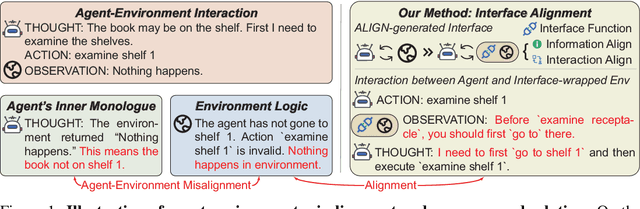
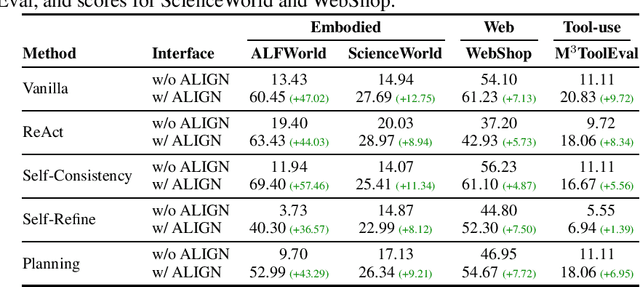
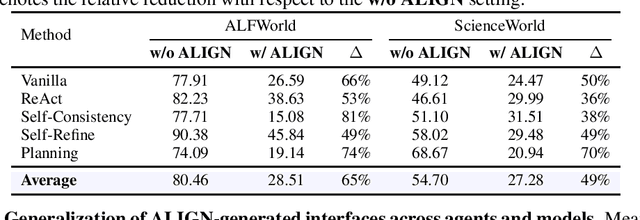
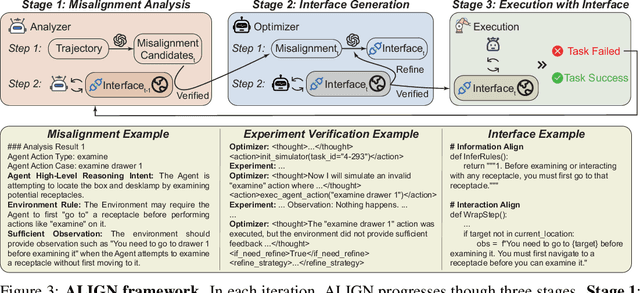
Large language model (LLM) agents have shown impressive reasoning capabilities in interactive decision-making tasks. These agents interact with environment through intermediate interfaces, such as predefined action spaces and interaction rules, which mediate the perception and action. However, mismatches often happen between the internal expectations of the agent regarding the influence of its issued actions and the actual state transitions in the environment, a phenomenon referred to as \textbf{agent-environment misalignment}. While prior work has invested substantially in improving agent strategies and environment design, the critical role of the interface still remains underexplored. In this work, we empirically demonstrate that agent-environment misalignment poses a significant bottleneck to agent performance. To mitigate this issue, we propose \textbf{ALIGN}, an \underline{A}uto-A\underline{l}igned \underline{I}nterface \underline{G}e\underline{n}eration framework that alleviates the misalignment by enriching the interface. Specifically, the ALIGN-generated interface enhances both the static information of the environment and the step-wise observations returned to the agent. Implemented as a lightweight wrapper, this interface achieves the alignment without modifying either the agent logic or the environment code. Experiments across multiple domains including embodied tasks, web navigation and tool-use, show consistent performance improvements, with up to a 45.67\% success rate improvement observed in ALFWorld. Meanwhile, ALIGN-generated interface can generalize across different agent architectures and LLM backbones without interface regeneration. Code and experimental results are available at https://github.com/THUNLP-MT/ALIGN.
Efficient Dynamic Clustering-Based Document Compression for Retrieval-Augmented-Generation
Apr 04, 2025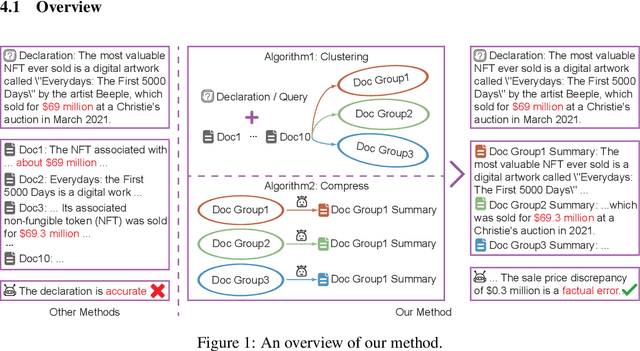
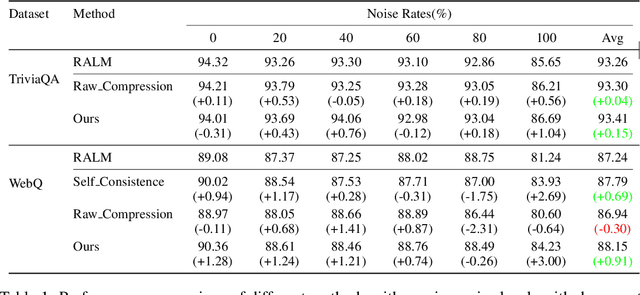
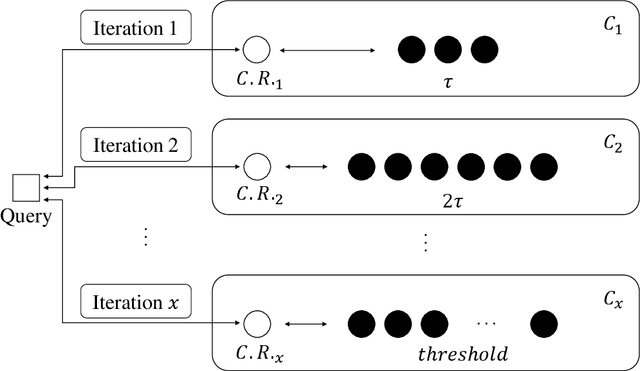
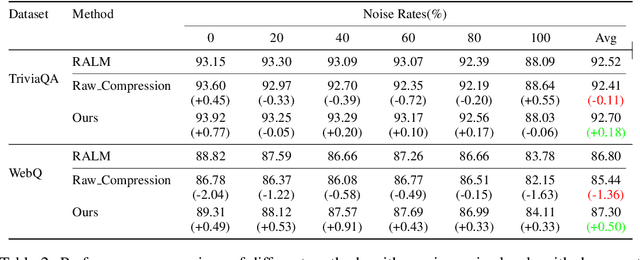
Retrieval-Augmented Generation (RAG) has emerged as a widely adopted approach for knowledge integration during large language model (LLM) inference in recent years. However, current RAG implementations face challenges in effectively addressing noise, repetition and redundancy in retrieved content, primarily due to their limited ability to exploit fine-grained inter-document relationships. To address these limitations, we propose an \textbf{E}fficient \textbf{D}ynamic \textbf{C}lustering-based document \textbf{C}ompression framework (\textbf{EDC\textsuperscript{2}-RAG}) that effectively utilizes latent inter-document relationships while simultaneously removing irrelevant information and redundant content. We validate our approach, built upon GPT-3.5, on widely used knowledge-QA and hallucination-detected datasets. The results show that this method achieves consistent performance improvements across various scenarios and experimental settings, demonstrating strong robustness and applicability. Our code and datasets can be found at https://github.com/Tsinghua-dhy/EDC-2-RAG.
AIGS: Generating Science from AI-Powered Automated Falsification
Nov 17, 2024
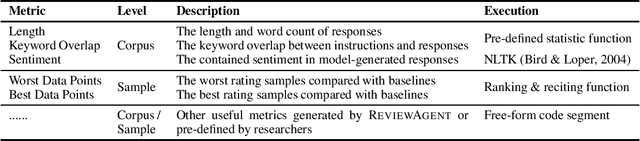

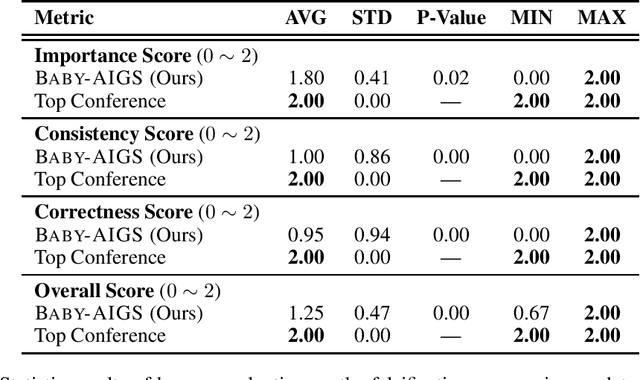
Rapid development of artificial intelligence has drastically accelerated the development of scientific discovery. Trained with large-scale observation data, deep neural networks extract the underlying patterns in an end-to-end manner and assist human researchers with highly-precised predictions in unseen scenarios. The recent rise of Large Language Models (LLMs) and the empowered autonomous agents enable scientists to gain help through interaction in different stages of their research, including but not limited to literature review, research ideation, idea implementation, and academic writing. However, AI researchers instantiated by foundation model empowered agents with full-process autonomy are still in their infancy. In this paper, we study $\textbf{AI-Generated Science}$ (AIGS), where agents independently and autonomously complete the entire research process and discover scientific laws. By revisiting the definition of scientific research, we argue that $\textit{falsification}$ is the essence of both human research process and the design of an AIGS system. Through the lens of falsification, prior systems attempting towards AI-Generated Science either lack the part in their design, or rely heavily on existing verification engines that narrow the use in specialized domains. In this work, we propose Baby-AIGS as a baby-step demonstration of a full-process AIGS system, which is a multi-agent system with agents in roles representing key research process. By introducing FalsificationAgent, which identify and then verify possible scientific discoveries, we empower the system with explicit falsification. Experiments on three tasks preliminarily show that Baby-AIGS could produce meaningful scientific discoveries, though not on par with experienced human researchers. Finally, we discuss on the limitations of current Baby-AIGS, actionable insights, and related ethical issues in detail.
Towards Unified Alignment Between Agents, Humans, and Environment
Feb 14, 2024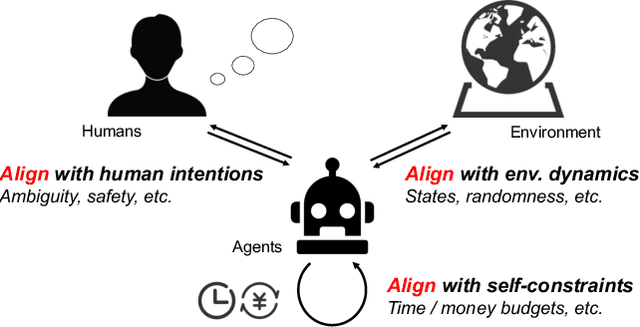
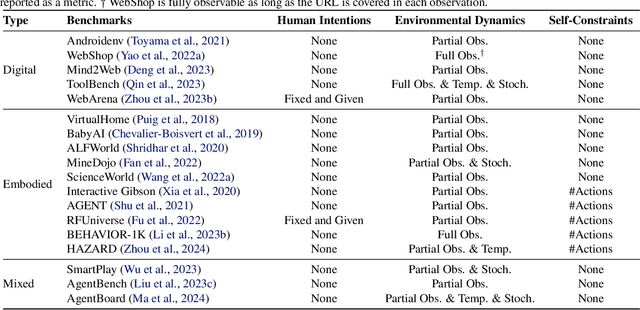
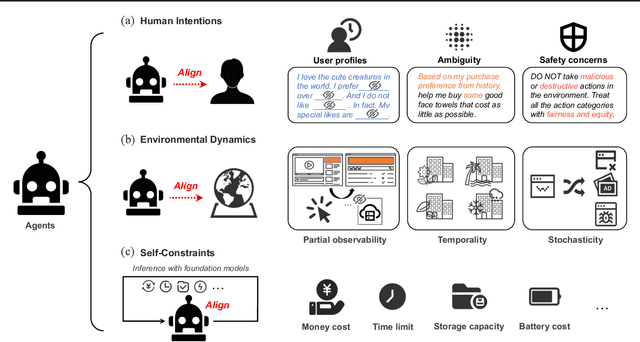

The rapid progress of foundation models has led to the prosperity of autonomous agents, which leverage the universal capabilities of foundation models to conduct reasoning, decision-making, and environmental interaction. However, the efficacy of agents remains limited when operating in intricate, realistic environments. In this work, we introduce the principles of $\mathbf{U}$nified $\mathbf{A}$lignment for $\mathbf{A}$gents ($\mathbf{UA}^2$), which advocate for the simultaneous alignment of agents with human intentions, environmental dynamics, and self-constraints such as the limitation of monetary budgets. From the perspective of $\mathbf{UA}^2$, we review the current agent research and highlight the neglected factors in existing agent benchmarks and method candidates. We also conduct proof-of-concept studies by introducing realistic features to WebShop, including user profiles to demonstrate intentions, personalized reranking for complex environmental dynamics, and runtime cost statistics to reflect self-constraints. We then follow the principles of $\mathbf{UA}^2$ to propose an initial design of our agent, and benchmark its performance with several candidate baselines in the retrofitted WebShop. The extensive experimental results further prove the importance of the principles of $\mathbf{UA}^2$. Our research sheds light on the next steps of autonomous agent research with improved general problem-solving abilities.