 Add to Chrome
 Add to Firefox
 Add to Edge
Investigating Uncertainty Calibration of Aligned Language Models under the Multiple-Choice Setting
Oct 18, 2023
Despite the significant progress made in practical applications of aligned language models (LMs), they tend to be overconfident in output answers compared to the corresponding pre-trained LMs. In this work, we systematically evaluate the impact of the alignment process on logit-based uncertainty calibration of LMs under the multiple-choice setting. We first conduct a thoughtful empirical study on how aligned LMs differ in calibration from their pre-trained counterparts. Experimental results reveal that there are two distinct uncertainties in LMs under the multiple-choice setting, which are responsible for the answer decision and the format preference of the LMs, respectively. Then, we investigate the role of these two uncertainties on aligned LM's calibration through fine-tuning in simple synthetic alignment schemes and conclude that one reason for aligned LMs' overconfidence is the conflation of these two types of uncertainty. Furthermore, we examine the utility of common post-hoc calibration methods for aligned LMs and propose an easy-to-implement and sample-efficient method to calibrate aligned LMs. We hope our findings could provide insights into the design of more reliable alignment processes for LMs.

Overcoming Recency Bias of Normalization Statistics in Continual Learning: Balance and Adaptation
Oct 13, 2023Continual learning entails learning a sequence of tasks and balancing their knowledge appropriately. With limited access to old training samples, much of the current work in deep neural networks has focused on overcoming catastrophic forgetting of old tasks in gradient-based optimization. However, the normalization layers provide an exception, as they are updated interdependently by the gradient and statistics of currently observed training samples, which require specialized strategies to mitigate recency bias. In this work, we focus on the most popular Batch Normalization (BN) and provide an in-depth theoretical analysis of its sub-optimality in continual learning. Our analysis demonstrates the dilemma between balance and adaptation of BN statistics for incremental tasks, which potentially affects training stability and generalization. Targeting on these particular challenges, we propose Adaptive Balance of BN (AdaB$^2$N), which incorporates appropriately a Bayesian-based strategy to adapt task-wise contributions and a modified momentum to balance BN statistics, corresponding to the training and testing stages. By implementing BN in a continual learning fashion, our approach achieves significant performance gains across a wide range of benchmarks, particularly for the challenging yet realistic online scenarios (e.g., up to 7.68%, 6.86% and 4.26% on Split CIFAR-10, Split CIFAR-100 and Split Mini-ImageNet, respectively). Our code is available at https://github.com/lvyilin/AdaB2N.
Score Regularized Policy Optimization through Diffusion Behavior
Oct 12, 2023Recent developments in offline reinforcement learning have uncovered the immense potential of diffusion modeling, which excels at representing heterogeneous behavior policies. However, sampling from diffusion policies is considerably slow because it necessitates tens to hundreds of iterative inference steps for one action. To address this issue, we propose to extract an efficient deterministic inference policy from critic models and pretrained diffusion behavior models, leveraging the latter to directly regularize the policy gradient with the behavior distribution's score function during optimization. Our method enjoys powerful generative capabilities of diffusion modeling while completely circumventing the computationally intensive and time-consuming diffusion sampling scheme, both during training and evaluation. Extensive results on D4RL tasks show that our method boosts action sampling speed by more than 25 times compared with various leading diffusion-based methods in locomotion tasks, while still maintaining state-of-the-art performance.
Hierarchical Decomposition of Prompt-Based Continual Learning: Rethinking Obscured Sub-optimality
Oct 11, 2023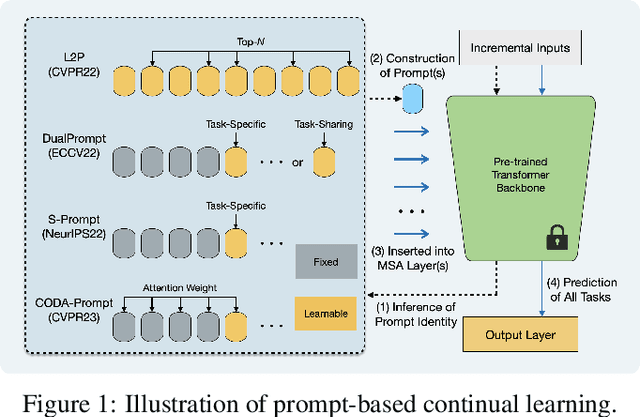
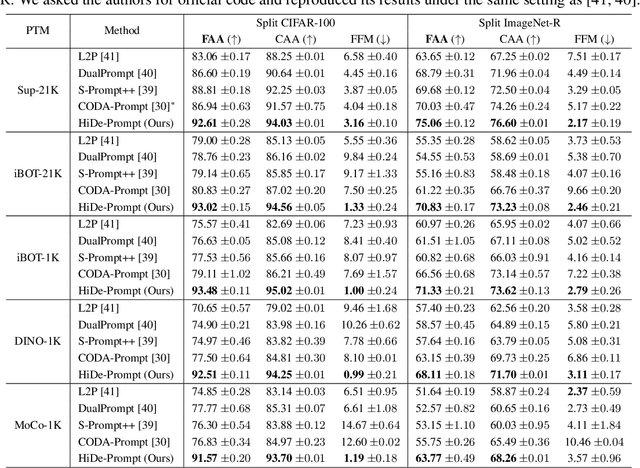

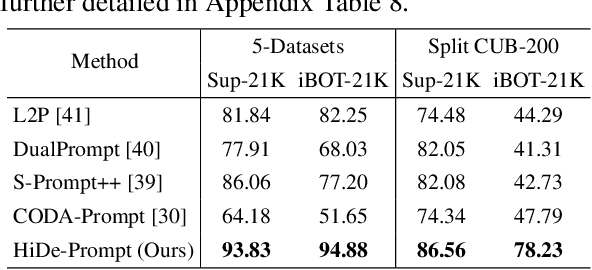
Prompt-based continual learning is an emerging direction in leveraging pre-trained knowledge for downstream continual learning, and has almost reached the performance pinnacle under supervised pre-training. However, our empirical research reveals that the current strategies fall short of their full potential under the more realistic self-supervised pre-training, which is essential for handling vast quantities of unlabeled data in practice. This is largely due to the difficulty of task-specific knowledge being incorporated into instructed representations via prompt parameters and predicted by uninstructed representations at test time. To overcome the exposed sub-optimality, we conduct a theoretical analysis of the continual learning objective in the context of pre-training, and decompose it into hierarchical components: within-task prediction, task-identity inference, and task-adaptive prediction. Following these empirical and theoretical insights, we propose Hierarchical Decomposition (HiDe-)Prompt, an innovative approach that explicitly optimizes the hierarchical components with an ensemble of task-specific prompts and statistics of both uninstructed and instructed representations, further with the coordination of a contrastive regularization strategy. Our extensive experiments demonstrate the superior performance of HiDe-Prompt and its robustness to pre-training paradigms in continual learning (e.g., up to 15.01% and 9.61% lead on Split CIFAR-100 and Split ImageNet-R, respectively). Our code is available at \url{https://github.com/thu-ml/HiDe-Prompt}.
How Robust is Google's Bard to Adversarial Image Attacks?
Sep 21, 2023
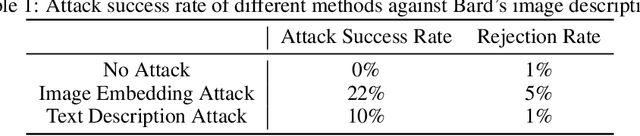


Multimodal Large Language Models (MLLMs) that integrate text and other modalities (especially vision) have achieved unprecedented performance in various multimodal tasks. However, due to the unsolved adversarial robustness problem of vision models, MLLMs can have more severe safety and security risks by introducing the vision inputs. In this work, we study the adversarial robustness of Google's Bard, a competitive chatbot to ChatGPT that released its multimodal capability recently, to better understand the vulnerabilities of commercial MLLMs. By attacking white-box surrogate vision encoders or MLLMs, the generated adversarial examples can mislead Bard to output wrong image descriptions with a 22% success rate based solely on the transferability. We show that the adversarial examples can also attack other MLLMs, e.g., a 26% attack success rate against Bing Chat and a 86% attack success rate against ERNIE bot. Moreover, we identify two defense mechanisms of Bard, including face detection and toxicity detection of images. We design corresponding attacks to evade these defenses, demonstrating that the current defenses of Bard are also vulnerable. We hope this work can deepen our understanding on the robustness of MLLMs and facilitate future research on defenses. Our code is available at https://github.com/thu-ml/Attack-Bard.
i-Octree: A Fast, Lightweight, and Dynamic Octree for Proximity Search
Sep 15, 2023
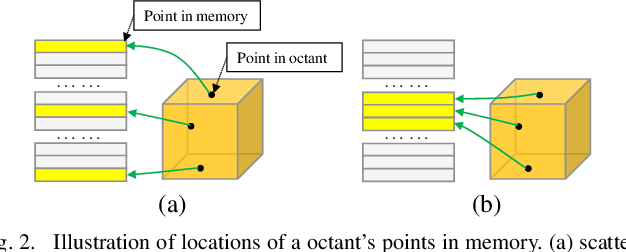
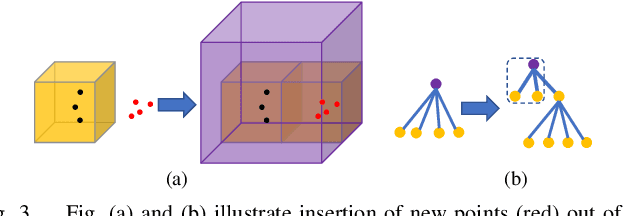
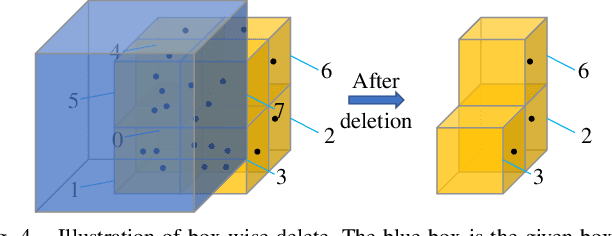
Establishing the correspondences between newly acquired points and historically accumulated data (i.e., map) through nearest neighbors search is crucial in numerous robotic applications.However, static tree data structures are inadequate to handle large and dynamically growing maps in real-time.To address this issue, we present the i-Octree, a dynamic octree data structure that supports both fast nearest neighbor search and real-time dynamic updates, such as point insertion, deletion, and on-tree down-sampling. The i-Octree is built upon a leaf-based octree and has two key features: a local spatially continuous storing strategy that allows for fast access to points while minimizing memory usage, and local on-tree updates that significantly reduce computation time compared to existing static or dynamic tree structures.The experiments show that i-Octree surpasses state-of-the-art methods by reducing run-time by over 50% on real-world open datasets.
Memory Efficient Optimizers with 4-bit States
Sep 06, 2023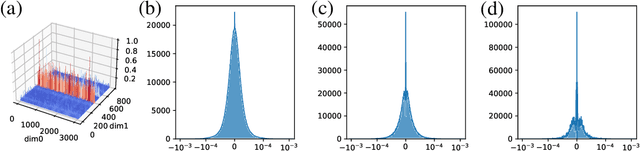
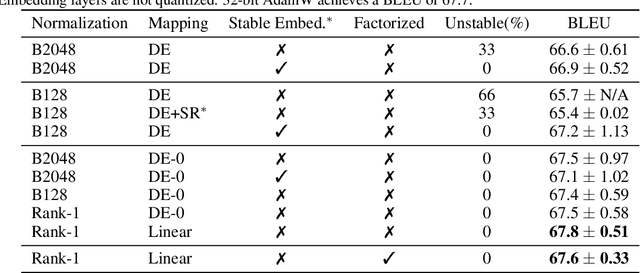
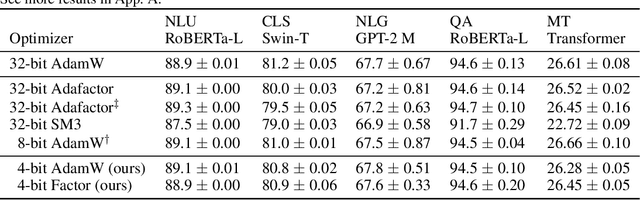
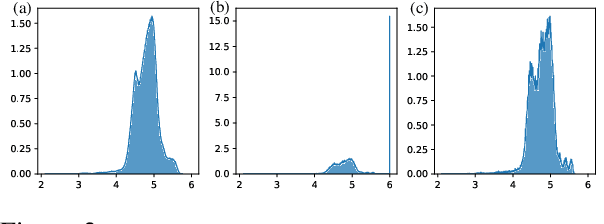
Optimizer states are a major source of memory consumption for training neural networks, limiting the maximum trainable model within given memory budget. Compressing the optimizer states from 32-bit floating points to lower bitwidth is promising to reduce the training memory footprint, while the current lowest achievable bitwidth is 8-bit. In this work, we push optimizer states bitwidth down to 4-bit through a detailed empirical analysis of first and second moments. Specifically, we find that moments have complicated outlier patterns, that current block-wise quantization cannot accurately approximate. We use a smaller block size and propose to utilize both row-wise and column-wise information for better quantization. We further identify a zero point problem of quantizing the second moment, and solve this problem with a linear quantizer that excludes the zero point. Our 4-bit optimizer is evaluated on a wide variety of benchmarks including natural language understanding, machine translation, image classification, and instruction tuning. On all the tasks our optimizers can achieve comparable accuracy with their full-precision counterparts, while enjoying better memory efficiency.
SeisCLIP: A seismology foundation model pre-trained by multi-modal data for multi-purpose seismic feature extraction
Sep 05, 2023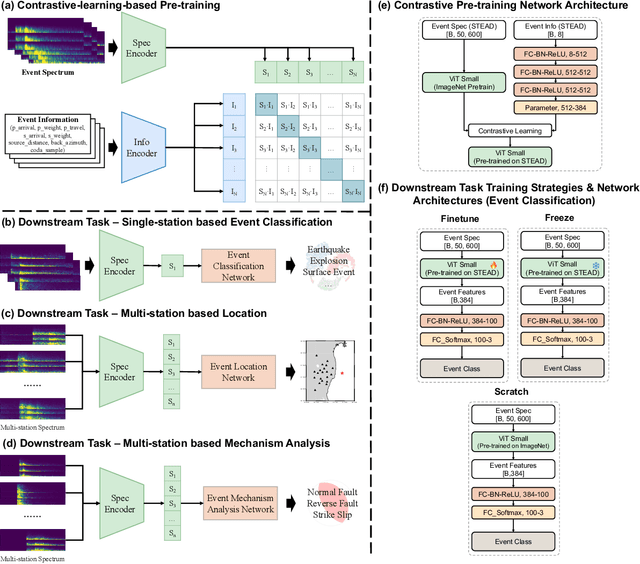
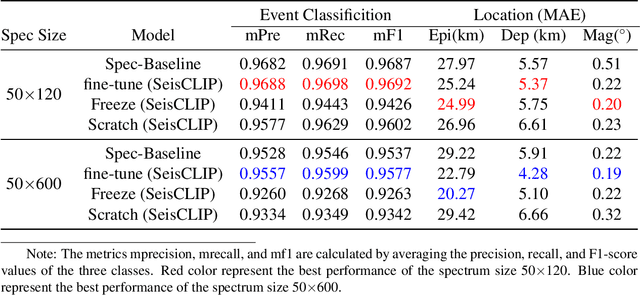
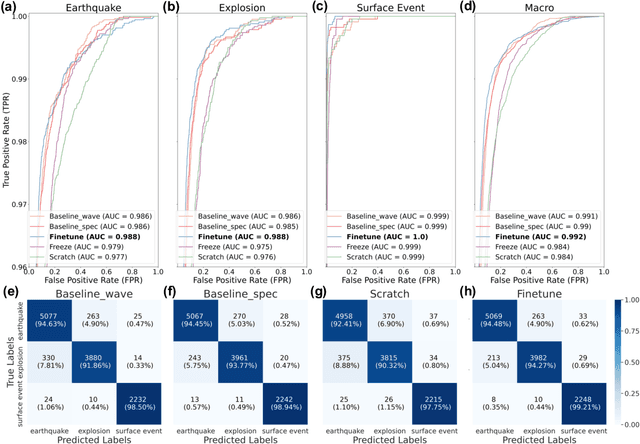
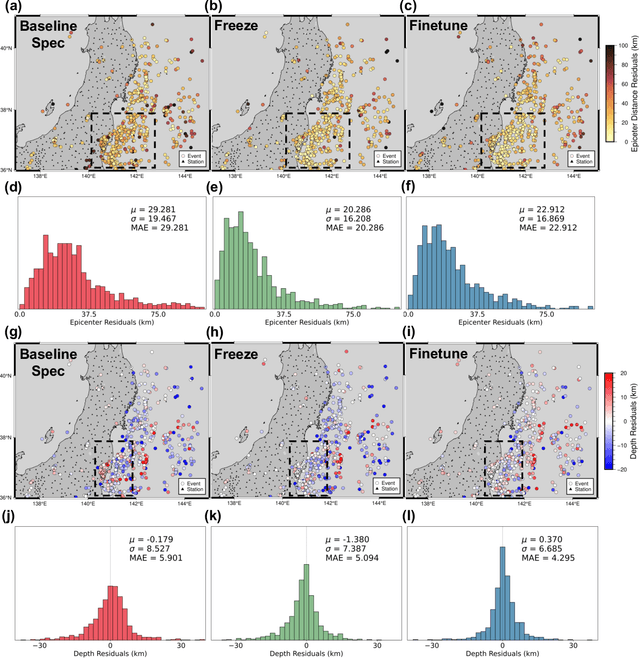
Training specific deep learning models for particular tasks is common across various domains within seismology. However, this approach encounters two limitations: inadequate labeled data for certain tasks and limited generalization across regions. To address these challenges, we develop SeisCLIP, a seismology foundation model trained through contrastive learning from multi-modal data. It consists of a transformer encoder for extracting crucial features from time-frequency seismic spectrum and an MLP encoder for integrating the phase and source information of the same event. These encoders are jointly pre-trained on a vast dataset and the spectrum encoder is subsequently fine-tuned on smaller datasets for various downstream tasks. Notably, SeisCLIP's performance surpasses that of baseline methods in event classification, localization, and focal mechanism analysis tasks, employing distinct datasets from different regions. In conclusion, SeisCLIP holds significant potential as a foundational model in the field of seismology, paving the way for innovative directions in foundation-model-based seismology research.
Incorporating Neuro-Inspired Adaptability for Continual Learning in Artificial Intelligence
Aug 29, 2023
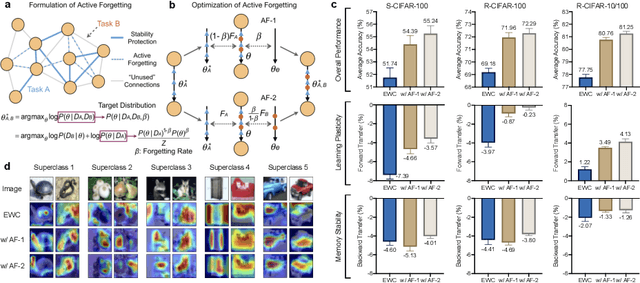

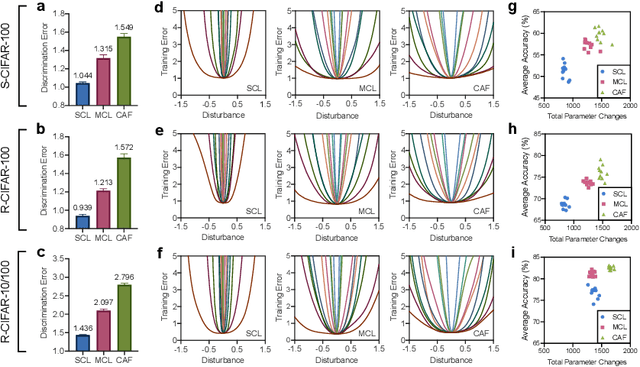
Continual learning aims to empower artificial intelligence (AI) with strong adaptability to the real world. For this purpose, a desirable solution should properly balance memory stability with learning plasticity, and acquire sufficient compatibility to capture the observed distributions. Existing advances mainly focus on preserving memory stability to overcome catastrophic forgetting, but remain difficult to flexibly accommodate incremental changes as biological intelligence (BI) does. By modeling a robust Drosophila learning system that actively regulates forgetting with multiple learning modules, here we propose a generic approach that appropriately attenuates old memories in parameter distributions to improve learning plasticity, and accordingly coordinates a multi-learner architecture to ensure solution compatibility. Through extensive theoretical and empirical validation, our approach not only clearly enhances the performance of continual learning, especially over synaptic regularization methods in task-incremental settings, but also potentially advances the understanding of neurological adaptive mechanisms, serving as a novel paradigm to progress AI and BI together.
Heterogeneous Multi-Task Gaussian Cox Processes
Aug 29, 2023This paper presents a novel extension of multi-task Gaussian Cox processes for modeling multiple heterogeneous correlated tasks jointly, e.g., classification and regression, via multi-output Gaussian processes (MOGP). A MOGP prior over the parameters of the dedicated likelihoods for classification, regression and point process tasks can facilitate sharing of information between heterogeneous tasks, while allowing for nonparametric parameter estimation. To circumvent the non-conjugate Bayesian inference in the MOGP modulated heterogeneous multi-task framework, we employ the data augmentation technique and derive a mean-field approximation to realize closed-form iterative updates for estimating model parameters. We demonstrate the performance and inference on both 1D synthetic data as well as 2D urban data of Vancouver.