 Add to Chrome
 Add to Firefox
 Add to Edge
Prism-GRPO: Faster VLA Policy Optimization via Splitting Same-outcome Groups
Aug 18, 2026
GRPO is increasingly used for reinforcement learning of vision-language-action (VLA) policies because, unlike PPO, it does not require training a critic. This simplification comes with a sampling cost: group-relative advantages require multiple rollouts from each scene. Under binary success rewards, groups whose rollouts all succeed or all fail have zero advantage and are discarded by dynamic sampling. These groups are especially common early in training, when most rollouts fail, wasting much of the expensive robotic rollout budget. We introduce Prism-GRPO, which augments binary outcome reward with a weighted trajectory-level execution-quality score. By splitting same-outcome groups into a quality spectrum, Prism-GRPO recovers training signal while ensuring that every success still outranks every failure. Quality scores can be derived from simulator contacts, executed actions, or visual observations, avoiding task-specific progress rewards. We prove that Prism-GRPO never increases the probability that a sampled group is discarded for having zero advantages, and derive a gradient-alignment condition under which its combined update remains a local ascent direction for task success. Across four RoboTwin tasks spanning different horizons and coordination patterns, Prism-GRPO improves success and quality at matched rollout budgets and reaches target success rates with up to 56% fewer rollouts. It also suppresses a reward-hacking shortcut, with the cleaner behavior transferring under direct deployment to a real robot. Through ablations, we show consistent gains across contact-, smoothness-, and VLM-derived quality signals.

Consilience for Verifier-Free Test-Time Scaling
Aug 10, 2026Test-time scaling often uses an external verifier, such as compilers and test cases in coding or trained value functions in robotics applications, to obtain high-quality rollouts. Verifier-free test-time scaling (or VF-TTS) is gaining extensive attention as a mechanism to enhance Large Language Model (LLM) reasoning, primarily because we do not have access to such high-quality verifiers in many real-world applications. Among existing VF-TTS methods, confidence-based VF-TTS methods, which compute and rank rollouts solely by confidence, are particularly promising. Such methods introduce near-zero overhead for sample evaluation and require minimal access to internal model states, making the methods highly flexible across models and tasks. In this paper, we demonstrate a critical limitation of existing confidence-based VF-TTS methods by showing that such methods catastrophically break down on complex tasks. We observe a very interesting phenomenon: uniformly high confidence frequently indicates a failure to explore, favoring confidently wrong answers. To address this, our core insight is that robust cognitive search requires a specific confidence trajectory pattern: such methods perform exploratory branching at the beginning, as manifested by low initial confidence, and converge to a high final confidence solution. To implement this insight, we introduce consilience, a novel selection framework that explicitly evaluates the temporal asymmetry of confidence in reasoning. We operationalize this via a combinatorial metric that actively penalizes high initial confidence while strictly demanding final certainty. Extensive experiments covering both graduate-level mathematics problems and free-form code generation demonstrate that consilience effectively outperforms existing baselines, validating our novel perspective on completion confidence.
NKI-Agent: Domain-Specific Fine-Tuning and Agentic Tool Use for Neuron Kernel Generation
Jul 05, 2026Recent agentic approaches to LLM-based kernel generation have achieved impressive results on CUDA. For emerging AI accelerators such as AWS Trainium and Inferentia, automated kernel generation and optimization remain largely unaddressed. Writing kernels for these chips via the Neuron Kernel Interface (NKI) is particularly challenging: developers must navigate a multi-engine architecture, tile-based programming, and explicit data movement across multi-level memory hierarchy. Moreover, no publicly-available training data, benchmarks, or tool-augmented agents exist for this domain. We introduce NKI-Agent, the first system combining domain-specific supervised fine-tuning (SFT) with a compile-verify-fix agent loop for NKI kernel generation. We adapt the existing CUDA-Agent framework to Neuron hardware, curate 6,000 NKI kernel generation tasks for training, and construct NKIBench, a 250-task benchmark across three difficulty levels. Evaluated on real Trn1 hardware, NKI-Agent with Claude Opus 4.8 and a rank-aware system prompt achieves a 77.3% pass rate on the 150-task NKIBench. We show that tool use is critical: Opus 4.8 scores 6% in single-shot mode without agent tools. On a 60-task subset, we show that an SFT-trained Qwen3-Coder-30B-A3B achieves 25.0% pass rate at 1/100th the cost, outperforming Claude Sonnet 4 (15.0%). We also report that Group Relative Policy Optimization (GRPO) with binary compilation reward fails to improve over SFT, providing guidance on reward design for RL-based kernel generation.
Dissecting model behavior through agent trajectories
Jun 17, 2026AI agent performance is not just a modeling problem, it is fundamentally a systems problem. The advanced capabilities of models are realized through agent harnesses. Therefore, a gap between model assumptions and harness behavior can easily prevent the model's full capabilities from translating into agent performance. We formalize this as the `intent-execution' gap: the mismatch between what the model intends and what the harness executes, and vice versa. We argue that minimizing this intent-execution gap is as important as other aspects of harness design such as tools and execution loops. To illustrate the impact of this harness-model alignment, we develop a simple and customizable harness called `Simple Strands Agent' (SSA). SSA aims to find the bulk of common patterns which generalize across different model families (such as Claude, Gemini, GPT, Grok, Qwen), as well as a small number of model-specific preferences. We make two contributions: (i) we reproduce or improve on the pass@1 performance reported by diverse model-provider families on popular agentic benchmarks (SWE-Pro, SWE-Verified and Terminal-Bench-2), and (ii) building on an analysis of 138k trajectories generated by SSA, we look beyond the pass@1 numbers which tend to be relatively even across frontier models. By representing agent trajectories in code state-spaces, we observe model-level differences in problem-solving behavior. Finer-grained metrics such as edit frequency, testing activity, and phase-transitions reveal how individual models allocate effort across different stages of autonomous problem solving.
ContextWeaver: Selective and Dependency-Structured Memory Construction for LLM Agents
Apr 24, 2026Large language model (LLM) agents often struggle in long-context interactions. As the agent accumulates more interaction history, context management approaches such as sliding window and prompt compression may omit earlier structured information that later steps rely on. Recent retrieval-based memory systems surface relevant content but still overlook the causal and logical structure needed for multi-step reasoning. We introduce ContextWeaver, a selective and dependency-structured memory framework that organizes an agent's interaction trace into a graph of reasoning steps and selects the relevant context for future actions. Unlike prior context management approaches, ContextWeaver supports: (1) dependency-based construction and traversal that link each step to the earlier steps it relies on; (2) compact dependency summarization that condenses root-to-step reasoning paths into reusable units; and (3) a lightweight validation layer that incorporates execution feedback. On the SWE-Bench Verified and Lite benchmarks, ContextWeaver improves performance over a sliding-window baseline in pass@1, while reducing reasoning steps and token usage. Our observations suggest that modeling logical dependencies provides a stable and scalable memory mechanism for LLM agents that use tools.
ExecTune: Effective Steering of Black-Box LLMs with Guide Models
Apr 09, 2026For large language models deployed through black-box APIs, recurring inference costs often exceed one-time training costs. This motivates composed agentic systems that amortize expensive reasoning into reusable intermediate representations. We study a broad class of such systems, termed Guide-Core Policies (GCoP), in which a guide model generates a structured strategy that is executed by a black-box core model. This abstraction subsumes base, supervised, and advisor-style approaches, which differ primarily in how the guide is trained. We formalize GCoP under a cost-sensitive utility objective and show that end-to-end performance is governed by guide-averaged executability: the probability that a strategy generated by the guide can be faithfully executed by the core. Our analysis shows that existing GCoP instantiations often fail to optimize executability under deployment constraints, resulting in brittle strategies and inefficient computation. Motivated by these insights, we propose ExecTune, a principled training recipe that combines teacher-guided acceptance sampling, supervised fine-tuning, and structure-aware reinforcement learning to directly optimize syntactic validity, execution success, and cost efficiency. Across mathematical reasoning and code-generation benchmarks, GCoP with ExecTune improves accuracy by up to 9.2% over prior state-of-the-art baselines while reducing inference cost by up to 22.4%. It enables Claude Haiku 3.5 to outperform Sonnet 3.5 on both math and code tasks, and to come within 1.7% absolute accuracy of Sonnet 4 at 38% lower cost. Beyond efficiency, GCoP also supports modular adaptation by updating the guide without retraining the core.
MURPHY: Multi-Turn GRPO for Self Correcting Code Generation
Nov 11, 2025Reinforcement Learning with Verifiable Rewards (RLVR) has emerged as a powerful framework for enhancing the reasoning capabilities of large language models (LLMs). However, existing approaches such as Group Relative Policy Optimization (GRPO) and its variants, while effective on reasoning benchmarks, struggle with agentic tasks that require iterative decision-making. We introduce Murphy, a multi-turn reflective optimization framework that extends GRPO by incorporating iterative self-correction during training. By leveraging both quantitative and qualitative execution feedback, Murphy enables models to progressively refine their reasoning across multiple turns. Evaluations on code generation benchmarks with model families such as Qwen and OLMo show that Murphy consistently improves performance, achieving up to a 8% relative gain in pass@1 over GRPO, on similar compute budgets.
Inference Optimization of Foundation Models on AI Accelerators
Jul 12, 2024
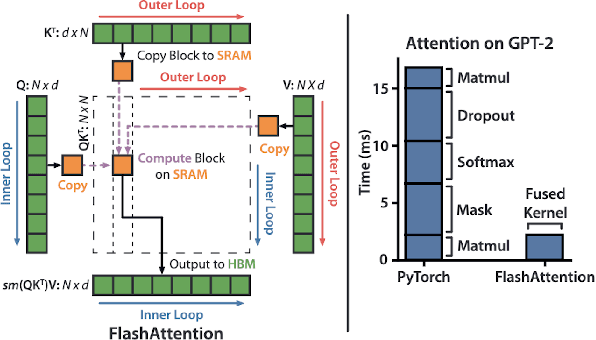


Powerful foundation models, including large language models (LLMs), with Transformer architectures have ushered in a new era of Generative AI across various industries. Industry and research community have witnessed a large number of new applications, based on those foundation models. Such applications include question and answer, customer services, image and video generation, and code completions, among others. However, as the number of model parameters reaches to hundreds of billions, their deployment incurs prohibitive inference costs and high latency in real-world scenarios. As a result, the demand for cost-effective and fast inference using AI accelerators is ever more higher. To this end, our tutorial offers a comprehensive discussion on complementary inference optimization techniques using AI accelerators. Beginning with an overview of basic Transformer architectures and deep learning system frameworks, we deep dive into system optimization techniques for fast and memory-efficient attention computations and discuss how they can be implemented efficiently on AI accelerators. Next, we describe architectural elements that are key for fast transformer inference. Finally, we examine various model compression and fast decoding strategies in the same context.
HLAT: High-quality Large Language Model Pre-trained on AWS Trainium
Apr 16, 2024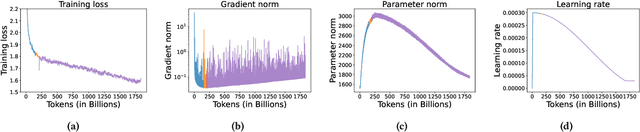
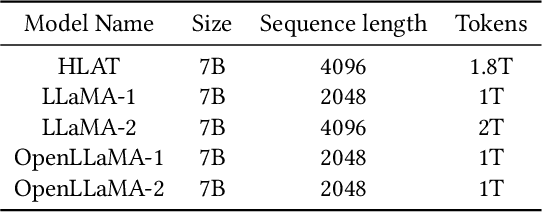
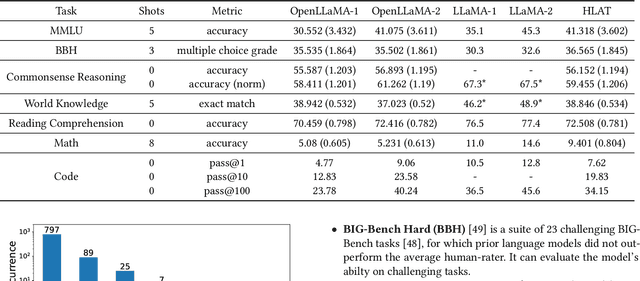
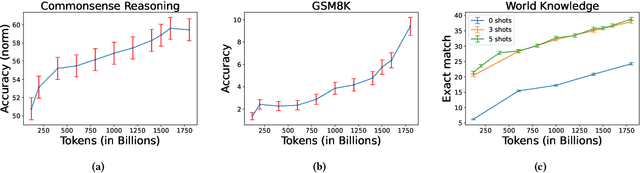
Getting large language models (LLMs) to perform well on the downstream tasks requires pre-training over trillions of tokens. This typically demands a large number of powerful computational devices in addition to a stable distributed training framework to accelerate the training. The growing number of applications leveraging AI/ML had led to a scarcity of the expensive conventional accelerators (such as GPUs), which begs the need for the alternative specialized-accelerators that are scalable and cost-efficient. AWS Trainium is the second-generation machine learning accelerator that has been purposely built for training large deep learning models. Its corresponding instance, Amazon EC2 trn1, is an alternative to GPU instances for LLM training. However, training LLMs with billions of parameters on trn1 is challenging due to its relatively nascent software ecosystem. In this paper, we showcase HLAT: a 7 billion parameter decoder-only LLM pre-trained using trn1 instances over 1.8 trillion tokens. The performance of HLAT is benchmarked against popular open source baseline models including LLaMA and OpenLLaMA, which have been trained on NVIDIA GPUs and Google TPUs, respectively. On various evaluation tasks, we show that HLAT achieves model quality on par with the baselines. We also share the best practice of using the Neuron Distributed Training Library (NDTL), a customized distributed training library for AWS Trainium to achieve efficient training. Our work demonstrates that AWS Trainium powered by the NDTL is able to successfully pre-train state-of-the-art LLM models with high performance and cost-effectiveness.
Random Walk on Multiple Networks
Jul 04, 2023Random Walk is a basic algorithm to explore the structure of networks, which can be used in many tasks, such as local community detection and network embedding. Existing random walk methods are based on single networks that contain limited information. In contrast, real data often contain entities with different types or/and from different sources, which are comprehensive and can be better modeled by multiple networks. To take advantage of rich information in multiple networks and make better inferences on entities, in this study, we propose random walk on multiple networks, RWM. RWM is flexible and supports both multiplex networks and general multiple networks, which may form many-to-many node mappings between networks. RWM sends a random walker on each network to obtain the local proximity (i.e., node visiting probabilities) w.r.t. the starting nodes. Walkers with similar visiting probabilities reinforce each other. We theoretically analyze the convergence properties of RWM. Two approximation methods with theoretical performance guarantees are proposed for efficient computation. We apply RWM in link prediction, network embedding, and local community detection. Comprehensive experiments conducted on both synthetic and real-world datasets demonstrate the effectiveness and efficiency of RWM.