 Add to Chrome
 Add to Firefox
 Add to Edge
Advancing Open and Reproducible Relational Learning: RelArena-$α$, TabPFN-Rel and RPI
Aug 17, 2026
This first release of Prior Labs in relational learning shows our continued commitment to open science. We open-source three pieces of software that we expect to accelerate research in the field towards meaningful real-world impact. We aim to steer further development based on feedback from, and in collaboration with, the community. Given the early stage of development, our $α$-release targets researchers and early-adopting practitioners. Over the past years, a variety of datasets and tasks for relational learning have emerged, but the community has not converged on a reliable, reproducible way to compare different methods on these tasks. Our $α$-release, RelArena-$α$, provides a unified framework for running and comparing baselines on RelBench v1 by standardizing data loading, evaluation protocols, tuning regimes, and support for systems with custom tuning, inspired by established tabular benchmarks such as TabArena. We plan to work with the research community to further develop RelArena-$α$ into a catalyst for progress in the relational learning community. We release the initial version of TabPFN-Rel, a purpose-built relational harness for TabPFN-3. Currently ranked first among models on RelArena-$α$, TabPFN-Rel makes key improvements upon RDBLearn. Beyond its ranking, TabPFN-Rel serves as a strong baseline, adding to the growing evidence that flattening a relational database into a single table remains competitive with specialized relational architectures on real-world tasks. To facilitate adoption of relational learning methods in research and industry, we release an initial $α$-version of our Relational Predictive Interface, RPI, an open-source, model-agnostic interface that enables early adopters to easily define problems on new databases and apply any model implemented in RelArena-$α$, including TabPFN-Rel, to these problems.

When LLMs get significantly worse: A statistical approach to detect model degradations
Feb 09, 2026Minimizing the inference cost and latency of foundation models has become a crucial area of research. Optimization approaches include theoretically lossless methods and others without accuracy guarantees like quantization. In all of these cases it is crucial to ensure that the model quality has not degraded. However, even at temperature zero, model generations are not necessarily robust even to theoretically lossless model optimizations due to numerical errors. We thus require statistical tools to decide whether a finite-sample accuracy deviation is an evidence of a model's degradation or whether it can be attributed to (harmless) noise in the evaluation. We propose a statistically sound hypothesis testing framework based on McNemar's test allowing to efficiently detect model degradations, while guaranteeing a controlled rate of false positives. The crucial insight is that we have to confront the model scores on each sample, rather than aggregated on the task level. Furthermore, we propose three approaches to aggregate accuracy estimates across multiple benchmarks into a single decision. We provide an implementation on top of the largely adopted open source LM Evaluation Harness and provide a case study illustrating that the method correctly flags degraded models, while not flagging model optimizations that are provably lossless. We find that with our tests even empirical accuracy degradations of 0.3% can be confidently attributed to actual degradations rather than noise.
* https://openreview.net/forum?id=cM3gsqEI4K
Inference Optimization of Foundation Models on AI Accelerators
Jul 12, 2024
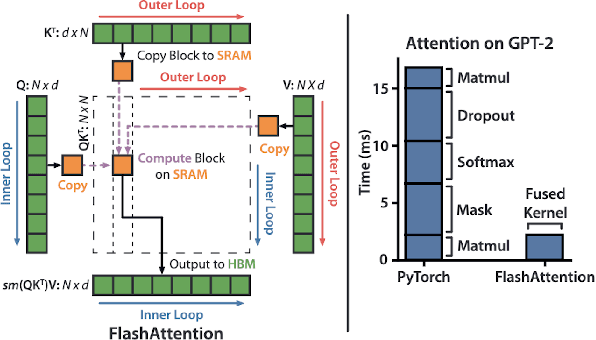


Powerful foundation models, including large language models (LLMs), with Transformer architectures have ushered in a new era of Generative AI across various industries. Industry and research community have witnessed a large number of new applications, based on those foundation models. Such applications include question and answer, customer services, image and video generation, and code completions, among others. However, as the number of model parameters reaches to hundreds of billions, their deployment incurs prohibitive inference costs and high latency in real-world scenarios. As a result, the demand for cost-effective and fast inference using AI accelerators is ever more higher. To this end, our tutorial offers a comprehensive discussion on complementary inference optimization techniques using AI accelerators. Beginning with an overview of basic Transformer architectures and deep learning system frameworks, we deep dive into system optimization techniques for fast and memory-efficient attention computations and discuss how they can be implemented efficiently on AI accelerators. Next, we describe architectural elements that are key for fast transformer inference. Finally, we examine various model compression and fast decoding strategies in the same context.
Kernel Conditional Moment Test via Maximum Moment Restriction
Mar 07, 2020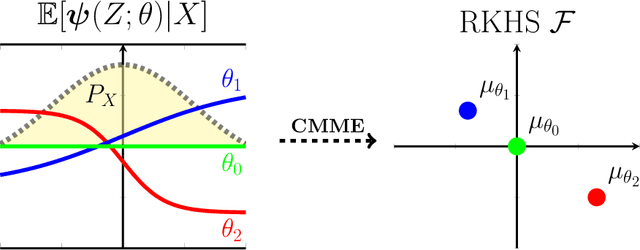
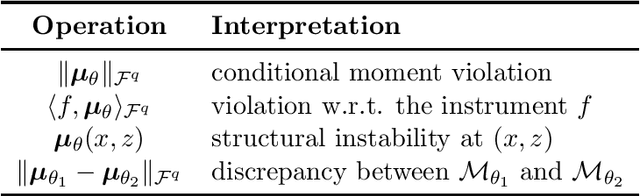
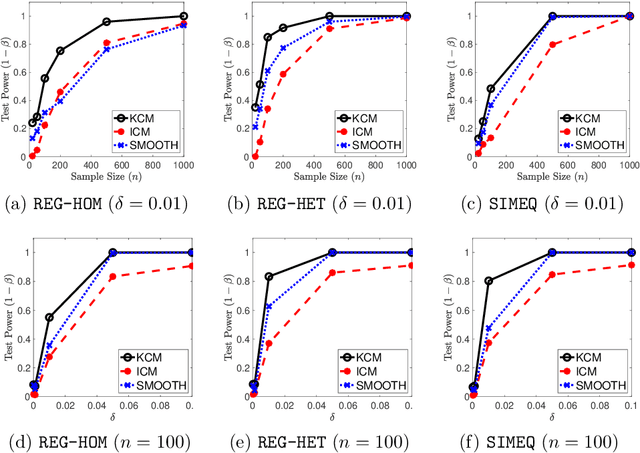
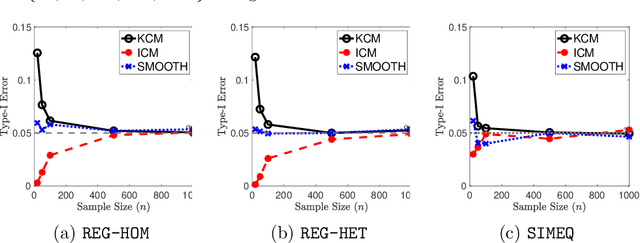
We propose a new family of specification tests called kernel conditional moment (KCM) tests. Our tests are built on conditional moment embeddings (CMME)---a novel representation of conditional moment restrictions in a reproducing kernel Hilbert space (RKHS). After transforming the conditional moment restrictions into a continuum of unconditional counterparts, the test statistic is defined as the maximum moment restriction within the unit ball of the RKHS. We show that the CMME fully characterizes the original conditional moment restrictions, leading to consistency in both hypothesis testing and parameter estimation. The proposed test also has an analytic expression that is easy to compute as well as closed-form asymptotic distributions. Our empirical studies show that the KCM test has a promising finite-sample performance compared to existing tests.