 Add to Chrome
 Add to Firefox
 Add to Edge
HeartBeat: Towards Controllable Echocardiography Video Synthesis with Multimodal Conditions-Guided Diffusion Models
Jun 20, 2024
Echocardiography (ECHO) video is widely used for cardiac examination. In clinical, this procedure heavily relies on operator experience, which needs years of training and maybe the assistance of deep learning-based systems for enhanced accuracy and efficiency. However, it is challenging since acquiring sufficient customized data (e.g., abnormal cases) for novice training and deep model development is clinically unrealistic. Hence, controllable ECHO video synthesis is highly desirable. In this paper, we propose a novel diffusion-based framework named HeartBeat towards controllable and high-fidelity ECHO video synthesis. Our highlight is three-fold. First, HeartBeat serves as a unified framework that enables perceiving multimodal conditions simultaneously to guide controllable generation. Second, we factorize the multimodal conditions into local and global ones, with two insertion strategies separately provided fine- and coarse-grained controls in a composable and flexible manner. In this way, users can synthesize ECHO videos that conform to their mental imagery by combining multimodal control signals. Third, we propose to decouple the visual concepts and temporal dynamics learning using a two-stage training scheme for simplifying the model training. One more interesting thing is that HeartBeat can easily generalize to mask-guided cardiac MRI synthesis in a few shots, showcasing its scalability to broader applications. Extensive experiments on two public datasets show the efficacy of the proposed HeartBeat.

Enhancing Incomplete Multi-modal Brain Tumor Segmentation with Intra-modal Asymmetry and Inter-modal Dependency
Jun 14, 2024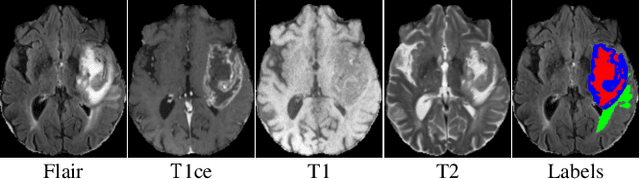
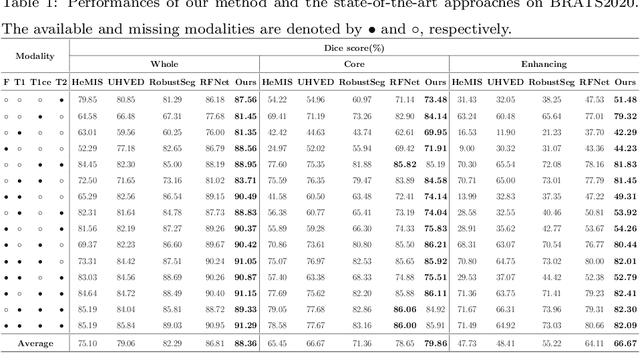
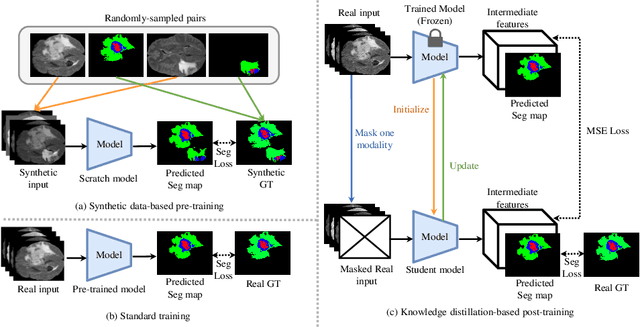
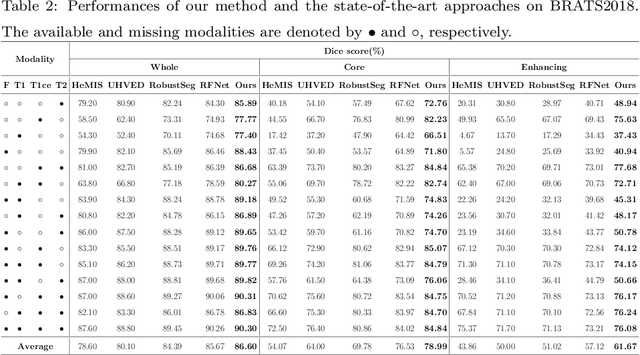
Deep learning-based brain tumor segmentation (BTS) models for multi-modal MRI images have seen significant advancements in recent years. However, a common problem in practice is the unavailability of some modalities due to varying scanning protocols and patient conditions, making segmentation from incomplete MRI modalities a challenging issue. Previous methods have attempted to address this by fusing accessible multi-modal features, leveraging attention mechanisms, and synthesizing missing modalities using generative models. However, these methods ignore the intrinsic problems of medical image segmentation, such as the limited availability of training samples, particularly for cases with tumors. Furthermore, these methods require training and deploying a specific model for each subset of missing modalities. To address these issues, we propose a novel approach that enhances the BTS model from two perspectives. Firstly, we introduce a pre-training stage that generates a diverse pre-training dataset covering a wide range of different combinations of tumor shapes and brain anatomy. Secondly, we propose a post-training stage that enables the model to reconstruct missing modalities in the prediction results when only partial modalities are available. To achieve the pre-training stage, we conceptually decouple the MRI image into two parts: `anatomy' and `tumor'. We pre-train the BTS model using synthesized data generated from the anatomy and tumor parts across different training samples. ... Extensive experiments demonstrate that our proposed method significantly improves the performance over the baseline and achieves new state-of-the-art results on three brain tumor segmentation datasets: BRATS2020, BRATS2018, and BRATS2015.
OphNet: A Large-Scale Video Benchmark for Ophthalmic Surgical Workflow Understanding
Jun 12, 2024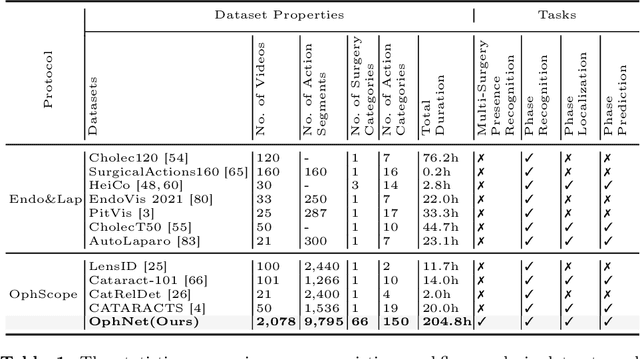
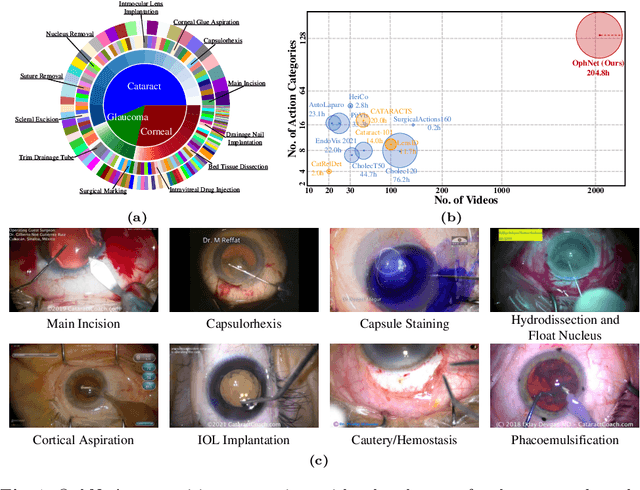
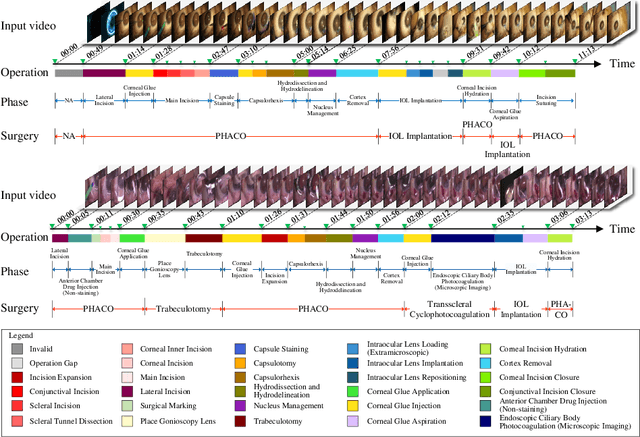
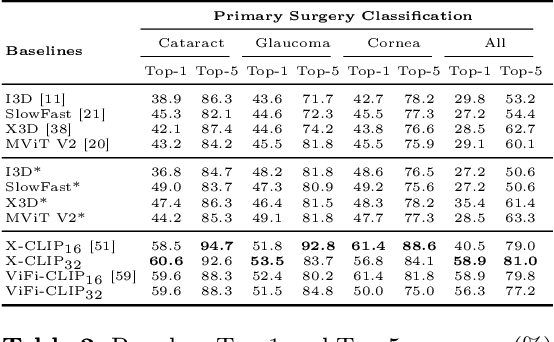
Surgical scene perception via videos are critical for advancing robotic surgery, telesurgery, and AI-assisted surgery, particularly in ophthalmology. However, the scarcity of diverse and richly annotated video datasets has hindered the development of intelligent systems for surgical workflow analysis. Existing datasets for surgical workflow analysis, which typically face challenges such as small scale, a lack of diversity in surgery and phase categories, and the absence of time-localized annotations, limit the requirements for action understanding and model generalization validation in complex and diverse real-world surgical scenarios. To address this gap, we introduce OphNet, a large-scale, expert-annotated video benchmark for ophthalmic surgical workflow understanding. OphNet features: 1) A diverse collection of 2,278 surgical videos spanning 66 types of cataract, glaucoma, and corneal surgeries, with detailed annotations for 102 unique surgical phases and 150 granular operations; 2) It offers sequential and hierarchical annotations for each surgery, phase, and operation, enabling comprehensive understanding and improved interpretability; 3) Moreover, OphNet provides time-localized annotations, facilitating temporal localization and prediction tasks within surgical workflows. With approximately 205 hours of surgical videos, OphNet is about 20 times larger than the largest existing surgical workflow analysis benchmark. Our dataset and code have been made available at: \url{https://github.com/minghu0830/OphNet-benchmark}.
Improving 3D Occupancy Prediction through Class-balancing Loss and Multi-scale Representation
May 25, 20243D environment recognition is essential for autonomous driving systems, as autonomous vehicles require a comprehensive understanding of surrounding scenes. Recently, the predominant approach to define this real-life problem is through 3D occupancy prediction. It attempts to predict the occupancy states and semantic labels for all voxels in 3D space, which enhances the perception capability. Birds-Eye-View(BEV)-based perception has achieved the SOTA performance for this task. Nonetheless, this architecture fails to represent various scales of BEV features. In this paper, inspired by the success of UNet in semantic segmentation tasks, we introduce a novel UNet-like Multi-scale Occupancy Head module to relieve this issue. Furthermore, we propose the class-balancing loss to compensate for rare classes in the dataset. The experimental results on nuScenes 3D occupancy challenge dataset show the superiority of our proposed approach over baseline and SOTA methods.
Distill-then-prune: An Efficient Compression Framework for Real-time Stereo Matching Network on Edge Devices
May 20, 2024In recent years, numerous real-time stereo matching methods have been introduced, but they often lack accuracy. These methods attempt to improve accuracy by introducing new modules or integrating traditional methods. However, the improvements are only modest. In this paper, we propose a novel strategy by incorporating knowledge distillation and model pruning to overcome the inherent trade-off between speed and accuracy. As a result, we obtained a model that maintains real-time performance while delivering high accuracy on edge devices. Our proposed method involves three key steps. Firstly, we review state-of-the-art methods and design our lightweight model by removing redundant modules from those efficient models through a comparison of their contributions. Next, we leverage the efficient model as the teacher to distill knowledge into the lightweight model. Finally, we systematically prune the lightweight model to obtain the final model. Through extensive experiments conducted on two widely-used benchmarks, Sceneflow and KITTI, we perform ablation studies to analyze the effectiveness of each module and present our state-of-the-art results.
FA-Depth: Toward Fast and Accurate Self-supervised Monocular Depth Estimation
May 17, 2024Most existing methods often rely on complex models to predict scene depth with high accuracy, resulting in slow inference that is not conducive to deployment. To better balance precision and speed, we first designed SmallDepth based on sparsity. Second, to enhance the feature representation ability of SmallDepth during training under the condition of equal complexity during inference, we propose an equivalent transformation module(ETM). Third, to improve the ability of each layer in the case of a fixed SmallDepth to perceive different context information and improve the robustness of SmallDepth to the left-right direction and illumination changes, we propose pyramid loss. Fourth, to further improve the accuracy of SmallDepth, we utilized the proposed function approximation loss (APX) to transfer knowledge in the pretrained HQDecv2, obtained by optimizing the previous HQDec to address grid artifacts in some regions, to SmallDepth. Extensive experiments demonstrate that each proposed component improves the precision of SmallDepth without changing the complexity of SmallDepth during inference, and the developed approach achieves state-of-the-art results on KITTI at an inference speed of more than 500 frames per second and with approximately 2 M parameters. The code and models will be publicly available at https://github.com/fwucas/FA-Depth.
Bootstrap 3D Reconstructed Scenes from 3D Gaussian Splatting
Apr 29, 2024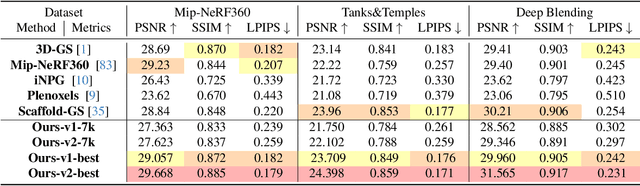
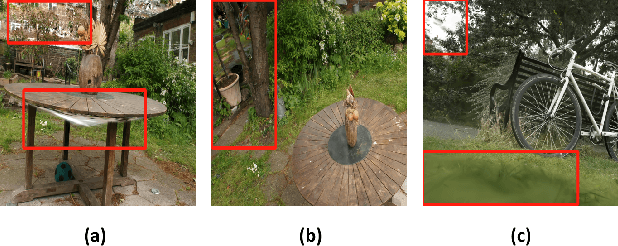
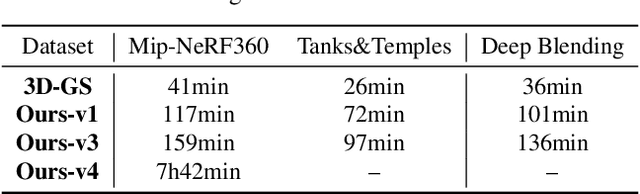
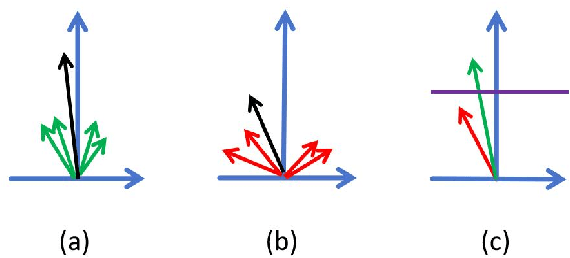
Recent developments in neural rendering techniques have greatly enhanced the rendering of photo-realistic 3D scenes across both academic and commercial fields. The latest method, known as 3D Gaussian Splatting (3D-GS), has set new benchmarks for rendering quality and speed. Nevertheless, the limitations of 3D-GS become pronounced in synthesizing new viewpoints, especially for views that greatly deviate from those seen during training. Additionally, issues such as dilation and aliasing arise when zooming in or out. These challenges can all be traced back to a single underlying issue: insufficient sampling. In our paper, we present a bootstrapping method that significantly addresses this problem. This approach employs a diffusion model to enhance the rendering of novel views using trained 3D-GS, thereby streamlining the training process. Our results indicate that bootstrapping effectively reduces artifacts, as well as clear enhancements on the evaluation metrics. Furthermore, we show that our method is versatile and can be easily integrated, allowing various 3D reconstruction projects to benefit from our approach.
Transfer CLIP for Generalizable Image Denoising
Mar 22, 2024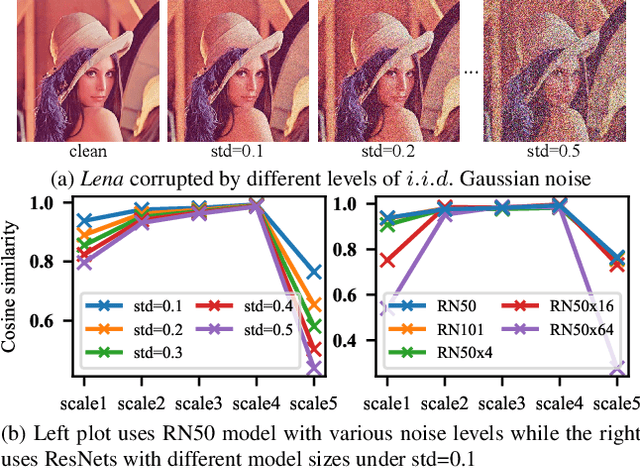
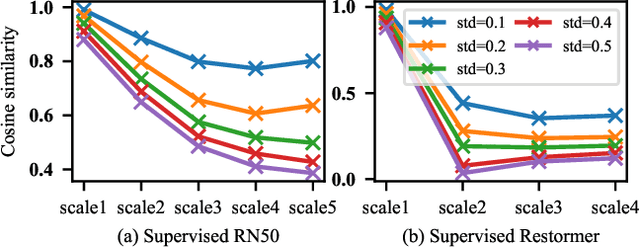
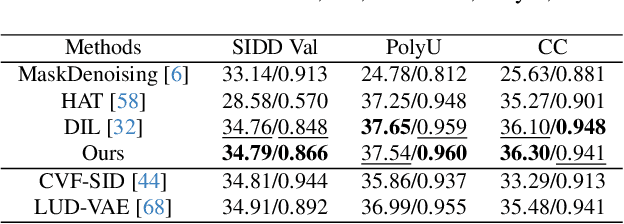
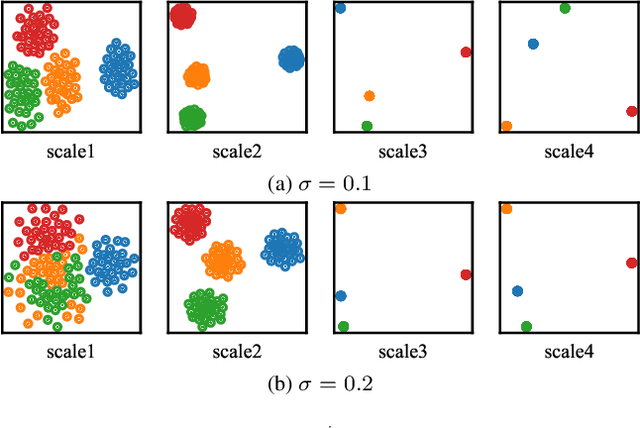
Image denoising is a fundamental task in computer vision. While prevailing deep learning-based supervised and self-supervised methods have excelled in eliminating in-distribution noise, their susceptibility to out-of-distribution (OOD) noise remains a significant challenge. The recent emergence of contrastive language-image pre-training (CLIP) model has showcased exceptional capabilities in open-world image recognition and segmentation. Yet, the potential for leveraging CLIP to enhance the robustness of low-level tasks remains largely unexplored. This paper uncovers that certain dense features extracted from the frozen ResNet image encoder of CLIP exhibit distortion-invariant and content-related properties, which are highly desirable for generalizable denoising. Leveraging these properties, we devise an asymmetrical encoder-decoder denoising network, which incorporates dense features including the noisy image and its multi-scale features from the frozen ResNet encoder of CLIP into a learnable image decoder to achieve generalizable denoising. The progressive feature augmentation strategy is further proposed to mitigate feature overfitting and improve the robustness of the learnable decoder. Extensive experiments and comparisons conducted across diverse OOD noises, including synthetic noise, real-world sRGB noise, and low-dose CT image noise, demonstrate the superior generalization ability of our method.
Learning Intra-view and Cross-view Geometric Knowledge for Stereo Matching
Mar 06, 2024Geometric knowledge has been shown to be beneficial for the stereo matching task. However, prior attempts to integrate geometric insights into stereo matching algorithms have largely focused on geometric knowledge from single images while crucial cross-view factors such as occlusion and matching uniqueness have been overlooked. To address this gap, we propose a novel Intra-view and Cross-view Geometric knowledge learning Network (ICGNet), specifically crafted to assimilate both intra-view and cross-view geometric knowledge. ICGNet harnesses the power of interest points to serve as a channel for intra-view geometric understanding. Simultaneously, it employs the correspondences among these points to capture cross-view geometric relationships. This dual incorporation empowers the proposed ICGNet to leverage both intra-view and cross-view geometric knowledge in its learning process, substantially improving its ability to estimate disparities. Our extensive experiments demonstrate the superiority of the ICGNet over contemporary leading models.
Image Denoising via Style Disentanglement
Sep 26, 2023


Image denoising is a fundamental task in low-level computer vision. While recent deep learning-based image denoising methods have achieved impressive performance, they are black-box models and the underlying denoising principle remains unclear. In this paper, we propose a novel approach to image denoising that offers both clear denoising mechanism and good performance. We view noise as a type of image style and remove it by incorporating noise-free styles derived from clean images. To achieve this, we design novel losses and network modules to extract noisy styles from noisy images and noise-free styles from clean images. The noise-free style induces low-response activations for noise features and high-response activations for content features in the feature space. This leads to the separation of clean contents from noise, effectively denoising the image. Unlike disentanglement-based image editing tasks that edit semantic-level attributes using styles, our main contribution lies in editing pixel-level attributes through global noise-free styles. We conduct extensive experiments on synthetic noise removal and real-world image denoising datasets (SIDD and DND), demonstrating the effectiveness of our method in terms of both PSNR and SSIM metrics. Moreover, we experimentally validate that our method offers good interpretability.