 Add to Chrome
 Add to Firefox
 Add to Edge
SSPO: Structure-Aware Similarity-Weighted Preference Optimization for Neural Combinatorial Optimization
Aug 12, 2026
Neural combinatorial optimization (NCO) relies on parallel solution sampling for training, yet existing methods fail to fully exploit the rich information latent in a co-sampled solution group. Preference-optimization methods anchor on the single best solution and discard fine-grained quality and structural signal from all other peers-a failure we term gradient signal polarization. Mean-based baselines instead weight peers uniformly, so structurally near-identical peers flood the baseline with redundant information and keep gradient variance high-a failure we term baseline redundancy. We propose SSPO (Structure-Aware Similarity-Weighted Preference Optimization), which scores all $B$ sampled solutions jointly through a dissimilarity-weighted leave-one-out baseline: structurally distinct peers receive higher weight, resolving both failures in a single mechanism. The baseline uses zero-parameter, problem-adaptive solution embeddings built from the encoder's existing node representations. Experiments on TSP, EFL, and JSP benchmarks show consistent gains over prior best-anchor and uniform-weight baselines. A direct comparison against uniform RLOO on TSP and EFL confirms that structure-aware weighting is the primary driver of improvement. The SSPO-trained EFL policy has been deployed in a production facility-location system at JD$\mathord{.}$com, confirming practical viability at scale.

Large Language Model for Operations Research Formulation Selection in Multi-Warehouse Inventory Allocation
Jul 28, 2026Multi-warehouse inventory allocation is typically formulated as a mixed-integer programming (MIP) problem, yet no single formulation consistently matches heterogeneous instance-level regimes induced by demand concentration, inventory imbalance, replenishment scale, service constraints, and forecast volatility. We study this issue as instance-wise operations research (OR) formulation selection, where each allocation instance is assigned to a solver-executable formulation from a candidate OR expert library. We propose a solver-guided large language model (LLM) framework for OR formulation selection, in which each OR expert corresponds to a MIP formulation encoding a distinct allocation priority. To train the selector, the framework first constructs balanced expert-conditioned supervised fine-tuning (SFT) records for schema learning, and then uses MIP solver evaluation on historical instances to convert solver-evaluated allocation-quality gaps into margin-weighted identity preference optimization (IPO) preferences and per-instance expert-score metadata for reward lookup during group relative policy optimization (GRPO) to assign rewards to sampled responses. Experiments on multi-warehouse inventory allocation instances from JD$\mathord{.}$com, one of China's largest e-retailers, demonstrate that GRPO substantially improves expert-selection accuracy relative to the SFT+IPO selector and, more importantly, produces higher realized allocation quality than both the preference-trained selector and the best fixed formulation. With GRPO, Hit Ratio@1 and Hit Ratio@2 increase from 21.45% to 50.42% and from 70.47% to 82.31%. The resulting selector achieves an allocation accuracy gain of 12.57 percentage points over the incumbent baseline, outperforming both the SFT+IPO selector and the best fixed OR expert, and reduces the gap to the ex-post oracle to 4.85 percentage points.
Solver-Verified Formulation Generation and Selection for Multi-Warehouse Inventory Allocation Using Large Language Models
Jun 28, 2026Balance-oriented multi-warehouse inventory allocation is a recurring decision problem in large-scale e-commerce supply chains, in which a fixed replenishment quantity is distributed across warehouses to balance post-allocation inventory coverage while accounting for demand forecasts and heterogeneous allocation constraints. In practice, allocation requirements are often scenario-dependent and expressed in semi-structured or natural-language form rather than as ready-to-solve operations research (OR) formulations. We propose an OR-guided Large Language Model (LLM) for Allocation (ORLA) that uses solver feedback to generate, verify, and select OR formulations. ORLA integrates automatic "Problem-Model-Code (PMC)" generation, learning-based formulation selection, and feasibility restoration. We develop three complementary mixed-integer programming formulation families based on deviation minimization, soft band compliance, and knapsack-inspired allocation, together with solver-ready mixed-integer linear programming reformulations, modular constraint extensions, and a penalty-based relaxation mechanism for infeasible cases. The LLM component generates candidate formulations and executable solver code from textual or semi-structured specifications, while the solver provides verification signals for executability, feasibility, and solution quality. To address instance heterogeneity, ORLA estimates the expected quality of candidate formulations, selects promising candidates, and combines their outputs through score-aware aggregation. Experimental results on 29 production evaluation batches from JD.com show that the best single OR formulation improves allocation accuracy by 3.4 percentage points over the incumbent approach, while the full ORLA framework achieves a 4.5 percentage-point overall improvement and improves allocation accuracy in 26 of the 29 evaluation batches.
Removing Averaging: Personalized Lip-Sync Driven Characters Based on Identity Adapter
Mar 09, 2025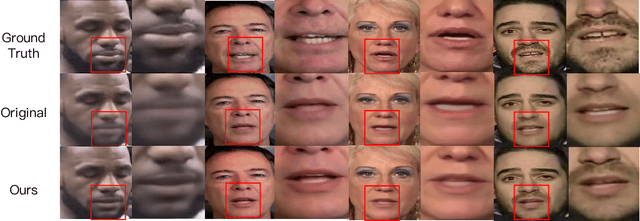
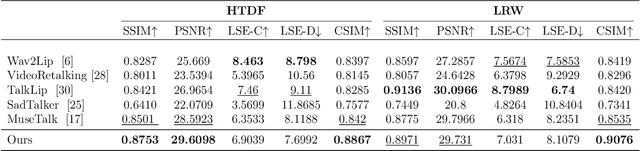
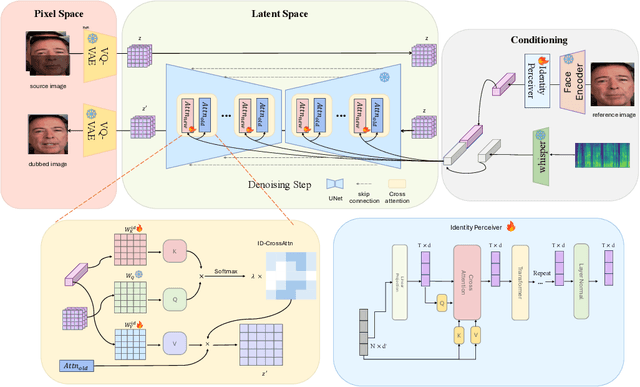
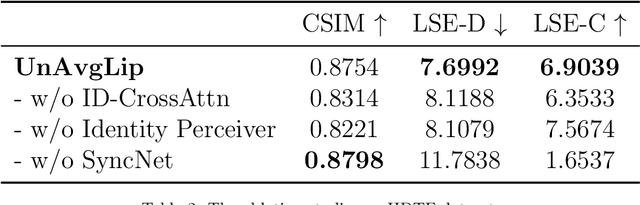
Recent advances in diffusion-based lip-syncing generative models have demonstrated their ability to produce highly synchronized talking face videos for visual dubbing. Although these models excel at lip synchronization, they often struggle to maintain fine-grained control over facial details in generated images. In this work, we identify "lip averaging" phenomenon where the model fails to preserve subtle facial details when dubbing unseen in-the-wild videos. This issue arises because the commonly used UNet backbone primarily integrates audio features into visual representations in the latent space via cross-attention mechanisms and multi-scale fusion, but it struggles to retain fine-grained lip details in the generated faces. To address this issue, we propose UnAvgLip, which extracts identity embeddings from reference videos to generate highly faithful facial sequences while maintaining accurate lip synchronization. Specifically, our method comprises two primary components: (1) an Identity Perceiver module that encodes facial embeddings to align with conditioned audio features; and (2) an ID-CrossAttn module that injects facial embeddings into the generation process, enhancing model's capability of identity retention. Extensive experiments demonstrate that, at a modest training and inference cost, UnAvgLip effectively mitigates the "averaging" phenomenon in lip inpainting, significantly preserving unique facial characteristics while maintaining precise lip synchronization. Compared with the original approach, our method demonstrates significant improvements of 5% on the identity consistency metric and 2% on the SSIM metric across two benchmark datasets (HDTF and LRW).
A Regularized Newton Method for Nonconvex Optimization with Global and Local Complexity Guarantees
Feb 07, 2025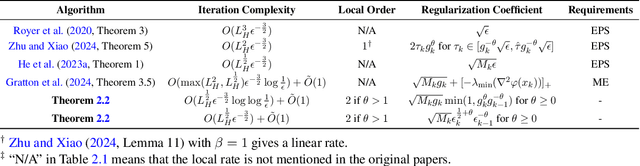
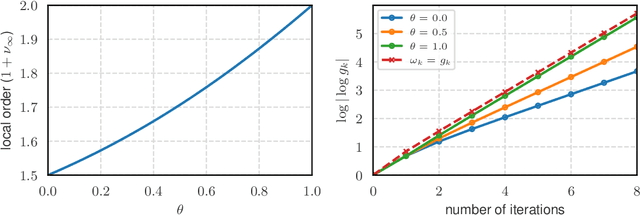
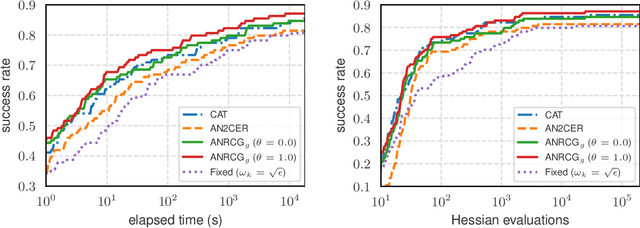
We consider the problem of finding an $\epsilon$-stationary point of a nonconvex function with a Lipschitz continuous Hessian and propose a quadratic regularized Newton method incorporating a new class of regularizers constructed from the current and previous gradients. The method leverages a recently developed linear conjugate gradient approach with a negative curvature monitor to solve the regularized Newton equation. Notably, our algorithm is adaptive, requiring no prior knowledge of the Lipschitz constant of the Hessian, and achieves a global complexity of $O(\epsilon^{-\frac{3}{2}}) + \tilde O(1)$ in terms of the second-order oracle calls, and $\tilde O(\epsilon^{-\frac{7}{4}})$ for Hessian-vector products, respectively. Moreover, when the iterates converge to a point where the Hessian is positive definite, the method exhibits quadratic local convergence. Preliminary numerical results illustrate the competitiveness of our algorithm.
Dust to Tower: Coarse-to-Fine Photo-Realistic Scene Reconstruction from Sparse Uncalibrated Images
Dec 27, 2024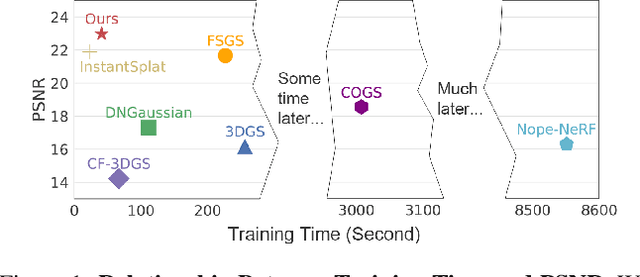
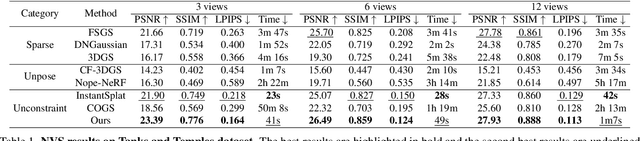
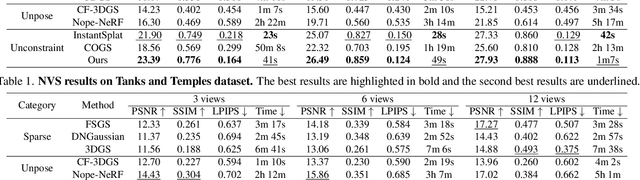
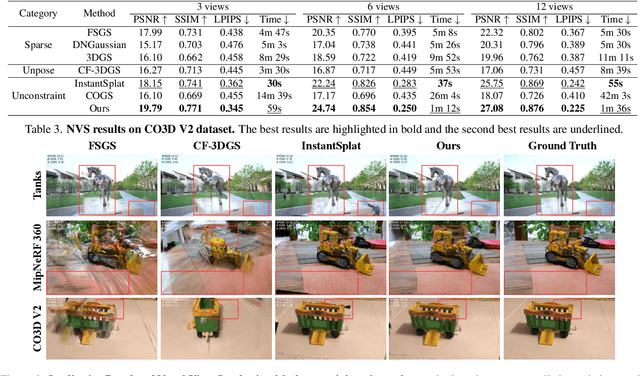
Photo-realistic scene reconstruction from sparse-view, uncalibrated images is highly required in practice. Although some successes have been made, existing methods are either Sparse-View but require accurate camera parameters (i.e., intrinsic and extrinsic), or SfM-free but need densely captured images. To combine the advantages of both methods while addressing their respective weaknesses, we propose Dust to Tower (D2T), an accurate and efficient coarse-to-fine framework to optimize 3DGS and image poses simultaneously from sparse and uncalibrated images. Our key idea is to first construct a coarse model efficiently and subsequently refine it using warped and inpainted images at novel viewpoints. To do this, we first introduce a Coarse Construction Module (CCM) which exploits a fast Multi-View Stereo model to initialize a 3D Gaussian Splatting (3DGS) and recover initial camera poses. To refine the 3D model at novel viewpoints, we propose a Confidence Aware Depth Alignment (CADA) module to refine the coarse depth maps by aligning their confident parts with estimated depths by a Mono-depth model. Then, a Warped Image-Guided Inpainting (WIGI) module is proposed to warp the training images to novel viewpoints by the refined depth maps, and inpainting is applied to fulfill the ``holes" in the warped images caused by view-direction changes, providing high-quality supervision to further optimize the 3D model and the camera poses. Extensive experiments and ablation studies demonstrate the validity of D2T and its design choices, achieving state-of-the-art performance in both tasks of novel view synthesis and pose estimation while keeping high efficiency. Codes will be publicly available.
Spatiotemporal Decoupling for Efficient Vision-Based Occupancy Forecasting
Nov 21, 2024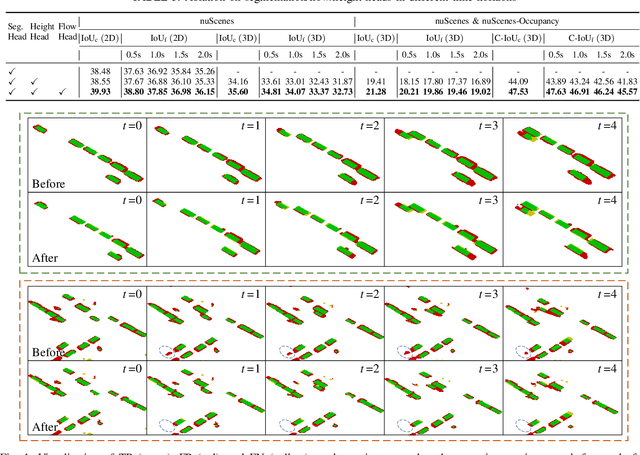

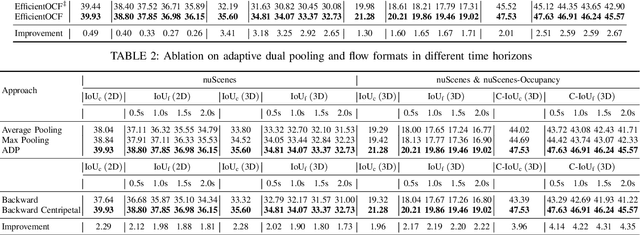

The task of occupancy forecasting (OCF) involves utilizing past and present perception data to predict future occupancy states of autonomous vehicle surrounding environments, which is critical for downstream tasks such as obstacle avoidance and path planning. Existing 3D OCF approaches struggle to predict plausible spatial details for movable objects and suffer from slow inference speeds due to neglecting the bias and uneven distribution of changing occupancy states in both space and time. In this paper, we propose a novel spatiotemporal decoupling vision-based paradigm to explicitly tackle the bias and achieve both effective and efficient 3D OCF. To tackle spatial bias in empty areas, we introduce a novel spatial representation that decouples the conventional dense 3D format into 2D bird's-eye view (BEV) occupancy with corresponding height values, enabling 3D OCF derived only from 2D predictions thus enhancing efficiency. To reduce temporal bias on static voxels, we design temporal decoupling to improve end-to-end OCF by temporally associating instances via predicted flows. We develop an efficient multi-head network EfficientOCF to achieve 3D OCF with our devised spatiotemporally decoupled representation. A new metric, conditional IoU (C-IoU), is also introduced to provide a robust 3D OCF performance assessment, especially in datasets with missing or incomplete annotations. The experimental results demonstrate that EfficientOCF surpasses existing baseline methods on accuracy and efficiency, achieving state-of-the-art performance with a fast inference time of 82.33ms with a single GPU. Our code will be released as open source.
PRISM: PRogressive dependency maxImization for Scale-invariant image Matching
Aug 07, 2024


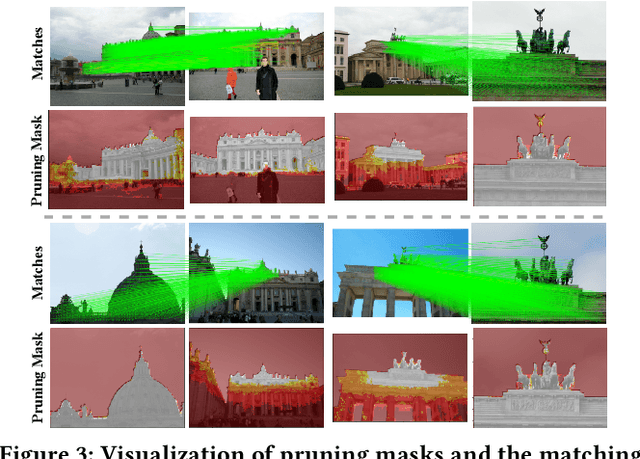
Image matching aims at identifying corresponding points between a pair of images. Currently, detector-free methods have shown impressive performance in challenging scenarios, thanks to their capability of generating dense matches and global receptive field. However, performing feature interaction and proposing matches across the entire image is unnecessary, because not all image regions contribute to the matching process. Interacting and matching in unmatchable areas can introduce errors, reducing matching accuracy and efficiency. Meanwhile, the scale discrepancy issue still troubles existing methods. To address above issues, we propose PRogressive dependency maxImization for Scale-invariant image Matching (PRISM), which jointly prunes irrelevant patch features and tackles the scale discrepancy. To do this, we firstly present a Multi-scale Pruning Module (MPM) to adaptively prune irrelevant features by maximizing the dependency between the two feature sets. Moreover, we design the Scale-Aware Dynamic Pruning Attention (SADPA) to aggregate information from different scales via a hierarchical design. Our method's superior matching performance and generalization capability are confirmed by leading accuracy across various evaluation benchmarks and downstream tasks. The code is publicly available at https://github.com/Master-cai/PRISM.
BEVPlace++: Fast, Robust, and Lightweight LiDAR Global Localization for Unmanned Ground Vehicles
Aug 03, 2024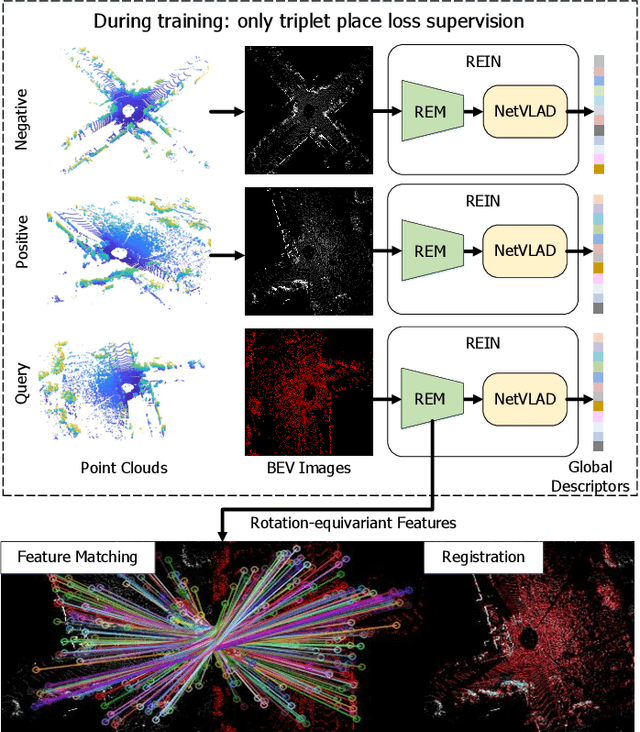
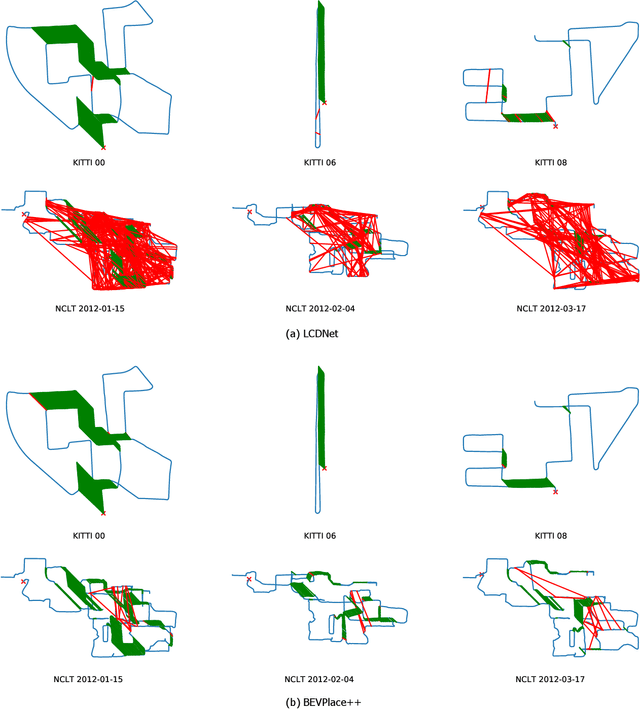

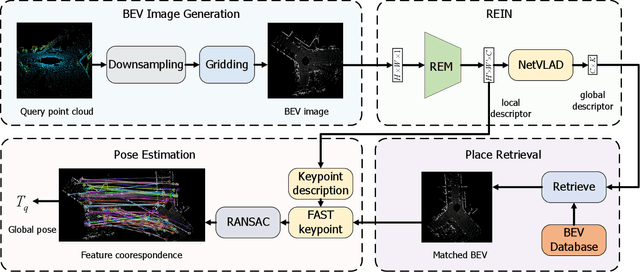
This article introduces BEVPlace++, a novel, fast, and robust LiDAR global localization method for unmanned ground vehicles. It uses lightweight convolutional neural networks (CNNs) on Bird's Eye View (BEV) image-like representations of LiDAR data to achieve accurate global localization through place recognition followed by 3-DoF pose estimation. Our detailed analyses reveal an interesting fact that CNNs are inherently effective at extracting distinctive features from LiDAR BEV images. Remarkably, keypoints of two BEV images with large translations can be effectively matched using CNN-extracted features. Building on this insight, we design a rotation equivariant module (REM) to obtain distinctive features while enhancing robustness to rotational changes. A Rotation Equivariant and Invariant Network (REIN) is then developed by cascading REM and a descriptor generator, NetVLAD, to sequentially generate rotation equivariant local features and rotation invariant global descriptors. The global descriptors are used first to achieve robust place recognition, and the local features are used for accurate pose estimation. Experimental results on multiple public datasets demonstrate that BEVPlace++, even when trained on a small dataset (3000 frames of KITTI) only with place labels, generalizes well to unseen environments, performs consistently across different days and years, and adapts to various types of LiDAR scanners. BEVPlace++ achieves state-of-the-art performance in subtasks of global localization including place recognition, loop closure detection, and global localization. Additionally, BEVPlace++ is lightweight, runs in real-time, and does not require accurate pose supervision, making it highly convenient for deployment. The source codes are publicly available at \href{https://github.com/zjuluolun/BEVPlace}{https://github.com/zjuluolun/BEVPlace}.
S4TP: Social-Suitable and Safety-Sensitive Trajectory Planning for Autonomous Vehicles
Apr 18, 2024


In public roads, autonomous vehicles (AVs) face the challenge of frequent interactions with human-driven vehicles (HDVs), which render uncertain driving behavior due to varying social characteristics among humans. To effectively assess the risks prevailing in the vicinity of AVs in social interactive traffic scenarios and achieve safe autonomous driving, this article proposes a social-suitable and safety-sensitive trajectory planning (S4TP) framework. Specifically, S4TP integrates the Social-Aware Trajectory Prediction (SATP) and Social-Aware Driving Risk Field (SADRF) modules. SATP utilizes Transformers to effectively encode the driving scene and incorporates an AV's planned trajectory during the prediction decoding process. SADRF assesses the expected surrounding risk degrees during AVs-HDVs interactions, each with different social characteristics, visualized as two-dimensional heat maps centered on the AV. SADRF models the driving intentions of the surrounding HDVs and predicts trajectories based on the representation of vehicular interactions. S4TP employs an optimization-based approach for motion planning, utilizing the predicted HDVs'trajectories as input. With the integration of SADRF, S4TP executes real-time online optimization of the planned trajectory of AV within lowrisk regions, thus improving the safety and the interpretability of the planned trajectory. We have conducted comprehensive tests of the proposed method using the SMARTS simulator. Experimental results in complex social scenarios, such as unprotected left turn intersections, merging, cruising, and overtaking, validate the superiority of our proposed S4TP in terms of safety and rationality. S4TP achieves a pass rate of 100% across all scenarios, surpassing the current state-of-the-art methods Fanta of 98.25% and Predictive-Decision of 94.75%.