 Add to Chrome
 Add to Firefox
 Add to Edge
SSPO: Structure-Aware Similarity-Weighted Preference Optimization for Neural Combinatorial Optimization
Aug 12, 2026
Neural combinatorial optimization (NCO) relies on parallel solution sampling for training, yet existing methods fail to fully exploit the rich information latent in a co-sampled solution group. Preference-optimization methods anchor on the single best solution and discard fine-grained quality and structural signal from all other peers-a failure we term gradient signal polarization. Mean-based baselines instead weight peers uniformly, so structurally near-identical peers flood the baseline with redundant information and keep gradient variance high-a failure we term baseline redundancy. We propose SSPO (Structure-Aware Similarity-Weighted Preference Optimization), which scores all $B$ sampled solutions jointly through a dissimilarity-weighted leave-one-out baseline: structurally distinct peers receive higher weight, resolving both failures in a single mechanism. The baseline uses zero-parameter, problem-adaptive solution embeddings built from the encoder's existing node representations. Experiments on TSP, EFL, and JSP benchmarks show consistent gains over prior best-anchor and uniform-weight baselines. A direct comparison against uniform RLOO on TSP and EFL confirms that structure-aware weighting is the primary driver of improvement. The SSPO-trained EFL policy has been deployed in a production facility-location system at JD$\mathord{.}$com, confirming practical viability at scale.

DualCert: A Solver for the Traveling Salesman Problem with Constraint-Coupled Learning
Aug 10, 2026Large traveling salesman problem (TSP) instances require a solver to allocate limited computation while preserving the validity of its outputs. Existing neural--operations-research (OR) hybrids predict guidance without requiring learned transitions to satisfy constraints discovered during search. DualCert introduces \emph{constraint-coupled learning}, in which current degree equations and dynamically separated subtour-elimination constraints (SECs) define each learned transition. At each refinement, the degree equations and selected, strictly satisfied SEC equations, with positive slacks, define an iterate-dependent primal-slack Karush--Kuhn--Tucker (KKT) manifold. Repaired dual variables and violated SEC rows define a local cost field. An exact constrained mirror-descent step maps each finite state to a positive state on the same manifold. Where selected rows and deterministic ties remain fixed, implicit differentiation maps parameter perturbations into the manifold tangent space and reuses the forward constraint operator for the local-cost-field derivative. The terminal edge state allocates computation across Held--Karp ascent, candidate-graph edge tests, and tour construction under a fixed budget. Deterministic verification recomputes original costs and accepts only verified candidate-graph lower bounds and edge decisions. On 1,000 held-out TSP1000 instances, DualCert attains a mean tour-cost gap of \(0.0573\%\) from Lin--Kernighan--Helsgaun version 3 (LKH-3) reference tours in \(9.55\) batch-amortized seconds per instance. It returns a verified candidate-graph lower bound for every instance and achieves \(81.46\%\) edge-decision coverage. The mean gap is \(67.1\%\) smaller than the reported NeuroLKH mean gap. Thus, optimization constraints govern learning, while deterministic verification preserves output validity.
SPORD: A Simulation-Propose-then-OR-Dispose Approach for Supply Chain Planning
Jul 23, 2026For years, supply chain planning at e-commerce firms has operated as a collection of isolated projects. Each planning task from static network planning to dynamic warehouse assortment planning requires analysts to spend weeks building models from scratch, calibrating and persuading executives to act on outputs they cannot verify. Three barriers drive this: bespoke models proliferate because standardization is difficult (operational fragmentation); once unified, the combinatorial scale of millions of SKUs, thousands of nodes, and intricate routing logic exceeds what solvers can handle within a tight window (computational intractability); and a mathematically optimal solution still fails to be implemented if the executives do not trust it (implementation hurdle). To bridge this gap, we propose and implement the Simulation-Propose-then-OR-Dispose method, deployed as JD.com's NetSim platform. The central insight is decoupling: simulation proposes by generating and evaluating the full set of operationally valid candidate paths-absorbing all idiosyncratic business logic, while an integer program disposes by selecting the globally optimal subset. Computationally, matrix-vectorized CPU/GPU accelerated simulation achieves a 10-100 times speedup over serial methods, and a list scheduling algorithm reduces coupled-order processing from hours to minutes. Operationally, we establish a closed loop via an intelligent diagnosis engine. Since 2025, NetSim has optimized end to-end services for over 20,000 suppliers, the cross-regional fulfillment rate dropped from 6.1% to 4.9%, and the average monthly carbon reduction is approximately 5,745 tCO2e. SPORD moves simulation from monitoring to active planning. The transparent outputs turn skeptical executives into engaged collaborators, and the modular architecture ensures that the next planning requires just configuration, not reconstruction.
Decision-Focused Sequential Experimental Design: A Directional Uncertainty-Guided Approach
Feb 05, 2026We consider the sequential experimental design problem in the predict-then-optimize paradigm. In this paradigm, the outputs of the prediction model are used as coefficient vectors in a downstream linear optimization problem. Traditional sequential experimental design aims to control the input variables (features) so that the improvement in prediction accuracy from each experimental outcome (label) is maximized. However, in the predict-then-optimize setting, performance is ultimately evaluated based on the decision loss induced by the downstream optimization, rather than by prediction error. This mismatch between prediction accuracy and decision loss renders traditional decision-blind designs inefficient. To address this issue, we propose a directional-based metric to quantify predictive uncertainty. This metric does not require solving an optimization oracle and is therefore computationally tractable. We show that the resulting sequential design criterion enjoys strong consistency and convergence guarantees. Under a broad class of distributions, we demonstrate that our directional uncertainty-based design attains an earlier stopping time than decision-blind designs. This advantage is further supported by real-world experiments on an LLM job allocation problem.
ORPR: An OR-Guided Pretrain-then-Reinforce Learning Model for Inventory Management
Dec 22, 2025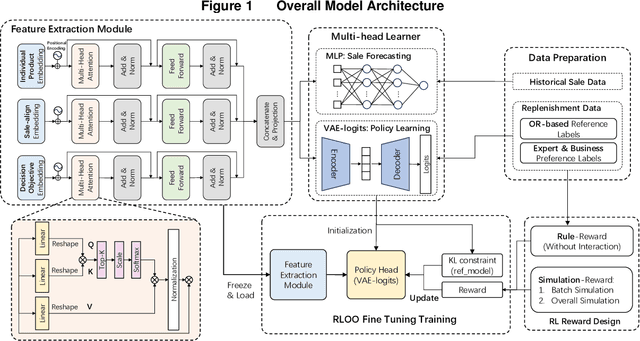
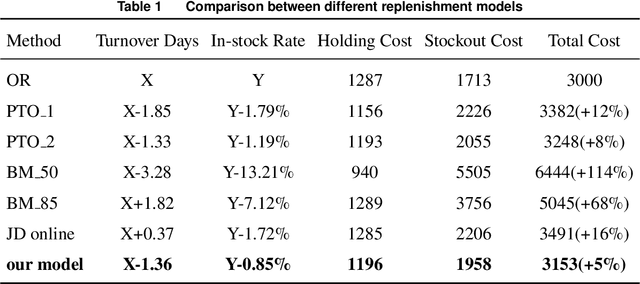
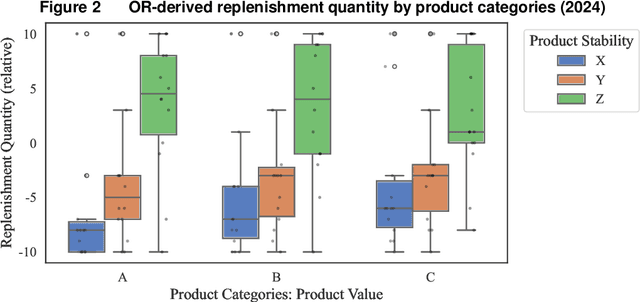
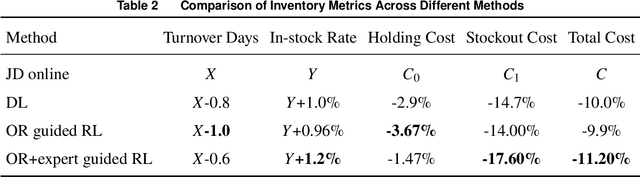
As the pursuit of synergy between Artificial Intelligence (AI) and Operations Research (OR) gains momentum in handling complex inventory systems, a critical challenge persists: how to effectively reconcile AI's adaptive perception with OR's structural rigor. To bridge this gap, we propose a novel OR-Guided "Pretrain-then-Reinforce" framework. To provide structured guidance, we propose a simulation-augmented OR model that generates high-quality reference decisions, implicitly capturing complex business constraints and managerial preferences. Leveraging these OR-derived decisions as foundational training labels, we design a domain-informed deep learning foundation model to establish foundational decision-making capabilities, followed by a reinforcement learning (RL) fine-tuning stage. Uniquely, we position RL as a deep alignment mechanism that enables the AI agent to internalize the optimality principles of OR, while simultaneously leveraging exploration for general policy refinement and allowing expert guidance for scenario-specific adaptation (e.g., promotional events). Validated through extensive numerical experiments and a field deployment at JD.com augmented by a Difference-in-Differences (DiD) analysis, our model significantly outperforms incumbent industrial practices, delivering real-world gains of a 5.27-day reduction in turnover and a 2.29% increase in in-stock rates, alongside a 29.95% decrease in holding costs. Contrary to the prevailing trend of brute-force model scaling, our study demonstrates that a lightweight, domain-informed model can deliver state-of-the-art performance and robust transferability when guided by structured OR logic. This approach offers a scalable and cost-effective paradigm for intelligent supply chain management, highlighting the value of deeply aligning AI with OR.
Leveraging LLM-Based Agents for Intelligent Supply Chain Planning
Sep 04, 2025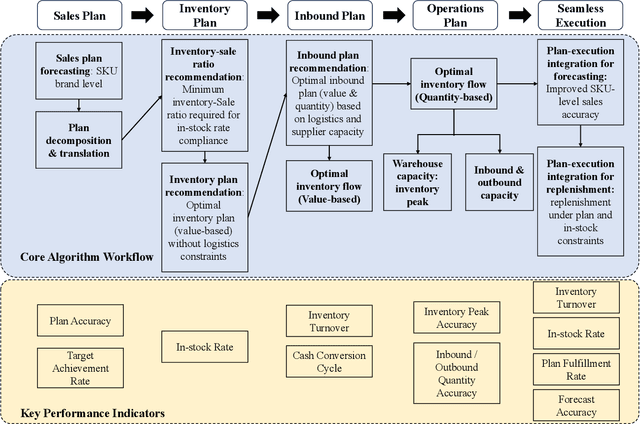
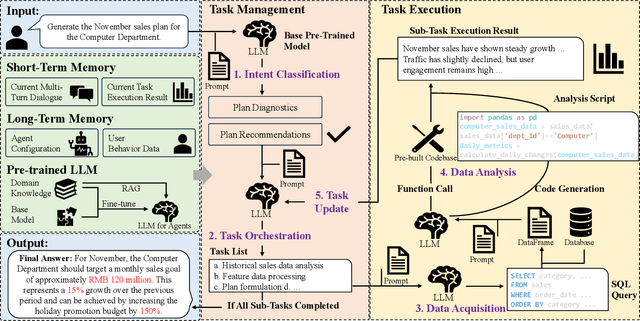
In supply chain management, planning is a critical concept. The movement of physical products across different categories, from suppliers to warehouse management, to sales, and logistics transporting them to customers, entails the involvement of many entities. It covers various aspects such as demand forecasting, inventory management, sales operations, and replenishment. How to collect relevant data from an e-commerce platform's perspective, formulate long-term plans, and dynamically adjust them based on environmental changes, while ensuring interpretability, efficiency, and reliability, is a practical and challenging problem. In recent years, the development of AI technologies, especially the rapid progress of large language models, has provided new tools to address real-world issues. In this work, we construct a Supply Chain Planning Agent (SCPA) framework that can understand domain knowledge, comprehend the operator's needs, decompose tasks, leverage or create new tools, and return evidence-based planning reports. We deploy this framework in JD.com's real-world scenario, demonstrating the feasibility of LLM-agent applications in the supply chain. It effectively reduced labor and improved accuracy, stock availability, and other key metrics.
Learning While Repositioning in On-Demand Vehicle Sharing Networks
Jan 31, 2025We consider a network inventory problem motivated by one-way, on-demand vehicle sharing services. Due to uncertainties in both demand and returns, as well as a fixed number of rental units across an $n$-location network, the service provider must periodically reposition vehicles to match supply with demand spatially while minimizing costs. The optimal repositioning policy under a general $n$-location network is intractable without knowing the optimal value function. We introduce the best base-stock repositioning policy as a generalization of the classical inventory control policy to $n$ dimensions, and establish its asymptotic optimality in two distinct limiting regimes under general network structures. We present reformulations to efficiently compute this best base-stock policy in an offline setting with pre-collected data. In the online setting, we show that a natural Lipschitz-bandit approach achieves a regret guarantee of $\widetilde{O}(T^{\frac{n}{n+1}})$, which suffers from the exponential dependence on $n$. We illustrate the challenges of learning with censored data in networked systems through a regret lower bound analysis and by demonstrating the suboptimality of alternative algorithmic approaches. Motivated by these challenges, we propose an Online Gradient Repositioning algorithm that relies solely on censored demand. Under a mild cost-structure assumption, we prove that it attains an optimal regret of $O(n^{2.5} \sqrt{T})$, which matches the regret lower bound in $T$ and achieves only polynomial dependence on $n$. The key algorithmic innovation involves proposing surrogate costs to disentangle intertemporal dependencies and leveraging dual solutions to find the gradient of policy change. Numerical experiments demonstrate the effectiveness of our proposed methods.
TimeHF: Billion-Scale Time Series Models Guided by Human Feedback
Jan 27, 2025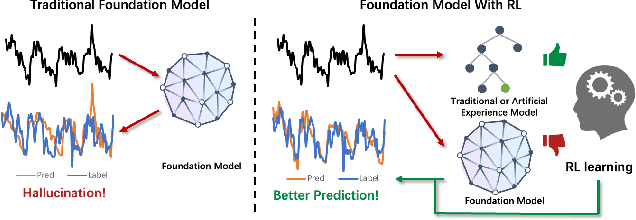
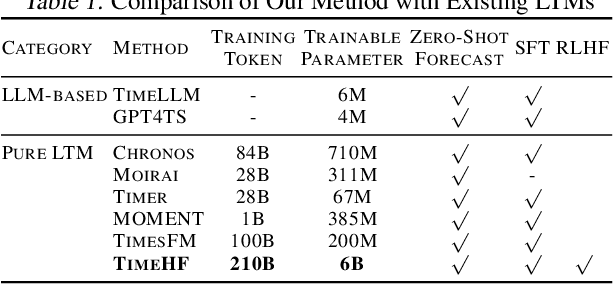

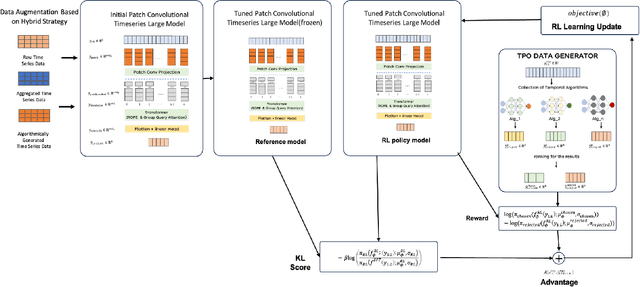
Time series neural networks perform exceptionally well in real-world applications but encounter challenges such as limited scalability, poor generalization, and suboptimal zero-shot performance. Inspired by large language models, there is interest in developing large time series models (LTM) to address these issues. However, current methods struggle with training complexity, adapting human feedback, and achieving high predictive accuracy. We introduce TimeHF, a novel pipeline for creating LTMs with 6 billion parameters, incorporating human feedback. We use patch convolutional embedding to capture long time series information and design a human feedback mechanism called time-series policy optimization. Deployed in JD.com's supply chain, TimeHF handles automated replenishment for over 20,000 products, improving prediction accuracy by 33.21% over existing methods. This work advances LTM technology and shows significant industrial benefits.
Online MDP with Transition Prototypes: A Robust Adaptive Approach
Dec 19, 2024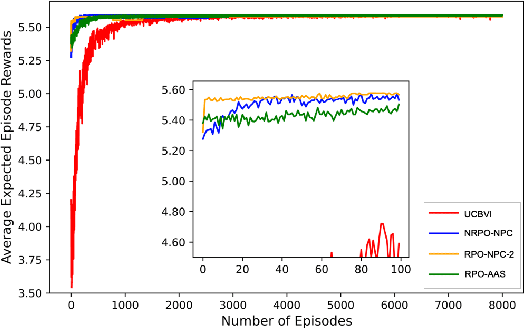
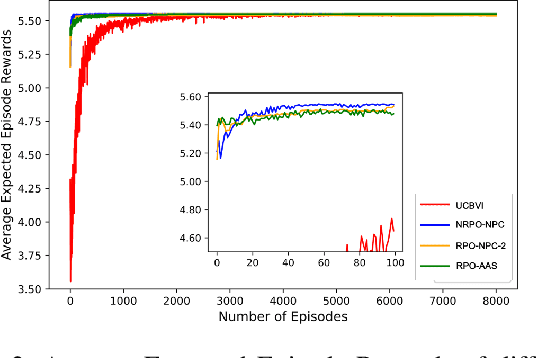
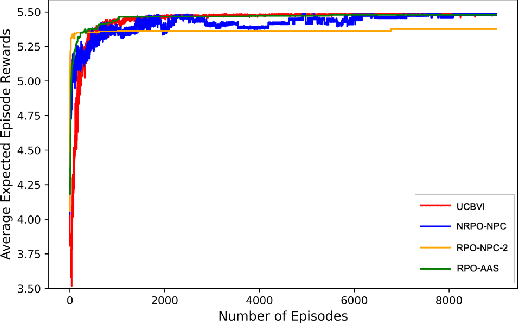
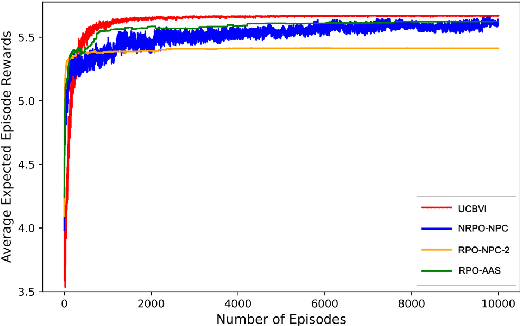
In this work, we consider an online robust Markov Decision Process (MDP) where we have the information of finitely many prototypes of the underlying transition kernel. We consider an adaptively updated ambiguity set of the prototypes and propose an algorithm that efficiently identifies the true underlying transition kernel while guaranteeing the performance of the corresponding robust policy. To be more specific, we provide a sublinear regret of the subsequent optimal robust policy. We also provide an early stopping mechanism and a worst-case performance bound of the value function. In numerical experiments, we demonstrate that our method outperforms existing approaches, particularly in the early stage with limited data. This work contributes to robust MDPs by considering possible prior information about the underlying transition probability and online learning, offering both theoretical insights and practical algorithms for improved decision-making under uncertainty.
Using Drone Swarm to Stop Wildfire: A Predict-then-optimize Approach
Nov 25, 2024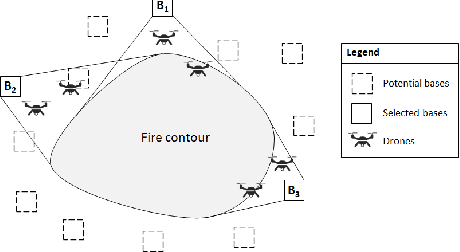
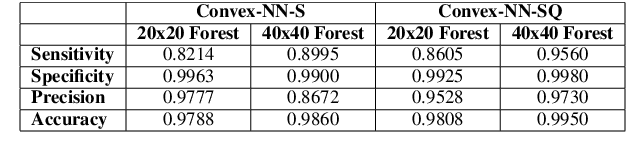
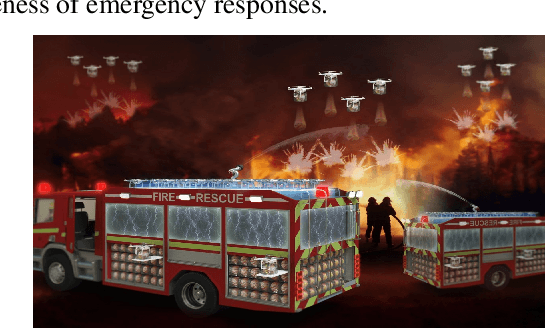

Drone swarms coupled with data intelligence can be the future of wildfire fighting. However, drone swarm firefighting faces enormous challenges, such as the highly complex environmental conditions in wildfire scenes, the highly dynamic nature of wildfire spread, and the significant computational complexity of drone swarm operations. We develop a predict-then-optimize approach to address these challenges to enable effective drone swarm firefighting. First, we construct wildfire spread prediction convex neural network (Convex-NN) models based on real wildfire data. Then, we propose a mixed-integer programming (MIP) model coupled with dynamic programming (DP) to enable efficient drone swarm task planning. We further use chance-constrained robust optimization (CCRO) to ensure robust firefighting performances under varying situations. The formulated model is solved efficiently using Benders Decomposition and Branch-and-Cut algorithms. After 75 simulated wildfire environments training, the MIP+CCRO approach shows the best performance among several testing sets, reducing movements by 37.3\% compared to the plain MIP. It also significantly outperformed the GA baseline, which often failed to fully extinguish the fire. Eventually, we will conduct real-world fire spread and quenching experiments in the next stage for further validation.